
Have you ever looked at a treatment plan from your dentist or an Explanation of Benefits (EOB) from your insurance company and felt like you were reading a secret code? You see a list of procedures, but next to them are strange five-digit numbers starting with “D.” It almost looks like a different language.
You are looking at Current Dental Terminology (CDT) codes. Don’t let the official name intimidate you. Think of these codes as the universal language of dentistry. They are the shorthand that allows your dentist to talk to your insurance company, ensuring everyone is on the same page about what work was done and how much it should cost.
This guide is here to pull back the curtain. We will walk through what these codes are, why they are so important, and how understanding them can make you a more confident and informed dental patient. Whether you are just curious or trying to figure out a specific bill, you are in the right place.
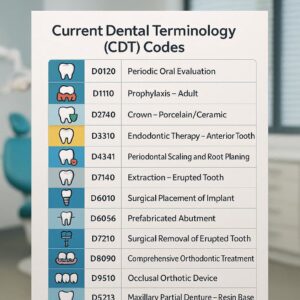
Current Dental Terminology Codes
Table of Contents
ToggleWhat Exactly Are Current Dental Terminology (CDT) Codes?
Let’s start with the basics. In the simplest terms, a CDT code is a standardized, five-digit alphanumeric code that describes a specific dental procedure. Every single one starts with the letter “D” (for Dental) and is followed by four numbers.
For example:
-
D1110: Prophylaxis (a routine cleaning for an adult)
-
D2140: Amalgam filling, one surface, primary or permanent (a silver filling)
-
D2750: Crown – porcelain fused to high noble metal (a cap for a tooth)
These codes are published in a manual called the Current Dental Terminology, which is updated and released every year by the American Dental Association (ADA). This is the official reference that dental offices and insurance companies across the United States use.
The Difference Between CDT, CPT, and ICD-10 Codes
A common point of confusion is the difference between dental codes and medical codes. It’s helpful to know the distinction:
-
CDT Codes (D______): Describe the procedure or treatment the dentist performed (the cleaning, the filling, the x-ray).
-
CPT Codes (______): Current Procedural Terminology codes are used by medical doctors to describe their procedures. Think of them as the medical world’s equivalent of CDT codes.
-
ICD-10 Codes (______): The International Classification of Diseases, 10th Revision, describes the diagnosis or the problem the patient has (like gum disease or a cavity).
So, for a single visit, your file might have an ICD-10 code for “chronic gum disease” and a CDT code for the “deep cleaning” procedure (scaling and root planing) used to treat it. They work hand-in-hand to tell the full story.
Why Should You, the Patient, Care About These Codes?
It is easy to think of these codes as “inside baseball” for dentists and insurance bureaucrats. But understanding them a little bit can actually be a superpower for you as a patient. Here is why they matter in your everyday life.
1. Demystifying Your Treatment Plan
When your dentist recommends a crown, they don’t just say, “You need a crown.” They (or the treatment coordinator) will often give you a paper or digital treatment plan. On that plan, next to the procedure, will be a CDT code, like D2740 (crown – porcelain/ceramic substrate). Seeing this code allows you to look it up later or ask precise questions: “I see the code for the crown is D2740. What are the other options for crown materials?”
2. Understanding Your Insurance Benefits
This is where CDT codes are most powerful. Your insurance policy doesn’t just say “we cover cleanings.” It specifies coverage based on these codes. Your policy might cover D1110 (adult cleaning) at 100% twice a year, but it might only cover D4341 (deep cleaning) at 50%. When you get an Explanation of Benefits (EOB) from your insurer, it will list the CDT codes for the work done and show you exactly what they paid and what you owe. This transparency helps you verify that your benefits were applied correctly.
3. Ensuring Accurate Billing
Mistakes can happen. A dental bill might accidentally have the wrong code, like a code for a complex filling when you actually had a simple one. This can change your out-of-pocket cost. If you have a basic awareness of the codes, you can spot potential errors and ask your dentist’s office to double-check, saving you money and hassle.
4. Making it Easier to Switch Dentists
If you move or decide to change dental providers, your new office will request your records. Those records will be filled with CDT codes. This gives your new dentist a clear, concise history of exactly what work has been done, allowing them to provide you with better, more informed care without needing to re-do expensive diagnostic work.
A Look Inside the Code Book: Major Categories of CDT Codes
The CDT manual is organized into categories, making it easier for dental professionals to find the right code. Here are the main sections you are likely to encounter on a treatment plan.
D0100-D0999: Diagnostic
This category covers everything related to examining and diagnosing your dental health. It’s the “information gathering” phase.
-
D0120: Periodic oral evaluation (your regular check-up)
-
D0140: Limited oral evaluation (problem-focused, like a toothache)
-
D0210: Intraoral – complete series of radiographic images (full set of x-rays)
-
D0274: Bitewings – four radiographic images (the x-rays where you bite down on a tab)
-
D0330: Panoramic radiographic image (the x-ray machine that rotates around your head)
D1000-D1999: Preventive
These are the services designed to prevent dental disease from starting or progressing.
-
D1110: Prophylaxis – adult (routine cleaning)
-
D1120: Prophylaxis – child (routine cleaning for a child)
-
D1208: Topical application of fluoride (fluoride treatment)
-
D1351: Sealant – per tooth (the plastic coating on chewing surfaces)
D2000-D2999: Restorative
This is the “fixing things” category. It covers procedures that repair or restore the structure of a tooth.
-
D2140: Amalgam – one surface, primary or permanent (silver filling, one surface)
-
D2330: Resin-based composite – one surface, anterior (tooth-colored filling for a front tooth)
-
D2391: Resin-based composite – one surface, posterior (tooth-colored filling for a back tooth)
-
D2740: Crown – porcelain/ceramic substrate (all-porcelain crown)
-
D2750: Crown – porcelain fused to high noble metal (crown with a metal core and porcelain layer)
-
D2950: Core buildup, including any pins (rebuilding a tooth structure before placing a crown)
D3000-D3999: Endodontics
Endodontics deals with the inside of the tooth, specifically the pulp and nerve.
-
D3110: Pulp cap – direct (protecting the nerve after a deep cavity)
-
D3310: Endodontic therapy, anterior tooth (root canal on a front tooth)
-
D3320: Endodontic therapy, premolar tooth (root canal on a bicuspid)
-
D3330: Endodontic therapy, molar tooth (root canal on a back tooth)
D4000-D4999: Periodontics
This category focuses on the health of the gums and bone structure that support your teeth.
-
D4210: Gingivectomy or gingivoplasty – four or more contiguous teeth (reshaping gum tissue)
-
D4341: Periodontal scaling and root planing – four or more teeth per quadrant (deep cleaning)
-
D4355: Full mouth debridement to enable comprehensive evaluation (a preliminary cleaning to remove heavy buildup so the dentist can see what’s going on)
-
D4910: Periodontal maintenance (ongoing maintenance following active gum disease treatment)
D5000-D5899: Prosthodontics (Removable)
This covers appliances you can take out, like dentures and partials.
-
D5110: Complete denture – maxillary (full upper denture)
-
D5120: Complete denture – mandibular (full lower denture)
-
D5211: Partial denture – maxillary (upper partial)
-
D5281: Removable unilateral partial denture – one piece cast metal (a “flipper” for a small gap)
D6000-D6199: Prosthodontics (Fixed)
This covers restorations that are permanently attached, usually involving implants.
-
D6056: Prefabricated abutment – includes modification and placement (the connector piece on top of an implant)
-
D6057: Custom fabricated abutment – includes placement
-
D6060: Implant supported crown (a crown that screws or cements onto an implant)
-
D6100: Implant removal (removing a failed implant)
D7000-D7999: Oral and Maxillofacial Surgery
This includes extractions and other surgical procedures.
-
D7111: Extraction, coronal remnants – primary tooth (removing a baby tooth that is mostly gone)
-
D7140: Extraction, erupted tooth or exposed root (a simple, non-surgical tooth pull)
-
D7210: Extraction, erupted tooth requiring removal of bone and/or section of tooth (a surgical extraction)
-
D7240: Removal of impacted tooth – partially bony (wisdom tooth removal)
D8000-D8999: Orthodontics
This category is for diagnosing and treating misaligned teeth and jaws.
-
D8070: Comprehensive orthodontic treatment of the adolescent dentition (braces for a teenager)
-
D8090: Comprehensive orthodontic treatment of the adult dentition (braces for an adult)
-
D8660: Pre-orthodontic treatment visit to monitor growth and development (checking if/when a child might need braces)
-
D8670: Periodic orthodontic treatment visit (your regular adjustment appointment)
D9000-D9999: Adjunctive General Services
These are miscellaneous services that don’t fit neatly into other categories, like anesthesia and sleep apnea appliances.
-
D9210: Local anesthesia not in conjunction with operative or surgical procedures (numbing for something other than a filling)
-
D9222: Deep sedation/general anesthesia – first 15 minutes (being put to sleep for a procedure)
-
D9248: Non-intravenous conscious sedation (like taking a pill to relax)
-
D9946: Oral orthotic to treat sleep apnea (a mouthguard for sleep apnea)
CDT Code Modifiers: The Fine Print
Sometimes, a simple five-digit code isn’t quite enough to describe a specific situation. That’s where modifiers come in. A modifier is a two-character code (a number or a letter) added to the end of a CDT code to provide extra information.
The most common modifier you’ll see is for placement on an arch:
-
-TU: Maxillary (upper arch)
-
-TD: Mandibular (lower arch)
For example, if you get a crown on an upper tooth, it might be billed as D2750 – TU.
Another important modifier relates to medical necessity:
-
-GA: Waiver of liability on file. This indicates you were told your insurance might not pay for a service, and you signed a form agreeing to be financially responsible.
-
-GY: Item or service statutorily excluded. This means the service is not a covered benefit under your specific insurance plan.
Modifiers ensure that claims are processed accurately and help explain special circumstances to the insurance company.
The Annual Update: Why Staying “Current” Matters
Remember that the “C” in CDT stands for Current. The ADA releases a new version of the code set every year, usually taking effect on January 1st. These updates can include:
-
New Codes: For new technologies or procedures (like new types of sleep apnea appliances).
-
Revised Codes: Changes to the description of an existing code to make it clearer.
-
Deleted Codes: Codes that are no longer used because the procedure is obsolete.
This is why you should always rely on your dental office for the most accurate information. A code lookup from a 2022 online search might be out of date. If you are curious about a code on your bill, asking your dentist’s office is always the best practice. They have the most current resources available.
How to Read Your Dental Bill Like a Pro
Armed with this new knowledge, let’s look at a mock dental bill to see how it all comes together.
| Date | Procedure Description | CDT Code | Tooth # | Fee | Insurance Pays | Patient Owes |
|---|---|---|---|---|---|---|
| 03/09/2026 | Comprehensive Oral Evaluation | D0150 | $95.00 | $70.00 | $25.00 | |
| 03/09/2026 | Four Bitewing X-rays | D0274 | $65.00 | $50.00 | $15.00 | |
| 03/09/2026 | Adult Prophylaxis (Cleaning) | D1110 | $110.00 | $90.00 | $20.00 | |
| 03/09/2026 | Resin-based composite, two surfaces | D2392 | 14 | $210.00 | $130.00 | $80.00 |
Here is what you can now understand:
-
The Visit: You came in for a check-up. The dentist did a full exam (D0150), took x-rays (D0274), and the hygienist did a cleaning (D1110). They also found a cavity on tooth #14 and fixed it with a tooth-colored filling (D2392).
-
The Breakdown: You can see the exact fee for each service, how much your insurance contract allowed, and the remaining portion you are responsible for.
-
Verification: You can verify that the codes match the work you thought you had done. Everything looks correct here.
If you saw a code you didn’t recognize, or if a code seemed to be for a different tooth, this is your cue to ask a question.
Common Questions Patients Ask About CDT Codes
Over the years, dental offices hear the same excellent questions from patients. Here are a few, answered in plain English.
“Why did my insurance pay for a D1110 cleaning but not a D4341 deep cleaning?”
This usually comes down to the difference between preventive and basic restorative care. Most plans cover preventive care (D1110) at 100% to encourage you to stay healthy. A deep cleaning (D4341) is considered a “basic” procedure to treat active gum disease, so plans often cover it at a lower percentage, like 80% or 50%. You are responsible for the rest (co-insurance).
“What does it mean if there is a ‘-GA’ next to my code?”
This modifier is a sign of good communication from your dentist’s office. The -GA modifier tells the insurance company that the office discussed a procedure with you, explained that it might not be covered, and you signed an “Advanced Beneficiary Notice” agreeing to pay for it if insurance denies the claim. It prevents you from receiving a surprise bill later.
“My dentist used a different code than my friend for the same procedure. Why?”
This can happen for several reasons, and it doesn’t automatically mean someone is wrong.
-
Complexity: One filling might be simple and small (one surface), while another might be large and complex (three surfaces). They use different codes.
-
Materials: You might have chosen a silver filling (amalgam) while your friend wanted a tooth-colored one (composite resin). They use different codes.
-
Location: A filling on a front tooth (anterior) uses a different code than a filling on a back tooth (posterior).
“Can I look up a CDT code online?”
You can, but be careful. You can get a general idea of what a code like “D2750” means from many free websites. However, for the full, official description, you would need the current ADA code book. Many dental offices are happy to explain a code to you if you call and ask. It builds trust.
The Future of Dental Coding
The world of dental codes isn’t static. It evolves with technology and our understanding of health.
-
Teledentistry: We saw a rise in codes for remote evaluations, allowing patients to consult with a dentist via video chat. These codes are here to stay.
-
Medical-Dental Integration: There is a growing recognition of the link between oral health and overall health (e.g., gum disease and diabetes). This is leading to more conversations about how CDT codes and medical codes (ICD-10) work together, potentially leading to better, more integrated care.
-
Digital Dentistry: As intraoral scanners and 3D printing become the norm, the codes will continue to adapt to cover these digital workflows accurately.
Additional Resources
-
American Dental Association (ADA): The official source for the CDT code set. You can purchase the current code book here. (Search for “ADA CDT” on their website).
-
Cigna Dental Code Lookup: Many major insurers like Cigna offer a helpful, free online tool to look up the meaning of common CDT codes. A quick search for “[Insurance Company Name] dental code lookup” can provide a patient-friendly explanation.
Conclusion
Current Dental Terminology codes are the backbone of dental administration. While they may seem complex at first glance, they are simply a systematic way to describe your dental care. By understanding the basic structure of these codes and where to find them on your treatment plans and bills, you move from being a passive patient to an active partner in your healthcare decisions. This knowledge helps you ask better questions, understand your insurance coverage, and ensure your bills are accurate, leading to a more transparent and trustworthy relationship with your dental team.
Frequently Asked Questions (FAQ)
1. What does “CDT” stand for in dentistry?
CDT stands for Current Dental Terminology. It is the official code set maintained by the American Dental Association (ADA) used to describe dental procedures.
2. Are CDT codes the same for every dentist in the US?
Yes, that is the entire point. The CDT code set is a standardized system. All dentists and insurance companies in the United States are required by law (under HIPAA) to use the same set of codes for billing and record-keeping.
3. How often do CDT codes change?
The ADA updates the CDT code set annually. New editions are typically released in the fall and go into effect on January 1st of the following year.
4. My dentist used a code starting with a number, not a “D.” Is that wrong?
Yes, if it is for a dental procedure. All valid CDT codes for the US begin with the letter “D.” If you see a code starting with a number on a dental bill, it might be a medical code (CPT) or a mistake. It is worth asking your dentist’s office about it.
5. Where can I find the official list of current dental terminology codes?
The only official source is the American Dental Association. You can purchase the current CDT Manual directly from the ADA’s website. Free online resources can provide general meanings but may not include the full, legally precise descriptions.


