
In the ever-evolving field of dentistry, accurate diagnostic coding is essential for patient care, insurance claims, and practice management. One such code, D0415, plays a crucial role in diagnostic testing but is often misunderstood or underutilized.
This comprehensive guide will explore the D0415 dental code in detail, covering its definition, clinical applications, billing implications, and how it compares to similar codes. Whether you’re a dentist, hygienist, or billing specialist, understanding D0415 can enhance diagnostic accuracy and optimize reimbursement.
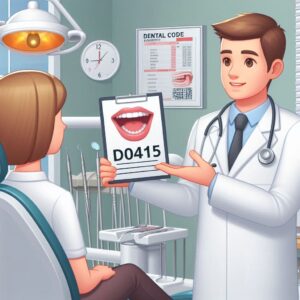
D0415 Dental Code
2. What is the D0415 Dental Code?
The D0415 code is classified under the American Dental Association (ADA) Current Dental Terminology (CDT) as:
“Laboratory test for the detection of oral pre-malignant or malignant lesions, including cytology or DNA analysis, by brush biopsy or other method.”
In simpler terms, D0415 is used when a dentist performs a diagnostic test to detect early signs of oral cancer or precancerous lesions. This test is typically non-invasive, often involving a brush biopsy that collects cells for laboratory analysis.
Key Features of D0415:
-
Non-invasive diagnostic procedure
-
Helps detect oral cancer at early stages
-
Often used for high-risk patients (smokers, tobacco users, HPV-positive individuals)
-
Requires laboratory analysis for definitive results
3. Purpose and Clinical Applications
Why is D0415 Important?
Oral cancer is a significant public health concern, with over 54,000 new cases diagnosed annually in the U.S. alone. Early detection is critical, as the 5-year survival rate improves from ~60% to over 85% when caught early.
D0415 aids in:
-
Early detection of dysplasia (pre-cancerous cells)
-
Confirming suspicious lesions
-
Monitoring high-risk patients
When Should Dentists Use D0415?
| Scenario | Recommended Action |
|---|---|
| Patient presents with a white/red patch (leukoplakia/erythroplakia) | Perform brush biopsy (D0415) |
| High-risk patient (tobacco/alcohol use, HPV history) | Consider routine screening |
| Lesion persists after two weeks | Further testing (D0415 or scalpel biopsy) |
4. Differences Between D0415 and Similar Codes
D0415 is often confused with other biopsy-related codes. Here’s how it differs:
| Code | Description | Invasiveness | Use Case |
|---|---|---|---|
| D0415 | Brush biopsy for lab analysis | Non-invasive | Early screening |
| D7286 | Exfoliative cytology sample | Minimally invasive | Surface cell analysis |
| D7953 | Surgical biopsy (scalpel) | Invasive | Definitive diagnosis |
Key Takeaway:
-
D0415 is for preliminary screening
-
D7953 is for definitive diagnosis
5. Billing and Insurance Considerations
Will Insurance Cover D0415?
Coverage varies by provider:
-
Medicare/Medicaid: Often covered for high-risk patients
-
Private Insurance: Case-by-case basis (pre-authorization may be needed)
Tips for Successful Reimbursement:
-
Document medical necessity (patient risk factors, lesion description)
-
Use supporting codes (e.g., Z77.22 for tobacco use)
-
Submit pathology reports with claims
6. Common Misconceptions About D0415
❌ Myth: “D0415 replaces a traditional biopsy.”
✅ Fact: It’s a screening tool; a scalpel biopsy (D7953) may still be needed.
❌ Myth: “All oral lesions require D0415.”
✅ Fact: Only suspicious or high-risk cases need this test.
7. Case Studies and Real-World Applications
Case Study 1: Early Detection Saves a Life
A 62-year-old smoker presented with a white patch on the floor of the mouth. A D0415 brush biopsy revealed moderate dysplasia, leading to early intervention and complete remission.
Case Study 2: Avoiding Unnecessary Procedures
A patient with a benign lichenoid reaction was spared an invasive biopsy after D0415 confirmed no malignancy.
8. Future Trends in Diagnostic Testing
-
AI-assisted cytology for faster results
-
Saliva-based DNA testing for non-invasive screening
-
Expanded insurance coverage for preventive oral cancer tests
9. Conclusion
The D0415 dental code is a vital tool for early oral cancer detection, improving patient outcomes through non-invasive screening. Proper documentation, understanding insurance nuances, and distinguishing it from other biopsy codes ensure optimal use. As technology advances, D0415 will continue to play a key role in preventive dentistry.
10. FAQs
Q1: Is D0415 painful?
No, it’s a gentle brush biopsy with minimal discomfort.
Q2: How often should high-risk patients be screened?
Annually, or as recommended based on risk factors.
Q3: Can D0415 diagnose oral HPV?
No, it detects abnormal cells but not specific viruses.


