If you’ve recently been told you need a partial denture for your bottom arch, you’ve likely entered a world of confusing dental insurance jargon and procedure codes. Your dentist throws around terms like “D5211” or “cast framework,” and your insurance explanation of benefits (EOB) looks like it’s written in a secret language.
Don’t worry, you are not alone.
Understanding the specific dental code for a lower partial denture is the first step in taking control of your treatment plan and your budget. These codes aren’t just random numbers; they are the standardized language of dentistry, created by the American Dental Association (ADA), that dictates what your insurance will pay for and what your dentist will provide.
This guide is designed to pull back the curtain. We will walk through every major code associated with lower partials, explain what they mean in plain English, compare the differences, and help you navigate the financial and procedural landscape. By the end, you’ll be equipped to have an informed, confident conversation with your dental office.
Whether you are missing one tooth or several, understanding these codes ensures you get the right appliance for your needs without any financial surprises.
Dental Code for a Lower Partial Denture
Table of Contents
ToggleWhat is a Lower Partial Denture? (The Basics)
Before we dive into the codes, let’s establish what we’re actually talking about.
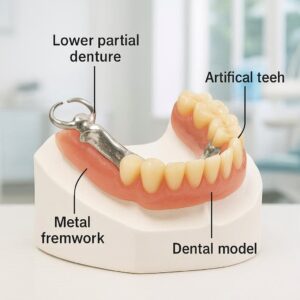
A lower partial denture is a removable prosthetic device designed to replace one or more missing teeth on the lower jaw (mandibular arch). Unlike a full denture, which replaces an entire arch of teeth, a partial denture fills in the gaps left by missing teeth and prevents the remaining natural teeth from shifting.
Think of it as a puzzle piece. It rests on your gums and is held in place, usually by metal clasps or precision attachments, onto your existing teeth.
Why the Lower Arch is Different
Lower partials present unique challenges compared to upper partials. The tongue is a powerful muscle, and it constantly wants to dislodge a lower appliance. Saliva pools in the lower arch, and the bone structure is denser but also prone to faster resorption (shrinkage) after tooth loss. This is why the design and material of a lower partial are critical for stability and comfort—and why the specific code used matters so much.
Why Dental Codes Matter for You (The Patient)
You might think dental codes are just administrative busywork. However, understanding them puts power in your hands.
-
Insurance Coverage: Your insurance company uses these codes to determine if a procedure is “covered” and at what percentage. A simple mix-up between a code for an acrylic partial versus a cast metal partial could mean a difference of hundreds or thousands of dollars out of your pocket.
-
Treatment Plan Clarity: When you see the codes on your treatment plan, you can verify exactly what your dentist is proposing. Are you getting a basic temporary appliance or a long-term, durable solution?
-
Comparing Costs: If you are shopping around for dental care, having the specific codes allows you to get accurate “apples-to-apples” price quotes from different offices.
-
Filing Claims: If your dentist doesn’t file insurance for you, knowing the correct code is essential for you to file the claim yourself and get reimbursed.
The Main Dental Codes for a Lower Partial Denture
The ADA’s Current Dental Terminology (CDT) codes are updated every year. For lower partial dentures, the codes you will encounter most frequently fall into the D5000s range, which covers prosthodontics (removable). Let’s break down the heavy hitters.
D5211: Maxillary Partial Denture – Resin Base (Including Retainers, Clasps, and Teeth)
D5212: Mandibular Partial Denture – Resin Base (Including Retainers, Clasps, and Teeth)
Let’s start with the codes for the lower jaw, but it’s helpful to see them side-by-side with their upper-jaw counterparts.
D5212 is the specific dental code for a lower partial denture made entirely, or primarily, of resin (acrylic).
What is a Resin Base Partial?
This appliance is often referred to as a “flipper” or a “temporary partial,” though it can sometimes be used as a long-term solution in specific cases. The base, which sits on your gums, is made of pink acrylic. The replacement teeth are also acrylic, and the clasps that hook onto your natural teeth are usually made of the same acrylic or sometimes flexible nylon.
The Pros:
-
Faster to fabricate: Usually requires fewer dental visits.
-
Less expensive: The most affordable option upfront.
-
Lightweight: The acrylic is lighter than metal.
The Cons:
-
Bulkier: To maintain strength, the acrylic base needs to be thicker, which can feel bulky in the mouth.
-
Less Durable: Acrylic is prone to breaking or cracking over time.
-
Poor Fit Over Time: Acrylic does not hold its shape as well as metal. As your jawbone naturally changes, an acrylic partial can become loose quickly.
-
Can Cause Damage: Because it’s bulkier and flexible, it can trap food and plaque more easily, potentially increasing the risk of decay on the abutment (anchor) teeth.
| Feature | D5212 (Lower Resin Base Partial) |
|---|---|
| Material | Acrylic (Resin) |
| Base | Thick, pink acrylic |
| Clasps | Acrylic or flexible nylon |
| Durability | Low to Moderate |
| Cost | $ (Least Expensive) |
| Best Use Case | Temporary / Transitional |
D5213: Maxillary Partial Denture – Cast Metal Framework with Resin Denture Bases (Including Retainers, Clasps, and Teeth)
D5214: Mandibular Partial Denture – Cast Metal Framework with Resin Denture Bases (Including Retainers, Clasps, and Teeth)
Now we arrive at the gold standard for removable partials. D5214 is the dental code for a lower partial denture that utilizes a cast metal framework.
What is a Cast Metal Framework Partial?
This is the workhorse of removable prosthetics. A thin, incredibly strong metal framework—usually made of an alloy containing chromium and cobalt—is custom-cast to fit the contours of your mouth perfectly. The pink acrylic part that holds the false teeth is attached to this metal skeleton, and the clasps are also cast in metal.
The Pros:
-
Superior Strength and Durability: The metal framework is thin but extremely strong, resisting breakage for many years.
-
Better Fit and Retention: The metal framework is rigid and holds its shape. It can be designed to fit precisely around your natural teeth, often with rest seats (small ledges) that transfer chewing forces down the long axis of the tooth, which is healthier for the anchor teeth.
-
More Comfortable and Less Bulky: Because the metal is so strong, it can be made much thinner than acrylic, taking up less space in your mouth. This is a huge advantage on the lower arch, giving your tongue more room.
-
Hygienic: The metal is non-porous and easy to keep clean. The open design of the framework (major connectors) also allows more of your gum tissue to feel natural stimulation from chewing and brushing.
The Cons:
-
Higher Cost: This is a significant investment, often two to three times the cost of an acrylic partial.
-
Longer Fabrication Time: The process of creating a custom metal casting takes more lab time and more patient visits for fittings.
-
Aesthetics: While incredibly functional, the metal clasps can be visible, especially if they need to be placed on front teeth.
| Feature | D5214 (Lower Cast Metal Partial) |
|---|---|
| Material | Cast Metal (Cr-Co) & Acrylic |
| Base | Thin metal framework |
| Clasps | Cast Metal |
| Durability | High (Long-term) |
| Cost | $$$ (Most Expensive) |
| Best Use Case | Definitive / Long-term |
Comparing Your Options: D5212 vs. D5214
To make this even clearer, let’s put them side-by-side in a direct comparison. This is the conversation you need to have with your dentist.
| Feature | D5212 (Acrylic/Resin Base) | D5214 (Cast Metal Framework) |
|---|---|---|
| Primary Code | D5212 (Lower) | D5214 (Lower) |
| Common Name | Flipper, Temporary Partial | Cast Metal Partial, Chrome Partial |
| Structure | Entirely thick acrylic | Thin metal base with acrylic saddles |
| Longevity | 1-5 years (often less) | 5-10+ years (with good care) |
| Comfort | Can feel bulky, especially on the tongue side | Thin, minimal, more comfortable for speech |
| Function | OK for light chewing; can rock and trap food | Excellent chewing stability; transfers forces properly |
| Oral Health | Can trap plaque; risk of decay on anchor teeth | More hygienic; healthier for anchor teeth |
| Cost Estimate | $700 – $1,500 | $1,500 – $3,500+ |
| Insurance View | Often considered a basic service, but seen as temporary | Viewed as a definitive, standard-of-care treatment |
Other Important Codes You Might See
Your journey to a lower partial won’t just involve the code for the denture itself. Several other procedures are often necessary and billed separately.
Preliminary Procedures
-
D0190: Screening of a patient. (A quick look, not a comprehensive exam).
-
D0150: Comprehensive Oral Evaluation – new or established patient. (This is the full exam where your dentist plans your treatment).
-
D0210: Intraoral – Complete Series of Radiographic Images. (Full mouth X-rays).
-
D0330: Panoramic Radiographic Image. (The machine that rotates around your head).
Essential Preparatory Work
Before a partial can be made, the mouth must be ready.
-
D4341 / D4346: Periodontal Scaling and Root Planing (Deep cleaning). If you have gum disease, this must be treated first.
-
D5110 / D5120: Complete Dentures. If the partial is for a few teeth, but the rest are being extracted, the plan may shift to a full denture.
-
D7140 / D7210: Extractions. Removal of hopeless teeth that cannot be saved.
-
D2950: Core Buildup. Building up a tooth structure to properly support a clasp or rest.
The Denture Fabrication Process Codes
The final denture code (D5212 or D5214) is a global fee that usually includes all the lab work and visits. However, you might see these as part of an itemized estimate:
-
D5510: Repair broken complete denture base. (If your partial breaks in the future).
-
D5520: Replace missing or broken tooth – complete denture. (If a false tooth pops off).
-
D5610: Resin base (reline), mandibular. (Adjusting the inside of the denture to fit better).
-
D5611: Resin base (reline), maxillary.
-
D5710 / D5711: Rebase complete denture (maxillary/mandibular). (More extensive than a reline, essentially making a new base).
How Dental Insurance Interprets These Codes
This is where understanding the code becomes financially critical. Insurance companies don’t just look at the code; they apply your plan’s specific “benefits.”
The “Alternative Benefit” Clause
Many insurance plans have a clause that states if a more expensive procedure (like D5214) can treat a condition, but a less expensive procedure (like D5212) can also treat it, the insurance will only pay based on the cost of the less expensive option.
In Plain English: Your dentist may recommend the cast metal D5214 for its durability and health benefits. But if your plan has an alternative benefit clause, they might say, “We will only pay our portion based on the price of the acrylic D5212. You are responsible for the price difference.”
Frequency Limitations
Removable partial dentures are major procedures. Most insurance plans have a “once in a lifetime” or “once every 5 years” limitation for these codes. Don’t expect your insurance to pay for a new partial every year.
The Waiting Period
If you just got dental insurance, there is often a waiting period (6-12 months) for major procedures like partials. This prevents people from signing up for insurance, getting a $3,000 denture, and then canceling.
Deductibles and Coinsurance
-
Deductible: The amount you must pay out-of-pocket first (e.g., $50 or $100) before insurance starts paying.
-
Coinsurance: After the deductible, insurance pays a percentage, and you pay the rest. For major procedures like dentures, a common split is 50% insurance / 50% you. So, if the allowed amount for D5214 is $2,000, they might pay $1,000, and you pay $1,000, plus your deductible.
A Step-by-Step Journey to Your Lower Partial (D5214 Focus)
Let’s walk through what getting a cast metal lower partial (D5214) actually feels like.
Visit 1: Diagnosis and Treatment Planning
Your dentist performs a comprehensive exam (D0150), takes X-rays (D0210), and discusses your options. Impressions of your teeth may be taken for diagnostic models. You receive a treatment plan with the proposed codes and costs.
Visit 2: Mouth Preparation
Any necessary extractions, fillings, or cleanings are completed. Your mouth needs to be healthy before the denture work begins.
Visit 3: Master Impressions
Your dentist takes a very precise impression of your lower arch. This is sent to the dental lab. They will also record how your jaws bite together.
Visit 4: Try-In (Framework Try-In)
The lab sends back the metal framework. You try it in your mouth. The dentist checks the fit, the retention, and the bite. If the framework is perfect, they send it back to the lab to add the teeth in wax.
Visit 5: Try-In (Wax Try-In)
Now the framework has the pink wax and false teeth set in place. You try this in. This is your last chance to check the appearance, the shape of the teeth, and the fit before it becomes permanent. You can ask for changes to tooth color, shape, or positioning.
Visit 6: Delivery
The final appliance is ready. The dentist inserts it, makes minor adjustments, and shows you how to put it in and take it out. Important Note: It will feel weird! There is a learning curve.
Visit 7: Post-Op Adjustment
You come back a week or two later. You discuss any sore spots. The dentist will easily adjust the acrylic where it’s rubbing. This is a normal and necessary step.
A Note from Your Dentist: “Getting a new lower partial is a process, not a single event. Don’t be discouraged if it feels awkward for the first few weeks. Your tongue and cheeks need time to learn to work with this new ‘appliance’ in your mouth. We are here to adjust it until it feels right.”
Cost Breakdown: What Are You Really Paying For?
When you see the price tag for D5214, it helps to know where that money goes. It’s not just “profit” for the dentist.
-
Overhead (40-60%): This covers the rent, utilities, staff salaries (assistants, front desk), equipment sterilization, and supplies at the dental office.
-
Dental Laboratory Fees (20-30%): This is the cost of the highly skilled technicians who actually make your partial. They take the dentist’s impressions and use their artistry to craft the metal framework and set the teeth. This fee can range from $500 to $1,500 depending on the complexity.
-
Dentist’s Fee (10-20%): This is the compensation for the dentist’s years of education, expertise, and clinical skill in diagnosing, designing, and delivering the appliance.
-
Miscellaneous: Impressions materials, disposables, etc.
Flexible and Alternative Options
The world of partials isn’t just limited to D5212 and D5214.
Valplast / Flexible Partials (No specific code)
These are a popular alternative, often made of a flexible, biocompatible nylon. They are very aesthetic because the clasps are tooth-colored. However, they are typically coded using the resin base codes (D5212) because they don’t have a cast metal frame. They have pros (aesthetic, flexible) and cons (can be bulky, can lose retention over time, difficult to repair).
Precision Attachment Partials (D5282 – D5283)
For those seeking the ultimate in aesthetics and function, these partials attach to crowns on your natural teeth with special male/female connectors, eliminating visible clasps. This is a highly complex and expensive treatment, but it feels the most like having fixed bridgework. The codes for these are:
-
D5282: Removable unilateral partial denture, one piece cast metal, including clasps and teeth (wrought wire). (Often for a small, side-specific partial).
-
D5283: Removable unilateral partial denture, one piece cast metal, with precision attachments.
Implant-Retained Overdentures (D6110 – D6114)
This is a hybrid solution. A few dental implants are placed in the jaw, and a special partial or denture snaps onto them. This offers incredible stability, especially for the lower arch. It is significantly more expensive due to the surgical implant placement.
Frequently Asked Questions (FAQ)
Q: What is the most common dental code for a lower partial denture?
A: The most common code for a standard, long-term lower partial is D5214 (Mandibular partial denture – cast metal framework with resin denture bases) . For temporary appliances, D5212 (Resin base) is used.
Q: Will my insurance cover D5214?
A: Most dental insurance plans cover a portion of D5214 as a “major” service, usually at 50% after your deductible is met. However, check your plan for the “alternative benefits” clause, as they may try to limit payment to the cost of D5212.
Q: How long does it take to get a D5214 partial?
A: From start to finish, the process typically takes 4 to 8 weeks. This includes multiple visits for impressions, try-ins, and the final delivery.
Q: Why does my dentist recommend D5214 instead of D5212?
A: Most dentists recommend D5214 because it is better for your long-term oral health. The rigid metal framework protects your natural anchor teeth, distributes chewing forces evenly, and is more comfortable and durable. They view it as a better investment in your health.
Q: Can I sleep with my lower partial in?
A: It is generally recommended that you remove your partial at night. This gives your gums a chance to rest and recover from the pressure of chewing. It also allows your saliva to naturally clean the tissues and prevents plaque buildup under the appliance. Soak it in water or a denture cleaner overnight.
Q: What does D5214 look like on an EOB?
A: On your Explanation of Benefits from your insurance, you will see “D5214” listed, along with the dentist’s fee, the insurance company’s “allowed amount,” what they paid, and your remaining responsibility.
Conclusion
Navigating the world of dental prosthetics can feel overwhelming, but understanding the specific dental code for a lower partial denture is your map. Whether it’s the economical D5212 acrylic base or the preferred, durable D5214 cast metal framework, these codes define your treatment and your financial responsibility. By understanding the difference, you can partner with your dentist to choose the option that best fits your health needs, lifestyle, and budget, ensuring a confident smile for years to come.
Additional Resource
For the most up-to-date information on CDT codes directly from the source, visit the American Dental Association’s store for the current Code on Dental Procedures and Nomenclature (CDT Code) .
[Link: https://www.ada.org/en/publications/cdt/]
Disclaimer: This article is for informational purposes only and does not constitute medical or financial advice. Dental procedures, codes, and insurance coverage vary widely by provider, location, and individual plan. You should always consult with a qualified dental professional and your insurance provider to discuss your specific situation and treatment options.
Author: Professional SEO Web Writing Team
Date: March 19, 2026