
Let’s be honest: looking at a dental treatment plan can sometimes feel like trying to read a foreign language. Between the clinical terms and the string of numbers, it’s easy to feel a little lost. If you’ve been told you have a cavity, you’ve likely seen a strange code next to the procedure description. That, in essence, is the dental code for cavity filling.
But what do those numbers actually mean? Why are there different ones? And more importantly, how do they affect the cost of your treatment and what your insurance will cover?
This guide is designed to pull back the curtain on dental coding. We’ll walk through everything you need to know about cavity filling codes, from the basic definitions to the factors that influence which code your dentist uses. Our goal is to empower you with knowledge, so you can have more confident conversations about your dental health and your bill.
Whether you’re facing your first filling or you’re just curious about the billing process, you’re in the right place. Let’s dive in and make sense of those numbers together.
Dental Code for Cavity Filling
What Exactly is a Dental Code?
Before we get into the specifics of fillings, it’s helpful to understand the system itself. Dental codes are part of a standardized language that dentists and insurance companies use to communicate. Think of them as a shorthand for dental procedures.
In the United States, this system is called the Current Dental Terminology (CDT) code. It’s published by the American Dental Association (ADA) and is updated every year to include new procedures and technologies. Every single treatment your dentist might perform—from a routine exam to a complex surgery—has a specific five-character alphanumeric code that starts with the letter “D.”
Why Are These Codes So Important?
These codes serve several critical functions:
-
For Your Dentist’s Office: They are used to accurately record the treatment provided in your patient chart. This ensures a clear and consistent clinical history.
-
For Insurance Claims: When your dental office submits a claim to your insurance company, they use these codes to say, “This is the procedure we performed.” The insurance company then uses the code to determine how much of the cost they will cover based on your specific plan.
-
For You, the Patient: Understanding these codes helps you decipher your “Explanation of Benefits” (EOB) from your insurer and your final bill from the dentist. It ensures you’re being charged for the correct procedure and allows you to verify what your insurance paid for.
Without this system, dental billing would be chaotic. The CDT code provides a common language that makes the entire process more transparent and efficient. So, when you’re looking for the dental code for cavity filling, you’re essentially looking for the specific “language” used to describe your treatment.
The Main Dental Codes for Cavity Fillings
Now, to the heart of the matter. You might think there’s just one code for a filling, but that’s not the case. The specific code used depends on two main factors: the material used for the filling and the number of surfaces of the tooth that need to be repaired.
A tooth has five surfaces:
-
Occlusal (O): The chewing surface of the back teeth.
-
Mesial (M): The front surface of the tooth, towards the midline of your mouth.
-
Distal (D): The back surface of the tooth, away from the midline.
-
Buccal (B) / Facial (F): The surface facing your cheek or lips.
-
Lingual (L): The surface facing your tongue.
A cavity can affect one, two, three, or more of these surfaces. The more surfaces involved, the more complex the procedure, and consequently, the higher the code number and cost.
Let’s break down the most common filling codes by material type.
Codes for Amalgam Fillings (Silver Fillings)
Amalgam fillings are the classic silver-colored fillings. They are a mixture of metals, including silver, tin, copper, and mercury. They have been used for over a century and are known for their strength and durability, especially in the back teeth where chewing force is greatest. While less popular for visible teeth due to their color, they remain a reliable and cost-effective option.
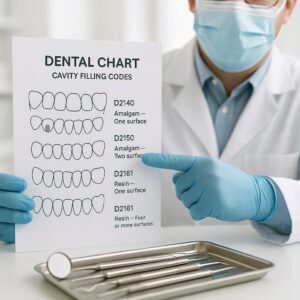
Here are the CDT codes for amalgam fillings, categorized by the number of surfaces:
-
D2140: Amalgam – one surface, primary or permanent. This code is used for a small cavity confined to just one surface of the tooth.
-
D2150: Amalgam – two surfaces, primary or permanent. This is for a cavity that has spread to involve two surfaces of a tooth, like the Mesial and Occlusal (MO).
-
D2160: Amalgam – three surfaces, primary or permanent. A larger filling that covers three surfaces, such as Mesial, Occlusal, and Distal (MOD).
-
D2161: Amalgam – four or more surfaces, primary or permanent. This is for an extensive filling that covers most of the chewing surface and sides of the tooth.
Note: You might notice the phrase “primary or permanent” in these descriptions. This simply means the codes are the same whether the tooth is a baby tooth or an adult tooth.
Codes for Resin-Based Composite Fillings (Tooth-Colored Fillings)
Composite fillings are made of a mixture of plastic and fine glass particles. They are incredibly popular today because they can be precisely matched to the color of your natural teeth, creating a virtually invisible repair. They also bond directly to the tooth structure, which can sometimes allow the dentist to preserve more of the healthy tooth.
These codes are similar to the amalgam codes but start with a different number:
-
D2330: Resin-based composite – one surface, anterior. This is for a one-surface white filling on a front tooth (incisor or canine).
-
D2331: Resin-based composite – two surfaces, anterior.
-
D2332: Resin-based composite – three surfaces, anterior.
-
D2335: Resin-based composite – four or more surfaces or involving the incisal angle (the biting edge), anterior.
For back teeth (premolars and molars), the codes are slightly different:
-
D2391: Resin-based composite – one surface, posterior.
-
D2392: Resin-based composite – two surfaces, posterior.
-
D2393: Resin-based composite – three surfaces, posterior.
-
D2394: Resin-based composite – four or more surfaces, posterior.
Codes for Other Filling Materials and Procedures
While amalgam and composite are the most common, there are other materials and related procedures with their own specific codes.
-
D1352: Caries-detecting dye. This isn’t a filling code, but a diagnostic code. It’s used when the dentist applies a special stain to help identify the full extent of a cavity, especially in the grooves of teeth. It’s a sign of a dentist being thorough.
-
D2940: Protective restoration. This might be a sedative filling placed to calm an irritated nerve, or a temporary filling used between appointments. It is not intended to be a permanent solution.
-
D2710 – D2799: Crowns (Caps). If a cavity is too large for a filling, a crown may be necessary. These codes are for the various types of crowns (e.g., porcelain fused to metal, all ceramic, full cast metal). For example, D2740 is for a porcelain/ceramic crown.
-
D2910: Recement or re-cement inlay. This code is used when a prefabricated or existing piece needs to be reattached.
-
D1351: Sealant. This is a preventive code. A sealant is a thin, protective coating placed on the chewing surfaces of back teeth to prevent cavities from forming. It is not a filling.
Dental Codes for More Complex Restorations: Inlays and Onlays
Sometimes, a cavity is too large for a simple filling but not quite large enough to warrant a full crown. In these cases, a dentist might recommend an inlay or an onlay. These are considered “indirect” restorations because they are manufactured outside of the mouth—often in a dental lab—and then bonded to the tooth in a second appointment.
Understanding these codes is important because these procedures often have different costs and insurance coverage levels than standard fillings.
Inlays
An inlay is a restoration that fits within the cusps (the pointed tips) of a tooth. It’s like a filling that is crafted to fit precisely into the prepared cavity, but it doesn’t cover the entire chewing surface.
-
D2510: Inlay – metallic – one surface.
-
D2520: Inlay – metallic – two surfaces.
-
D2530: Inlay – metallic – three or more surfaces.
-
D2610: Inlay – porcelain/ceramic – one surface.
-
D2620: Inlay – porcelain/ceramic – two surfaces.
-
D2630: Inlay – porcelain/ceramic – three or more surfaces.
Onlays
An onlay is a more extensive restoration. It covers one or more of the tooth’s cusps and protects the chewing surface more comprehensively. It’s sometimes called a “partial crown.”
-
D2542: Onlay – metallic – two surfaces.
-
D2543: Onlay – metallic – three surfaces.
-
D2544: Onlay – metallic – four or more surfaces.
-
D2642: Onlay – porcelain/ceramic – two surfaces.
-
D2643: Onlay – porcelain/ceramic – three surfaces.
-
D2644: Onlay – porcelain/ceramic – four or more surfaces.
The choice between a large composite filling, an inlay, and an onlay depends on the amount of healthy tooth structure remaining, the location of the tooth, and the bite forces it will endure. Inlays and onlays are very strong and can be an excellent, long-lasting option.
Quick Comparison Table: Dental Filling Codes at a Glance
To help you visualize the differences, here is a simple comparison of the most common filling codes.
| CDT Code | Procedure Description | Material | Typical Location | Relative Complexity |
|---|---|---|---|---|
| D2140 | Amalgam – 1 Surface | Silver-colored | Back Teeth | Lower |
| D2150 | Amalgam – 2 Surfaces | Silver-colored | Back Teeth | Low-Moderate |
| D2160 | Amalgam – 3 Surfaces | Silver-colored | Back Teeth | Moderate |
| D2161 | Amalgam – 4+ Surfaces | Silver-colored | Back Teeth | Higher |
| D2330 | Resin – 1 Surface, Anterior | Tooth-colored | Front Teeth | Lower |
| D2331 | Resin – 2 Surfaces, Anterior | Tooth-colored | Front Teeth | Low-Moderate |
| D2332 | Resin – 3 Surfaces, Anterior | Tooth-colored | Front Teeth | Moderate |
| D2391 | Resin – 1 Surface, Posterior | Tooth-colored | Back Teeth | Lower |
| D2392 | Resin – 2 Surfaces, Posterior | Tooth-colored | Back Teeth | Low-Moderate |
| D2393 | Resin – 3 Surfaces, Posterior | Tooth-colored | Back Teeth | Moderate |
| D2394 | Resin – 4+ Surfaces, Posterior | Tooth-colored | Back Teeth | Higher |
| D2610 | Porcelain Inlay – 1 Surface | Ceramic | Back Teeth | High |
| D2642 | Porcelain Onlay – 2 Surfaces | Ceramic | Back Teeth | Very High |
How Dentists Choose the Right Code
You might wonder how your dentist decides which code to use. It’s not an arbitrary decision. It’s a clinical one based on a few key factors during your exam.
-
Clinical Examination: The dentist will visually inspect your tooth and may use a small explorer to feel for soft spots. They’ll also check the contacts between your teeth with dental floss to see if a cavity has broken through.
-
X-Rays (Radiographs): This is a crucial step. X-rays show cavities between teeth (interproximal decay) and beneath existing fillings that aren’t visible to the naked eye. The dentist can see the exact size and depth of the decay on the X-ray image.
-
Assessment of Surfaces: Based on the exam and X-rays, the dentist determines exactly which surfaces of the tooth are affected. They note this in your chart. If the decay is on the Mesial and Occlusal surfaces, they know the code will be for two surfaces (e.g., D2392 for a posterior composite).
The final step is a conversation with you. The dentist will explain their findings, show you the cavity on the X-ray, discuss the material options (amalgam vs. composite), and recommend the best treatment for your long-term oral health. The code is simply the technical translation of that clinical decision.
Dental Codes and Your Insurance: What to Expect
This is where the rubber meets the road for most patients. You’ve had the filling, you have the code, and now you’re wondering what your insurance will pay. Here’s the reality of how insurance companies view these codes.
Classification of Benefits
Insurance companies typically group procedures into three categories, and this classification affects your coverage:
-
Class I: Preventive and Diagnostic (e.g., Exams, Cleanings, X-rays). Usually covered at the highest percentage (80-100%).
-
Class II: Basic Restorative Procedures (e.g., Fillings, Simple Extractions). Typically covered at a mid-range percentage (50-80%). Most standard amalgam and composite fillings fall into this class.
-
Class III: Major Restorative Procedures (e.g., Crowns, Bridges, Dentures, Inlays, Onlays, Root Canals). Usually covered at the lowest percentage (often 50% or less).
The “Alternate Benefit” Clause
This is a critical concept. Many insurance plans have an “alternate benefit” clause, sometimes called the “least expensive alternative treatment” (or a similar phrase). This is most commonly seen with fillings.
For example, your dentist might recommend a tooth-colored composite filling on a back tooth. However, your insurance plan might consider an amalgam (silver) filling to be the “standard” benefit for that tooth. In this case, the insurance company will:
-
Calculate what they would have paid for the amalgam filling (e.g., D2160).
-
Pay that amount toward your composite filling (e.g., D2393).
-
You are then responsible for the difference in cost between the two procedures.
This does not mean you can’t get the composite filling. It just means your insurance coverage will be based on the less expensive alternative. Always check with your insurance provider or your dentist’s billing coordinator to understand your plan’s specific rules.
Additional Factors That Influence the Final Code
Sometimes, a simple filling isn’t so simple. The final code can also be influenced by other procedures performed at the same time.
-
D2954: Crown buildup (often referred to as a “core buildup”). If a tooth has very little structure left because of a large cavity or an old filling, the dentist may need to build up the core of the tooth with a special material before placing a crown. This is a separate procedure with its own code and cost. It is not a filling code itself, but it’s a common related code.
-
D2950: Pin retention. In the past, dentists would sometimes use small pins placed into the tooth to help hold a large filling in place. This is less common today with modern bonding agents, but you might still see this code on older records.
The Importance of Diagnostic Codes
While we’ve focused on the treatment codes, it’s worth briefly mentioning diagnostic codes. These are the “why” behind the procedure. The most common one you’ll see with a filling is:
-
D0601 – D0604: Caries risk assessment and classification. These newer codes allow dentists to document the type and severity of the cavity. For example, D0602 might be used for a moderate cavity, while D0603 is for a high-risk situation. This helps track your oral health over time and justify the need for treatment.
A Look at an “Explanation of Benefits” (EOB)
To make this all real, let’s imagine a scenario and see how it would look on your insurance paperwork.
Scenario: You have a cavity on the back surface (Distal) and chewing surface (Occlusal) of a lower molar. Your dentist recommends a tooth-colored composite filling.
-
The Diagnosis: Decay on the Distal and Occlusal surfaces (DO) of tooth #30.
-
The Treatment Plan: Resin-based composite filling, two surfaces, posterior.
-
The Code Used on the Claim: D2392
-
Your Insurance EOB Might Look Something Like This:
| Code | Description | Provider Charge | Plan Allowed Amount | Plan Pays | Patient Responsibility |
|---|---|---|---|---|---|
| D2392 | Resin-based composite, two surf, post | $275.00 | $210.00 | $147.00 (70%) | $128.00 |
| Total Paid: $147.00 | You Owe: $128.00 |
In this example, the insurance company’s “allowed amount” for that code is $210. Their coverage is 70% for basic restorative care, so they pay $147. You are responsible for the remaining balance of the dentist’s full fee ($275 – $147 = $128).
Frequently Asked Questions (FAQ)
Q: Is there a universal dental code for a cavity?
A: No. There isn’t one single code. The correct code depends on the material used (like amalgam or composite) and how many surfaces of the tooth the cavity affects.
Q: Why is my tooth-colored filling more expensive than the insurance estimate?
A: This is often due to the “alternate benefit” clause. Your insurance may base their payment on the cost of a silver (amalgam) filling, which is usually less expensive. You are responsible for the price difference if you choose the composite material.
Q: Does the same code apply to baby teeth and adult teeth?
A: Yes, for most standard fillings, the CDT codes are the same for both primary (baby) and permanent (adult) teeth.
Q: My dentist mentioned a code D1352. What is that?
A: D1352 is the code for caries-detecting dye. It’s a diagnostic aid used to help the dentist see the full extent of the decay, ensuring they remove it all while preserving as much healthy tooth as possible.
Q: What’s the difference between a D2392 (filling) and a D2642 (onlay)?
A: A D2392 filling is placed directly into the tooth and hardened in one visit. A D2642 onlay is an indirect restoration, typically made in a lab, that covers more of the tooth’s surface, including one or more of the chewing cusps. It usually requires two visits and is considered a “major” procedure.
Additional Resources
For the most authoritative and up-to-date information, you can always refer to the source:
-
American Dental Association (ADA) – CDT Code: The ADA is the official publisher and maintainer of the CDT code set. You can find more information about the coding process on their website.
(Please note: The ADA website is the primary source. General web searches for “dental codes” can sometimes lead to outdated or unofficial information, so it’s best to consult with your dentist or a trusted professional resource.)
Conclusion
Understanding the dental code for cavity filling can transform a confusing bill into a clear picture of the care you received. The code isn’t just an arbitrary number; it tells a story about the material your dentist used and the extent of the work required to restore your tooth to health. While it can feel like a complex system, knowing the basics—like the difference between a D2140 (one-surface silver filling) and a D2393 (three-surface white filling)—empowers you to be an active participant in your dental care and financial planning. The next time you see a code on your treatment plan, you’ll have the confidence to ask informed questions and understand the answers.
Disclaimer: This article is intended for informational purposes only and does not constitute dental or financial advice. Dental coding, insurance policies, and treatment costs can vary. Always consult with your qualified dentist or dental insurance provider to understand the specifics of your treatment plan and coverage.


