
If there is one moment in the restorative dental process that brings a smile to a patient’s face, it is delivery day. After weeks of impressions, wax try-ins, and adjustments, the patient finally gets to walk out of the office with a brand-new set of teeth. But for the dental team, the clinical success of that appointment is only half the battle. The other half is making sure the administrative work is just as precise.
Billing for prosthodontics can feel like navigating a maze. Use the wrong code, miss a modifier, or bundle services incorrectly, and you could be looking at a denied claim or a significant loss in revenue.
This guide is designed to demystify the process. We will focus specifically on the dental code for denture delivery, how it interacts with other codes, and how to ensure your hard work is properly compensated.
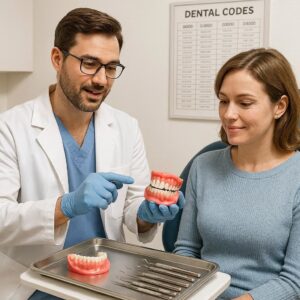
Dental Code for Denture Delivery
What is a “Delivery” Code in Dentistry?
Before we dive into the specific numbers, it is crucial to understand the philosophy behind dental procedure codes (CDT codes). Unlike medical billing, which often bundles a service into one global fee, dental coding frequently separates the “laboratory fabrication” from the “clinical placement.”
When we talk about the dental code for denture delivery, we are referring to the specific CDT code used to bill for the final insertion, placement, and adjustment of the prosthesis at the chairside. This code represents the clinical skill and time required to seat the denture, check the occlusion, and ensure the patient’s comfort.
It is important to note that these codes are almost always billed in conjunction with the fabrication codes, but they represent distinct phases of treatment.
The Complete List of Denture Codes (Fabrication vs. Delivery)
To understand delivery, you must first understand the complete denture codes. These are broken down by the type of denture (complete vs. partial) and the arch (maxillary vs. mandibular).
Here are the primary CDT codes you will use:
Complete Dentures (Full Arch)
-
D5110: Complete denture – maxillary.
-
D5120: Complete denture – mandibular.
Partial Dentures (Removable)
-
D5211: Upper partial denture – resin base (including any conventional clasps, rests, and teeth).
-
D5212: Lower partial denture – resin base (including any conventional clasps, rests, and teeth).
-
D5213: Upper partial denture – cast metal framework with resin denture bases (including any conventional clasps, rests, and teeth).
-
D5214: Lower partial denture – cast metal framework with resin denture bases (including any conventional clasps, rests, and teeth).
Immediate Dentures
-
D5130: Immediate denture – maxillary.
-
D5140: Immediate denture – mandibular.
Other Related Codes
-
D5410: Adjust complete denture – maxillary.
-
D5411: Adjust complete denture – mandibular.
-
D5511: Repair broken complete denture base, mandibular.
-
D5520: Replace missing or broken teeth – complete denture (each tooth).
So, What is the Specific Dental Code for Denture Delivery?
Here is where many billers get confused. In the CDT manual, there is no single standalone code that says “Denture Delivery.” Instead, the delivery is inherent within the primary prosthesis codes listed above.
When you bill D5110 (Complete Denture Maxillary), you are billing for the entire service: the fabrication and the delivery.
However, the timing of when you bill this code matters significantly for your cash flow.
The “Global” Service vs. Staged Billing
Traditionally, you would bill the complete denture code (e.g., D5110) only when the denture is seated and delivered to the patient. This is a “global” claim—one fee for the entire process from start to finish.
But given the high cost of dental lab fees, many dentists prefer to bill in stages to help with the practice’s cash flow. This is where the concept of “Interim” codes comes into play.
If you choose to stage your billing, you would use the following:
-
D5110: Complete Denture – Maxillary (Final Placement/Insertion).
-
D5120: Complete Denture – Mandibular (Final Placement/Insertion).
The “Try-In” Code (The Pre-Delivery Code)
Before you can bill the delivery code, you must complete the clinical steps. To get paid for the lab work up front, you use the try-in code, which includes the major connector and setup.
-
D5850: Tissue conditioning, maxillary or mandibular (Often used for immediate dentures pre-delivery).
-
D5820: Interim partial denture (maxillary)
-
D5821: Interim partial denture (mandibular)
The Golden Rule: Once you bill the final delivery code (D5110-D5140), you cannot bill for a try-in or an interim prosthesis. It is a finality code.
Understanding the Reimbursement: What to Expect
Reimbursement for the dental code for denture delivery varies wildly depending on your geographic location and the patient’s insurance plan. However, understanding the usual and customary (U&C) fees helps set patient expectations.
Here is a hypothetical comparison table to illustrate the range. Note: These are estimates for educational purposes only and do not reflect actual fees.
| CDT Code | Description | Estimated Fee Range (U.S. Private Insurance) | Lab Cost Estimate |
|---|---|---|---|
| D5110 | Complete Denture – Maxillary | $1,200 – $2,500 | $400 – $800 |
| D5120 | Complete Denture – Mandibular | $1,200 – $2,500 | $400 – $800 |
| D5213 | Partial Denture – Cast Metal Upper | $1,100 – $2,200 | $600 – $1,000 |
| D5410 | Adjustment – Complete Denture | $50 – $150 (Per visit) | N/A |
Important Note for Readers: Insurance companies often have a “frequency limitation” on dentures. Most plans only cover a new complete denture once every five (5) to seven (7) years. Always verify patient benefits before beginning treatment.
The Delivery Day Appointment: What the Code Covers
When you bill the dental code for denture delivery, the insurance company expects that a specific set of clinical services were performed. It is more than just handing the denture to the patient.
The delivery appointment typically includes:
-
Seating the Prosthesis: Ensuring the denture fits passively and snugly on the ridge.
-
Occlusal Adjustment: Using articulating paper to mark high spots and adjust the bite so the teeth meet evenly. This prevents sore spots and bone resorption.
-
Pressure Indicator Paste (PIP): Using PIP to identify areas of excessive pressure on the tissue side of the denture. These areas are relieved to prevent ulcers.
-
Patient Education: Instructing the patient on how to insert and remove the denture, proper cleaning techniques, and wearing schedules.
-
Post-Operative Instructions: Scheduling the follow-up appointment for the first recall/adjustment.
Immediate Dentures: A Special Billing Case (D5130 / D5140)
Immediate dentures are placed on the same day that the natural teeth are extracted. This presents a unique coding challenge because the patient leaves the office with the denture, but the gums and bone will shrink significantly over the next 3-6 months.
When you bill the immediate denture delivery code (D5130 or D5140), it covers the surgical placement of the denture over the extraction sites. However, it does not cover the inevitable adjustments and relines required later.
The “Hard” vs. “Soft” Reline
Because the bone shrinks after extractions, an immediate denture will become loose. Usually, after about 6 months, the denture needs a reline.
-
D5730: Reline complete maxillary denture (chairside).
-
D5731: Reline complete mandibular denture (chairside).
-
D5740: Reline complete maxillary denture (laboratory).
Do not confuse the delivery code with the reline code. They are separate services and are billed separately once the tissue has stabilized.
5 Common Billing Mistakes for Denture Delivery
To keep your claims clean and your accounts receivable healthy, avoid these common pitfalls:
-
Billing the Delivery Too Early: If you bill D5110 at the “wax try-in” appointment, you are committing fraud. The prosthesis has not been delivered. Wait until the patient walks out with the final product.
-
Missing the Medical Necessity: If the denture is needed due to an accident or oral pathology (like cancer surgery), you may be able to bill it to medical insurance, not just dental. This requires specific diagnosis codes (ICD-10) like S02.6XX (Fracture of mandible) or C03.9 (Malignant neoplasm of gum).
-
Failing to Itemize Adjustments: Most insurance plans include one adjustment within the first 90 days as part of the delivery fee. If you bill D5410 during this period, it will likely be denied as part of the global service.
-
Incorrect Arch Designation: Always double-check if you are billing for the upper (maxillary) or lower (mandibular). An insurance claim for D5110 (Upper) when you delivered a lower denture (D5120) will be rejected.
-
Overlapping Benefits: If the patient has both medical and dental insurance, ensure the primary payer has processed the claim before submitting to the secondary. Coordination of benefits is vital for high-cost items like dentures.
List of Necessary Documentation for Claims
To ensure smooth processing of your denture delivery claim, attach the following documentation if requested:
-
Periodontal charting (to prove the need for extractions/extensive restorations).
-
Intraoral photographs (showing the edentulous ridge or failing dentition).
-
Pre-operative radiographs (showing bone levels and pathology).
-
Laboratory prescription (a copy can be requested by auditors).
-
Treatment plan signed by the patient.
How to Discuss Costs with Patients (The Script)
Discussing the cost associated with the dental code for denture delivery can be sensitive. Here is a friendly way to approach it:
“Mrs. Smith, we are now ready for the final step—your denture delivery. You’ve seen the wax model, and we are about to create your final, permanent smile.
The fee we discussed covers the craftsmanship of the dental lab to create your teeth, as well as my time today to seat them perfectly and adjust them so they feel comfortable. I want to make sure that when you leave, you feel confident speaking and smiling.
My front desk team will go over the final balance and help you schedule your follow-up appointment to make sure everything is healing nicely.”
Conclusion
Mastering the dental code for denture delivery is essential for the financial health of any restorative practice. Remember that the delivery is not a separate line item but is encompassed within the final prosthesis codes (D5110-D5140). Accurate coding ensures you are reimbursed for the significant clinical skill required on delivery day, from occlusal adjustments to patient education. By avoiding common pitfalls like premature billing and understanding the nuances of immediate dentures, you can ensure a smooth process for both your patient and your bottom line.
Frequently Asked Questions (FAQ)
1. Can I bill D5110 and D5120 on the same day?
Yes, absolutely. If you deliver both an upper and a lower complete denture to the patient at the same appointment, you can (and should) bill both codes. Most insurance plans cover both arches separately. Just make sure to append the correct modifiers if required by the specific carrier (e.g., for different tooth shades or base materials, though this is rare).
2. My patient needs an adjustment a week after delivery. Can I bill D5410?
Probably not. Most dental insurance plans consider adjustments performed within the first 30, 60, or 90 days as part of the original delivery fee. This is considered “follow-up care” to perfect the fit. You can only bill D5410 (Adjust complete denture) if the adjustment is needed after that initial post-delivery warranty period has expired, or if it is due to a new issue not related to the initial seating (e.g., the patient dropped the denture).
3. What is the difference between D5110 and D5130?
The difference lies in timing. D5110 is for a standard complete denture delivered to a patient who has been edentulous (without teeth) for a period of time, allowing the gums to heal. D5130 (Immediate denture) is fabricated before the teeth are extracted and is placed immediately after the extractions on the same day. Immediate dentures act as a bandage and maintain the patient’s appearance during healing.
4. Does dental insurance cover 100% of the denture delivery fee?
Rarely. Most dental plans have an annual maximum benefit (often $1,000 – $2,000). Since a single denture can easily exceed that amount, the patient is often responsible for a significant portion of the fee. Always verify the patient’s “Prosthodontic Lifetime Maximum” and “Annual Maximum” before treatment.
5. My lab sent back the denture, but the bite is off. Can I bill the insurance for the remake?
This depends on who made the error. If the dentist made a clinical error in the impression or bite registration, the lab remake is the practice’s expense. If the lab made a manufacturing error (teeth in wrong position, fracture), they should remake it at no cost to you. Insurance will not pay for a second denture if the first one was delivered successfully (D5110) but the patient simply doesn’t like it.


