
Let’s be honest: looking at a dental treatment plan or an Explanation of Benefits (EOB) from your insurance company can sometimes feel like reading a foreign language. Between the clinical terms and the seemingly random jumbles of letters and numbers, it’s easy to feel lost. If you’re about to get dentures—whether it’s your first full set or a replacement for ones you’ve had for years—you’ve likely encountered these mysterious codes.
You might be asking yourself: What does this code mean? Is my insurance covering what it’s supposed to? Am I paying a fair price?
This guide is here to translate that language for you. We’ll demystify the world of Current Dental Terminology (CDT) codes specifically for dentures. Think of this as your friendly, reliable roadmap. We won’t just throw a list of codes at you; we’ll walk through what they mean for your specific situation, from the initial consultation to the moment you flash your new smile.
Our goal is simple: to empower you with knowledge, so you can have more confident conversations with your dentist and your insurance provider. Let’s turn that confusion into clarity.
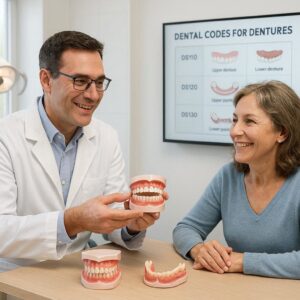
Dental Code for Dentures
What Exactly is a “Dental Code”?
Before we dive into the specific codes for dentures, it’s helpful to understand what these codes are and why they exist. They aren’t just random numbers dreamt up to confuse patients. They are the standardized language of dentistry.
The CDT Code: The Industry Standard
The codes we use in the United States are called CDT codes. CDT stands for Current Dental Terminology. It’s a set of codes maintained and updated annually by the American Dental Association (ADA). Think of it as the official dictionary for dental procedures.
Every time a dentist provides a service—whether it’s a simple examination, a filling, or a full set of dentures—they translate that service into a specific CDT code on your dental claim form. This code tells your insurance company, in no uncertain terms, exactly what procedure was performed.
Why is this important for you?
-
Standardization: It ensures that a “complete upper denture” in New York is described the same way as a “complete upper denture” in California.
-
Insurance Processing: Insurance companies use these codes to determine what they will pay for. Their coverage policies are built around these specific codes.
-
Treatment Clarity: When you see a code on your treatment plan, it’s your key to understanding exactly what your dentist is proposing. It removes the guesswork.
How to Read a Dental Code
A typical CDT code is structured simply. It always begins with the letter D (for Dental), followed by a four-digit number.
For example: D5110
-
The D tells us it’s a dental procedure code.
-
The 5110 is the specific identifier for a procedure. In this case, it stands for “Complete Denture – Maxillary.”
Throughout this article, you’ll see many codes starting with D5***, as the “5000” series is the section of the CDT manual dedicated to prosthodontics (removable prosthetics), which includes dentures.
A Note on Payer Systems: While the CDT code is the universal standard, sometimes your insurance company’s internal processing system might group codes slightly differently for benefits purposes. However, the CDT code on your claim form is the non-negotiable starting point.
The Core Dental Codes for Dentures (With a Handy Table)
Now, let’s get to the heart of the matter. Here are the most common CDT codes you’ll encounter on your journey to getting dentures. We’ve broken them down into two main categories: complete dentures (replacing all teeth in an arch) and partial dentures (replacing some teeth).
To make this easier to digest, we’ve created a clear reference table. Bookmark this section!
Complete Denture Codes
| CDT Code | Procedure Description | What This Means for You |
|---|---|---|
| D5110 | Complete Denture – Maxillary | This is a full upper denture. It replaces all of the teeth in the upper jaw (maxillary arch). |
| D5120 | Complete Denture – Mandibular | This is a full lower denture. It replaces all of the teeth in the lower jaw (mandibular arch). |
| D5130 | Immediate Denture – Maxillary | An upper denture made before your natural teeth are removed. It is placed immediately after the extractions, so you are never without teeth. Requires later relining as your gums heal and shrink. |
| D5140 | Immediate Denture – Mandibular | A lower denture made before extractions and placed immediately after. |
Partial Denture Codes
Partial dentures are designed to fill in the gaps where some natural teeth remain. They often have clasps (metal or tooth-colored) that attach to your existing teeth for support.
| CDT Code | Procedure Description | What This Means for You |
|---|---|---|
| D5211 | Maxillary Partial Denture – Resin Base (Including Retentive Clasps, Rest, and Teeth) | An upper partial denture where the base (the part that looks like gums) is made of acrylic (resin). This is often a more economical option. |
| D5212 | Mandibular Partial Denture – Resin Base (Including Retentive Clasps, Rest, and Teeth) | A lower partial denture with an acrylic base. |
| D5213 | Maxillary Partial Denture – Cast Metal Framework with Resin Denture Bases | An upper partial denture with a strong, thin, and more precise framework made of cast metal. The acrylic gums and teeth are attached to this frame. These are typically more durable and comfortable. |
| D5214 | Mandibular Partial Denture – Cast Metal Framework with Resin Denture Bases | A lower partial denture with a cast metal framework. |
| D5282 | Removable Unilateral Partial Denture – One Piece Cast Metal (w/ Clasps) – Maxillary | Often called a “Maryland bridge” but in removable form, this is a small partial that replaces one or a few teeth on one side of the upper arch. |
| D5283 | Removable Unilateral Partial Denture – One Piece Cast Metal (w/ Clasps) – Mandibular | The same as above, but for the lower arch. |
| D5286 | Removable Unilateral Partial Denture – Composite/Resin (w/ Clasps) | An economical, all-acrylic partial for replacing teeth on one side of the mouth only. |
Reline and Repair Codes
Dentures aren’t a “set it and forget it” solution. Your mouth changes over time, and dentures can break or wear out. These codes cover the maintenance.
| CDT Code | Procedure Description | What This Means for You |
|---|---|---|
| D5410 | Adjust Complete Denture – Maxillary | An adjustment to an upper denture to relieve pressure points or discomfort. |
| D5411 | Adjust Complete Denture – Mandibular | An adjustment to a lower denture. |
| D5421 | Adjust Partial Denture – Maxillary | Adjusting an upper partial. |
| D5422 | Adjust Partial Denture – Mandibular | Adjusting a lower partial. |
| D5511 | Repair Broken Complete Denture Base – No Teeth Damaged | Fixing a crack or break in the pink base of a full denture. |
| D5512 | Repair Broken Partial Denture Base – No Teeth Damaged | Fixing a crack or break in the base of a partial denture. |
| D5520 | Replace Missing or Broken Teeth – Complete Denture (Each Tooth) | Adding a new tooth to an existing complete denture. Charged per tooth. |
| D5610 | Repair Broken Partial Denture – Resin Base | Fixing a break in the acrylic part of a partial denture. |
| D5620 | Repair Cast Framework – Partial Denture | A more complex repair, like fixing a broken metal clasp or frame on a partial. |
| D5630 | Repair or Replace Broken Clasp – Partial Denture | Specifically fixing or replacing a single broken clasp, without remaking the whole framework. |
| D5640 | Replace Broken Teeth – Partial Denture (Each Tooth) | Adding a new tooth to an existing partial denture. |
| D5710 | Rebase Complete Denture – Maxillary | This is a major procedure. The dentist uses the existing teeth but replaces the entire pink acrylic base to make it fit a changed mouth structure. |
| D5711 | Rebase Complete Denture – Mandibular | Rebase for a lower complete denture. |
| D5720 | Rebase Partial Denture – Maxillary | Replacing the acrylic base of an upper partial denture. |
| D5721 | Rebase Partial Denture – Mandibular | Replacing the acrylic base of a lower partial denture. |
| D5730 | Reline Complete Denture – Maxillary (Chairside) | A reline adds a new layer of material to the tissue side of the denture to improve the fit. “Chairside” means it’s done in one appointment, right in the dental chair. |
| D5731 | Reline Complete Denture – Mandibular (Chairside) | Same as above, for a lower denture. |
| D5740 | Reline Partial Denture – Maxillary (Chairside) | Chairside reline for an upper partial. |
| D5741 | Reline Partial Denture – Mandibular (Chairside) | Chairside reline for a lower partial. |
| D5750 | Reline Complete Denture – Maxillary (Laboratory) | A reline where the impression is taken, and the denture is sent to a dental lab for the new material to be processed. This is more precise and durable than a chairside reline. |
| D5751 | Reline Complete Denture – Mandibular (Laboratory) | Laboratory-processed reline for a lower denture. |
| D5760 | Reline Partial Denture – Maxillary (Laboratory) | Laboratory-processed reline for an upper partial. |
| D5761 | Reline Partial Denture – Mandibular (Laboratory) | Laboratory-processed reline for a lower partial. |
Implant-Supported Denture Codes
For many, implant-supported dentures (like “All-on-4” or “Snap-On” dentures) are the gold standard. The codes for the implants themselves are separate, but these are the codes for the denture that attaches to them.
| CDT Code | Procedure Description | What This Means for You |
|---|---|---|
| D6110 | Implant/Abutment Supported Removable Denture – Maxillary | An upper denture that is designed to snap onto or attach to dental implants for extra stability. It can be removed for cleaning. |
| D6111 | Implant/Abutment Supported Removable Denture – Mandibular | The lower version of a snap-on denture. Very common for lower arches. |
| D6112 | Implant/Abutment Supported Fixed Denture – Maxillary | An upper denture that is screwed onto implants and is only removable by a dentist. Often referred to as a “fixed hybrid” denture. |
| D6113 | Implant/Abutment Supported Fixed Denture – Mandibular | The lower version of a fixed hybrid denture. |
| D6114 | Implant/Abutment Supported Complete Denture – Maxillary | A term for a complete upper denture that is fully supported by implants. |
| D6115 | Implant/Abutment Supported Complete Denture – Mandibular | A term for a complete lower denture that is fully supported by implants. |
| D6116 | Implant/Abutment Supported Interim Complete Denture – Maxillary | A temporary denture used during the implant healing process for the upper arch. |
| D6117 | Implant/Abutment Supported Interim Complete Denture – Mandibular | A temporary denture for the lower arch during implant healing. |
| D6118 | Implant/Abutment Supported Partial Denture – Maxillary | An upper partial denture that uses implants for support, often when few natural teeth remain. |
| D6119 | Implant/Abutment Supported Partial Denture – Mandibular | A lower implant-supported partial denture. |
Navigating Your Treatment Plan: From Codes to Clarity
Okay, you’ve seen the codes. But what do they look like in the real world? Let’s walk through a typical patient journey and see how these codes pop up.
The Initial Consultation and Exam (D0150, D0120)
Your journey will almost certainly begin with an examination. Your dentist will assess your oral health, take X-rays, and discuss your goals. This initial exam has its own code (often a comprehensive oral evaluation, D0150, or a periodic exam, D0120). This is a separate, necessary service to create a treatment plan tailored just for you.
Case Presentation: The Breakdown
After your exam, the dentist or treatment coordinator will present a plan. This is where you’ll see the codes in action. A plan for a patient needing a full upper and lower denture might look like this:
Treatment Plan for John Doe
| CDT Code | Description | Fee | Insurance Est. | Patient Est. |
|---|---|---|---|---|
| D5110 | Complete Denture – Maxillary | $1,800 | $1,000 | $800 |
| D5120 | Complete Denture – Mandibular | $1,800 | $1,000 | $800 |
| D9310 | Consultation – Diagnostic | $75 | $50 | $25 |
| Total | $3,675 | $2,050 | $1,625 |
A Friendly Tip: Don’t be afraid to ask questions! If you see a code you don’t recognize, just say, “I see code D5120 on my plan. Can you explain exactly what that covers?” A good dental office will be happy to walk you through it.
What About Insurance?
This is where the codes become crucial. Your insurance plan has a fee schedule and coverage rules attached to each code.
-
Coverage Levels: Most dental insurance plans cover basic dentures (like D5110 and D5120) at 50%, after you meet your deductible. However, they often pay a fixed, pre-determined amount (a “usual, customary, and reasonable” or UCR fee) which might be less than your dentist’s fee.
-
Frequency Limits: Insurance plans have strict rules on how often they’ll pay for certain procedures. For example, most plans will only cover a complete denture (D5110, D5120) once every five, seven, or even ten years. They may cover a rebase (D5710) or reline (D5750) once every two to three years.
-
“Alternative” Benefits: If your dentist recommends a premium denture (perhaps with higher-quality teeth or a more precise fit) and your plan only covers a “standard” denture, they might apply an “alternate benefit” clause. This means they will pay the equivalent of what a standard denture would have cost, and you pay the difference.
Immediate vs. Conventional Dentures: A Code-Level View
One of the most common points of confusion is the difference between immediate and conventional (sometimes called “regular”) dentures. The codes tell the story.
Conventional Dentures (D5110, D5120)
A conventional denture is made after your teeth have been removed and your gums have fully healed. This healing process typically takes several months (often 3 to 6 months). During that time, you would be without teeth.
-
Process: Extractions -> Heal for months -> Impressions -> Denture fabricated -> Delivery.
-
Code Logic: Since there is no hurry and the gums are stable, the denture can be made with a precise fit from the start.
Immediate Dentures (D5130, D5140)
An immediate denture is fabricated before your teeth are extracted. The dentist takes impressions of your mouth with your teeth still in place. The lab uses this model to create the denture.
-
Process: Impressions with teeth -> Denture fabricated -> Extractions -> Denture inserted immediately after.
-
Code Logic: The procedure code (D5130, D5140) is different because the process is more complex for the dentist. They have to anticipate the shape of your gums after extraction, and the denture often requires more adjustments.
-
Important Consideration: Because your jawbone and gums will shrink and change shape as they heal after the extractions, an immediate denture will inevitably become loose. This means you will almost certainly need a reline (D5730/D5750) or rebase (D5710) a few months down the road to make it fit properly again. Some people choose to use an immediate denture as a temporary solution and then have a new, conventional denture made once their mouth has stabilized.
A Quick Comparison
| Feature | Conventional Denture (D5110/D5120) | Immediate Denture (D5130/D5140) |
|---|---|---|
| Timing | Made after teeth are removed and gums heal. | Made before teeth are removed; placed immediately after. |
| Healing Period | You are without teeth during healing (months). | You have teeth immediately; no “toothless” period. |
| Appointments | Fewer, more straightforward appointments. | More appointments, including multiple post-op adjustments. |
| Fit Over Time | Starts with a good fit; eventually may need reline as bone changes slowly with age. | Initial fit is a “best guess”; guaranteed to loosen and require a reline within the first year. |
| Cost | The denture itself is typically less expensive. | The initial code may be similar, but the inevitable reline adds to the total cost of treatment. |
The “Fine Print”: Other Important Codes You Might See
Beyond the main denture codes, there are a few other procedural codes that often appear on treatment plans or statements. Knowing what they are can prevent surprises.
Impressions and Try-Ins (D0470)
You might wonder, “If I’m paying for the denture, why are there charges for taking impressions?” In modern dentistry, the fee for a denture (like D5110) is almost always an “all-inclusive” fee. It covers everything from the initial impressions to the final insertion.
-
D0470 (Diagnostic Casts): This is a specific code for making study models of your mouth. This is usually considered part of the diagnostic phase and is often included in the exam fee or the overall denture fee. It’s very rare to see this as a separate, additional charge when you’re getting a full denture.
-
Try-In Appointments: The process of making a denture involves “try-in” appointments where you check the fit, the tooth shape, and the color. These are not billed separately; they are integral steps within the main denture code.
Adjustments (D5410, D5411, D5421, D5422)
This is an important one. No denture fits perfectly from the second it’s placed. There is always a period of adjustment as your mouth learns to function with the new appliance.
Most ethical dentists will include a certain number of post-insertion adjustments (often called “post-ops”) in the fee for the denture. However, if you come back months or years later with a sore spot, the adjustment (D5410 for an upper denture) will be a separate, billable service. Your insurance may cover these adjustments, often with no deductible or a small copay.
Tissue Conditioning (D5850)
If you’ve been wearing an ill-fitting denture for a long time, the soft tissues in your mouth can become irritated and inflamed. A tissue conditioning procedure involves placing a soft, temporary liner in your denture. This liner acts as a cushion, allowing your gums to heal and return to a healthier state before a final reline or new denture is made.
-
D5850 (Tissue Conditioning – Maxillary)
-
D5851 (Tissue Conditioning – Mandibular)
This is a therapeutic procedure, separate from a reline, designed to improve the health of your mouth first.
Frequently Asked Questions About Denture Codes
Let’s tackle some of the most common questions patients have.
1. Why does my insurance cover a different code than what my dentist recommends?
This often comes down to the “least expensive adequate treatment” clause. If your dentist recommends a cast metal partial (D5213) but your insurance only covers a resin base partial (D5211), they will likely pay the benefit based on the resin base code. You would then be responsible for the difference in cost.
2. My dentist says I need a “rebase” (D5710), not a “reline” (D5750). What’s the difference?
Think of it this way: a reline is like adding new tread to a tire. It adds new material to the inside surface of your existing denture base to improve the fit. A rebase is like putting the same tire tread on a brand-new wheel. They keep the same teeth but replace the entire pink acrylic base. A rebase is done when the base is cracked, warped, or too porous to simply reline.
3. How often will my insurance pay for a new denture?
This varies by plan, but it’s typically every 5 to 7 years for complete dentures. Check your specific plan’s “frequency limits” in your benefits booklet.
4. Does insurance cover denture repairs (like D5510 or D5520)?
Many plans do cover repairs, often with a separate, smaller deductible or copay. It’s usually a much better value to repair a denture than to replace it, and insurance companies recognize that.
5. What if I lose my denture? Is that covered?
Most standard dental insurance plans do not cover lost or misplaced dentures. It’s treated similarly to losing your glasses. However, some more comprehensive “premier” or “gold” level plans might offer a small benefit for replacement in cases of loss. It’s always best to ask.
Your Action Plan: How to Use This Information
Knowledge is power, but only if you use it. Here’s your simple action plan for your next dental visit.
-
Ask for a Written Treatment Plan: Before any work begins, ask for a detailed, written estimate that includes the CDT codes, descriptions, and fees.
-
Review the Codes: Use this guide (or ask your dentist) to understand what each code means.
-
Call Your Insurance: You can call the customer service number on your insurance card. Provide them with the CDT codes your dentist gave you. Ask:
-
“Is this a covered benefit?”
-
“What is my coverage percentage for this code?”
-
“Is there a frequency limit for this code? When was my last one?”
-
“Is there a deductible I need to meet first?”
-
-
Clarify the “Patient Portion”: Once you have info from both your dentist and your insurance, you’ll have a clear picture of what you’ll owe. If there’s a discrepancy, ask your dentist’s billing coordinator for help. They deal with insurance companies every day and are your best ally.
Additional Resources
For the most official and up-to-date information, you can always refer to the source. The American Dental Association is the keeper of the CDT codes.
-
Resource Link: American Dental Association – CDT (This link leads to the official page where you can learn more about the CDT code set.)
Conclusion
Understanding the dental codes for dentures doesn’t require a medical degree, just a little guidance. By familiarizing yourself with common codes like D5110 for a full upper denture or D5213 for a cast metal partial, you transform a confusing bill into a clear roadmap of your treatment. This knowledge empowers you to have better conversations with your dental team, ask the right questions about your insurance coverage, and feel confident that you’re making informed decisions for your smile and your budget. In short, a little code literacy goes a long way toward a stress-free denture experience.
Disclaimer: This article is for informational purposes only and does not constitute medical or insurance advice. Dental codes, insurance coverage, and treatment costs vary by provider and individual plan. You should always consult with your qualified dentist and your dental insurance provider for information specific to your situation.


