
If you have ever sat in the dentist’s chair and heard the front desk mention a “D2391” or “D2140,” you know it can sound like a foreign language. You are not alone. The world of dental insurance and procedural codes is complex, but understanding it can save you money and confusion.
When it comes to repairing a tooth, the dental code for filling teeth is not just one number. It is a family of codes that describe exactly what work was done, what material was used, and how many surfaces of the tooth were involved.
This guide is designed to demystify these codes. Whether you are trying to understand an Explanation of Benefits (EOB) from your insurance or simply want to know what your dentist is planning to do, we’ve got you covered.
Dental Code for Filling Teeth
Table of Contents
ToggleWhat is a Dental Code, and Why Does It Matter?
Dental procedures are standardized using a system called CDT Codes (Current Dental Terminology). These codes are published by the American Dental Association (ADA) and are used universally by dental offices and insurance companies to ensure everyone is speaking the same language.
When you see a dental code for filling teeth on a claim form, it tells the insurance company three specific things:
-
The Type of Service: It’s a restorative procedure (a filling).
-
The Material Used: Was it amalgam (silver) or resin (tooth-colored)?
-
The Complexity: How many surfaces of the tooth needed repair?
Understanding these codes helps you verify that your bill matches the work you received and helps you understand what your insurance will cover.
Important Note: Dental codes describe the procedure, not the diagnosis. They explain what was done, while diagnostic codes (like those for cavities) explain why it was done.
The Core Dental Codes for Fillings: Amalgam vs. Resin
Fillings generally fall into two material categories: Silver (Amalgam) and White/Tooth-colored (Resin). The ADA has different code ranges for these materials.
Silver Fillings (Amalgam) Codes
Amalgam fillings have been used for over a century. They are durable, cost-effective, and often used on the back teeth where chewing force is greatest. The codes for amalgam range from D2140 to D2161.
-
D2140: Amalgam – one surface, primary or permanent.
-
D2150: Amalgam – two surfaces.
-
D2160: Amalgam – three surfaces.
-
D2161: Amalgam – four or more surfaces.
Tooth-Colored Fillings (Resin) Codes
Composite resins are popular because they match the natural color of your teeth. They bond directly to the tooth structure, which can sometimes allow the dentist to preserve more of the healthy tooth. The codes for resin range from D2330 to D2394.
-
D2330: Resin-based composite – one surface, anterior (front teeth).
-
D2331: Resin-based composite – two surfaces, anterior.
-
D2332: Resin-based composite – three surfaces, anterior.
-
D2335: Resin-based composite – four or more surfaces or involving the incisal tip (the biting edge of front teeth).
For back teeth (posterior), the codes are slightly different, often implying a higher level of difficulty:
-
D2391: Resin-based composite – one surface, posterior.
-
D2392: Resin-based composite – two surfaces, posterior.
-
D2393: Resin-based composite – three surfaces, posterior.
-
D2394: Resin-based composite – four or more surfaces, posterior.
Understanding “Surfaces”: The Key to the Code
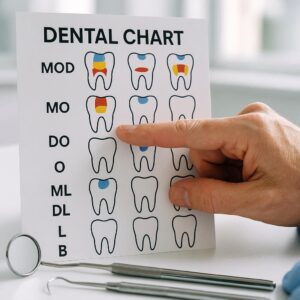
To truly understand the dental code for filling teeth, you must understand tooth surfaces. A dentist doesn’t just fill a “hole”; they fill a specific side of the tooth.
Here are the common abbreviations you will see on a treatment plan:
-
O (Occlusal): The chewing surface of the back teeth.
-
B (Buccal): The surface facing the cheek.
-
L (Lingual): The surface facing the tongue.
-
M (Mesial): The front surface, towards the midline of your mouth.
-
D (Distal): The back surface, away from the midline.
If a cavity is on the chewing surface and spreads to the side, the dentist might need to fill two surfaces (e.g., MO for Mesial-Occlusal or DO for Distal-Occlusal). If it wraps around the tooth, it might be MOD (Mesial-Occlusal-Distal).
Surface Code Cheat Sheet
| Surfaces Involved | Abbreviation | Likely Dental Code (Posterior Resin) | What It Means |
|---|---|---|---|
| One Surface | O, B, or L | D2391 | A small, simple cavity on one side. |
| Two Surfaces | MO or DO | D2392 | The cavity has spread to two areas. |
| Three Surfaces | MOD | D2393 | A larger filling that wraps around the tooth. |
| Four+ Surfaces | MODL or MODB | D2394 | A significant restoration, nearing the need for a crown. |
Why the Code Changes: From Filling to Crown
There is a common misconception that you can just keep “re-filling” a tooth forever. However, dental codes reflect the structural integrity of the tooth.
If a tooth is cracked, or if a filling is so large that it covers most of the tooth (like a D2394), the dentist might recommend a D2740 (Crown – porcelain/ceramic) or D2750 (Crown – porcelain fused to high noble metal).
The code changes because the procedure changes. A filling involves placing pliable material into a prepared cavity. A crown involves fabricating a cap that covers the entire tooth. Your insurance benefits often change at this threshold as well.
Comparison: Filling vs. Crown Codes
| Procedure | Code Range | Purpose | Longevity Expectancy |
|---|---|---|---|
| Amalgam Filling | D2140 – D2161 | Restore small to medium cavities in high-stress areas. | 10-15 years |
| Resin Filling | D2330 – D2394 | Restore cavities with aesthetic, bonded material. | 7-10 years |
| Inlay/Onlay | D2510 – D2664 | Indirect restoration for large cavities, preserving more tooth. | 15-20 years |
| Crown | D2710 – D2799 | Cap and protect a severely broken or decayed tooth. | 15-20+ years |
The Patient Experience: What to Expect During the Procedure
Now that you know the code, let’s look at what happens in the chair. Understanding the process helps reduce anxiety.
-
Diagnosis and Coding: The dentist examines your x-rays and teeth. They identify the cavity and note the surfaces. They tell the assistant the dental code for filling teeth (e.g., “We have a D2392 on tooth #19”).
-
Numbing (Anesthesia): The area is numbed to ensure you are comfortable.
-
Preparation: The dentist removes the decayed portion of the tooth. The shape of this preparation determines the surfaces involved.
-
Placement: For a resin filling, the tooth is etched and bonded, and the resin is placed in layers. For amalgam, the mixed material is packed into the preparation.
-
Shaping and Polishing: The filling is carved to match the natural anatomy of your tooth and polished to a smooth finish.
Dental Insurance and Your Filling Code
This is where things get tricky for most patients. Insurance companies use these codes to determine their “usual, customary, and reasonable” (UCR) fees.
-
The 50/80/100 Myth: Many people think all procedures are covered at a flat rate. In reality, preventive care (cleanings) is often covered at 100%, but fillings usually fall under “Basic Restorative Care,” often covered at 70-80% after your deductible is met.
-
Code Substitution: Occasionally, an insurance company might downcode a procedure. For example, if your dentist bills for a complex three-surface composite (D2393), the insurance might only pay for a two-surface amalgam (D2150) because it’s cheaper. You would then be responsible for the price difference. This is called the “alternate benefit” provision.
-
Frequency Limitations: Insurance typically will not pay to replace a filling just because it is old. There is usually a waiting period (often 2-5 years) before they will consider paying for a replacement of the same tooth using the same code. If a filling fails due to trauma or recurrent decay, a different code might be used to reflect the new diagnosis.
Decoding Your EOB: A Mini-Glossary
When you get your Explanation of Benefits (EOB) in the mail or online, look for these terms next to the code:
-
Amount Billed: What the dentist charges for the procedure (e.g., D2392).
-
Allowed Amount: The price your insurance company has negotiated with the dentist as the maximum payable.
-
Paid by Plan: What the insurance company paid the dentist.
-
Patient Responsibility: The difference you owe. This includes your deductible, co-insurance (your share of the allowed amount), and any balance if the dentist charges more than the allowed amount.
Frequently Asked Questions (FAQ)
Q: Why is the code for a front tooth filling often different from a back tooth filling?
A: Front teeth (anteriors) are primarily for cutting and aesthetics. The codes D2330-D2335 reflect the complexity of matching the tooth’s translucency and color. Back teeth (posteriors) endure heavy chewing forces, so the codes D2391-D2394 reflect the structural complexity and durability required.
Q: My dentist says I need a “D2950.” What is that? It’s not a filling.
A: A D2950 is a “core buildup.” This is not a standard filling. It is a procedure used to build up enough tooth structure to support a crown. If a tooth is broken down significantly, the dentist must rebuild the foundation before placing the crown. This is often an additional cost not included in the crown procedure.
Q: Does insurance cover the full cost of a white filling (resin)?
A: Most insurance plans will cover the cost equivalent to an amalgam filling. If you choose a resin filling on a back tooth (which is often more expensive than amalgam), you may have to pay the difference out-of-pocket. This is known as the “patient portion” or the upgrade fee.
Q: Can I ask my dentist for the codes before the work is done?
A: Absolutely. A reputable dental office will provide you with a treatment plan that includes the CDT codes, a description, and the fee before any work begins. This is your right as a patient and helps you check with your insurance beforehand.
Q: Is there a code for fixing a chipped tooth without a cavity?
A: Yes. If the tooth is chipped but has no decay, the dentist might perform a procedure coded as D6240 (Pontic) if it’s part of a bridge, but for a simple chip, it is often treated with composite bonding. This is usually billed under one of the resin codes (like D2330) depending on the location, or sometimes as D2990 (Resin Infiltration) or a similar code for enamel repair, though this is less common. It’s best to ask your dentist specifically how they code for aesthetic bonding.
Additional Resources
For the most authoritative information on dental codes, you should always refer to the source. While the full CDT manual is a paid publication, the ADA provides resources and updates regarding dental procedures.
-
Link: American Dental Association – CDT (Official source for code updates and guidelines)
Conclusion
Navigating dental codes doesn’t have to be a headache. Remember that the specific dental code for filling teeth is determined by the material used and the number of surfaces repaired. By understanding the difference between D2391 (one surface) and D2394 (four or more surfaces), you can better understand your dentist’s recommendations and your insurance benefits. Always ask for a detailed breakdown of codes before treatment begins to ensure clarity and avoid surprises.
Disclaimer: This article is for informational purposes only and does not constitute medical or financial advice. Dental codes and insurance policies vary by provider and region. Always consult with your dental professional and insurance carrier for specific information regarding your treatment and coverage.


