
If you’ve ever sat in the dental chair and felt a gentle stream of water aimed just below your gumline, you’ve experienced gingival irrigation. It is a therapeutic procedure designed to flush out bacteria, food debris, and toxins from the periodontal pockets.
But when the hygienist or dentist picks up the irrigation syringe, a question often arises at the front desk: How do we bill for this?
Unlike a routine cleaning or a fluoride treatment, gingival irrigation sits in a gray area of dental coding. There isn’t a flashy, standalone code specifically named “Gingival Irrigation” in the standard CDT (Current Dental Terminology) manual. However, that doesn’t mean you can’t—or shouldn’t—get reimbursed for it.
In this guide, we will explore the ins and outs of the dental code for gingival irrigation, how to document it correctly, and what you need to know to keep your practice compliant while ensuring patients get the best care.
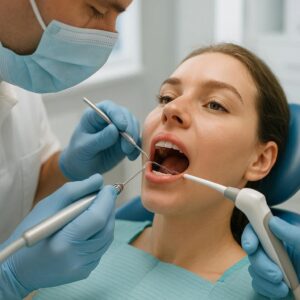
Dental Code for Gingival Irrigation
What is Gingival Irrigation? A Quick Refresher
Before diving into the complexities of billing, it’s important to understand the procedure itself. Gingival irrigation is the process of using a stream of liquid to wash below the gumline.
Therapeutic vs. Cosmetic Irrigation
It is vital to distinguish between the two main types of irrigation performed in a dental office:
-
Cosmetic Irrigation: This is usually a quick spray to remove loose debris from the mouth, often performed after polishing.
-
Therapeutic Subgingival Irrigation: This involves placing a blunt-tipped cannula or special tip slightly into the periodontal pocket to deliver antimicrobial agents (like chlorhexidine) or water to flush out bacteria. This is a targeted, clinical procedure aimed at reducing inflammation.
Important Note: For insurance purposes, we are concerned exclusively with therapeutic subgingival irrigation. This is the medical, rather than cosmetic, application of the service.
The Primary Dental Code for Gingival Irrigation: D4999
If you search the CDT manual for a specific code like “D4991” or “D4921” for irrigation, you will likely come up empty. The most accepted and commonly used code for this procedure is:
D4999 – Unspecified Periodontal Procedure, by Report
This is the “catch-all” code for periodontal services that do not have a specific, dedicated code.
Why D4999 is the Go-To Code
The American Dental Association (ADA) has not created a specific code for irrigation because it is often considered a component of Scaling and Root Planing (SRP) or Periodontal Maintenance. However, when irrigation is performed as a standalone therapeutic procedure—for example, during a supportive periodontal therapy visit where SRP is not indicated—D4999 becomes the appropriate choice.
When to Use D4999:
-
Standalone Therapy: A patient with a history of periodontitis comes in for a recall visit. They have localized areas of inflammation but do not require full scaling. You perform subgingival irrigation with an antimicrobial agent.
-
Adjunctive Therapy: You perform irrigation immediately following scaling and root planing to deliver medication subgingivally.
-
Focused Treatment: A patient presents with acute pericoronitis (infection around a wisdom tooth), and you irrigate the area to flush out debris and bacteria.
Decoding the “By Report” (BR) Requirement
Using D4999 isn’t as simple as typing in the code and hitting send. The “By Report” designation means you cannot just submit a number; you must provide documentation to justify the procedure.
What to Include in Your Report
To get this claim paid, your narrative must answer the “who, what, when, why, and how” of the procedure.
-
The Diagnosis (The “Why”): You must link the procedure to a diagnosis code. This is usually a periodontal code like:
-
K05.2: Aggressive periodontitis
-
K05.3: Chronic periodontitis
-
K05.4: Periodontosis
-
K05.5: Other periodontal diseases
-
-
The Clinical Narrative (The “What”): Describe exactly what you did.
-
Example: “Subgingival irrigation was performed in sites 3, 4, and 5 using a blunt-tip cannula and 0.12% chlorhexidine digluconate to reduce localized inflammation and pocket depth.”
-
-
Clinical Findings (The “Proof”): Include the periodontal charting. Show the pocket depths (e.g., 5mm, 6mm) and bleeding points. This proves medical necessity.
-
The Treatment Plan: Briefly explain why this was done. Example: “Procedure performed to disrupt subgingival biofilm and deliver antimicrobial agent to sites not requiring mechanical debridement at this time.”
Alternative Billing Scenarios
While D4999 is the primary code, there are situations where irrigation is “bundled” into another procedure.
Irrigation as Part of D4910 (Periodontal Maintenance)
Periodontal maintenance is the “gold standard” code for patients who have been treated for periodontitis. It is a multi-faceted procedure that includes:
-
Supragingiscal and subgingival scaling.
-
Polishing.
-
Subgingival irrigation.
-
Examination of periodontal tissues.
Because irrigation is considered an inherent part of maintaining a periodontally compromised patient, you cannot bill D4999 separately on the same day as D4910. The reimbursement for D4910 is meant to cover the irrigation.
Irrigation as Part of D4341/D4346 (Scaling and Root Planing)
Similarly, if you are performing scaling and root planing (SRP), any irrigation you do during that visit to flush the pockets is considered part of the SRP procedure. It is not a separate billable service.
| Scenario | Primary Code | Can you bill D4999 separately? |
|---|---|---|
| SRP visit with irrigation | D4341 / D4346 | No. Irrigation is inclusive. |
| Periodontal Maintenance | D4910 | No. Irrigation is inclusive. |
| Emergency visit for localized infection | D9110 (Palliative) | No. Usually bundled, though D4999 might be considered if extensive. |
| Standalone irrigation at a recall visit | D4999 | Yes. This is the correct use case. |
How to Document Gingival Irrigation
Proper documentation is your best friend when using an unspecified code. If you don’t write it down, it didn’t happen.
A Sample Chart Note
Here is a template you can adapt for your records:
Date: [Date of Service]
Procedure: D4999 – Unspecified Periodontal Procedure, by Report (Subgingival Irrigation)
Tooth/Sites: #14 (Distal and Mesial), #15 (Mesial)
Findings: 5-6mm pocket depths with bleeding on probing. Localized inflammation present. No significant calculus detected requiring scaling.
Procedure Details: Following supragingival debridement, a blunt irrigation tip was placed 2-3mm subgingivally. Sites were irrigated with [Name of Solution, e.g., 0.12% Chlorhexidine] until the return was clear.
Goal: Reduce bacterial load and inflammation at these sites to promote healing and prevent further attachment loss.
Next Visit: Reevaluate sites in 3 months.
Does Insurance Cover Gingival Irrigation?
This is the million-dollar question. Coverage is inconsistent.
The Reality of Reimbursement
-
Medical Necessity is Key: Insurance companies are more likely to pay if the documentation shows deep pockets, bleeding, and active disease.
-
Plan Limitations: Many dental PPOs view irrigation as a “comfort” or “preventive” service that is not covered. If the plan explicitly excludes “oral hygiene instruction” or “plaque control programs,” they may deny irrigation.
-
Patient Responsibility: It is crucial to have a strong financial agreement with the patient. Because D4999 can be unpredictable with insurance, you should inform the patient beforehand that the insurance may consider this a non-covered service.
Tips for Getting Paid
-
Use X-Rays: Reference radiographs in your narrative to support the presence of bone loss, justifying the need for subgingival therapy.
-
Appeal Denials: If denied, you can appeal with a letter stating, “Therapeutic subgingival irrigation is a proven method to deliver antimicrobial agents directly to the site of infection, which cannot be achieved by patient home care alone.”
Frequently Asked Questions (FAQ)
1. Is there a specific CDT code for gingival irrigation?
No, there is no single specific CDT code named “gingival irrigation.” The standard and most accurate code to use is D4999 (Unspecified Periodontal Procedure, by Report) , provided it is performed as a therapeutic, standalone procedure.
2. Can I bill for irrigation during a cleaning?
It depends on the type of cleaning. If it is a D1110 (prophylaxis) on a healthy patient, irrigation is not a standard of care and likely wouldn’t be billed separately. If it’s a D4910 (periodontal maintenance) on a gum disease patient, irrigation is included in the code and cannot be billed additionally.
3. Will my insurance pay for D4999?
Coverage varies widely. Insurance companies prefer to pay for procedures with dedicated codes. Since D4999 is “unspecified,” it often raises red flags. Payment is more likely if you provide exceptional documentation (pocket depths, bleeding, diagnosis) proving the service was medically necessary.
4. What is the difference between D4999 and D4921?
D4921 is the code for “Gingival Irrigation – Per Quadrant,” which was removed from the CDT code set years ago. It is no longer a valid code. If you see an old fee schedule referencing D4921, it should now be replaced with D4999.
5. Is water irrigation the same as chlorhexidine irrigation?
From a coding standpoint, the solution used doesn’t change the code. However, it changes the justification. Using a prescription antimicrobial like chlorhexidine provides stronger evidence of medical necessity compared to water, as it implies you are treating an active infection or inflammation.
Additional Resources
For the most up-to-date coding information and to verify code sets, always refer to the official source:
-
American Dental Association (ADA) CDT Code Book: Link to ADA Store
Conclusion
Navigating the dental code for gingival irrigation requires a clear understanding of CDT guidelines and insurance expectations. While no standalone code exists for this common procedure, D4999 serves as the appropriate vehicle when therapeutic irrigation is performed independently. Success hinges on thorough documentation and clear communication with patients regarding potential coverage.
Disclaimer
The information provided in this article is for general informational and educational purposes only and does not constitute legal, billing, or professional medical advice. Dental coding and reimbursement policies are complex and subject to change based on payer contracts, regional jurisdictions, and updates to the CDT manual. You should always consult with your billing specialist, insurance carrier, or a professional coding consultant to verify the accuracy and applicability of codes for your specific situation.


