
If you have recently been told by your dentist or periodontist that you need a gingivectomy, you might be feeling a little anxious. Not just about the procedure itself, but about what it means for your wallet. Dental insurance can feel like a foreign language, filled with numbers and jargon that seem designed to confuse.
One of the most important things you will encounter on your treatment plan is a five-digit “CDT code” (Current Dental Terminology). If your procedure is a gingivectomy, you will likely see one of three specific codes: D4210, D4211, or D4212.
This article is designed to be your friendly, reliable guide. We’ll strip away the complexity and walk through exactly what these codes mean, how they differ, what impacts your out-of-pocket costs, and how to talk to your insurance company with confidence. Think of this as your roadmap to understanding both the dental procedure and the paperwork that comes with it.
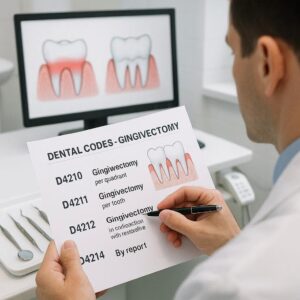
Dental Code for Gingivectomy
What is a Gingivectomy? (And Why You Might Need One)
Before we decode the numbers, let’s make sure we’re clear on the “what” and the “why.” A gingivectomy is a surgical procedure performed by a dentist or periodontist (a gum specialist) to remove and reshape diseased or excess gum tissue.
The word itself comes from “gingiva” (gum) and “ectomy” (removal). It’s not just a simple cleaning; it’s a reshaping of the gums to restore health and function.
You might need a gingivectomy for a few key reasons:
-
To Treat Periodontal Disease: This is the most common medical reason. When gum disease creates deep pockets between your teeth and gums, it becomes impossible to keep the area clean. Bacteria thrive in these pockets, leading to bone loss and tooth looseness. A gingivectomy removes the pocket wall, making the area easier to clean.
-
To Reshape Gummy Smiles: Sometimes, people have a “gummy smile” where an excessive amount of gum tissue covers their teeth. In these cases, a gingivectomy is often performed for cosmetic reasons to expose more of the natural tooth structure, creating a more balanced and aesthetically pleasing smile.
-
To Access Underlying Tooth Structure: If a tooth has decay that extends below the gum line, a gingivectomy might be needed to remove the gum tissue covering it, allowing the dentist to properly place a filling or crown.
It’s important to know that a gingivectomy is different from a gingivoplasty. While a gingivectomy is about removing tissue, a gingivoplasty is about reshaping it. Often, they are performed together.
The Importance of Accurate Dental Codes
Why do these little numbers matter so much? In the world of dentistry, the CDT code is the universal language for communication between your dentist’s office and your insurance company.
-
For Insurance: The code tells the insurance company exactly what procedure was performed. They use this information to determine if the service is covered under your plan and how much they will pay.
-
For Billing: The code is directly linked to the fee. Your dentist’s office bills the insurance company using these codes, and the insurance company calculates your benefits based on them.
-
For Your Record: These codes create a detailed history of the dental care you have received, which is valuable for future treatment planning.
Using the wrong code can lead to a denied claim, meaning you could be stuck with the entire bill. That’s why it’s helpful for you, as a patient, to have a basic understanding of what these codes represent.
The Three Main Dental Codes for Gingivectomy
When it comes to a gingivectomy, the specific code used depends heavily on two factors: the number of teeth involved and the reason for the procedure (specifically, if it’s related to gum disease or for other reasons). Let’s break down the big three.
D4210: Gingivectomy or Gingivoplasty – Four or More Contiguous Teeth or Tooth-Bounded Spaces
This is the code you will see most often for a medically necessary procedure.
-
What it means: D4210 is used when a gingivectomy (or gingivoplasty) is performed on a section of your mouth covering four or more teeth that are next to each other (contiguous). This could be an entire quadrant of your mouth.
-
When it’s used: It is typically used to eliminate periodontal pockets caused by moderate to severe gum disease. Because it involves a larger area, it’s considered a more involved surgical procedure.
-
The Procedure: The dentist will numb the area with a local anesthetic. They will then use a scalpel, a laser, or an electrosurgery device to carefully cut away and remove the diseased gum tissue. The goal is to eliminate the deep pockets and create a new, healthy gum line that is easier to keep clean. The area is then cleaned, and a periodontal pack (a soft, putty-like dressing) may be placed to protect the site while it heals.
D4211: Gingivectomy or Gingivoplasty – One to Three Contiguous Teeth or Tooth-Bounded Spaces
As you might have guessed, this code is for smaller, more localized procedures.
-
What it means: D4211 is used when the procedure is confined to a smaller area, specifically one, two, or three teeth that are next to each other.
-
When it’s used: This might be necessary if gum disease is localized to a specific spot in your mouth. For example, you might have a deep pocket around just two molars that isn’t responding to non-surgical treatments like scaling and root planing. It can also be used for cosmetic crown lengthening on a single tooth to prepare for a crown.
-
The Procedure: The process is virtually identical to D4210, but it’s performed on a smaller scale. The recovery and aftercare are very similar.
Here’s a quick comparison to make it crystal clear:
| Feature | D4210 | D4211 |
|---|---|---|
| Scope of Procedure | Larger | Smaller |
| Number of Teeth | 4 or more adjacent teeth | 1 to 3 adjacent teeth |
| Typical Reason | Widespread periodontal pockets | Localized pockets or single-tooth work |
| Complexity | More extensive surgery | Less extensive surgery |
D4212: Gingivectomy or Gingivoplasty to Allow Access for Restorative Procedure
This code is a bit different. It’s not primarily about treating gum disease. It’s about access.
-
What it means: D4212 is specifically used when gum tissue must be removed to allow a dentist to perform another procedure, usually a restorative one like placing a crown or a filling.
-
When it’s used: Imagine a tooth has a cavity that extends far below the gum line. To get a clean, dry field to place the filling or prepare the tooth for a crown, the dentist needs to see the whole area. They can’t just “bury” the restoration under the gum. So, they perform a small gingivectomy to expose the edge of the tooth.
-
Key Distinction: This code is often paid under the restorative portion of your insurance plan, not the periodontal (gum disease) portion. This is a critical distinction that can affect your coverage.
Important Note for Patients:
If you see D4212 on your treatment plan, it’s a good idea to ask your dentist: “Is this being done to access a cavity, or is it part of treating gum disease?” The answer will give you a big clue as to how your insurance might handle the claim.
A Note on Adjunctive Codes: Gingivoplasty (D4230 & D4231)
You may also hear the term “gingivoplasty,” which is the reshaping of healthy gum tissue. While a gingivoplasty is often performed during a gingivectomy, it can be billed separately in some cases, especially for cosmetic work.
-
D4230: Gingivoplasty – four or more contiguous teeth or tooth-bounded spaces.
-
D4231: Gingivoplasty – one to three contiguous teeth or tooth-bounded spaces.
If your procedure is purely cosmetic to fix a “gummy smile,” your dentist might use these codes. However, it is very common for the gingivectomy codes (D4210, D4211) to also cover the necessary reshaping.
How Dental Insurance Classifies Gingivectomy
Now for the part that directly impacts your finances. Dental insurance plans generally categorize procedures into three classes: Preventive, Basic, and Major.
A gingivectomy almost always falls under Periodontics, which is typically classified as a Major Service.
This classification has a huge impact on your coverage:
-
Deductible: You will likely have to meet your annual deductible first. For example, if your deductible is $100, you must pay that amount before your insurance starts to contribute.
-
Coinsurance: Instead of covering 100% (like for a cleaning), major services are usually covered at a lower percentage. A common plan design might cover 50% of the cost of a major service. So, if the procedure costs $1,000, the insurance pays $500, and you are responsible for the other $500.
-
Annual Maximum: Your payment is also subject to your plan’s annual maximum—the total dollar amount your insurance will pay in a year. If you’ve already used a portion of your benefits for other work, the amount left for your gingivectomy will be lower.
Medical vs. Dental Coverage: A Gray Area
Sometimes, a gingivectomy can cross over into medical necessity in a way that might (rarely) trigger medical insurance benefits.
-
Dental Insurance: Covers the procedure as a dental service.
-
Medical Insurance: Might provide some coverage if the gum disease is a direct result of, or is complicating, a medical condition. For example, severe infections related to gum disease, or for patients with certain autoimmune disorders or those undergoing treatments like chemotherapy or organ transplants that compromise the immune system.
This is the exception, not the rule. Your dental office would need to submit a predetermination to your medical insurer, and they would need a very strong case for medical necessity.
What Impacts the Cost of Your Gingivectomy?
Because the cost can vary so widely, it’s helpful to understand what goes into the final price tag. This knowledge will also help you ask better questions when you get your treatment plan.
-
Geographic Location: Dental fees are highly regional. A procedure in New York City will almost certainly cost more than one in a rural town in the Midwest.
-
Provider Type: A specialist, like a periodontist, will typically charge more than a general dentist. However, for more complex cases involving significant gum disease, seeing a specialist is often the recommended course of action.
-
Extent of the Procedure: As you saw with the codes, a D4210 on a full quadrant will cost more than a D4211 on a single tooth.
-
Technology Used: The method used can influence the cost.
-
Scalpel Surgery: The traditional method, often very effective and predictable.
-
Laser Gingivectomy: Lasers are becoming increasingly common. They can cauterize as they cut, which often results in less bleeding and faster healing times for the patient. This advanced technology can come with a higher fee.
-
Average Cost Ranges (Without Insurance)
To give you a realistic ballpark, here are typical out-of-pocket costs if you don’t have insurance. Please remember these are estimates and can vary.
-
D4212 (Access for Restoration): $200 – $400 per tooth.
-
D4211 (1-3 Teeth): $300 – $700 for the area.
-
D4210 (4+ Teeth): $600 – $1,500+ per quadrant.
If you are paying out-of-pocket, always ask your dentist’s office if they offer an in-house membership plan or a discount for paying in full at the time of service. Many do.
A Step-by-Step Walkthrough of Your Gingivectomy Procedure
Knowing what to expect can significantly reduce anxiety. Here is a general timeline of what a gingivectomy looks like.
Before the Procedure (The Consultation)
Your dentist or periodontist will perform a comprehensive exam. This will include:
-
Measuring periodontal pocket depths around each tooth.
-
Taking X-rays to check for bone loss.
-
Reviewing your medical history.
-
Discussing the procedure, the codes that will be used, and providing you with a financial estimate.
-
Pro Tip: This is the perfect time to ask if they will submit a predetermination to your insurance company. This gives you a written estimate of what your insurance will pay before you commit to the procedure.
The Day of the Procedure
-
Anesthesia: A local anesthetic will be administered to numb the area completely. You will be awake but should feel no pain, only pressure.
-
The Gingivectomy: The dentist will use their chosen instrument (scalpel, laser, etc.) to carefully remove the diseased or excess gum tissue. They will mark the new gum line to ensure a natural and functional result.
-
Cleaning and Debridement: The roots of your teeth will be thoroughly cleaned to remove any remaining bacteria and tartar.
-
Placement of Periodontal Pack (Optional): In some cases, a soft dressing is placed over the surgical site. This protects the area, aids in healing, and makes you more comfortable. It is usually removed in about a week.
After the Procedure (Recovery and Aftercare)
Your dentist will give you specific instructions. They will likely include:
-
Pain Management: Over-the-counter pain relievers like ibuprofen are often sufficient. Your dentist may prescribe something stronger if needed.
-
Diet: Stick to soft foods (yogurt, soup, smoothies) for a few days. Avoid anything crunchy, spicy, or too hot.
-
Oral Hygiene: You will need to be gentle. You may be instructed to rinse with a special antimicrobial mouthwash (like chlorhexidine) and to avoid brushing the surgical site directly for a few days.
-
Follow-up: You will have a follow-up appointment to check on healing and remove the periodontal pack if one was placed.
Tips for Talking to Your Dentist and Insurance Company
Feeling empowered in these conversations can make a huge difference.
-
Ask for a “Predetermination of Benefits.” Before the work is done, ask your dentist’s office to send a predetermination to your insurance. This isn’t a guarantee of payment, but it is a reliable estimate of how your plan will apply its benefits to these specific codes.
-
Clarify the “Why.” Don’t be shy about asking, “Is this procedure being done primarily to treat an active disease, or is it for cosmetic or access reasons?” This helps you understand which code (D4210 vs. D4212) is likely to be used.
-
Understand Your Plan’s Limitations. Take a few minutes to read your insurance summary. Look for the waiting periods for periodontal services. Many plans have a 6 to 12-month waiting period for major services like a gingivectomy before they will provide any coverage.
-
Inquire About Payment Plans. If your out-of-pocket cost is higher than expected, ask the dental office if they offer third-party financing (like CareCredit) or an in-house payment plan. This can help you manage the cost over time.
Additional Resources
For the most authoritative and up-to-date information on dental procedures and codes, the American Dental Association (ADA) is the definitive source.
Frequently Asked Questions (FAQ)
1. Is a gingivectomy considered a major dental service?
Yes, in almost all dental insurance plans, a gingivectomy falls under periodontics, which is classified as a major service. This means your coverage percentage is typically lower (e.g., 50%) than it would be for a basic or preventive service.
2. What is the difference between D4210 and D4211?
The difference is purely based on the size of the area being treated. D4210 is used for four or more adjacent teeth, while D4211 is used for one to three adjacent teeth. The procedure itself is the same.
3. Can a gingivectomy be covered by medical insurance?
It is uncommon, but possible in specific situations where the gum disease is directly related to, or complicating, a systemic medical condition. Your dentist would need to coordinate with your medical doctor and submit a detailed claim.
4. Is a gingivectomy painful?
The procedure itself is not painful due to the local anesthetic. After the anesthesia wears off, you can expect some soreness and discomfort, which is usually well-managed with over-the-counter pain medication. Your dentist will provide you with detailed post-op care instructions.
5. How long does it take to recover from a gingivectomy?
Initial healing of the gum tissue typically takes about one to two weeks. The area may be sensitive during this time. Complete healing and the maturing of the new gum contours can take several months.
6. What does “contiguous teeth” mean?
It simply means teeth that are next to each other, with no gaps. For example, four teeth in a row in the same part of your mouth are contiguous.
7. Will my insurance cover a gingivectomy for a “gummy smile”?
This is tricky. Most standard dental insurance plans are designed to treat disease, not for cosmetic enhancements. If the procedure is purely for aesthetic reasons (a gingivoplasty), it is often considered a cosmetic procedure and may not be covered at all. If it is being done to treat disease in that area, it’s more likely to be covered.
Disclaimer: This article is for informational purposes only and does not constitute medical or legal advice. Dental procedures, coding, and insurance coverage vary widely. You should always consult with your qualified dentist or dental specialist for advice regarding your specific condition and with your insurance provider for details about your specific plan.
Author: Professional English-Speaking Web Writer
Date: March 13, 2026


