
If you have recently been told that you grind your teeth at night (a condition known as bruxism), your dentist has likely recommended a night guard. Specifically, a hard night guard is often the gold standard for protecting your teeth from the significant forces of clenching and grinding.
However, when you hear the words “insurance,” “billing,” and “codes” thrown around, the conversation can quickly shift from healthcare to confusion. You might be wondering: What is the actual dental code for a hard night guard? Will my insurance cover it? Why is the price so variable?
This guide is designed to demystify the process. We will explore the nitty-gritty of dental coding for occlusal guards, what you can expect to pay, and how to navigate your insurance benefits like a pro. Our goal is to provide you with a realistic, honest, and comprehensive understanding so you can make informed decisions about your oral health.
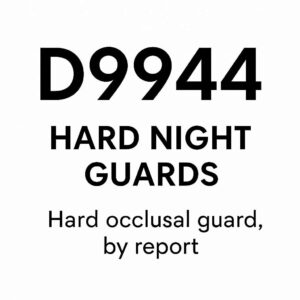
Dental Code for Hard Night Guards
What Is a Hard Night Guard? Understanding the Appliance
Before diving into the numerical codes, it is vital to understand the appliance itself. A night guard (also called an occlusal guard or bite splint) is a removable dental appliance worn typically on the upper arch of teeth, though sometimes on the lower. Its primary job is to create a barrier between your upper and lower teeth, preventing them from grinding against each other.
Hard night guards are typically made from a firm acrylic material. They are different from soft or dual-laminate guards:
-
Hard Night Guards: Durable, long-lasting, and ideal for moderate to severe grinding. They provide a smooth, rigid surface that allows the jaw to glide without catching, preventing muscle tension.
-
Soft Night Guards: Often boil-and-bite types. While comfortable, they can actually encourage clenching in some people because the soft material gives the brain a signal to chew.
-
Dual-Laminate Guards: Featuring a soft inner layer for comfort and a hard outer layer for durability, these are a middle-ground option.
For this article, we are focusing on the professionally made, custom-fitted hard acrylic night guard fabricated by a dental laboratory based on impressions taken by your dentist.
The Main Event: The Dental Code for Hard Night Guard
In the world of dental billing, specificity is everything. There is not just one “night guard code.” Instead, there are specific codes that describe the type of appliance and the service provided. The primary code you are looking for falls under the category of Occlusal Guards.
The standard dental code (CDT Code) for a hard night guard is:
D9944 – Occlusal Guard – Hard Appliance, Full Arch
This is the code you will see on most treatment plans for a custom, hard acrylic night guard that covers all the teeth on either the upper or lower arch.
-
D (Diagnostic): The letter prefix indicates the service is diagnostic or involves the mouth.
-
9944: The specific numerical sequence designates a full-arch, hard occlusal appliance.
It is important to differentiate this from other related codes:
| CDT Code | Description | Typical Use Case |
|---|---|---|
| D9944 | Occlusal Guard – Hard appliance, Full Arch | The standard custom hard night guard for bruxism. |
| D9945 | Occlusal Guard – Soft appliance, Full Arch | A custom soft guard, often used for patients with mild grinding or TMJ disorders where a softer material is indicated. |
| D9946 | Occlusal Guard – Hard appliance, Partial Arch | Less common. Used when the guard only covers a section of the teeth, often for specific orthodontic reasons or localized protection. |
| D9947 | Occlusal Guard – Soft appliance, Partial Arch | The soft version of a partial guard. |
| D9948 | Adjustment of Occlusal Guard | Used if you need to return to the dentist to have the guard adjusted for fit or comfort after the initial placement. |
| D9949 | Repair of Occlusal Guard | If your guard breaks (cracks or chips), this code is used for the repair by the dental lab. |
Important Note for Readers: Always confirm with your dental office which specific code they are using. While D9944 is the standard for a hard, full-arch guard, your specific case might require a different appliance.
The Procedure: What Does the Code Cover?
When your dentist presents a treatment plan with the code D9944, it is not just paying for a piece of plastic. The fee covers a multi-step professional service that ensures the guard fits perfectly and functions correctly.
Step 1: Examination and Diagnosis
Before any appliance is made, the dentist must diagnose the reason for your grinding. This involves checking for:
-
Wear facets on your teeth (flat, worn spots).
-
Jaw muscle tenderness.
-
Signs of Temporomandibular Joint (TMJ) disorders.
-
Gum recession caused by the stress of grinding.
Step 2: Impressions or Digital Scan
The dentist will take a precise impression of your teeth using dental putty or, in modern offices, a digital intraoral scanner (like an iTero or 3Shape scanner). This creates a highly accurate 3D model of your mouth. The code D9944 inherently includes the expertise and materials needed to capture this data.
Step 3: Laboratory Fabrication
The impression or digital file is sent to a professional dental laboratory. Here, skilled technicians pour a stone model and use it to create the hard acrylic guard. They carefully map out the bite to ensure even contact and proper jaw positioning. This is the most time-intensive and skilled part of the process, which is reflected in the overall cost.
Step 4: Fitting and Adjustments (Delivery)
When the guard returns from the lab, you will have a “delivery” appointment. The dentist will place the guard in your mouth, check the fit, and make any necessary adjustments.
-
Pressure Points: They will mark areas where the guard might be too tight and trim them down.
-
Bite Adjustment: They will use articulating paper to see where your teeth hit the guard and adjust the acrylic to ensure a harmonious bite. This step is crucial; a poorly adjusted guard can actually worsen jaw pain.
Step 5: Follow-up Care
While not always included in the initial fee, good practices include a follow-up visit to ensure the guard is comfortable and effective. Adjustments later on (coded as D9948) may incur a separate, smaller fee.
The Financial Reality: Cost, Insurance, and Out-of-Pocket Expenses
Let’s be realistic: dental care is an investment. The cost associated with code D9944 can vary significantly based on geography, the dentist’s expertise, and the lab used.
Average Price Ranges
-
Without Insurance: A custom hard night guard (D9944) typically ranges from $300 to $1,000 per arch. In major metropolitan areas, the cost can be even higher.
-
With Insurance: Your out-of-pocket cost depends entirely on your plan.
How Dental Insurance Typically Treats D9944
Most dental insurance plans do not cover night guards at 100% like they would a routine cleaning. Here is the breakdown:
-
Major vs. Basic Restorative: Night guards are almost always classified as “Major Restorative” care, similar to crowns and bridges. This means they have a lower coverage percentage.
-
Coverage Percentage: A typical plan might cover 50% of the allowed amount for a night guard after you have met your annual deductible.
-
Annual Maximum: This is a critical number. Most plans have an annual maximum benefit (often $1,000 to $2,000). Since a night guard can take a big chunk out of that, you need to budget for any other major work you might need in the same year.
-
Frequency Limitations: Insurance companies know you don’t need a new guard every year. Most plans will only cover a new night guard (D9944) once every 3, 5, or even 10 years. If you lose or break yours before that time limit, replacement is often an out-of-pocket expense.
Example Scenario
-
Your Plan: 50% coverage for D9944, $100 deductible, $1,500 annual maximum.
-
Your Dentist’s Fee: $800 for the hard night guard.
-
Insurance Allowed Amount: Your insurance has a contracted rate with the dentist. Let’s say they allow $700.
-
Calculation:
-
Insurance allows $700.
-
Subtract your deductible: $700 – $100 = $600.
-
Insurance pays 50% of $600 = $300.
-
You pay: $800 (dentist fee) – $300 (insurance payment) = $500.
-
Pro-Tip: Before proceeding with treatment, ask the dental office to perform a “courtesy insurance check.” They will contact your insurance company to verify your benefits for code D9944 and give you a written estimate of your out-of-pocket cost.
Why Choose a Custom Hard Guard? The Value Proposition
With the rise of online retailers and pharmacy “boil-and-bite” kits, you might wonder why the professional code D9944 commands a higher price. This is where honesty and realism are key.
The Custom Fit Advantage
A generic guard is made from a standard mold. It rocks back and forth, can be bulky, and often falls out at night. A custom guard made under D9944 is precisely contoured to every curve and crevice of your teeth.
-
Retention: It snaps into place securely.
-
Comfort: It is thinner and more refined because it is designed for your mouth, not an average one.
Material Quality and Longevity
Professional labs use medical-grade, high-impact acrylic. It is polished to a smooth finish that is comfortable for your tongue and lips and resists wear from grinding.
-
Durability: A custom hard guard can last 5-10 years with proper care.
-
Safety: Cheap materials can contain BPA or other harmful plastics. Dental-grade materials are biocompatible and safe for long-term use.
Therapeutic Bite
This is the most crucial difference. Over-the-counter guards simply provide a barrier. A dentist fabricating a guard under code D9944 designs the biting surface.
-
Disclusion: They create what is called “mutually protected occlusion.” This means that when you grind, only your front teeth touch the guard, instantly relaxing the powerful jaw muscles that close your mouth. This protects your back teeth from the destructive forces of clenching. A boil-and-bite guard cannot achieve this therapeutic effect.
How to Navigate Your Dental Benefits for a Night Guard
Understanding the code is half the battle. The other half is talking to the right people. Here is a simple checklist to follow:
-
Call Your Insurance Company: Ask specific questions.
-
“What is my coverage percentage for CDT code D9944?”
-
“Have I met my deductible for this year?”
-
“What is my remaining annual maximum?”
-
“Is there a frequency limitation for this code? How often will you cover a new one?”
-
-
Talk to Your Dentist’s Financial Coordinator: They are experts in this. Provide them with your insurance information and ask them to run a “predetermination of benefits.” This is a formal request sent to the insurance company that returns a written guarantee of what they will pay.
-
Ask About Payment Plans: If your out-of-pocket cost is higher than expected, many dental offices offer third-party financing (like CareCredit) or in-house payment plans to spread the cost over several months.
Caring for Your Investment: Maintenance Tips
Once you have your custom hard guard, you want it to last. Proper care is essential.
-
Daily Cleaning: Brush your guard every morning with a soft toothbrush and non-abrasive toothpaste or plain soap. Do not use hot water, as it can warp the acrylic.
-
Storage: When not in use, keep it in a sturdy, ventilated case. This protects it from pets (dogs love chewing them!), drops, and dust.
-
Deep Cleaning: Once a week, you can soak it in a denture cleaner or a specialized night guard cleaning tablet to kill bacteria and keep it fresh.
-
Regular Check-ups: Bring your guard to every dental check-up. The dentist can assess it for wear and tear and professionally clean it.
Frequently Asked Questions (FAQ)
Q: Is the dental code D9944 the same for upper and lower guards?
A: Yes. The code D9944 specifies a “Full Arch” appliance. Whether it is made for the upper or lower teeth, the code is the same. The lab prescription will indicate the arch.
Q: My dentist is recommending a night guard for TMJ, not just grinding. Is D9944 still the right code?
A: Possibly. While D9944 is the code for a hard guard, some TMJ therapies require a different type of splint (like an anterior positioning device or a distraction splint) which have different codes. Discuss the specific goal of your treatment with your dentist.
Q: Can I use my FSA or HSA dollars to pay for a hard night guard?
A: In almost all cases, yes. Since a night guard is a medical treatment for a diagnosed condition (bruxism), it is considered a qualified medical expense. You can use your Flexible Spending Account (FSA) or Health Savings Account (HSA) funds to pay for your out-of-pocket costs. Keep your receipt and the treatment plan from your dentist for your records.
Q: What happens if my insurance denies coverage for D9944?
A: Denials happen. First, find out why. It could be due to the frequency limitation (you had one too recently). If it’s denied as “not a covered benefit,” you can ask your dentist to write a letter of medical necessity explaining the damage caused by your grinding and why the guard is essential to prevent further destruction of your teeth.
Q: Is it worth buying a cheap online guard instead?
A: For mild grinding or if cost is an insurmountable barrier, an OTC guard is better than nothing. However, for moderate to severe bruxism, a custom guard (D9944) is a superior investment. It is more comfortable, lasts longer, and provides a therapeutic bite that protects not just your teeth, but your jaw joints and muscles. It is an investment in long-term health.
Conclusion
Navigating the world of dental codes doesn’t have to be a mystery. The specific dental code for a hard night guard is D9944, and it represents a sophisticated, multi-step process designed to protect your teeth from the damaging effects of bruxism. While the upfront cost can seem significant, understanding your insurance benefits, asking the right questions, and recognizing the value of a custom-fitted, therapeutic appliance will ensure you make the best decision for your oral health and your wallet.
Additional Resource
For a deeper dive into the symptoms and long-term effects of teeth grinding, the American Academy of Oral Medicine provides an excellent patient resource.
[Link: https://www.aaom.com/index.php?option=com_content&view=article&id=141:bruxism&catid=22:patient-condition-information&Itemid=120] (Example link – Replace with a relevant, authoritative .org or .gov link if needed)
Disclaimer: This article is for informational purposes only and does not constitute medical or financial advice. Dental codes, insurance policies, and coverage benefits vary by provider and individual plan. You should always consult with a qualified dental professional and your insurance provider regarding your specific diagnosis, treatment options, and financial responsibilities.
Author: AI Web Content Specialist
Date: March 15, 2026


