
If you’ve ever looked at a dental implant treatment plan and wondered about the line items for tiny screw-like parts, you are not alone. For patients, these terms sound like engineering jargon. For dental professionals, they represent a critical—and sometimes confusing—part of the billing process.
When it comes to the restoration phase of dental implants, one of the most common questions we receive is: “What is the correct dental code for a healing abutment?”
The answer isn’t always as straightforward as we would like it to be. Unlike a simple filling, implant dentistry involves components, each with its own specific Current Dental Terminology (CDT) code. Using the wrong code can mean the difference between a paid claim and a denied one.
This guide is designed to walk you through everything you need to know about billing for healing abutments. We will cover the specific codes, the difference between healing abutments and other components, and practical tips to ensure your claims are processed smoothly.
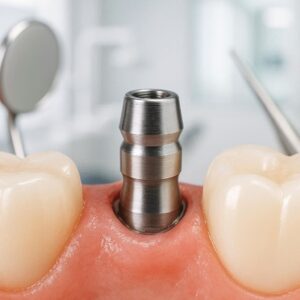
Dental Code for Healing Abutment
What Is a Healing Abutment? A Quick Primer
Before we dive into the numbers, let’s make sure we are all talking about the same thing. In the world of dental implants, precision is everything.
A healing abutment—sometimes called a healing cuff or gingival former—is a small, usually cylindrical component that is placed into the dental implant fixture after the implant has been surgically placed. Its purpose is purely biological.
Think of it as a place holder. After the implant (the artificial root) is placed deep in the bone, the gum tissue needs to heal in a specific way. If you simply covered the implant up, the gum would grow over it. The healing abutment protrudes through the gum line, guiding the soft tissue (gums) to heal in a nice, round, uniform shape. This creates a smooth tunnel from the gum surface down to the implant, making it easier for the dentist to place the final crown later.
Key takeaway: It is a temporary device used during the healing phase to shape the gums. It is not the final abutment that holds the crown.
The Primary Dental Codes for Healing Abutments
In the world of CDT coding, there are two main codes you will encounter regarding abutments. The code you use depends entirely on who is providing the part and what type of part it is.
D6056: Prefabricated Abutment – Includes Modification and Placement
This is the most common code you will see associated with the final restoration, but it is often mistakenly used for healing abutments. Code D6056 is designated for a prefabricated abutment.
-
What it is: A stock abutment made in a factory. It is manufactured in standard sizes and shapes (e.g., 4mm, 5mm height). The dentist may need to modify it by cutting or grinding it to fit the patient’s specific anatomy.
-
What it includes: The code covers the component itself, any necessary modifications by the dentist or lab, and the placement of the abutment onto the implant.
-
When to use it: Use this code for the final abutment that will support the crown. This is a permanent or semi-permanent part of the restoration.
Is this a healing abutment? Generally, no. While a healing abutment is technically “prefabricated,” it is not the load-bearing structure for the final crown. Using D6056 for a healing abutment is a red flag for insurance auditors because it implies you are placing the final restoration hardware, which contradicts the fact that the site is still in the healing phase.
D6057: Custom Abutment – Includes Placement
Code D6057 is used for an abutment that is specifically designed and fabricated for the patient.
-
What it is: An abutment created by a dental lab based on an impression of the implant site. It is designed to account for the specific angle, depth, and soft tissue profile of the patient’s mouth.
-
What it includes: The fabrication by the lab and the placement by the dentist.
-
When to use it: Use this for the final abutment when the angle of the implant requires a custom solution to ensure the crown sits correctly.
D6010: Surgical Placement of Implant Body
To understand the healing abutment billing lifecycle, you need to understand where the abutment fits in the surgical procedure.
Code D6010 covers the surgical placement of the implant body (the screw that goes into the bone). In many modern surgical protocols, the healing abutment is placed immediately after the implant body is placed. So, how is that billed?
Historically, the placement of the healing abutment was considered part and parcel of the surgical placement (D6010). The thought process was: you can’t just leave the implant open; you have to put something there to help the tissue heal. Therefore, the service of placing the healing abutment is included in the surgical fee.
The Grey Area: Does a Healing Abutment Have Its Own Code?
This is the million-dollar question. If you look through the current CDT manual, you will not find a specific line code that says “Healing Abutment.”
So, what code do you use for the healing abutment itself?
The answer depends on the context of the claim and the insurance carrier’s specific policies. However, the most common industry practice falls into two categories:
1. Inclusive to the Surgical Fee (D6010)
For the vast majority of claims, the placement of the healing abutment at the time of surgery is not billed separately. The fee for D6010 (Surgical Placement) is expected to cover:
-
The incision.
-
Preparing the site.
-
Placing the implant body.
-
Placing the cover screw or healing abutment.
-
Suturing.
If the dentist places the implant and immediately screws on the healing abutment, they should not bill a separate code for that act. The cost of the physical healing abutment component is usually factored into the overall surgical fee or billed to the patient as a separate lab/part cost, but not as a CDT insurance code.
2. The “Parts” Breakdown (Patient Responsibility)
Because insurance companies often balk at paying for “temporary” components, many dental offices choose to handle the healing abutment as a direct patient cost. On a treatment plan, you might see it itemized, but it is usually listed without a CDT code, simply described as “Implant Healing Cap/Abutment” with a fee.
However, if you must submit a code to an insurance plan for a healing abutment that is placed after the initial surgery (for example, if the implant was placed submerged under the gum and you are now doing a second-stage surgery to expose it and attach the healing abutment), you need to be careful.
In this specific scenario (second-stage surgery), many dentists and billing experts turn to D6055.
D6055: Connecting Bar or Abutment
Code D6055 is officially titled “Connecting bar—includes and abutments.” It is a tricky code because it was originally designed for bars that splint implants together for overdentures.
However, in the absence of a specific code, D6055 has become a commonly used (though debated) code for the placement of healing abutments during a second-stage uncovering procedure. If the patient had the implant placed, it was buried under the gum, and now months later you are exposing it and attaching the healing abutment, you are performing a service that requires anesthesia, incision, and component placement.
In this case, billing D6055 for the service of placing the healing abutment (and sometimes for the component itself, depending on the payer) is a recognized workaround, though you should always verify with the specific insurance carrier first.
Dental Code for Healing Abutment: At-a-Glance Comparison
To make this easier to digest, here is a simple breakdown of how these codes interact with the concept of the healing abutment.
| CDT Code | Description | Is this a Healing Abutment? | Typical Use Case |
|---|---|---|---|
| D6010 | Surgical Placement of Implant Body | No (Service) | The surgery to place the implant. The act of placing a healing abutment at this time is included in this fee. |
| D6056 | Prefabricated Abutment | No (Component) | The final stock abutment that holds the crown. Too permanent for the healing phase. |
| D6057 | Custom Abutment | No (Component) | The final lab-made abutment. Too permanent for the healing phase. |
| D6055 | Connecting Bar/Abutment | Sometimes (Service) | Often used as a surrogate code for the service of placing a healing abutment during a second-stage uncovering procedure. |
| No Code | Healing Abutment Component | Yes (Component) | The physical part is usually a pass-through expense (lab bill) billed directly to the patient, not as a reimbursable CDT code. |
Common Billing Scenarios and How to Handle Them
Let’s look at three realistic scenarios to see how these rules apply in practice.
Scenario 1: Single-Stage Surgery
-
Procedure: The dentist places the implant and immediately places a healing abutment on top. The gum is sutured around the abutment, not over it.
-
Billing: The office bills D6010 (Surgical Placement). The fee for D6010 should cover the entire procedure, including the placement of the abutment. The healing abutment itself is considered a part of the surgical supply cost. It is not billed to insurance as a separate line item.
Scenario 2: Two-Stage Surgery (Submerged Healing)
-
Procedure: The dentist places the implant and places a cover screw (a flat, low-profile cap) over the top. The gum is sutured closed over the implant to heal completely buried. Three months later, the patient returns. The dentist makes a small incision, removes the cover screw, and attaches a healing abutment to allow the gum to heal and shape itself for the future crown.
-
Billing:
-
First visit: D6010 (Surgical Placement).
-
Second visit: This is the tricky part. Many offices will bill D6055 for the uncovering and placement of the healing abutment. Others may bill a limited oral evaluation (D0140) along with a patient-level charge for the abutment part. You must check the patient’s plan, as some consider this second surgery included in the global surgical fee.
-
Scenario 3: The Abutment Swap
-
Procedure: The patient has been healing with a healing abutment for 6-8 weeks. The gums look healthy and shaped perfectly. The dentist removes the healing abutment, takes an impression of the implant, and places a new, sterile healing abutment or a temporary abutment/crown back in while the lab makes the final parts.
-
Billing: This is generally considered part of the restorative phase. The removal of the healing abutment is not billed. The placement of the temporary (if used for an extended period) may be billed under D6070 (Abutment Supported Crown – Provisional). The impression is billed under the final crown procedure (D6058-D6065).
Important Note for Readers: Insurance coding is not a perfect science. The information provided here reflects standard industry practices, but every insurance company interprets codes slightly differently. Always refer to the most current CDT manual published by the ADA and verify coverage with the patient’s specific insurance provider before proceeding with treatment.
Preventing Claim Denials: Best Practices for Abutment Billing
To ensure your claims get paid and your patients understand their bills, follow these best practices:
-
Master the Implant Timeline: The biggest mistake is billing incorrectly because you mislabeled the phase of treatment. Is this the surgical phase or the restorative phase? A healing abutment exists at the intersection of both. If it’s placed during surgery, it’s surgical. If it’s placed later to prep for the crown, it’s restorative.
-
Use Clear Descriptions in Narratives: When submitting a claim for a procedure involving a healing abutment (especially if using D6055), include a clear narrative.
-
Good: “Patient presented for stage-two implant uncovering. Cover screw removed from site #19. Healing abutment placed to contour tissue. Site healing well.”
-
Bad: “Placed abutment.” (Too vague).
-
-
Separate Parts from Services: Be transparent about the cost of the physical healing abutment. If your lab bill for the part is $75, and you charge the patient $100 for it, make sure it’s listed clearly on the patient estimate, even if it’s not going to insurance. This avoids confusion when the insurance explanation of benefits (EOB) doesn’t mention it.
-
Know Your PPO Contracts: Some dental PPOs have global fees for implant procedures. This means they bundle the surgery, the abutment placement, and sometimes even the crown into one total fee. Billing separately for a healing abutment placement in this context would be a contract violation.
The Financial Perspective: Why This Matters to Patients
For patients reading this, understanding these codes helps you decipher your treatment plan. If you see a charge for a “healing abutment” or “gingival former,” understand that this is a necessary medical device.
-
Is it covered? Most dental insurance plans consider healing abutments a component of the implant procedure. If your plan covers implants, the cost of the abutment (both healing and final) is usually baked into the overall coverage allowance. If your plan does not cover implants, you will likely be responsible for 100% of the cost of the healing abutment, just as you would be for the implant itself.
-
Why does it cost money? Even though it’s “temporary,” it is a precision-machined piece of medical-grade titanium or PEEK (plastic) polymer. It must fit the specific brand of your implant with microscopic accuracy to ensure proper healing and future restoration.
Conclusion
Finding the specific “dental code for healing abutment” can feel like a treasure hunt without a map. The reality is that there is no single, universal CDT code for the healing abutment component itself. Instead, billing for this procedure depends entirely on timing. When placed during initial surgery, it is included in the surgical placement code (D6010). When placed during a second-stage uncovering, it is often represented by a supporting code like D6055, supported by a strong clinical narrative. Ultimately, successful billing relies on understanding the service being performed, not just the part being used.
Frequently Asked Questions (FAQ)
1. What is the difference between a healing abutment and a cover screw?
A cover screw is a low-profile, flat cap placed over an implant to keep it sealed if the gum is going to be stitched closed over it. A healing abutment is a taller, cylinder-shaped component that extends through the gum line to shape the soft tissue for the future crown.
2. Can I bill D6056 for a healing abutment?
No, this is not recommended. D6056 is specifically for a prefabricated final abutment designed to support a crown. Using it for a healing abutment misrepresents the stage of treatment and can lead to insurance audits and claim denials.
3. My dentist placed the healing abutment at the same time as the implant. Why is it a separate charge on my bill?
While the service of placing it is included in the surgical fee, the physical part (the abutment itself) costs the dentist money. Many offices itemize this on the patient portion of the bill as a “parts” or “lab” fee, separate from the insurance claim for the surgery.
4. Is a healing abutment permanent?
No, it is temporary. It stays in place for several weeks or months while the gums heal. Once the tissue is stable and shaped correctly, the dentist removes it to take impressions and places the final abutment and crown.
5. What happens if my healing abutment falls out?
Contact your dentist immediately. This is not an emergency, but it needs to be addressed quickly. If the abutment falls out, the gum tissue can begin to close over the implant site. The dentist will need to replace it to maintain the proper tissue shape.
Additional Resource
For the most accurate and up-to-date information, always refer to the source of all CDT codes. You can access the latest code set and guidelines through the American Dental Association.
Visit the American Dental Association (ADA) CDT Store
Disclaimer: This article is for informational purposes only and does not constitute legal or billing advice. Dental coding regulations are subject to change and vary by payer. You should always consult with your billing software provider, coding consultant, or the specific insurance carrier to verify coverage and correct coding practices before submitting a claim.


