
Navigating the world of dental insurance and procedural codes can sometimes feel like learning a foreign language. If your dentist has recommended a procedure to save a part of a damaged molar, you might have heard the term “hemisection.” While the name sounds complex, the concept is a clever way to preserve your natural tooth structure.
But when it comes to understanding the paperwork, the billing, and what your insurance will cover, everything hinges on one specific identifier: the dental code for hemisection.
This guide is designed to be your friendly, reliable roadmap. We’ll break down exactly what this code means, what the procedure entails, why it’s used, and—most importantly—what it means for your wallet and your oral health. Whether you’re a patient trying to understand a treatment plan or a student looking for clarity, you’re in the right place.
Dental Code for Hemisection
What is a Hemisection? (And Why It Needs a Specific Code)
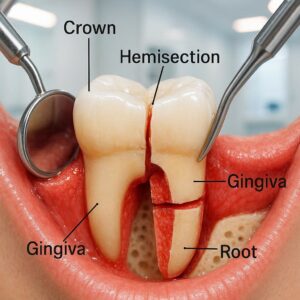
Before we dive into the numbers, let’s understand the “what” and the “why.” Imagine a molar in the back of your mouth. Unlike your front teeth, which usually have a single root, lower molars typically have two roots, and upper molars have three. A hemisection is a surgical procedure performed exclusively on mandibular (lower) molars.
Think of it as a precise, surgical separation. In a hemisection, the tooth is literally cut in half. The surgeon removes the diseased or damaged root and its corresponding portion of the crown (the part of the tooth you see). The healthy root and the remaining crown portion are left in place to be restored, often with a crown.
So, why wouldn’t your dentist just pull the whole tooth? The goal is preservation. Keeping part of your natural tooth maintains the bone structure and prevents the need for a more extensive (and often more expensive) restoration like a dental bridge or an implant.
Important Note: A hemisection is a procedure of last resort. It is only considered when the damage or infection is confined to one specific root of a multi-rooted tooth, and the remaining root structure is healthy and strong enough to support a restoration.
Because this is a distinct and complex surgical procedure, it has its own unique code in the Current Dental Terminology (CDT), which is the standard set of codes used for dental claims in the United States. This brings us to the star of the show.
The Specific Dental Code for Hemisection: D3920
When you look at a dental treatment plan or an insurance claim form (the ADA 2020 claim form), you won’t see the words “hemisection.” Instead, you will see a five-character alphanumeric code. The specific, official dental code for hemisection is D3920.
Let’s write that out clearly:
-
Code: D3920
-
Official Descriptor: “Hemisection (including any root removal), not including root canal therapy.”
This descriptor is critical. It tells the insurance company exactly what was done: the surgical splitting of the tooth and the removal of one root. It also explicitly states what is not included, which is the root canal therapy.
Breaking Down the Code Descriptor
To be a truly informed patient, it’s helpful to understand the nuances of this description.
-
“Hemisection”: This is the primary procedure. It signifies the surgical division of the multi-rooted tooth.
-
“(including any root removal)”: This clarifies that the removal of the compromised root is part of the procedure. You don’t need a separate code for the extraction of that root.
-
“not including root canal therapy”: This is the most important part for billing. Before a tooth can be hemisected, the root that is staying needs to be healthy. This usually requires a root canal (endodontic therapy) on that remaining root. Because the code explicitly states it’s not included, the root canal treatment must be billed separately.
So, if your dentist performs a hemisection, your treatment plan will likely include at least two codes:
-
D3920 for the hemisection surgery itself.
-
D3330 or a similar code for the root canal therapy on the remaining root.
How D3920 Fits into the CDT Category
The CDT codes are organized into categories of service. Understanding where D3920 lives can give you insight into how insurance companies view it. D3920 falls under the category of “Surgical Services” (D3000-D3999) . This distinguishes it from a simple extraction (which is in the D7000 series) or a basic restorative procedure (like a filling). It is, first and foremost, an oral surgery.
The Step-by-Step Procedure Behind the Code
Knowing what physically happens during a hemisection helps justify the use of code D3920 and its associated costs. It’s not a simple procedure; it requires significant skill and precision.
-
Diagnosis and Planning: This begins with X-rays (often a 3D CBCT scan) to confirm that one root is non-restorable due to decay, fracture, or bone loss, while the other root is perfectly healthy.
-
Root Canal Therapy (Endodontics): As mentioned, this is a prerequisite but billed separately. The dentist or an endodontist performs a root canal on the healthy root that will be retained. This cleans out the nerve and blood vessels and seals the canal to prevent future infection.
-
The Hemisection Procedure (D3920):
-
The area is numbed with local anesthesia.
-
Using a high-speed dental handpiece and a specialized surgical bur, the dentist makes a precise cut through the tooth, separating the crown portion and the root structure into two distinct segments.
-
The diseased root and its overlying portion of the crown are gently removed, often with dental elevators and forceps. This part is essentially a sophisticated, targeted extraction.
-
-
Socket Management: The area where the root was removed (the socket) may be gently curetted to remove any remaining infection or debris. Sometimes, a bone graft material may be placed in the socket to preserve the bone for potential future implant placement, though this is a separate procedure with its own code.
-
Temporary Restoration: A temporary filling or crown may be placed to protect the remaining tooth structure while the gums heal.
-
Final Restoration (Healing Phase): After a healing period of several weeks to months, the remaining “hemisected” tooth is prepared for a permanent crown. This crown will cover the remaining root and function like a smaller, but fully operational, tooth.
D3920 vs. Other Procedures: A Comparative Look
It’s easy to confuse hemisection with other procedures that aim to save teeth. Here’s a quick comparison to clarify the differences, which is also helpful when understanding why one code is used over another.
| Procedure | CDT Code(s) | Description | Goal |
|---|---|---|---|
| Hemisection | D3920 | Surgical cutting of a lower molar in half to remove a diseased root and keep the healthy one. | Preserve part of the natural tooth. |
| Root Amputation | D3920 (Historically) / D3450 | Similar to hemisection but performed on upper molars. It involves removing one root while leaving the crown of the tooth intact. | Remove a diseased root from an upper molar while keeping the crown. |
| Apotomy / Bicuspidization | (No specific code; often reported as D3920 with narrative) | Similar to hemisection, but instead of removing a root, the tooth is cut in half and both sections are restored as two separate teeth (like two premolars). | To manage severe furcation involvement without removing either root. |
| Extraction – Complete | D7140, D7210 | Removal of the entire tooth, including all roots. | Remove a non-restorable tooth entirely. |
| Endodontic Therapy | D3310-D3330 | Root canal treatment to clean and seal the inside of the tooth’s root. | Save a tooth by removing infected pulp. |
Key Takeaway: While root amputation is a separate concept, many insurance companies and dentists still use D3920 to report it, as historically, the code covered both. Always check with your provider’s billing department for clarity.
The Real-World Impact: Cost and Insurance Coverage for D3920
Let’s talk about money. This is often the most stressful part of any dental procedure, but understanding the code helps demystify the process.
What is the typical cost of D3920?
The cost for the hemisection procedure (code D3920) alone can vary widely based on your geographic location, the complexity of the case, and the dentist’s expertise.
-
Average Cost Range: You can typically expect the fee for D3920 to range from $300 to $600 or more.
-
What’s Included: This fee covers the surgeon’s time, the use of the operatory, the surgical supplies, and the complexity of the case.
Remember: This is just for the surgical code. You must factor in the cost of the root canal (which can range from $800 to $1,500+ per root) and the final crown (which can range from $1,000 to $2,500+). A full course of treatment involving a hemisection can easily total $2,500 to $5,000+.
How Dental Insurance Handles D3920
Because D3920 is a surgical procedure, it is typically covered under the “Major Restorative” or “Surgery” category of your dental insurance plan.
-
Classification: Most insurance plans classify D3920 as a major procedure. This is important because major procedures usually have a lower coverage percentage than preventive or basic services.
-
Coverage Percentage: If your plan covers major services at 50%, the insurance company will pay 50% of the allowed amount for the procedure, not necessarily 50% of the dentist’s full fee. You are responsible for the remaining balance.
-
Deductibles and Annual Maximums:
-
You will likely need to meet your annual deductible before coverage kicks in.
-
The cost of the hemisection, along with the root canal and crown, will count toward your annual maximum (the total amount your insurance will pay in a year, typically $1,000 – $2,000). For a procedure this extensive, it’s very common to hit that annual maximum.
-
-
Medical Necessity: Insurance companies will only cover D3920 if it is deemed “medically necessary.” This is usually proven by X-rays and a narrative from your dentist explaining why saving the tooth (or part of it) is preferable to extraction.
A Crucial Piece of Advice: Before scheduling the procedure, ask your dentist’s office to submit a predetermination (or pre-authorization) to your insurance company. This will give you an estimate of what the insurance will pay and what your out-of-pocket cost will be, preventing surprise bills later.
Pros and Cons: Is a Hemisection the Right Choice?
Choosing to proceed with a hemisection is a big decision. Here’s a balanced look at the advantages and disadvantages.
The Pros (The Case for Saving the Tooth)
-
Preserves Natural Tooth Structure: Keeping even half of your natural tooth is biologically superior to replacing it entirely. It maintains proprioception (the feeling of biting force) and helps preserve the alveolar bone around the remaining root.
-
Avoids a More Complex Replacement: A successful hemisection can delay or eliminate the need for a dental bridge or an implant, both of which are more invasive and costly procedures.
-
Maintains Adjacent Teeth: Unlike a bridge, which requires grinding down the teeth next to the gap, a hemisection leaves your other teeth completely untouched.
-
Less Invasive than an Implant (in some ways): While it is surgery, it avoids the need for a separate site preparation (like a bone graft and implant placement) that an implant requires.
The Cons (The Risks and Challenges)
-
High Long-Term Failure Rate: Studies suggest that hemisected teeth have a higher long-term failure rate compared to implants or successful root canals on single-rooted teeth. They are more prone to fracture or periodontal problems over time.
-
Complex and Technically Sensitive: The procedure requires a high level of skill from the dentist. If not done perfectly, the remaining root can be damaged.
-
Challenging to Clean: The area where the roots were separated can be difficult for a patient to keep clean, making it a potential trap for food and bacteria, leading to gum disease.
-
Future Tooth Fracture: The remaining root structure, especially after being cut and prepared for a crown, can be susceptible to vertical root fracture, which would then necessitate extraction.
-
Cost: As we’ve seen, it is an expensive procedure that may not have the best longevity compared to the alternative of an extraction and implant.
Frequently Asked Questions (FAQ) About the Dental Code for Hemisection
Q1: Is D3920 considered a surgical extraction?
A: Not exactly. While it involves the removal of a root, it is classified as a surgical procedure to save a tooth, not an extraction code (which is for removing the entire tooth). This distinction is important for insurance billing.
Q2: Will my insurance cover D3920?
A: Most likely, yes, if it’s a covered benefit under your “Major Services.” However, coverage is usually at 50%. You must have met your deductible, and the cost will apply to your annual maximum. Always get a pre-determination.
Q3: Can D3920 be used for any tooth?
A: The official description is for a hemisection, which is technically for lower molars. However, the code is often used to report root amputation on upper molars. It is not used for front teeth or premolars, as they don’t have multiple roots suitable for this procedure.
Q4: Why is the root canal billed separately from D3920?
A: Because the code descriptor for D3920 explicitly states “not including root canal therapy.” The root canal is a separate, distinct service (endodontics) that is necessary to make the remaining root healthy before the surgery.
Q5: What happens if D3920 fails?
A: If the remaining root later fractures or becomes infected, the tooth will likely need to be extracted completely. At that point, you would be looking at replacement options like a dental implant or bridge.
Conclusion
Understanding the dental code for hemisection—D3920—is the key to unlocking a clear understanding of this complex tooth-saving procedure. It’s a surgical service used to salvage a portion of a lower molar, offering a way to preserve natural tooth structure and avoid more extensive dental work. However, it’s a significant investment, both biologically and financially, and requires careful consideration of its long-term prognosis compared to alternatives like extraction and implant placement. By understanding the code, the procedure, and how insurance applies, you can have a more confident and informed conversation with your dental team.
Additional Resource
For the most up-to-date and official information on dental codes, you should always refer to the source. The American Dental Association (ADA) publishes the Current Dental Terminology (CDT) manual. You can find more information about the coding process here:
Link to the American Dental Association’s CDT page (Please note: This is a link to the ADA’s official page for the CDT, the definitive resource for dental codes.)
Disclaimer: This article is for informational purposes only and does not constitute medical or financial advice. Dental procedures, costs, and insurance coverage vary widely. You should always consult with a qualified dental professional for a proper diagnosis and treatment plan, and with your insurance provider for details regarding your specific coverage.


