If you’ve recently visited a dentist who uses lasers—or if you’re a dental professional trying to make sense of billing—you’ve likely run into a common point of confusion: what is the correct dental code for laser therapy?
Unlike a simple filling or a routine cleaning, laser dentistry doesn’t always fit neatly into a single insurance box. Lasers are used for a wide variety of procedures, from treating gum disease to removing benign tumors. Because of this, there isn’t one universal “laser code.” Instead, the code you use depends entirely on what the laser is being used to treat.
This guide is designed to demystify the process. Whether you are a patient trying to understand your Explanation of Benefits (EOB) or a dentist ensuring your practice is billing correctly, we’ll walk you through the most common codes, the insurance landscape, and how to navigate the system for maximum acceptance.
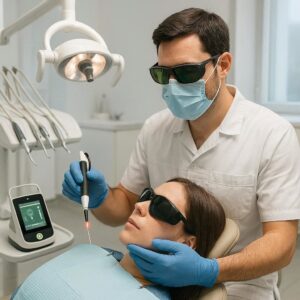
Dental Code for Laser Therapy
Table of Contents
ToggleUnderstanding CDT Codes: The Language of Dental Billing
Before we dive into the specifics of lasers, it’s essential to understand the framework. In the United States, dental procedures are billed using Current Dental Terminology (CDT) codes. These are a set of codes maintained by the American Dental Association (ADA) that describe specific dental procedures.
When a dentist performs a procedure, they assign a CDT code to it. This code is sent to the insurance company, which then processes the claim based on your plan’s coverage.
Important Note: There is no single, standalone code called “D9999” or “D4999” that universally covers “laser use.” Using unspecified codes usually leads to automatic claim denials. The key is to pair the laser procedure with the correct descriptive code.
The Most Common Dental Codes for Laser Procedures
Since the laser is a tool—like a scalpel or a drill—the billing is based on the treatment performed. Here are the most frequently used codes in laser dentistry, broken down by category.
1. Laser Gum Therapy (Periodontal Codes)
This is arguably the most common area where lasers are used. Lasers offer a minimally invasive way to treat gum disease.
| CDT Code | Procedure Description | When is it used? |
|---|---|---|
| D4342 | Periodontal Scaling and Root Planing (Per Quadrant) | For patients with moderate to severe gum disease (four or more teeth in a quadrant). Lasers are often used alongside scalers to disinfect the pocket. |
| D4346 | Scaling in Presence of Generalized Moderate or Severe Gingival Inflammation | For patients with gum inflammation (gingivitis) but no active bone loss. The laser can be used to remove inflamed tissue and bacteria. |
| D4381 | Localized Delivery of Chemotherapeutic Agents | If the laser is used to decontaminate the pocket, followed by placing an antibiotic (like Arestin), this code is used for the antibiotic placement itself. |
| D4999 | Unspecified Periodontal Procedure | Use with extreme caution. Only use this if you have a special laser protocol not described by other codes, and be prepared to submit a narrative and photos. |
2. Laser Gum Contouring and Reshaping
Lasers are excellent for sculpting gum tissue for either medical or cosmetic reasons.
| CDT Code | Procedure Description | When is it used? |
|---|---|---|
| D4210 | Gingivectomy or Gingivoplasty (Per Quadrant) | Surgical removal or reshaping of gum tissue. This is the correct code for laser gum contouring when four or more contiguous teeth or bounded spaces are involved. |
| D4211 | Gingivectomy or Gingivoplasty (Per Tooth) | Used when contouring three or fewer teeth, or isolated areas. |
| D4240 | Gingival Flap Procedure | For more advanced surgical procedures where the gum tissue is reflected (folded back) to allow the laser to clean deep infection and bone. |
| D4249 | Clinical Crown Lengthening (Soft Tissue) | When the laser is used to remove excess gum tissue to expose more of the tooth structure, usually for a crown or for cosmetic reasons. |
3. Laser Frenectomy (Lip and Tongue Ties)
A frenectomy is the removal or modification of the frenum—the small piece of tissue that connects the lips, tongue, or cheeks to the jawbone. Lasers have become the gold standard for this procedure due to reduced bleeding and faster healing.
| CDT Code | Procedure Description | When is it used? |
|---|---|---|
| D7960 | Frenulectomy (Frenectomy) | The surgical removal or revision of the frenum. This is the standard code for both lip-tie and tongue-tie releases. |
| D7963 | Frenuloplasty | A more complex revision of the frenum, which may involve repositioning the tissue or suturing. While often done with a scalpel, a laser can also be used for this procedure. |
4. Laser Biopsy and Lesion Removal
If a dentist finds a suspicious sore or growth, a laser can be used to remove it for analysis or simply to eliminate a benign annoyance.
| CDT Code | Procedure Description | When is it used? |
|---|---|---|
| D7286 | Biopsy of Oral Tissue (Soft Tissue) | When a sample of tissue is removed using a laser and sent to a pathologist for diagnosis. |
| D7410 | Excision of Benign Lesion (Up to 1 cm) | When a dentist removes a known benign lesion, such as a fibroma or a mucocele. |
| D7411 | Excision of Benign Lesion (> 1cm) | For larger benign growths. |
| D7465 | Destruction of Lesion by Physical or Chemical Method | This is a key code for laser use. It describes the destruction of tissue (like a canker sore or a benign growth) without the need for a biopsy. The laser physically destroys the cells. |
5. Laser Operative Procedures (Treating Cavities)
This is where things get a bit tricky. While lasers can be used to remove decay and prepare a tooth for a filling, the billing usually reverts to the filling code itself.
| CDT Code | Procedure Description | When is it used? |
|---|---|---|
| D2140-D2161 | Amalgam and Resin Fillings (Various surfaces) | If a laser is used to remove decay and etch the enamel for bonding, you still bill the appropriate code for the filling that was placed. |
| D2971 | Additional Procedures to Construct a Crown | In some rare cases, a laser might be used for crown lengthening or troughing (exposing the margin of a tooth) prior to taking an impression for a crown. This code can sometimes be used, but it requires excellent documentation. |
6. Laser Therapy for Pain and Cold Sores (Low-Level Laser Therapy)
Low-Level Laser Therapy (LLLT), also known as photobiomodulation, is used not to cut tissue, but to reduce pain, inflammation, and accelerate healing. This is a rapidly growing field.
| CDT Code | Procedure Description | When is it used? |
|---|---|---|
| D9110 | Palliative (Emergency) Treatment of Dental Pain | This is a common code used when a patient presents with pain (like from a toothache or a cold sore) and the laser is used to provide immediate relief. |
| D4921 | Gingival Curettage | In some interpretations, using a laser to “decontaminate” a pocket is considered a form of curettage (scraping the lining of the gum). However, many insurers view this as inclusive to scaling and root planing. |
| D9999 | Unspecific Code | Unfortunately, there is no perfect code for LLLT. Many dentists use D9110 for pain relief or occasionally D4921, but coverage is highly variable. Some may create an in-house code for tracking, but insurance will rarely cover it without a specific diagnosis. |
Important Note for Patients: If your dentist uses a laser to treat a cold sore or TMD pain under code D9110, this is often considered a “non-routine” service. Your insurance may not cover it, or it may fall under a separate “major” or “miscellaneous” benefit category.
Why Insurance Claims for Laser Therapy Get Denied
Even when you use the correct code from the list above, claims can still be rejected. Understanding why can help you prepare an appeal or set expectations.
-
The “Experimental” Label: Although lasers have been used in dentistry for over 30 years, some insurance companies still classify certain laser procedures as “experimental” or “investigational.” This is an outdated view, but it persists, especially for hard-tissue (cavity) procedures.
-
Lack of Radiographic Evidence (X-rays): Insurance companies need proof. If you bill for laser pocket disinfection under a periodontal code, the x-rays must clearly show bone loss. If you bill for laser decay removal, the x-ray must show the cavity.
-
Frequency Limitations: Insurance plans have strict rules on how often you can have a procedure. For example, if a patient had scaling and root planing (D4341/D4342) six months ago, the insurance will deny a second round, even if a laser was used for “maintenance,” because they consider it too soon.
-
Upcoding: This is when a dentist uses a more expensive code than the procedure warrants. For example, billing a full-blown gingival flap procedure (D4240) when a simple laser gingivectomy (D4210) was performed just to get a higher reimbursement.
Best Practices for Dental Professionals: How to Get Paid
To minimize denials and ensure your practice is compensated for the advanced technology you provide, follow these guidelines.
Documentation is Everything
Insurance companies don’t just want to know you used a laser; they want to know why.
-
Take Photos: Intraoral photos of the condition before treatment are the single best piece of evidence you can provide.
-
Record Pocket Depths: For periodontal procedures, always include a full periodontal charting with probing depths.
-
Write a Narrative: For any complex case or any use of a less common code (like D7465), attach a short, clear narrative explaining the procedure, the medical necessity, and why the laser was the best choice for the patient.
Check Medical Necessity First
Before you even pick up the laser, verify the patient’s insurance benefits. Ask the insurance company specific questions:
-
“Is scaling and root planing (D4342) a covered benefit for this patient?”
-
“Does the patient’s plan have coverage for surgical procedures like frenectomy (D7960) or gingivectomy (D4210)?”
-
“Is there any specific exclusion for laser dentistry in this policy?”
Pre-Authorization is Your Friend
For larger cases—like a full-mouth laser gum treatment or a frenectomy on an infant—submit a pre-authorization (sometimes called a predetermination). Send the codes, x-rays, photos, and a narrative to the insurance company before the procedure. They will send back a letter stating what they will cover and what the patient owes. This protects both you and the patient from surprise bills.
The “Laser” Modifier (Does it exist?)
You might be wondering, “Is there a modifier I can add to a code to say ‘I did this with a laser’?” In the standard CDT coding system, there is no official modifier to indicate laser use.
However, some dental software systems allow for “treatment notes” or “electronic attachments.” The best practice is to indicate laser use in the procedure description sent to the insurance company. For example: “D4210 – Gingivectomy (Laser Assisted) .” While the insurance computer may not read the text, a human reviewer will see it, which can help during an appeal.
A Patient’s Guide: What Will My Insurance Cover?
If your dentist has recommended a laser procedure, you are likely wondering about the cost. Here is the honest reality:
-
Medical vs. Dental: Some procedures, like a frenectomy for a tongue-tied infant, straddle the line between dental and medical. Sometimes, a frenectomy is covered by medical insurance, not dental insurance. It is worth checking with both.
-
Cosmetic Exclusions: If the laser is being used purely for cosmetic reasons—like reshaping a “gummy smile”—it is highly unlikely your dental insurance will cover it. You will be responsible for the full fee.
-
The “Standard of Care” Argument: If your dentist recommends a laser over a scalpel for a medical necessity (like treating an infection), they may need to argue that the laser provides a better outcome. In this case, the insurance should cover the procedure at the same rate they would cover the traditional method. You may be responsible for any “upcharge” for the technology, depending on the practice’s policy.
The Future of Dental Laser Coding
The world of dental coding is slow to change, but it does change. As laser technology becomes more ubiquitous and more research confirms its efficacy, we may see changes in the future.
-
Potential for New Codes: The ADA’s Code Maintenance Committee periodically reviews requests for new codes. As Low-Level Laser Therapy becomes more mainstream, there is pressure to create a dedicated code for photobiomodulation rather than relying on D9110.
-
Increased Acceptance: As younger dentists who trained with lasers become the majority, and as insurance companies see the long-term cost benefits (laser treatments can be more precise and reduce the need for retreatment), denial rates are likely to drop.
Conclusion
Navigating the dental code for laser therapy doesn’t have to be a nightmare. The golden rule is simple: Code for the procedure, not the tool. By matching the laser treatment to the accurate CDT code—whether for gum disease, a biopsy, or a frenectomy—and backing it up with solid documentation, you maximize the chance of successful insurance processing. For patients, understanding this process helps set realistic expectations about coverage and out-of-pocket costs.
Frequently Asked Questions (FAQ)
1. Is there a specific insurance code for “laser dentistry”?
No. There is no single code. You must use the code that describes the procedure being performed (e.g., gingivectomy, frenectomy, biopsy). The laser is the method, not the procedure itself.
2. Why did my insurance deny my claim for laser gum treatment?
Denials can happen for several reasons: the insurer may consider the laser “experimental” for that procedure, you may have reached your plan’s periodontal frequency limit, or the documentation (x-rays/charts) may not have proven medical necessity.
3. Will my insurance cover laser treatment for a cold sore?
Often, yes, under the code D9110 (palliative treatment of dental pain) . However, coverage depends on your specific plan. Some plans consider this a preventive or miscellaneous benefit and may cover it at a lower percentage or with a separate deductible.
4. What code is used for laser gum contouring to fix a “gummy smile”?
If it is for cosmetic reasons only, the code is typically D4210 (gingivectomy) . However, because it is cosmetic, most dental insurance plans will not cover it. You will likely need to pay for this out-of-pocket.
5. My dentist used a laser to remove a growth on my gums. What code should I see on my claim?
Depending on the size and whether it was sent for testing, you should look for D7410 (excision of benign lesion) or D7465 (destruction of lesion) . If a sample was sent to a lab, you might also see D7286 (biopsy) .
6. What is the code for a tongue-tie release with a laser?
The standard code is D7960 (frenulectomy) . For infants, remember that this procedure is sometimes billed to medical insurance (CPT code 41010) rather than dental insurance.
Additional Resource
For the most up-to-date information on coding rules and annual updates, refer directly to the source. The American Dental Association publishes the official CDT manual each year. You can find more information and purchase the current code set on their website.
[Link to American Dental Association (ADA) – CDT Coding]
(Note: As a web writer, I cannot hyperlink, but you would link this to: https://www.ada.org/en/publications/cdt)
Disclaimer: This article is for informational purposes only and does not constitute legal or billing advice. Coding rules, insurance policies, and coverage benefits vary by provider, plan, and geographic location. Dental professionals should consult with their coding experts and insurance carriers to verify coverage and appropriate coding for specific procedures. Patients should discuss all costs and coverage directly with their dental insurance provider and dental office prior to treatment.