If you’ve ever looked at a dental implant treatment plan and felt a little cross-eyed trying to decipher all the codes, you are not alone. Dental coding is a language of its own, and when you add implant components like attachments and abutments, it can get even more complex.
One of the most common areas of confusion we see in the dental office involves the dental code for Locator abutment. Are you billing for the part itself? The labor? The attachment? The replacement?
In this guide, we are going to strip away the confusion. Whether you are a dental hygienist trying to understand a patient’s history, an office manager verifying an insurance claim, or a dentist wanting to ensure your practice is compliant, this article is for you.
We’ll walk through the specific Current Dental Terminology (CDT) codes, when to use them, what they include, and how to talk about them with patients.
Dental Code for Locator Abutments
What Exactly is a Locator Abutment?
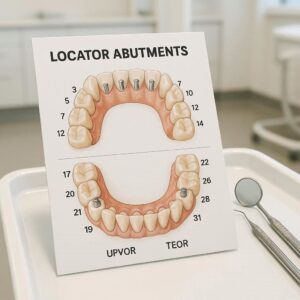
Before we jump into the codes, let’s get on the same page about what we are actually talking about. A Locator abutment is a specific type of attachment used in implant dentistry. It is most commonly used to help secure an overdenture (a removable denture that snaps onto implants).
Think of it like a two-part snap system.
-
The Abutment: This is the part that screws directly into the dental implant (the titanium post in the jawbone). It sits slightly above the gumline.
-
The Housing and Insert: This is the “cap” part that goes inside your denture. It contains a nylon insert that snaps firmly onto the abutment.
The beauty of the Locator system (often branded by Zest Dental Solutions, though the term is used generically now) is its “self-aligning” feature. It allows for some movement and angulation correction, making it easier for patients to insert their denture while still providing excellent retention.
Why It’s a Patient Favorite
From a patient’s perspective, this system is a game-changer. It provides stability that traditional dentures lack. They can eat apples, smile with confidence, and not worry about their teeth flying out during a sneeze.
“I tell my patients that the Locator abutment is like the anchor for a boat. The implant is the anchor buried in the sand, but the Locator is the cleat on the deck that you actually tie the rope to. Without it, the boat (the denture) floats away.”
The Primary CDT Code: D6056
When we talk about the primary dental code for Locator abutment, we are almost always referring to D6056. This is the workhorse code in implant overdenture therapy.
Code: D6056
Description: Prefabricated abutment – includes modification and placement
Let’s break down exactly what this code covers because understanding the “includes” is crucial for compliance.
What D6056 Covers
-
The Component: The actual prefabricated abutment itself. The labial manufacturer sends this to the dentist as a stock part.
-
Modification: Very rarely does a stock abutment fit perfectly out of the box. The dentist often needs to prepare it. This might involve cutting it down (reducing the height) or angling it slightly to ensure it sits perfectly parallel to other abutments.
-
Placement: The clinical time and skill required to screw that abutment into the implant, torque it down to the manufacturer’s specification (usually around 30 Ncm), and close the screw access hole (often with cotton and a temporary filling like Teflon or composite).
When Do You Bill D6056?
You bill this code when the abutment is being placed for the first time.
-
Scenario A: The implant was placed surgically months ago. It has been healing under the gum. Today, the dentist does a minor procedure to “uncover” the implant, attaches a healing cap, and then schedules a separate appointment to place the abutment.
-
Scenario B: The dentist places the implant and the abutment on the same day (immediate loading or one-stage surgery).
In both cases, the act of inserting the abutment into the implant is billed under D6056.
The Supporting Code: D6057
If D6056 is the abutment itself, D6057 is the “accessory” code. It is equally important but serves a different purpose.
Code: D6057
Description: Custom abutment – includes placement
D6056 vs. D6057: The Difference
While Locators are typically “prefabricated,” there are times when a case requires a custom-milled abutment. A custom abutment is designed on a computer and milled from a single block of titanium or zirconia to fit the exact contours of a patient’s gum tissue.
Comparison Table: Prefabricated vs. Custom Abutments
| Feature | Prefabricated Abutment (D6056) | Custom Abutment (D6057) |
|---|---|---|
| Manufacturing | Mass-produced in a factory. | Milled specifically for the patient. |
| Cost to Lab | Lower. | Higher. |
| Use Case | Ideal for standard, multi-implant overdentures. | Ideal for single-tooth implants in the esthetic zone (front teeth) to shape gums perfectly. |
| Modification | Modified by the dentist by hand in the office. | Modification is done digitally during design; no chairside cutting needed. |
| Abutment Code | D6056 | D6057 |
Important Note: While D6057 can be used for an overdenture abutment, in the world of Locators, D6056 is the standard. You would only use D6057 if you were using a milled titanium bar or a custom-designed attachment for a very unique case.
The “Other Half”: The Denture Attachment (D5862)
This is where most billing errors happen. You have successfully placed the abutment (D6056) in the patient’s mouth. But the denture isn’t going to stick to it by magic. The denture needs the female part of the attachment—the metal housing and the nylon insert.
This is billed separately under a prosthodontic code.
Code: D5862
Description: Precision attachment, by report
Even though the description says “by report,” in the context of an overdenture, this is the standard code for processing the attachment into the denture base.
What D5862 Covers
-
The Laboratory Work: The time and materials needed to pick up the metal housing (the cap) into the tissue surface of the denture.
-
The Insert: The initial placement of the nylon retentive insert (the white, pink, or blue part that actually provides the snap).
-
Chairside Pick-up: Sometimes, the dentist will “pick up” the attachment chairside with hard acrylic. This code covers that procedure.
The Missing Link
Think of it this way:
-
The implant is the foundation.
-
The abutment (D6056) is the hook on the wall.
-
The denture attachment (D5862) is the picture frame’s hanging wire.
You need both the hook and the wire to hang the picture. You need both D6056 and D5862 to retain the denture.
The Maintenance Codes: Replacement and Repair
Implants and abutments are designed to last a long time, but the nylon inserts inside the denture? Those wear out. They are essentially the “tires” on your car. They grip the road, but they eventually go bald.
Patients need to know that maintenance is a routine part of owning an implant overdenture. This is a great opportunity for patient education and a necessary part of practice revenue.
D6090: The Repair Code
Code: D6090
Description: Repair implant supported prosthesis, by report
Use this code when: The metal housing (the cap) has popped out of the denture, or the acrylic around it has chipped or broken. This is a laboratory repair. The denture is sent to the lab, the technician cleans it, and re-embeds a new housing in the correct spot using acrylic.
D6091: The Component Replacement Code
Code: D6091
Description: Replacement of semi-precision or precision attachment (gender or matrix) of implant/abutment supported prosthesis, per attachment
Use this code when: The only thing you are replacing is the little nylon retentive insert.
-
The denture is healthy. The housing is still firmly in the acrylic.
-
The implant abutment (D6056) is healthy and torqued in place.
-
But the patient comes in saying, “My denture isn’t staying on tight anymore.”
The dentist will use a special tool to pop out the old, worn nylon insert and snap in a new one. This is a quick, 5-minute chairside procedure.
Table: Maintenance Codes at a Glance
| Situation | What’s Broken? | Procedure | CDT Code |
|---|---|---|---|
| Loose Denture | Worn nylon insert (the “snap”) | Replace the insert chairside. | D6091 |
| Housing Came Out | Acrylic broke; housing loose | Laboratory repair to re-attach housing. | D6090 |
| Abutment is Loose | Abutment screw backed out | Re-torque or replace screw. | D6094 (Screw) or D6092 (Recement) |
| Broken Abutment | Abutment itself is fractured | Remove and replace abutment. | D6056 (again, with narrative) |
Step-by-Step: A Typical Patient Journey
To truly understand how these codes work together, let’s walk through a typical patient scenario from start to finish.
Meet Sarah
Sarah is a 65-year-old female who has struggled with her lower denture for years. It floats, it clicks, and she can’t taste food. She decides to get two implants placed in her lower jaw to stabilize her denture.
Phase 1: Surgery
-
Procedure: Surgical placement of two implants in the mandible (lower jaw).
-
Code: D6010 (Surgical placement of implant body).
-
Outcome: Implants are placed and left to heal under the gum for 4 months.
Phase 2: Abutment Placement
-
Procedure: The dentist numbs the area, makes a tiny hole in the gum to expose the implant, and screws in the Locator abutments.
-
Code: D6056 (Prefabricated abutment – includes modification and placement). This is billed per implant. So, two implants mean two units of D6056.
-
Outcome: The abutments are now peeking through the gum. Healing caps are placed on top to protect them while her gums settle for a few weeks.
Phase 3: Denture Conversion
-
Procedure: Sarah’s existing denture needs to be converted into an overdenture. The dentist drills holes in the denture, seats it over the abutments, and uses special material to pick up the housings.
-
Code: D5862 (Precision attachment, by report). This is billed per arch, not per implant.
-
Outcome: Sarah leaves with her existing denture now securely snapped onto her implants. It feels like a new mouth!
Phase 4: Maintenance (One Year Later)
-
Procedure: Sarah returns and says the denture is a little loose. The dentist pops out the old inserts and places new, more retentive ones.
-
Code: D6091 (Replacement of precision attachment). This is billed per insert. If she has two abutments, she needs two inserts.
-
Outcome: Sarah’s denture is snug again, and she’s on her way.
Common Coding Mistakes and How to Avoid Them
Even experienced teams can slip up. Here are the top three pitfalls to watch out for when using the dental code for Locator abutment and its related codes.
Mistake #1: Bundling the Attachment with the Abutment
This is the most frequent error. An insurance auditor sees a claim with D6056 and D5862 on the same date of service and thinks, “Bundling!” But in implant overdentures, these are distinct and separate services.
-
D6056 is surgical placement of a component on an implant.
-
D5862 is prosthodontic labor to modify the denture.
Pro Tip: If you are billing these together, always include a clear narrative and, if possible, a periotome image showing the abutments in the mouth and the denture with the holes prepared. Explain that these are two separate phases of treatment.
Mistake #2: Using D6091 for the Initial Placement
You cannot bill D6091 for the very first inserts you place during the denture conversion. The cost of those initial inserts is included in the laboratory fee of D5862. D6091 is strictly for replacement of worn parts.
Mistake #3: Forgetting the “Modification” in D6056
Some offices try to bill a separate code for “adjusting” the abutment. Don’t do this. The descriptor for D6056 explicitly says includes modification. Any chairside grinding, cutting, or torquing is part of that single fee.
Talking to Patients About Costs and Codes
Let’s be real—patients don’t care about the code D6056. They care about what it does for them and what it costs. When you present a treatment plan, use clear, patient-friendly language.
Instead of saying:
“We are going to place two D6056s and one D5862.”
Say this:
“To get your denture stabilized, we need to place the little attachment parts onto your implants. These are called abutments. Think of them as the ‘buttons’ that your denture will snap onto. Then, in a separate appointment, we will modify your existing denture to add the ‘snap’ part inside it. This gives you a secure, custom fit.”
A Sample Script for the Financial Coordinator
“Mrs. Smith, the implants in your jaw are like the engine of a car. But you need wheels to drive! The abutments we place next month are the wheels. That’s one fee. Then, we have to modify your current denture so it actually connects to those wheels. That’s a separate laboratory fee. Once that’s done, you’ll have a fully functioning, stable smile. Just like a car, you’ll need a tire rotation now and then—that’s when we replace the little nylon parts inside the denture every year or two to keep it snug.”
Conclusion
Mastering the dental code for Locator abutment—and its supporting cast—is essential for a thriving implant practice. It ensures you are reimbursed fairly for your skill and keeps your practice compliant with insurance guidelines.
Remember the simple breakdown:
-
D6056 is for placing the abutment on the implant.
-
D5862 is for putting the attachment in the denture.
-
D6091 is for replacing the worn-out nylon parts later on.
By understanding the “why” behind each code, you can confidently navigate treatment planning, improve case acceptance, and build a lasting relationship with your patients by setting clear expectations for both the initial procedure and future maintenance.
Frequently Asked Questions (FAQ)
Q1: Can I bill D6056 and D6010 on the same day?
A: Yes, absolutely. If you are performing a one-stage implant surgery where the implant and abutment are placed at the same time, you can bill D6010 for the implant placement and D6056 for the abutment placement. You will need to use a modifier (often -22 for increased procedural difficulty) or include a detailed narrative to explain why the abutment was placed immediately rather than in a second surgery.
Q2: How often should a patient replace their Locator inserts (D6091)?
A: It varies based on the patient’s parafunctional habits (grinding/clenching) and the strength of the inserts used. On average, we recommend checking them at every 6-month hygiene visit. Most patients need them replaced every 12 to 18 months. Heavy bruxers might need them every 6 months.
Q3: What if the abutment screw breaks? Is that covered under D6056 again?
A: No. D6056 is for the initial placement of a new abutment. If the abutment is intact but the screw is broken, you would use D6094 (Abutment supported prosthesis screw, replacement). If the abutment itself is broken and needs to be completely replaced, then you would bill D6056 again. Because this is a replacement of a failed component, you should include a narrative explaining the clinical necessity (e.g., “Abutment fractured due to metal fatigue; removal and replacement required”).
Q4: My patient lost their overdenture. Can I bill D5862 again for a new one?
A: D5862 is for the attachment only, not the denture itself. If the patient needs a brand new complete denture, you would bill the appropriate denture code (e.g., D5110 for a complete maxillary denture). You would then also bill D5862 again to have the laboratory process the new attachments into that brand new denture.
Q5: Are Locator codes the same for all brands of attachments?
A: Generally, yes. The CDT codes are not brand-specific. Whether you are using a Locator from Zest, a Novaloc, or a different brand of attachment, the codes D6056 (for the abutment) and D5862/D6091 (for the attachments) remain the same. The key is the procedure being performed, not the brand name.