If you’ve recently had a tooth extracted, or if you’re a dental professional looking to clarify your coding, you’ve likely encountered the term “socket preservation.” It’s a procedure that sounds straightforward but sits at a fascinating crossroads of dentistry and medicine. Understanding the correct dental code for socket preservation isn’t just about paperwork; it’s about ensuring patients get the care they need and that dental practices are reimbursed fairly for their expertise.
Let’s be honest: dental coding can sometimes feel like learning a new language. You have letters, numbers, and a whole lot of nuance. But don’t worry. This guide is designed to walk you through everything you need to know about the dental code for socket preservation. We’ll break down the jargon, compare it to other procedures, and give you the confidence to handle this code like a pro. Whether you’re a patient trying to understand your treatment plan or a dental team member aiming to master billing, you’re in the right place.
Dental Code for Socket Preservation
What is Socket Preservation? A Quick Overview
Before we dive into the numbers and letters of the code, let’s make sure we’re all on the same page about what the procedure actually is.
Think of your tooth as a plant in a pot. The pot is the socket—the hole in your jawbone where the tooth root sits. When a tooth is removed, that empty socket is like freshly turned soil. Without anything to hold it in place, the soil (your bone) will naturally start to shrink and resorb over time.
Socket preservation, also known as alveolar ridge preservation, is a procedure done at the time of tooth extraction to minimize this bone loss. The goal is to maintain the volume and contours of the socket to create a healthy foundation for a future dental implant or other prosthetic.
Here’s a simple breakdown of the process:
-
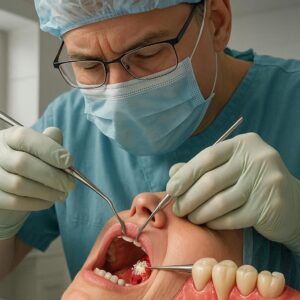
Atraumatic Extraction: The tooth is removed as gently as possible to preserve the surrounding bone walls.
-
Socket Cleaning: The socket is thoroughly cleaned of any infection or debris.
-
Grafting: The empty socket is filled with a bone graft material. This material acts as a scaffold, encouraging your body to grow new bone.
-
Barrier Placement (Often): A membrane is often placed over the graft. This barrier protects the graft, keeps fast-growing gum tissue from invading the slow-growing bone area, and helps contain the graft particles. This is a key part of the procedure.
-
Closure: The site is often sutured to promote healing.
The result? A much better-preserved ridge of bone that is ready for an implant in a few months. Without this step, you might end up needing a more complex and costly bone graft later just to have enough bone for an implant.
The Primary Dental Code for Socket Preservation: D7950
So, what’s the magic number? In the world of dental coding, which uses the Current Dental Terminology (CDT) codes published by the American Dental Association, the primary code for this procedure is D7950.
Let’s get to know this code intimately.
Code: D7950
Description: Osseous, osteoperiosteal, or cartilage graft of the mandible or facial bones; autogenous or nonautogenous, including graft harvest; including closure; alveolar cleft (where described), sinus, or site augmentation factor, including membrane fixation and suturing, when performed.
Wait, that’s a mouthful, isn’t it? The description can seem overwhelming. Let’s simplify what it actually means in the context of a standard socket preservation after an extraction.
In plain English, for a routine socket preservation, D7950 covers:
-
Placing a bone graft (which could be from you, a donor, or a synthetic source) into the extraction socket.
-
Placing a membrane over the graft.
-
Securing that membrane and suturing the site closed.
The code essentially bundles the key components of the procedure—the graft material, the membrane, and the surgical placement—into one service. This is important because it means you typically cannot bill separately for the membrane and the graft material itself. The surgical skill and the supplies are all included in the fee for D7950.
When to Use D7950
This code is your go-to when you are performing a procedure specifically to preserve the bone volume in an existing socket immediately after an extraction. The intent is to prevent the bone from collapsing before a future restoration, most commonly an implant.
Important Considerations for D7950
-
It Follows an Extraction: D7950 is always performed in conjunction with an extraction (codes D7111, D7140, D7210, or D7250). It is a separate, additional procedure.
-
It is Not a Sinus Lift: While the code description mentions “sinus,” in the context of socket preservation, you are grafting the tooth socket itself. A true sinus lift (often coded as D7951 or D7952) is a different procedure performed in the upper back jaw to lift the sinus membrane and create bone height.
-
Membrane is Included: As the description clarifies, membrane fixation is included when performed. You do not add a separate code for the membrane (like D4266 or D4267) when it’s used for socket preservation under D7950.
The Medical Crosswalk: CPT Codes for Socket Preservation
Here’s where things get really interesting. Dentistry and medicine are increasingly interconnected, especially with procedures like dental implants. If a patient has medical insurance that might cover aspects of an extraction and grafting due to a medical necessity (like trauma, tumor removal, or congenital defects), you might need to use a Current Procedural Terminology (CPT) code, which is the coding system used by physicians and hospitals for billing medical insurance.
There isn’t one single, perfect CPT code that mirrors the dental D7950 for every situation. The coding depends on the specifics of the case. However, the most common CPT codes used for socket preservation and bone grafting procedures fall into a few categories.
Common CPT Codes for Bone Grafting
-
21210: Graft, bone; nasal, maxillary or malar areas (separate procedure). This can sometimes be used for grafts in the upper jaw.
-
21215: Graft, bone; mandible (separate procedure). This is often considered for grafts in the lower jaw.
-
21230: Graft, costochondral (rib graft). Less common.
-
21235: Graft; ear cartilage, autogenous (from the patient). Less common.
Including the Membranes with CPT
When using CPT codes, the placement of a barrier membrane is often billed separately, unlike in the bundled CDT code.
-
21248: Reconstruction of mandible or maxilla, excluding dentoalveolar; with reconstruction plate and bone graft (includes obtaining graft). This is a more complex code.
-
21249: Reconstruction of mandible or maxilla, excluding dentoalveolar; with reconstruction plate and bone graft (includes obtaining graft) and including soft tissue flap closure and/or mucous membrane graft.
For the membrane itself, you might look at codes related to tissue grafts or barrier placement, but this requires expert medical coding knowledge. Because medical coding is so complex and payer-specific, it’s almost always a good idea to work with a specialized medical billing consultant if you plan to submit claims to medical insurance for these procedures.
Dental vs. Medical: A Simple Comparison
To make the distinction clearer, let’s look at a simple table comparing the two coding worlds for socket preservation.
| Feature | Dental Coding (CDT) | Medical Coding (CPT) |
|---|---|---|
| Primary Code | D7950 (Osseous graft for site augmentation) | Varies (e.g., 21210, 21215, 21248) |
| Payer | Dental Insurance Plans | Medical Insurance Plans (e.g., BCBS, Cigna, Aetna medical) |
| Typical Scenario | Routine extraction to prepare for future implant. | Trauma, pathology (cyst/tumor), congenital defect. |
| Membrane | Included in D7950. | Often billed separately with a different code. |
| Complexity | Standardized for dental use. | Highly variable and diagnosis-dependent. |
| Bundling | The procedure (graft + membrane) is one bundled service. | The components (graft, membrane, closure) can be separate. |
Other Relevant CDT Codes in the Same Family
To truly master the dental code for socket preservation, it’s helpful to understand the codes that are related to D7950. This helps prevent common billing errors, like using the wrong code for a similar but distinct procedure.
D4266 & D4267: The Membrane Codes
-
D4266: Mesiodistal wedge and/or palatal/lingual sliding flap, including papilla and osseous surgery (when performed). This is not for membranes.
-
D4267: Surgical revision procedure, peri-implant soft tissue, including placement of graft material and/or barrier membrane, when performed. This is for soft tissue revision around an existing implant.
There are specific codes for membrane placement, but they are not for socket preservation. You might see codes like D4266 or D4267, but these are for periodontal surgery and peri-implantitis treatment, not for placing a membrane over a fresh extraction graft. Remember, for D7950, the membrane is included, so you do not add these codes.
D7951 & D7952: Sinus Lift Codes
-
D7951: Sinus augmentation with immediate implant placement via lateral open approach.
-
D7952: Sinus augmentation via lateral open approach.
These are for the procedure commonly known as a “sinus lift.” This is performed in the upper back jaw (premolar/molar area) where the maxillary sinuses are located. The goal is to lift the sinus floor to create bone height for an implant. While a socket preservation can be in the same area, it is specifically grafting the tooth socket after an extraction. A sinus lift is grafting the area above where the teeth used to be, into the sinus cavity.
D6104: The Implant Graft Code
-
D6104: Bone graft at time of implant placement.
This code is used when a graft is placed at the same time as the dental implant is placed. For example, if a surgeon places an implant and notices a small gap or defect around it, they might place some graft material to fill that space. This is different from socket preservation, where the graft is placed in the empty socket, and the implant is placed months later after the bone has healed.
Quick Reference: Choosing the Right Graft Code
| Scenario | What is Being Done? | Correct Code |
|---|---|---|
| Socket Preservation | Tooth is extracted. Graft placed in socket. Membrane placed. Implant later. | D7950 |
| Immediate Implant with Graft | Tooth extracted. Implant placed immediately. Small gap grafted around it. | D6010 (implant) + D6104 (graft) |
| Sinus Lift (No Implant Today) | Sinus membrane lifted, graft placed. Implant later. | D7952 |
| Ridge Augmentation | Graft placed on a healed ridge that is too narrow. | D7950 (often used) or D7953 (bone replacement graft for ridge) |
A Step-by-Step Guide to Billing D7950
Now that we know the code, let’s walk through the process of using it correctly. Accurate billing ensures the practice gets paid and the patient’s benefits are used correctly.
Step 1: Verify Patient Benefits
This is the first and most crucial step. Not all dental plans cover socket preservation. Some may cover a portion, while others may consider it a non-covered, elective procedure. Always check:
-
Is D7950 a covered benefit?
-
What is the patient’s annual maximum? (This graft will use a significant portion of it).
-
What is the patient’s deductible? Has it been met?
-
Is there a waiting period for major services? (Surgical graft procedures are often classified as “major”).
-
Does the plan require a pre-determination (pre-auth)? This is highly recommended for a procedure of this cost. Sending x-rays and a narrative to the insurance company before the procedure gives you a written estimate of what they will pay.
Step 2: Document Medical Necessity
For the claim to be successful, especially if there’s any hope of medical insurance overlap, the treatment note must clearly document why the procedure was necessary. Good documentation includes:
-
Pre-operative radiograph: Showing the condition of the tooth and bone.
-
Tooth number: Specify which tooth was extracted (e.g., #30).
-
Reason for extraction: e.g., “Non-restorable caries,” “Severe periodontal disease,” “Vertical root fracture.”
-
Description of the procedure: “Following atraumatic extraction of tooth #30, the socket was thoroughly curetted. Freeze-dried mineralized bone allograft was hydrated and densely packed into the socket. A resorbable collagen membrane was trimmed and placed over the graft, tucked under the gingival margins. The site was sutured with 4-0 chromic gut suture for primary closure.”
-
Rationale for preservation: “Socket preservation procedure was performed to maintain alveolar bone volume and architecture for future implant placement at site #30.”
Step 3: Prepare the Claim Form
Use the standard ADA dental claim form. Enter the code D7950 on a line item. The fee should be the full fee for the procedure. Attach the narrative and any required radiographs. If you have a pre-determination, attach a copy of it to the claim.
Step 4: Handle the Payment and Patient Portion
Once the insurance processes the claim, they will apply their coverage terms. They will pay their portion (if any) based on the patient’s plan. The remaining balance is the patient’s responsibility. It’s best practice to have a financial conversation with the patient before the procedure, explaining the estimated total cost, what insurance might pay, and what their estimated out-of-pocket portion will be.
The Patient’s Perspective: What to Ask Your Dentist
If you’re a patient reading this, the coding world can seem distant. But understanding these codes empowers you to have better conversations with your dental office. Here are a few questions you might want to ask:
-
“Will I need a bone graft after my extraction?”
-
“What is the specific code for the procedure you’re recommending?” (Listen for D7950).
-
“Can you help me understand what my dental insurance might cover for this code?”
-
“Is it possible that my medical insurance could help cover any of this, for instance, if the tooth was broken in an accident?”
-
“Can you send a pre-determination to my insurance company so we know what to expect before we schedule the extraction?”
A good dental office will welcome these questions. It shows you’re an engaged patient, and it helps set clear expectations, which leads to a much better experience for everyone.
The Value of Socket Preservation: Why the Code Matters
It’s easy to get lost in the numbers—D7950, 21210, D6104. But at the heart of every code is a patient and a clinical need. The reason we have a specific dental code for socket preservation is that it is a distinct, valuable procedure.
The value isn’t just in the code or the fee. It’s in the long-term outcome for the patient.
-
Predictable Implant Placement: By preserving bone, the patient is a much better candidate for a dental implant down the road. The implant can often be placed in the ideal restorative position without needing additional, more complex grafting.
-
Aesthetics: Preserving the bone also preserves the gum tissue around it. This leads to a much more natural-looking final result, whether it’s an implant, a bridge, or even a partial denture.
-
Simpler Future Treatment: A well-preserved ridge is easier and less invasive for the surgeon to work with when the time comes for the implant. This can potentially save the patient time, money, and discomfort in the long run.
Conclusion
Mastering the dental code for socket preservation—D7950—is about more than just filling out forms. It’s about accurately representing a skilled surgical procedure that provides immense long-term value to patients. It’s a bundled code that efficiently captures the complexity of grafting an extraction socket to preserve bone for the future.
While the dental world primarily uses D7950, it’s also valuable to be aware of the medical CPT coding landscape, as the lines between dental and medical necessity continue to blur. By understanding the nuances of this code, how it differs from related procedures like sinus lifts or immediate implant grafts, and how to document it properly, dental professionals can ensure they are fairly compensated, and patients can confidently navigate their treatment plans.
Frequently Asked Questions (FAQ)
Q1: Is D7950 covered by insurance?
A: Coverage varies widely by plan. Many dental insurance plans consider socket preservation a covered benefit, though often at a percentage (like 50%) after the deductible is met. Some plans may classify it as “major” restorative surgery. Always check with your insurance provider or have your dental office send a pre-determination.
Q2: Can I use D7950 for a graft done months after an extraction?
A: No. D7950 is specifically for a graft performed at the time of extraction to preserve the existing socket. If you are grafting a site that has already healed, the procedure is typically coded as a “ridge augmentation” or “alveolar ridge preservation,” which might still use D7950 or a similar code depending on the technique, but it is distinct from the immediate post-extraction procedure. The key is the timing and condition of the site.
Q3: What’s the difference between D7950 and D4263?
A: Great question. D4263 is a periodontal surgery code for “bone replacement graft” – but it’s used in treating periodontal disease, specifically for filling defects around existing teeth caused by bone loss from gum disease. D7950, on the other hand, is used in surgical extraction and implant planning to preserve bone in an empty socket after a tooth is removed. They are for completely different clinical situations.
Q4: Does D7950 include the cost of the bone graft material and membrane?
A: Yes, in the dental (CDT) coding system, D7950 is a bundled code. The fee for the procedure is intended to cover the surgeon’s skill and time, as well as the cost of the supplies, including the bone graft material and the barrier membrane. You should not bill for them separately.
Q5: My dentist mentioned using PRF (Platelet-Rich Fibrin) instead of a membrane. Is that still D7950?
A: Generally, yes. If the PRF is being used as a barrier or healing aid in conjunction with a bone graft placed in an extraction socket for the purpose of site preservation, the primary procedure is still the bone graft. D7950 would typically be the appropriate code, as it includes “membrane fixation… when performed.” PRF acts as a biological membrane, so it falls under the umbrella of the procedure.
Disclaimer: This article is for informational purposes only and does not constitute legal or billing advice. Coding rules, coverage policies, and reimbursement rates vary by payer, contract, and geographic location. Dental professionals should always consult the current CDT manual, their payer contracts, and, when necessary, a professional coding consultant to ensure accurate billing and compliance.