If you wear dentures, you know that comfort is everything. There is nothing quite like the annoyance of a loose lower denture or a spot that rubs against your gums until it becomes sore. When that happens, your dentist might suggest a procedure known as a soft reline.
But then, the front office hands you a treatment plan filled with numbers and codes. It can look like a foreign language. You might see something like “D5862” or “D5411” and wonder what it means for your wallet and your mouth.
This guide is designed to demystify that process. We are going to break down exactly what the dental code for a soft reline is, why it is used, how much it might cost, and what you need to know before sitting in the dentist’s chair.
Whether you are a patient looking for answers or someone new to the dental field trying to understand billing, you are in the right place.
Dental Code for Soft Reline
What Is a Soft Reline?
Before we jump into the numbers and codes, let’s talk about the procedure itself. Understanding the “what” makes the “why” of the billing much easier to grasp.
A soft reline is a dental procedure performed on existing dentures. Over time, your mouth changes. The bone and gums that once supported your teeth (and now support your denture) shrink and reshape. This is a natural process called resorption. When this happens, the hard plastic base of your denture no longer fits snugly against your gums.
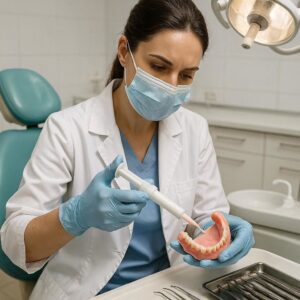
A soft reline involves placing a soft, pliable liner material onto the inside surface of your denture. This material acts like a cushion. It molds to the exact shape of your current gum ridges, providing a comfortable, snug fit.
Hard Reline vs. Soft Reline: What’s the Difference?
This is a common point of confusion. They sound similar, but they feel very different.
| Feature | Soft Reline | Hard Reline |
|---|---|---|
| Material | A soft, silicone-based or acrylic gel material. It remains flexible. | A hard, acrylic resin. It is the same material the denture is made of. |
| Feel | Cushioned and spongy. Acts as a shock absorber. | Firm and rigid. |
| Best For | Patients with sore spots, sharp bone ridges, or delicate gum tissue. Often used post-surgery or for immediate dentures. | Patients with healthy, well-healed gums who need a precise, durable fit. |
| Durability | Less durable. The soft liner can wear out, stain, or harbor bacteria over time. | Very durable. Can last for several years with proper care. |
| Cost | Generally less expensive than a new denture, but may vary (we’ll cover this). | Generally more expensive than a soft reline, but cheaper than new dentures. |
Think of it this way: a hard reline is like replacing the worn-out sole of a shoe with a new, sturdy one. A soft reline is like adding a comfortable gel insole to an existing shoe to make it feel better immediately.
The Dental Code for Soft Reline: D5862 vs. D5411
Now, let’s get to the heart of the matter: the codes. In the dental world, we use a standardized set of codes called CDT (Current Dental Terminology) codes. These are published by the American Dental Association (ADA) and are used by insurance companies to process claims.
When searching for the “dental code for soft reline,” you will likely encounter two main codes: D5862 and D5411. It is crucial to understand the difference, as using the wrong one can lead to a denied insurance claim.
Code D5862: Soft Liner for Dentures – The Chairside Solution
D5862 is defined as: “Soft liner for denture – chairside.”
Let’s break that down.
-
Soft liner: This confirms the material being used is a pliable, cushion-like substance.
-
Chairside: This is the most important word. It means the procedure is done right there in the dental office while you wait. The dentist applies the soft material directly to your existing denture, places it in your mouth, and allows it to set (cure) while you are in the chair.
How the procedure works with D5862:
-
Your dentist evaluates your denture and gums.
-
They rough up the inside surface of the denture to help the new liner stick.
-
They mix the soft liner material and apply it to the denture.
-
They place the denture in your mouth and guide you to bite together so the material molds perfectly to your gums.
-
After a few minutes, the material sets. The dentist removes the denture, trims away any excess material, and polishes it.
-
You walk out with a perfectly fitting denture in a single appointment.
Why use this code?
This is typically the code used for immediate relief. If you have a sore spot and need a fix now, D5862 is likely the code your dentist will use. It is efficient and provides instant comfort.
Important Note: While the procedure is fast, the soft liner material used in a chairside reline may not be as long-lasting as a laboratory-processed liner.
Code D5411: Adjust Denture – The Lab-Processed Approach
D5411 is defined as: “Adjust complete denture – mandibular” (for a lower denture) or D5410 “Adjust complete denture – maxillary” (for an upper denture). However, when we talk about a reline, the context changes slightly.
You might be thinking, “But D5411 is for an ‘adjustment,’ not a ‘reline’.” You are technically correct, which is why billing can get tricky. However, a more accurate code for a lab-processed soft liner is actually D5863.
Wait, there’s another one?
Yes. Let’s clarify the full family of reline codes to paint the whole picture.
-
D5410: Denture adjustment (maxillary) / D5411: Denture adjustment (mandibular) – This is for a simple, quick fix, like easing a pressure point with a bur. This is not a reline.
-
D5862: Soft liner (chairside) – We covered this.
-
D5863: Soft liner (laboratory) – This is the other “soft reline” code.
Code D5863: Soft Liner for Dentures – The Laboratory Approach
This code is used when the dentist sends your denture to a dental laboratory to have the soft liner professionally processed.
How the procedure works with D5863:
-
The dentist takes an impression of your gums inside your current denture. They use a runny material that records the exact shape of your tissue.
-
The denture, with the impression material in it, is sent to a dental lab.
-
At the lab, a technician pours a model, removes the old acrylic from the denture, and processes a new, durable soft liner onto the denture base under heat and pressure.
-
You return to the dentist in a day or two to have the finished denture inserted and checked.
| Feature | D5862 (Chairside Soft Liner) | D5863 (Lab Soft Liner) |
|---|---|---|
| Process | Done in the office in one visit. | Requires two visits and a dental lab. |
| Material | Chemically-cured (self-cure) soft liner. | Heat-cured (processed) soft liner. |
| Durability | Less durable. May need replacement sooner (6 months to 1 year). | More durable. Can last 1-3 years with good care. |
| Cost | Generally lower. | Generally higher due to lab fees. |
| Bacterial Growth | Slightly more porous, can harbor bacteria/stains over time. | Denser material, more resistant to stains and bacteria. |
So, which code is right?
If your dentist says you are getting a “soft reline,” look at your treatment plan. If it’s a one-appointment fix, it is almost certainly D5862. If they need to take an impression and have you come back, it is likely D5863.
For the sake of this article, and because it is the most common procedure performed for immediate relief, we will focus primarily on the D5862 (Soft liner – chairside) code.
Why Would You Need a Soft Reline?
Knowing the code is helpful, but understanding why your dentist recommends it helps you feel more in control of your health. Here are the most common reasons a dentist will use the dental code for a soft reline (D5862 or D5863) on your treatment plan.
1. Immediate Dentures and Post-Surgical Healing
If you had teeth extracted and received “immediate dentures” (dentures placed right after the extractions), your gums and bone will shrink dramatically over the next 6 to 12 months. During this healing phase, a hard reline isn’t practical because your mouth is still changing. A soft reline acts as a temporary “refiller,” keeping the denture comfortable during this unstable healing period.
2. Sore Spots and Irritation
As bone shrinks, the denture might rock or press too hard on specific areas, causing painful ulcers. A soft liner cushions these areas, distributing the pressure evenly across the entire gum ridge.
3. Bony Ridges or Sharp Anatomy
Some patients have very sharp bony areas (tori or exostoses) under their gums. A hard denture base pressing against these sharp spots can be excruciating. The cushioning effect of a soft reline is often the only way to make dentures wearable for these patients.
4. Dry Mouth (Xerostomia)
Saliva acts as a natural lubricant and adhesive for dentures. Patients with dry mouth (often caused by medications or medical conditions) have a harder time keeping their dentures in place. The “suction” feel is lost. A soft liner can provide a more intimate fit that compensates for the lack of natural lubrication.
How Much Does a Soft Reline Cost? (A Realistic Look)
Let’s talk money. This is the part everyone is most curious about. Dental costs vary wildly based on where you live, the dentist’s experience, and the complexity of your case. However, we can give you a realistic range.
For the dental code D5862 (Soft liner – chairside) , you can generally expect to pay between $200 and $500 per arch (per denture) .
For the dental code D5863 (Soft liner – laboratory) , the cost is higher due to the lab fees. This usually ranges from $350 to $700 per arch.
Factors That Influence the Price
-
Geographic Location: A dentist in downtown Manhattan will charge more than a dentist in rural Kansas. It’s simply the reality of overhead costs.
-
The Dentist’s Expertise: A prosthodontist (a specialist in restoring and replacing teeth) may charge a premium for their specialized skill set compared to a general dentist.
-
Type of Liner Material: There are different brands and qualities of soft liners. Some are firmer, some are ultra-soft. The material cost can vary.
-
Denture Age and Condition: If your denture is old, cracked, or badly stained, the liner may not bond well. The dentist might need to spend extra time preparing it, or may even recommend against a reline if the denture base is compromised.
Does Insurance Cover It?
This is the million-dollar question. Most dental insurance plans fall into two categories regarding dentures and relines.
-
Replacement Schedule: Many plans have a “replacement schedule.” For example, they might pay for a complete denture once every 5 or 7 years. They usually apply the same logic to relines. They may cover a reline once every 12 or 24 months.
-
Percentage Coverage: If you have out-of-network benefits, the insurance will often cover a percentage (like 50%) of the “allowed amount” for the code, not necessarily the full fee the dentist charges.
What to do:
Before scheduling a soft reline, call your insurance company or ask your dentist’s billing department to run a “predetermination of benefits.” They will send the code (likely D5862 or D5863) to your insurance, and the insurance will send you a letter stating exactly how much they will pay and how much you will owe. This prevents surprise bills.
A Note on Medicare and Medicaid: Original Medicare (Parts A and B) does not cover routine dental care or dentures. Some Medicare Advantage plans (Part C) do offer dental benefits. Medicaid coverage for adult dental services varies by state. Some states cover dentures and relines, while others offer very limited or no coverage.
The Procedure: What to Expect Step-by-Step
If you are feeling anxious about the appointment, don’t be. A soft reline is one of the quickest and least invasive ways to improve your denture comfort. Here is a friendly walkthrough of what happens when you go in for a D5862 procedure.
Step 1: The Evaluation
Your dentist will look at your denture and examine your gums. They will identify the sore spots and assess how much the fit has changed since your dentures were made.
Step 2: Preparation
The dentist will take your denture and thoroughly clean it. Then, they will use a dental bur to rough up the inside surface (the part that touches your gums). This creates a rough texture, which helps the new soft liner material stick securely to the old denture base.
Step 3: Mixing and Application
The soft liner material usually comes in two pastes: a base and a catalyst. The dentist or assistant will mix these together. Once mixed, they have a limited “working time” before the material starts to set. They will spread this soft, runny mixture evenly inside your denture.
Step 4: The “Molding” in Your Mouth
This is the most important part. The dentist will place the denture with the soft mix back into your mouth. They will ask you to bite down gently and guide your jaw into its normal position. You might be asked to pucker your lips, swallow, or make certain facial expressions. This muscle-pumping action helps the material mold itself perfectly to the contours of your gums and ridge while you are in function.
Step 5: The Setting Phase
You will sit still for about 5 to 10 minutes while the material chemically cures and hardens into its final, rubbery state. It will feel warm, but it shouldn’t burn. If you feel excessive heat, let the dentist know immediately.
Step 6: Removal and Trimming
The dentist will gently remove the denture from your mouth. Now that the material is set, they will use trimming burs and scissors to cut away any excess soft liner that squeezed out over the edges of the denture. This is crucial for comfort, as rough edges can irritate your cheeks and tongue.
Step 7: The Final Check
The dentist will place the denture back in your mouth one last time. They will check your bite, ensure the edges are smooth, and ask you how it feels. They may make a few minor adjustments with a bur if any high spots remain.
And that’s it! You walk out with a denture that feels like it was made just for you (well, technically, it now is).
Caring for a Soft Reline: Extending the Life of Your Liner
A soft reline is a wonderful solution, but it is not invincible. Because the material is soft and porous, it requires a different type of care than a hard denture. Proper maintenance will help it last longer and stay hygienic.
Do’s and Don’ts for Your Soft Liner
-
DO use a soft-bristled brush. Hard bristles can tear and gouge the soft surface.
-
DO rinse your denture after every meal. Food particles can get embedded in the soft material.
-
DO soak your denture nightly. Use an effervescent denture cleaner (like Polident or Efferdent) to help kill bacteria and keep the liner fresh.
-
DON’T use whitening or abrasive toothpastes. These are too harsh and will scratch and damage the soft liner.
-
DON’T use hot water. Hot water can warp the soft liner material and distort the fit. Use cold or lukewarm water only.
-
DON’T let the denture dry out. When you are not wearing it, keep it in water or a denture-soaking solution to prevent the soft liner from drying out and cracking.
How Long Does a Soft Reline Last?
This is a realistic expectation question. A chairside soft reline (D5862) typically lasts between 6 months and 1 year. Over time, the material can harden, stain, or become colonized by yeast (like Candida), which can lead to denture stomatitis (inflammation of the palate).
A laboratory-processed soft reline (D5863) is more durable and can last 1 to 3 years before needing replacement.
Eventually, the soft liner will need to be replaced. At that point, the dentist will remove the old liner and apply a fresh one.
Common Questions About Soft Reline Billing and Codes
Here are some of the most frequent questions we hear regarding the financial and coding aspects of this procedure.
“My dentist billed my insurance for D5862, but they denied it. Why?”
There are several reasons for a denial:
-
Frequency Limitations: Your plan may only cover a reline once every 12 or 24 months, and you’ve already had one within that timeframe.
-
Denture Age: Some insurance plans require the denture to be a certain age (e.g., at least 2 years old) before they will pay for a reline. If your dentures are new, they might consider this a “maintenance” issue that isn’t covered.
-
Missing Information: The claim may have been submitted without the required x-rays or narratives. Dentists sometimes need to prove the medical necessity of the reline (e.g., “Patient has painful bony undercuts”).
“Can a soft reline be coded as a repair?”
Technically, no. A repair (like D5511 or D5520 for repairing a broken denture base) is for fixing a broken or cracked denture. A reline is for improving the fit. They are different services and should be billed under their specific codes (D5862 or D5863). Bundling them incorrectly can be considered insurance fraud.
“Why did I get charged a separate ‘adjustment’ code after my soft reline?”
Sometimes, after the soft liner material is placed, you might develop a small sore spot a few days later. The first follow-up adjustment is often included in the cost of the reline. However, if you return months later for a check-up and need a small spot eased, that is a separate service and may be billed under an adjustment code like D5410 or D5411. Always ask your office about their policy on post-procedure adjustments.
“Does insurance cover a soft reline for an immediate denture?”
Yes, often it does. Since immediate dentures are placed at the time of extraction, it is expected that a reline will be needed after a few months. Many dentists factor this into the treatment plan. Insurance companies are generally accustomed to seeing a reline code (like D5862) filed 6-12 months after the initial denture delivery code. It is considered a standard part of the immediate denture process.
Additional Resources
Navigating dental benefits and treatment codes can be frustrating. For the most accurate and up-to-date information regarding dental coding, the definitive resource is the American Dental Association.
This link will take you to the official source where you can learn more about how these codes are developed and maintained. It is an excellent resource for dental professionals and patients who want to dive deeper into the “why” behind the numbers.
Conclusion
Understanding the dental code for a soft reline—primarily D5862 for a chairside procedure and D5863 for a lab-processed one—empowers you to have an informed conversation with your dentist and insurance company. A soft reline is a fantastic, non-invasive way to breathe new life into your dentures, providing cushioning and comfort that a hard denture base simply cannot offer. By knowing what to expect, how to care for the liner, and how to navigate the billing process, you can ensure your smile stays comfortable and functional for years to come.
Frequently Asked Questions (FAQ)
1. What is the main dental code for a soft reline?
The primary code is D5862, which stands for “Soft liner for denture – chairside.” This means the procedure is completed in one appointment at the dental office.
2. How often will my insurance pay for a soft reline?
Most dental insurance plans cover a reline once every 12 to 24 months. However, this varies by plan. Check your specific benefits or ask your dentist to file a pre-determination.
3. Is a soft reline painful?
The procedure itself is not painful. The dentist is simply molding material to your gums. However, if you have existing sore spots, the area may be tender. The new soft liner will actually help those sore spots heal faster by cushioning them.
4. Can I eat with a new soft reline?
Yes, but take it easy for the first 24 hours. Stick to softer foods. The new fit might feel “different,” and it takes a few days for your brain and mouth to adjust to the new feeling. Avoid very sticky or hard foods initially.
5. How do I clean a denture with a soft liner?
Use a soft-bristled brush and a non-abrasive denture cleaner. Avoid regular toothpaste. Soak the denture nightly in an effervescent cleaning solution to keep the soft liner fresh and free of bacteria.
6. What is the difference between D5862 and D5863?
D5862 is a soft liner done in the dental office in one visit (chairside). D5863 is a soft liner processed in a dental laboratory, which requires two visits and is generally more durable.
Disclaimer: This article is for informational purposes only and does not constitute medical, legal, or financial advice. Dental codes, insurance policies, and treatment costs vary by provider and location. You should always consult with a licensed dentist and your dental insurance provider for advice regarding your specific situation.