
If you’ve recently been told you need a partial denture, you’ve likely received a treatment plan filled with strange alphanumeric codes. For the uninitiated, terms like “D5211” or “D5213” look more like computer commands than medical procedures. Yet, understanding these codes is the key to unlocking your insurance benefits, estimating your out-of-pocket costs, and communicating effectively with your dental office.
Acrylic partial dentures—often called “flippers” or temporary partials—are a common and affordable solution for replacing missing teeth. But because they serve both temporary and long-term roles, the billing process can get confusing.
This guide is designed to demystify the dental coding system. We will explore exactly what these codes mean, when they are used, and how they impact your wallet. Whether you are a patient trying to decipher an estimate or a student entering the dental field, this article serves as your essential reference.
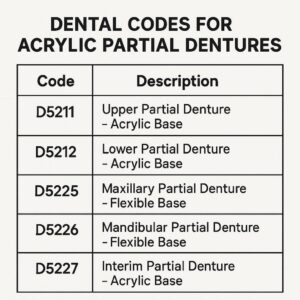
Dental Codes for Acrylic Partial Dentures
What Exactly is an Acrylic Partial Denture?
Before diving into the specific codes, it is important to understand the device itself. An acrylic removable partial denture (RPD) is a prosthetic device used to replace one or more missing teeth.
Unlike fixed bridges, which are cemented in place, a partial denture is removable. Unlike flexible partials made of nylon or Valplast, or cast-metal partials, these are made entirely from a pink or gum-colored acrylic base.
There are generally two types of acrylic partials:
-
The Temporary “Flipper”: This is often used as an immediate replacement for a missing tooth (often front teeth) while a patient waits for a more permanent solution, like an implant. It is lightweight and usually replaces a single tooth.
-
The Interim or Long-Term Acrylic Partial: This is used when a patient needs to replace several teeth but cannot afford or is not a candidate for a metal-based partial. These are bulkier than metal partials but serve as a functional and aesthetic solution.
Understanding this distinction is vital because the specific dental code used often depends on how many teeth are being replaced and whether the appliance is being made for the upper or lower arch.
The Core Dental Codes for Acrylic Partials
In the dental world, we use the Current Dental Terminology (CDT) codes, published by the American Dental Association (ADA). These are the standardized codes that every insurance company in the United States recognizes.
For acrylic partial dentures, the codes fall under the D5000s range, specifically D5211 through D5214. Here is the breakdown:
D5211: Maxillary (Upper) Acrylic Partial Denture
-
What it is: This code is used for a removable partial denture that replaces one or more missing teeth in the upper jaw (maxillary arch).
-
Material: The entire base and any clasps (the parts that hook onto your existing teeth) are made of acrylic.
-
When it’s used: For patients missing multiple teeth in the upper arch who need a non-metal option.
D5212: Mandibular (Lower) Acrylic Partial Denture
-
What it is: This is the exact same type of appliance as D5211, but specifically designed for the lower jaw (mandibular arch).
-
Note on Fit: Lower partials can sometimes be trickier to fit due to the movement of the tongue and the shape of the jawbone, but the billing code distinguishes only by location, not difficulty.
D5213: Maxillary (Upper) Acrylic Partial Denture with Resin Base
-
The Key Detail: At first glance, this looks identical to D5211. The difference lies in the historical coding language. While D5211 covers a standard acrylic partial, D5213 is often used interchangeably in modern practice.
-
Expert Insight: In many dental offices, D5211 is used for partials involving fewer teeth, while D5213 might be reserved for larger partials, but for insurance purposes, they are often treated the same. Always check your specific plan.
D5214: Mandibular (Lower) Acrylic Partial Denture with Resin Base
-
What it is: The lower arch counterpart to D5213.
-
Real-World Application: Like the maxillary codes, these are largely identical in function to D5212. The most important thing is that your dentist uses a code that matches the location (upper vs. lower).
Quick Comparison Table
To make this easier to digest, here is a simple breakdown of the four main codes:
| Code | Arch (Jaw) | Material | Typical Use Case |
|---|---|---|---|
| D5211 | Upper (Maxillary) | Full Acrylic | Replacing multiple missing teeth on the top. |
| D5212 | Lower (Mandibular) | Full Acrylic | Replacing multiple missing teeth on the bottom. |
| D5213 | Upper (Maxillary) | Full Acrylic | Interchangeable with D5211; often used for larger partials. |
| D5214 | Lower (Mandibular) | Full Acrylic | Interchangeable with D5212; often used for larger partials. |
Important Note: While these four codes are the primary ones you will see, they may occasionally be paired with other codes for adjustments, relines, or repairs, which we will cover later.
When Are These Codes Used? (Common Scenarios)
A code on a piece of paper doesn’t mean much until you understand the story behind it. Here are three common patient scenarios where these specific dental codes would appear on a treatment plan.
Scenario 1: The Single-Tooth “Flipper” (D5211)
Imagine a patient, Sarah, who lost a front tooth in a minor accident. She wants to close the gap immediately but needs time to save money for a dental implant, which can take several months.
-
The Treatment Plan: The dentist takes impressions and creates a small acrylic partial that hooks onto the adjacent teeth. It’s a temporary solution.
-
The Code: If the missing tooth is on top, the dentist will bill D5211. Even though it’s small, it is still a “partial denture” because it replaces teeth and attaches to existing ones.
Scenario 2: The Long-Term Economic Solution (D5212)
John is missing four teeth on his bottom jaw. He needs to chew properly but has a tight budget and has been advised against metal framework due to a metal allergy.
-
The Treatment Plan: The dentist constructs an acrylic partial denture that will serve as his long-term replacement. It is more robust than a flipper but bulkier than a cast-metal partial.
-
The Code: For this lower-arch, multi-tooth appliance, the office will bill D5212 (or D5214).
Scenario 3: The Transitional Partial (D5214)
Mary has several teeth that need to be extracted, but she cannot be left without teeth while her gums heal for 3-6 months.
-
The Treatment Plan: The dentist plans to extract the remaining teeth but places an “immediate” acrylic partial denture at the same appointment. She walks out with teeth. As her gums shrink and heal over the next year, the denture will need to be “relined” to fit properly.
-
The Code: Because the partial is placed immediately after extractions, the dentist will still use the standard acrylic partial code (e.g., D5214 for lower), often in conjunction with extraction codes.
What These Codes Do NOT Cover: Related Procedures
It is crucial to understand that the cost estimate attached to a D5211 or D5213 code is rarely the final number. Dentistry is a holistic service. The success of the partial depends on the health of your other teeth and the fit of the appliance. Here are common companion codes you might see on your bill:
Adjustments (D5410 & D5420)
-
D5410: Adjustments to a complete denture (full plate).
-
D5421: Adjustments to a partial denture.
-
What it is: After you receive your partial, it might rub against your gums, causing sore spots. You will need to return for “adjustments” where the dentist files down the acrylic in specific spots. Some offices include the first few adjustments in the global fee; others bill separately.
Relines (D5730-D5765)
When you wear a partial, your jawbone changes shape over time. The appliance will become loose. A “reline” involves adding new acrylic to the inside of the partial to make it fit snugly again.
-
D5730: Reline of a removable partial denture (chairside – done in one visit).
-
D5731: Reline of a removable partial denture (laboratory – sent to a lab for a better result).
Repairs (D5511-D5520)
Acrylic is strong, but it can break, especially the small clasps. If your partial breaks, the dentist will use a repair code.
-
D5511: Repair broken clasp on a partial denture.
-
D5520: Replace missing or broken tooth on a partial denture.
Additions (D5650)
If you unfortunately lose another tooth, the dentist can add a new artificial tooth to your existing partial. This is billed separately from the initial fabrication.
Insurance Coverage and Cost Breakdown
This is the part most readers care about: “What will I actually pay?” The answer lies in how your insurance plan reads these codes.
The “Medically Necessary” Factor
Most dental insurance plans cover acrylic partial dentures under the “Major Services” category (typically covering 50% after your deductible is met). However, insurance companies view them differently:
-
Metal Partials: Seen as the “Gold Standard” for longevity.
-
Acrylic Partials: Often seen as an “alternative benefit.” If your plan covers a metal partial at 50%, they might cover an acrylic partial at the same rate, or they might only cover it up to the cost of a less expensive alternative.
Typical Price Ranges
Because coding is standardized, the prices are not. Costs vary wildly based on location, lab fees, and the dentist’s expertise. However, to give you a realistic ballpark:
-
D5211 / D5212 (Standard Acrylic Partial): Typically ranges from $700 to $1,500 per arch.
-
D5213 / D5214 (Larger/Complex Acrylic Partial): Typically ranges from $900 to $2,000 per arch.
-
Single Tooth Flipper: While still coded as D5211 or D5212, a single-tooth flipper is often at the lower end of the price spectrum ($400 – $800).
Sample Cost Table
| Service (Code) | Average Fee (Without Insurance) | Insurance Coverage (Typical Plan) | Estimated Patient Cost (with 50% coverage after $100 deductible) |
|---|---|---|---|
| Upper Acrylic Partial (D5211) | $1,200 | 50% Major | ($1,200 – $100 Deductible) = $1,100 / 2 = $550 |
| Lower Acrylic Partial (D5212) | $1,200 | 50% Major | ($1,200 – $100 Deductible) = $1,100 / 2 = $550 |
| Partial Denture Repair (D5511) | $250 | 50-80% Basic | $50 – $125 |
| Partial Denture Reline (D5730) | $350 | Often 50% | $175 |
Reader Note: Always ask your dental office for a “predetermination of benefits.” They will send the codes (D5211, etc.) to your insurance company, and the insurance will send you a letter stating exactly how much they will pay. This prevents surprise bills.
A Step-by-Step Walkthrough: From Code to Smile
To truly understand the process, here is what happens behind the scenes when that D5211 code is entered into the computer.
-
The Diagnosis and Treatment Plan: The dentist examines your mouth and determines that an acrylic partial is the best option. The treatment coordinator creates an estimate using the appropriate code (e.g., D5211).
-
Verification and Predetermination: The office sends the code and a narrative (a short explanation of why you need the partial) to your insurance. They wait for the reply to confirm coverage.
-
Impressions (First Visit): The dentist takes an impression of your teeth using a soft gel material in a tray. This is the “mold.” This procedure is included in the D5211 fee.
-
Jaw Relation and Shade: A second visit may be needed to record how your jaws fit together and to pick the shape and color of the replacement teeth.
-
Fabrication: The dentist sends the prescription and models to a dental lab. A technician carefully crafts the acrylic base and places the teeth.
-
Delivery (Final Visit): You return, and the dentist seats the partial in your mouth, checks the bite, and makes minor adjustments.
-
Billing: The office submits the final claim with the D5211 code and the date of delivery.
Frequently Asked Questions (FAQ)
Here are the most common questions patients ask when they see these codes on their paperwork.
What is the difference between a “flipper” and a “partial denture” in the codes?
Technically, there is no separate code for a “flipper.” A flipper is a type of acrylic removable partial denture. Therefore, your dentist will use the same codes—D5211 for an upper flipper, D5212 for a lower flipper. The price may be on the lower end of the scale, but the code is the same.
Why did my dentist use D5213 instead of D5211?
In many practice management software systems, D5211 and D5213 are essentially the same. Some dentists use D5213 to indicate a partial denture with a specific type of resin base, but for insurance claims, they are processed identically. It is not something you need to worry about, as the coverage will be the same.
Does insurance cover acrylic partials for missing back teeth?
Yes. Insurance companies don’t discriminate based on which tooth is missing (front vs. back) as long as the appliance is medically necessary for chewing or preventing other teeth from shifting. An acrylic partial replacing molars (back teeth) is still billed under D5212 (lower) or D5211 (upper) .
How often will my insurance pay for a new acrylic partial?
Most dental insurance plans have a “missing tooth clause” and a frequency limitation. Typically, they will only pay for a replacement partial every 5 years. If you need a new one sooner because it broke or you lost it, insurance usually will not cover it.
Can I upgrade from an acrylic partial to a metal partial later?
Absolutely. If you initially choose an acrylic partial (D5211) due to cost but later decide you want a thinner, stronger cast-metal partial, you can do so. However, your insurance may not cover the new one if it hasn’t been 5 years since the last one. The code for that future appliance would be D5215 (cast metal partial) .
Additional Resources
Navigating dental codes can feel overwhelming, but you don’t have to do it alone. Here are some trustworthy resources to help you further:
-
American Dental Association (ADA) – CDT Code Book: The official source for all dental codes. Your dentist uses this book. (Available for purchase on ADA.org).
-
National Association of Dental Plans: A great resource for understanding how dental insurance works from the consumer perspective.
-
Your State Dental Association: Many state dental societies offer patient resources and help lines to answer billing questions.
Conclusion
Understanding the “dental code for acrylic partial denture” is the first step toward taking control of your dental health finances. Whether it’s a D5211 for an upper arch or a D5212 for a lower, these codes are simply a standardized language that helps your dentist communicate with your insurance company. Remember that the code is just the starting point—the final cost involves the appliance itself, the expertise of your dental team, and the specific details of your insurance plan. By being informed, you can have a more confident conversation with your dentist about your smile.
Disclaimer: This article is for informational purposes only and does not constitute medical, dental, or legal advice. Dental codes, insurance coverage, and pricing vary by provider, location, and individual insurance plan. You should always consult with your licensed dentist and insurance provider for specific information regarding your treatment and financial responsibility.


