
Let’s be honest: getting braces is a big deal. It’s a journey toward a healthier, more confident smile. But right alongside the excitement (and the slight nervousness) comes a mountain of paperwork. And right in the middle of that mountain is something that looks like a secret language: dental codes.
If you’ve ever glanced at a treatment plan or an insurance Explanation of Benefits (EOB) and wondered what on earth “D8080” means, you are not alone. Understanding the dental code for braces is the key to unlocking what you’re paying for and what your insurance will actually help cover.
Think of these codes as the ingredients list for your smile makeover. You don’t need to become a chef, but knowing the main components helps you understand the recipe—and the final price tag.
In this guide, we’re going to sit down together and demystify these numbers. We’ll look at the most common codes, what they represent, and how they translate into the real-world cost of straightening your teeth. No confusing jargon, just clear, friendly explanations.
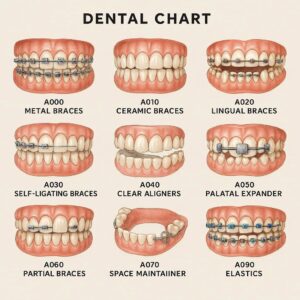
Dental Codes for Braces
What Exactly Are Dental Codes?
Before we dive into the specific code for braces, it helps to understand the big picture. In the United States, most dental professionals use a system called Current Dental Terminology (CDT) . This set of codes is published by the American Dental Association (ADA) and is updated every year. It’s the universal language that your orthodontist’s office uses to talk to your insurance company.
Every procedure, from a simple cleaning to a complex orthodontic treatment, has a specific five-character code that starts with the letter “D.” These codes ensure that everyone is on the same page about what work was done and how much it should cost.
The Main Event: The Orthodontic Category (D8000–D8999)
All the codes related to moving teeth and correcting bites live in the D8000 to D8999 range. This is your go-to neighborhood when looking for any dental code for braces. Let’s take a tour of the most important houses on this street.
The Comprehensive Exam: The Blueprint (D8070, D8080, D8090)
You can’t build a house without a blueprint, and you can’t start orthodontic treatment without a comprehensive evaluation. This isn’t your standard “open wide and say ahh” checkup. This is a detailed analysis of your bite, jaw alignment, and tooth positioning.
This is where you’ll first encounter the comprehensive orthodontic codes. The specific one used depends on the type of treatment being planned.
| Code | Description | What It Really Means |
|---|---|---|
| D8070 | Comprehensive Orthodontic Treatment of the Transitional Dentition | For kids who still have some baby teeth mixed with permanent teeth. It’s often for Phase 1 treatment to guide jaw growth or create space. |
| D8080 | Comprehensive Orthodontic Treatment of the Adolescent Dentition | This is the heavy hitter—the most common code you’ll see for teenagers and pre-teens who have all or most of their permanent teeth. If you hear someone talking about the “dental code for braces,” this is usually it. |
| D8090 | Comprehensive Orthodontic Treatment of the Adult Dentition | For patients who have all their permanent teeth (typically 18 years and older). Adult treatment can sometimes be more complex due to factors like gum health or previous dental work. |
Important Note for Readers: The code D8080 isn’t just for the brackets and wires. It’s a global fee that covers the entire course of active treatment—from the placement of the braces to their removal and the initial phase of retention. It’s a package deal.
The Limited Treatment Codes: For Smaller Jobs (D8010–D8030)
Sometimes, you don’t need a full set of braces. Maybe it’s just a minor correction or a single issue that needs addressing. That’s where the “limited” codes come in.
-
D8010: Limited Orthodontic Treatment of the Primary Dentition (baby teeth).
-
D8020: Limited Orthodontic Treatment of the Transitional Dentition (mixed baby and permanent teeth).
-
D8030: Limited Orthodontic Treatment of the Adolescent Dentition (permanent teeth).
A “limited” treatment might involve using a simple appliance to correct a single rotated tooth or to stop a thumb-sucking habit. It’s a smaller, more focused project.
The Orthodontic Visit Codes (D8670, D8680, D8999)
The comprehensive fee (D8080) usually covers the active treatment. But what about all those adjustment appointments every 4 to 10 weeks? And what happens when the braces come off?
-
D8670: Periodic Orthodontic Treatment Visit. This is the code for your regular adjustment appointments. Important: If you paid a global fee (D8080), this code is usually included and shouldn’t result in an extra charge. However, if you’re on a “fee-for-service” plan, each visit might be billed separately. Always confirm this with your provider!
-
D8680: Orthodontic Retention (Removal of appliances, construction and placement of retainer(s)). This code covers the day the braces come off, the final records, and the fabrication of your retainers. This is sometimes included in the global fee, but not always. Check your contract carefully.
-
D8999: Unspecified Orthodontic Procedure. This is the “miscellaneous” code. It’s used for items or procedures that don’t have a specific code of their own, like replacing a lost retainer or repairing a broken appliance. It will always require a written description explaining the charge.
Real-World Scenario: How the Dental Code for Braces Affects Your Bill
Okay, let’s make this real. Imagine a teenager, let’s call him Alex, is getting ready for braces. Here’s a simplified version of how the codes might appear on his treatment plan.
-
Consultation & Records: The orthodontist takes X-rays, photos, and impressions. This might be a separate fee or bundled into the comprehensive treatment cost. You might see codes like D0340 (cephalometric film) or D0350 (oral/facial photographic images).
-
The Treatment Plan: After analysis, the orthodontist presents a plan and uses code D8080 (Comprehensive Orthodontic Treatment – Adolescent). The fee quoted is for the entire active treatment.
-
The Journey: Over the next 24 months, Alex goes for adjustments. Internally, the office uses code D8670 for each visit, but because they are included in the global D8080 fee, Alex’s family doesn’t pay anything extra at each appointment.
-
The Finish Line: Braces come off! The office bills code D8680 for the retention phase, which includes the retainers. If this wasn’t included in the original D8080 fee, this is a separate, final payment.
-
An Unexpected Event: Six months later, Alex accidentally throws away his retainer in a school cafeteria. The office uses code D8999 with a description like “Replacement of lost maxillary retainer” to bill for a new one.
Why Understanding These Codes is Your Superpower
Knowing these codes isn’t just about being a savvy shopper; it’s about being an empowered patient.
-
You Can Verify Your Insurance Coverage. When you call your insurance provider, don’t just ask, “Do you cover braces?” Ask specific questions. “What is my coverage for code D8080?” “Do I have a lifetime maximum for orthodontics?” “Is code D8680 for retainers included in that coverage, or is it separate?” This gets you accurate answers fast.
-
You Can Compare Treatment Plans Accurately. If you get a second opinion, you can compare apples to apples. Does Orthodontist A’s quote for D8080 include everything that Orthodontist B’s quote for D8080 includes? Or does one of them plan to bill D8680 separately? A simple question can save you hundreds of dollars.
-
You Can Review Your Bills with Confidence. When you get an EOB from your insurance or a bill from your orthodontist, you can look at the codes and understand exactly what you’re being charged for. This helps you catch potential billing errors and feel in control of your finances.
A Quick Reference: Common Orthodontic Procedure Codes
To make things even easier, here’s a handy table you can refer back to. Think of it as your cheat sheet for navigating the world of braces billing.
| CDT Code | Procedure Description | Simplified Meaning |
|---|---|---|
| D8010 | Limited Orthodontic Tx, Primary Dentition | Simple treatment for a child with mostly baby teeth. |
| D8020 | Limited Orthodontic Tx, Transitional Dentition | Simple treatment for a child with mixed baby/permanent teeth. |
| D8030 | Limited Orthodontic Tx, Adolescent Dentition | Simple treatment for a teen/adult, like fixing one or two teeth. |
| D8070 | Comprehensive Orthodontic Tx, Transitional Dentition | Full Phase 1 treatment for a child to guide jaw growth. |
| D8080 | Comprehensive Orthodontic Tx, Adolescent Dentition | The standard full braces treatment for teens. |
| D8090 | Comprehensive Orthodontic Tx, Adult Dentition | Full braces treatment for adults. |
| D8660 | Pre-orthodontic Treatment Examination | The initial evaluation to determine if treatment is needed. |
| D8670 | Periodic Orthodontic Treatment Visit | Your regular adjustment appointment. |
| D8680 | Orthodontic Retention | Braces removal and retainer delivery. |
| D8999 | Unspecified Orthodontic Procedure | The “catch-all” for things like repairs or replacement retainers. |
| D0340 | Cephalometric Film | The side-view X-ray used for treatment planning. |
| D0350 | Oral/Facial Photographic Images | The photos taken for your records and treatment plan. |
Conclusion
Navigating the financial side of orthodontic treatment can feel overwhelming, but it doesn’t have to be a mystery. By understanding the basic language of the dental code for braces, you transform from a passive patient into an active, informed participant in your care. Remember that D8080 is your key term for comprehensive treatment, and codes like D8670 and D8680 help clarify what is included in that package. With this knowledge, you can confidently discuss your treatment plan, verify your insurance benefits, and focus on what really matters: the beautiful, healthy smile waiting for you at the finish line.
Frequently Asked Questions (FAQ)
Q: Is there a single universal dental code for braces?
A: Not exactly. While D8080 (Comprehensive Orthodontic Treatment of the Adolescent Dentition) is the most common for teens, the correct code depends on the patient’s age (child, adolescent, adult) and the scope of treatment (comprehensive or limited). Your orthodontist will select the code that best fits your specific diagnosis and treatment plan.
Q: Does my medical insurance cover braces?
A: Generally, no. Braces are considered a dental procedure, so they are typically covered by dental insurance, not medical. However, if braces are deemed medically necessary to correct a severe issue that affects chewing or speech (like a cleft palate), there might be some coordination between the two. It’s rare, but worth checking with both your medical and dental providers.
Q: What does “lifetime maximum” mean for orthodontic codes?
A: Many dental insurance plans have a separate, lower lifetime maximum for orthodontic benefits (often around $1,000–$2,000). This is the total amount the insurance company will ever pay for orthodontic treatment for a person under that policy. If your treatment costs $6,000 and your lifetime max is $1,500, that’s the total amount they will contribute, regardless of how long your treatment takes.
Q: I see a code on my bill that isn’t listed here. What should I do?
A: Don’t panic! The world of dental codes is vast. Your best first step is to simply call the billing department of your orthodontist’s office. They are there to help and can explain what any specific code on your statement means. It’s their job to ensure you understand your financial responsibility.
Q: Can the dental code for braces change during my treatment?
A: It’s unlikely, but possible. For example, if you started with a limited treatment plan (D8030) but then decided to proceed with full braces (D8080), the code would be updated. However, for a standard course of treatment, the primary code (like D8080) remains the same from start to finish.


