
If you have ever sat in a dental chair and heard the words “you need a crown,” you know the process can feel a bit mysterious. For dental professionals and office managers, however, the mystery often lies not in the procedure itself, but in how to properly document and bill for it. Understanding the correct dental code for cement crown procedures is essential for smooth insurance claims, accurate patient estimates, and a healthy cash flow for the practice.
Billing for crowns is one of the most common—and most frequently denied—procedures in dentistry. The reason? Coding errors. Whether you are permanently fixing a restoration or placing a temporary placeholder, using the right code is the difference between getting paid and writing off hours of labor.
This guide is designed to demystify the world of dental coding for crowns. We will walk through the primary CDT (Current Dental Terminology) codes, explore the nuances of cementation versus re-cementation, and provide practical tips to ensure your claims are processed without a hitch.
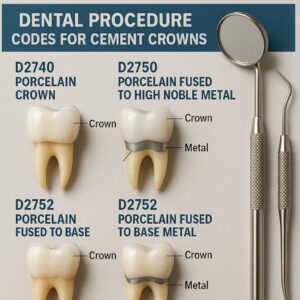
Dental Codes for Cement Crowns
Table of Contents
ToggleUnderstanding Dental Procedure Codes
Before we dive into the specific codes, it is important to understand the language we are speaking. In the United States, the standard set of codes used to report dental procedures is the CDT Code (Current Dental Terminology). These codes are published by the American Dental Association (ADA) and are updated annually.
Every dental procedure, from a simple oral exam to a complex bridge, has a unique alphanumeric code. When you see a code like D2740, it is a shorthand way of telling the insurance company exactly what service was performed. This system eliminates ambiguity and ensures that everyone—the dentist, the patient, and the payer—is on the same page.
When we talk about the dental code for cement crown procedures, we are usually referring to one of two things: the code for permanently fixing the crown (the crown procedure itself) or the code for re-attaching a crown that has fallen off (re-cementation).
Primary CDT Codes for Crown Placement
When a tooth is prepared and a permanent crown is fabricated, the procedure is billed using a specific code that describes the material of the crown. The cementation (or bonding) is considered an inclusive part of that procedure. You do not bill separately for the cement; the fee for the crown covers the lab work, materials, and the seating of the restoration.
Here are the most common crown codes you will encounter:
D2740 – Crown – Porcelain/Ceramic
This is one of the most popular codes in modern dentistry. It is used for all-porcelain or all-ceramic crowns. These are favored for their aesthetic qualities, as they closely mimic the translucency of natural teeth. This code is typically used for anterior teeth where appearance is paramount, though with modern materials like lithium disilicate (e.g., E.max), it is also used for posterior restorations.
D2750 – Crown – Porcelain Fused to High Noble Metal
Often abbreviated as PFM (Porcelain Fused to Metal), this code specifies that the crown has a metal substructure covered by porcelain. The “High Noble Metal” designation means the alloy contains at least 60% noble metals (like gold, platinum, or palladium), with at least 40% being gold. This combination offers excellent strength and a good aesthetic match.
D2751 – Crown – Porcelain Fused to Base Metal
This code is similar to D2750 but uses a base metal alloy (like nickel-chromium or cobalt-chromium) for the substructure. These crowns are incredibly strong and less expensive than their high-noble counterparts. They are a common choice for posterior teeth, though patients with nickel allergies should avoid them.
D2790 – Crown – Full Cast High Noble Metal
This code is used for crowns made entirely of a high-noble metal alloy. These are the classic “gold crowns.” They are incredibly durable, wear well against opposing teeth, and require minimal tooth reduction. While not aesthetically pleasing, they are the gold standard (pun intended) for longevity in posterior teeth.
D2390 – Resin-Based Composite Crown – Anterior
It is important not to confuse a crown with a large filling. This specific code is used for a full coverage crown made of composite resin, but only for anterior teeth. It is less common today due to the popularity of ceramics but is still used in certain situations, such as for pediatric patients or as a more economical temporary aesthetic solution.
Important Note: The cement used—whether it is traditional dental cement or a bonding agent—is considered part of the procedure. You do not need a separate “cement crown” code for the final placement if you are billing for a new crown.
The Difference: Crown Placement vs. Recementation
This is where the confusion often begins. A patient calls the office and says, “My crown fell out.” They come in, the dentist cleans the old crown and the tooth, and cements it back into place.
This is not a new crown. You should not bill D2740 or D2750 for this visit. Instead, you use a specific code designed for this exact scenario.
D2920 – Recement or Rebond Crown/Inlay/Onlay/Veneer
This is the specific dental code for cement crown re-attachment. It covers the labor and materials involved in cleaning the existing restoration and re-cementing it onto the prepared tooth structure.
-
When to use it: The patient’s original crown (or bridge, etc.) is intact and has simply lost its retention. The dentist cleans it, tries it in to ensure the fit is still good, and cements it back.
-
What it covers: The clinical time, the cement material, and the expertise required to properly seat the restoration.
-
What it does NOT cover: Any new preparation of the tooth, adjustments to the occlusion that take more than a few seconds, or repair of the crown itself.
A Word of Caution: If the crown has been out for a while, the opposing tooth may have drifted, or the decay under the crown may have progressed. If the dentist needs to adjust the crown significantly, add material to it, or perform any new preparation on the tooth, the D2920 code may no longer be appropriate. In some cases, a completely new crown (D2740, etc.) is necessary.
Temporary Crowns: Protecting the Preparation
Between the time the tooth is prepared and the permanent crown is seated, the patient wears a temporary crown (or “provisional” restoration). This protects the sensitive tooth structure, maintains spacing, and provides function.
D2970 – Temporary Crown (Fractured/Previous Crown)
This code is used specifically for the fabrication of a temporary crown to replace an existing crown that has fractured or is otherwise unusable while a new permanent crown is being made. It is not typically used for the temporary crown placed during the standard two-visit crown procedure.
D2930 – Prefabricated Stainless Steel Crown – Primary Tooth
This is a very common code in pediatric dentistry. It is used for a pre-made stainless steel crown placed on a baby tooth. These are often referred to as “silver caps.”
D2931 – Prefabricated Stainless Steel Crown – Permanent Tooth
Less common, but sometimes used for permanent teeth, especially in cases where a full-coverage restoration is needed quickly and cost-effectively, such as for patients with special needs or in certain public health settings.
D2929 – Prefabricated Porcelain/Ceramic Crown – Permanent Tooth
This code is for pre-manufactured, tooth-colored crowns (like CEREC same-day crowns or other milled options) that are placed in a single appointment. This blurs the line between temporary and permanent, as these are considered the final restoration.
Billing and Insurance Nuances
Knowing the correct dental code for cement crown procedures is only half the battle. The other half is understanding how to submit the claim to maximize the chance of acceptance and payment.
The Importance of Narratives and Radiographs
Insurance companies rarely pay for crowns based on a code alone. They want proof that the procedure was medically necessary. This is typically provided in two ways:
-
Radiographs (X-rays): A current, diagnostic-quality x-ray showing the extent of decay, the existing restoration, or the fracture is almost always required.
-
Tooth Narratives: If the need for a crown isn’t 100% clear on the x-ray (e.g., the tooth is structurally compromised from an old, large filling), a written narrative is essential. A strong narrative might say: “Tooth #19 requires a full coverage crown due to a cracked tooth syndrome and existing MOD amalgam restoration covering more than 60% of the clinical crown, placing the tooth at high risk for fracture.”
Common Denial Reasons and How to Avoid Them
-
Frequency Limitations: Most insurance plans have a “frequency” limitation on crowns. For example, they will only pay for one crown on the same tooth every five years. If you place a new crown on a tooth that had one two years ago, you must include a narrative explaining why the previous one failed (e.g., recurrent decay, fracture of porcelain).
-
Same Tooth/Date Conflict: You cannot bill for a crown (D2740, etc.) and a large filling (e.g., D2950) on the same tooth on the same date of service for the same surface. The crown procedure supersedes the build-up.
-
Missing Information: Failing to include the required x-rays or a specific tooth number is a surefire way to get the claim kicked back.
Understanding Insurance Benefits
It is crucial to set patient expectations. Most dental insurance plans cover a percentage of the crown cost based on the “Alternate Benefit” clause.
-
If a patient needs a gold crown (D2790) but their plan only covers the cost of a porcelain-fused-to-base-metal crown (D2751), they will be responsible for the difference in cost.
-
Always verify benefits and explain the patient’s financial responsibility before the procedure.
A Step-by-Step Guide for Patients
If you are a patient reading this, the billing side can feel overwhelming. Here is a simple breakdown of what to expect when your dentist says you need a crown, and what that dental code for cement crown on your treatment plan actually means for you.
-
The Diagnosis: Your dentist finds a tooth that is too weak or damaged for a filling. They recommend a crown to protect it. This is a “treatment plan.”
-
The Estimate: The office will create an estimate (often called a pre-determination or pre-authorization). On this document, you will see a code like D2740 (for a tooth-colored crown) and a fee. The insurance portion and your portion will be listed.
-
The First Appointment (Preparation): The dentist numbs you, shapes the tooth, and takes an impression. They place a temporary crown. The office will bill the insurance for the crown procedure now.
-
The Second Appointment (Seating): The temporary is removed, and the new permanent crown is tried in and cemented. The procedure is now complete.
-
The Follow-Up: You might get a bill for your remaining co-pay after the insurance pays their portion.
The Future of Crown Coding: Digital Dentistry
The world of dentistry is changing rapidly, and coding is trying to keep up. With the rise of CAD/CAM technology (like CEREC), a crown can be designed, milled, and placed in a single appointment.
While the final restoration code remains the same (e.g., D2740 for ceramic), the process is different. There is no temporary crown, and there is no lab bill. This is why it is vital for practices to understand their costs. Even though the code is the same, the overhead and workflow are entirely different from a traditional two-visit crown.
Conclusion: Mastering Crown Codes for Practice Success
Navigating the world of dental coding doesn’t have to be a headache. By understanding the distinct purposes of codes like D2740 for a new crown and D2920 for recementation, you can ensure accurate billing and clear communication with both patients and insurance companies. Remember, the code is a story—it tells the payer exactly what happened, why it was necessary, and what material was used. When you master this story, you master the financial health of your practice, reduce claim denials, and build trust with your patients by providing transparent and accurate treatment plans.
Frequently Asked Questions (FAQ)
Q1: What is the exact dental code for cementing a permanent crown?
There is no separate code for cementing a new permanent crown. The cost of cement and the labor of seating the crown is included in the primary crown code (e.g., D2740, D2750). The code for cementing an existing crown that has fallen out is D2920 – Recement Crown.
Q2: Can I bill for a core build-up (D2950) on the same day as a crown?
Yes, you can, but only if the build-up was necessary due to the extensive loss of tooth structure. The build-up code is separate and is used to restore the missing tooth structure so there is something for the crown to hold onto. You must document this with a narrative or x-rays.
Q3: My crown broke, and the dentist fixed it in my mouth. What code is used?
This is a repair. The appropriate code would be D2980 – Crown Repair. This is used when the crown is repaired intraorally. It is billed differently than a replacement or recement.
Q4: Does insurance cover the full cost of a crown (D2750)?
Most insurance plans do not cover 100% of a major procedure like a crown. Typically, they cover 50% of the “allowed amount” after you meet your deductible. The specific percentage depends entirely on your individual plan (e.g., 100/80/50, 100/80/50, etc.). Always check with your provider.
Q5: What is the difference between D2740 and D2750 for a patient?
The main difference is the material. D2740 (Porcelain/Ceramic) is an all-tooth-colored crown with no metal. It is the most aesthetic choice. D2750 (Porcelain fused to High Noble Metal) has a metal core underneath the porcelain. It is very strong, but over time, a dark line may appear at the gumline as the gums recede.
Additional Resource
For the most up-to-date and official information on dental codes, you should always refer to the source. The American Dental Association publishes the official Current Dental Terminology (CDT) manual each year. This book is the definitive guide for all dental coding in the United States.


