
Navigating the world of dental insurance and treatment plans can sometimes feel like learning a new language. You sit in the dentist’s chair, you get your teeth cleaned, and then you receive a statement filled with numbers and jargon. If you’ve ever looked at that paperwork and wondered what all those codes mean, you are in the right place.
Welcome to your comprehensive, friendly guide to understanding the dental code for cleaning.
Whether you are a new patient, someone with dental anxiety trying to understand the process, or simply trying to figure out why your last cleaning wasn’t fully covered by insurance, this article is for you. We will break down the different types of cleanings, the specific codes dentists use to bill for them, and why these distinctions matter for your oral health and your wallet.
Let’s demystify the numbers and get you talking like a pro (without needing a dental degree).
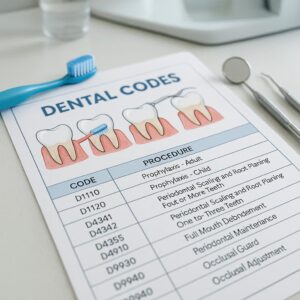
Dental Codes for Cleaning
What Exactly is a Dental Code?
Before we dive into the specific codes for cleaning, let’s take a step back. In the dental world, procedures are standardized using a system called CDT Codes (Current Dental Terminology) . Think of these as a universal language for dentists and insurance companies.
When your dentist says, “You need a cleaning,” they translate that service into a specific five-character code (starting with the letter D) to tell your insurance company exactly what was done. This ensures that whether you are in California or Maine, the procedure for a “regular cleaning” is billed the same way.
For the purposes of this guide, we will focus on the most common codes you will encounter. The main dental code for cleaning isn’t just one code—it’s a family of codes, each describing a different level of care.
The Three Main Types of Dental Cleaning Codes
Let’s get to the heart of the matter. There are three primary codes you will see on your dental paperwork. Understanding the difference between them is crucial because insurance plans often cover them at different percentages.
| CDT Code | Procedure Description | What It Means for You |
|---|---|---|
| D1110 | Prophylaxis – Adult | A standard “routine cleaning” for patients with healthy gums. It involves removing plaque, tartar, and stains. |
| D1120 | Prophylaxis – Child | The same as the adult code, but specifically for patients under the age of 14. It is a preventive measure for growing smiles. |
| D4910 | Periodontal Maintenance | A “maintenance cleaning” for patients who have a history of gum disease (periodontitis). It follows a more involved treatment (like scaling and root planing). |
Let’s explore each of these in detail.
D1110: The Standard Adult Prophylaxis
This is the code you will likely see most often. If you go to the dentist every six months for a check-up and have generally healthy gums, D1110 is the code your dentist will use.
What does D1110 involve?
This is your classic “scale and polish.” It is a preventive service aimed at keeping healthy patients healthy. Here is what happens during this appointment:
-
Supragingival and Subgingival Calculus Removal: The dentist or hygienist removes tartar (hardened plaque) from above and slightly below the gumline.
-
Plaque Removal: All soft, sticky plaque is meticulously removed from all tooth surfaces.
-
Stain Removal: Using a polisher, they buff away surface stains caused by coffee, tea, or tobacco.
-
Oral Hygiene Instructions: You’ll likely get a refresher on brushing and flossing techniques.
Why is it important?
Think of D1110 as the oil change for your car. It’s routine, it’s preventive, and it stops much bigger (and more expensive) problems from developing down the road. It keeps your gums healthy and prevents the onset of gum disease.
Important Note for Readers: Most dental insurance plans cover D1110 at 100% twice a year. This is because insurance companies know that prevention is cheaper than treatment. If you have insurance, take full advantage of this benefit!
D1120: The Child Prophylaxis
Children aren’t just small adults, and their dental needs are different too. Code D1120 is specifically for the prophylaxis (cleaning) of primary or transitional dentition.
What does D1120 involve?
The procedure is very similar to D1110 but is tailored for a child’s mouth. The hygienist will:
-
Remove plaque and tartar from the baby teeth and permanent teeth.
-
Polish the teeth to remove stains.
-
Provide age-appropriate instructions on brushing and flossing.
-
Often, this appointment includes a discussion about diet, thumb-sucking, and fluoride.
Why is it important?
Establishing a “dental home” for a child early on is vital. These visits acclimate them to the dental environment, making them less anxious as they grow. More importantly, keeping baby teeth healthy is essential for proper chewing, speech development, and holding space for permanent teeth.
D4910: Periodontal Maintenance
This is the code that often causes confusion. While D1110 is for healthy gums, D4910 is for patients who have been diagnosed with periodontitis (a more advanced form of gum disease) and have undergone active treatment, such as scaling and root planing (SRP, codes D4341 or D4342).
What does D4910 involve?
Periodontal maintenance is not just a “deep cleaning.” It is a therapeutic procedure designed to keep gum disease under control. It is more involved than a standard cleaning and includes:
-
Supragingival and Subgingival Calculus Removal: The hygienist will remove tartar from both above and deep below the gumline, in the “pockets” that have formed due to gum disease.
-
Scaling and Root Planing: They will smooth the root surfaces to make it harder for bacteria to re-attach.
-
Site-Specific Evaluation: The hygienist will carefully measure the depth of gum pockets around each tooth to monitor the disease’s status.
-
Detection of Recurring Disease: They are looking for areas where the disease might be becoming active again.
-
Irrigation: Sometimes, they will irrigate the gum pockets with antimicrobial agents.
Why is this code different?
Think of it this way:
-
D1110 (Prophylaxis) is like getting your house professionally cleaned every month because you are tidy.
-
D4910 (Periodontal Maintenance) is like getting your house professionally cleaned every month after you’ve had a major flood. You need to check for mold, ensure the structure is drying properly, and manage the ongoing risk.
Periodontal maintenance is typically recommended every 3-4 months, rather than every 6 months, to keep the bacterial levels under control.
Crucial Insurance Note: Many insurance plans have a different benefit level for D4910. It might be covered at 50-80% instead of 100%, and there may be a frequency limitation (e.g., covered only twice a year, even if your dentist recommends it four times a year). Always check with your provider.
Other Related Codes You Might Encounter
While D1110, D1120, and D4910 are the big three for routine and maintenance cleanings, there are a few other codes that sometimes get lumped into the “cleaning” category. It is helpful to know what these are, as they represent a different level of care.
D4341 & D4342: Scaling and Root Planing (The “Deep Cleaning”)
This is the big one. You will hear these codes when a patient has active gum disease (periodontitis). This is not a routine cleaning; it is a therapeutic procedure to treat a disease.
-
D4341: Periodontal scaling and root planing – four or more teeth per quadrant.
-
D4342: Periodontal scaling and root planing – one to three teeth per quadrant.
What’s the difference from a regular cleaning?
In a regular cleaning (D1110), the focus is on the visible part of the tooth and just slightly below the gumline. In a deep cleaning (D4341/4342), the dentist or hygienist will numb you with local anesthetic to clean deep down to the root of the tooth, removing bacteria and tartar from the deep pockets. This procedure is often the first step in getting gum disease under control, and it paves the way for future D4910 maintenance visits.
D1351: Silver Diamine Fluoride Application
This is not a cleaning, but you might see it alongside a cleaning code. It is a preventative/arrestment treatment where a liquid is painted on teeth to stop cavities from getting worse. It is becoming a popular, minimally invasive option, especially for children or those with special needs.
D1206 & D1208: Topical Fluoride Application
These codes are for fluoride treatments. If you have a cleaning and then the hygienist puts trays of foam or varnish on your teeth, they will bill one of these codes separately. D1206 is for fluoride varnish, and D1208 is for topical fluoride (like the foam or gel).
Why Your Cleaning Code Matters for Your Wallet
Understanding the dental code for cleaning on your treatment plan is the single best way to avoid surprise bills. Here is a common scenario that plays out in dental offices every single day:
The Scenario:
-
Patient: “Hi, I’m here for my free cleaning.”
-
Dentist (after exam): “I see you have some gum disease. You need a deep cleaning.”
-
Patient (at the front desk): “Wait, I was told my cleaning was free!”
What happened?
The patient assumed “cleaning” meant D1110 (Prophylaxis). The dentist, after examining them, diagnosed a condition that requires D4341 (Scaling and Root Planing). Because D4341 is a therapeutic procedure to treat a disease, it is billed differently and has a different insurance coverage level (often subject to your deductible).
How to be a savvy patient:
-
Ask for the Code: When the treatment coordinator gives you a treatment plan, ask for the CDT codes. It is your right to know.
-
Call Your Insurance: You can call the number on the back of your card and ask, “What is my coverage for D1110? What is my coverage for D4341?” This gives you a realistic picture of your costs.
-
Understand Your Diagnosis: If your dentist says you need a “deep cleaning” or “periodontal maintenance,” ask why. Understanding the health aspect helps you understand the financial aspect.
A Comparative Look: D1110 vs. D4910 vs. D4341
To make this crystal clear, let’s put these three heavy-hitters side-by-side.
| Feature | D1110 (Prophylaxis) | D4910 (Perio Maintenance) | D4341 (Scaling & Root Planing) |
|---|---|---|---|
| Patient Health | Generally healthy gums (gingivitis is reversible, but not active periodontitis). | History of periodontitis. Disease is controlled but managed. | Active periodontitis. Active disease state. |
| Goal | Prevention. Keep healthy patients healthy. | Maintenance. Keep controlled disease from flaring up. | Treatment. Stop active disease. |
| Area of Focus | Above the gumline and slightly below. | Above and deeply below the gumline. | Deeply below the gumline, on the roots. |
| Anesthetic | Usually not required. | Sometimes required for sensitive areas. | Almost always required for patient comfort. |
| Frequency | Every 6 months (standard). | Every 3-4 months, as prescribed. | As a one-time (per quadrant) treatment series. |
| Insurance View | 100% Preventive benefit. | 50-80% Therapeutic benefit, subject to limits. | 50-80% Therapeutic benefit, subject to your deductible. |
Common Questions Patients Ask About Cleaning Codes
Let’s address some of the real-world questions people have when they see these codes on their bills.
“Why did my insurance deny my cleaning?”
There are a few common reasons for this:
-
Frequency Limitation: You already had two cleanings in the past 12 months. Insurance is based on a calendar year, fiscal year, or rolling 12-month period. Check your policy.
-
Code Mismatch: Your dentist billed D4341 (deep cleaning), but you expected your routine D1110 benefit. Your insurance paid their portion for D4341, but because you hadn’t met your deductible, you owe the rest.
-
Plan Max Reached: You’ve reached the maximum amount your insurance will pay for the year.
-
Code Not Covered: While rare for basic codes, some stripped-down plans may not cover periodontal maintenance (D4910) at all.
“My dentist says I need a ‘gum treatment’ instead of a cleaning. What code is that?”
This is usually code D4341 (Scaling and Root Planing) or a code for a more advanced surgical procedure. It’s not a “cleaning” in the traditional sense; it’s a treatment for a bacterial infection in your gums. It’s the dental equivalent of needing antibiotics and wound care for an infection on your leg, rather than just washing it.
“Can I ask my dentist to use a different code so my insurance pays for it?”
This is a big NO. This is called insurance fraud. It is illegal to bill for a service that was not performed. If you had a simple cleaning (D1110), your dentist cannot bill it as a deep cleaning (D4341) to get more money from the insurance company. Likewise, they cannot bill a deep cleaning as a simple cleaning. Honest coding is the foundation of ethical dental practice.
Conclusion
In a nutshell, the dental code for cleaning is not a one-size-fits-all number. It is a specific language used to describe the exact type of care your gums need, ranging from a simple preventive polish (D1110) to ongoing management of gum disease (D4910) and active treatment (D4341). By understanding these key codes, you empower yourself to ask better questions, understand your treatment plan, and navigate your dental insurance with confidence, turning confusion into clarity one code at a time.
Frequently Asked Questions (FAQ)
1. What is the most common dental code for a routine cleaning?
The most common code is D1110, which stands for “prophylaxis – adult.” It is the standard preventive cleaning for patients with healthy gums.
2. What is the difference between D1110 and D4910?
D1110 is a preventive cleaning for patients with healthy gums. D4910 (periodontal maintenance) is a therapeutic cleaning for patients with a history of gum disease, aimed at keeping the disease under control. D4910 is typically more involved and may be recommended every 3-4 months.
3. Is a “deep cleaning” the same as a regular cleaning?
No. A “deep cleaning” is the common term for Scaling and Root Planing (D4341 or D4342) . It is a therapeutic treatment for active gum disease that involves cleaning below the gumline, often with local anesthetic. A regular cleaning (D1110) is a preventive service focused on the visible parts of the teeth.
4. How often does insurance pay for a dental cleaning (D1110)?
Most dental insurance plans cover a prophylaxis (D1110) at 100%, twice per calendar or benefit year. However, it is always best to verify your specific plan details, as some may have different limitations.
5. Why did my dentist say my “free” cleaning isn’t free?
If you were diagnosed with gum disease, your dentist likely recommended a therapeutic procedure like Scaling and Root Planing (D4341) instead of a routine prophylaxis (D1110). Therapeutic procedures are billed differently and often require you to pay your deductible or coinsurance, unlike preventive services.
6. What does the code D1120 mean?
D1120 is the code for a “prophylaxis – child.” It is a preventive cleaning tailored for patients under the age of 14, focusing on primary or mixed dentition.
Disclaimer:
The information provided in this article is for general informational purposes only and does not constitute professional medical or dental advice. Always seek the advice of your qualified dentist or other qualified health provider with any questions you may have regarding a dental condition or treatment. Insurance policies and coverage vary widely. You should consult with your insurance provider to understand the specifics of your plan.
Date: March 09, 2026


