
If you are considering straightening your teeth—or if you are a dental professional looking to streamline your billing process—you have likely run into a confusing wall of numbers and abbreviations. Dental insurance is a language of its own, and when it comes to modern orthodontic treatments like clear aligners, knowing the correct “dental code for clear aligners” is the difference between a smooth approval and a denied claim.
Whether you are a patient trying to understand your EOB (Explanation of Benefits) or a practice manager submitting claims, this guide is designed to walk you through everything you need to know. We will keep it simple, practical, and honest—no fluff, just the facts you need.
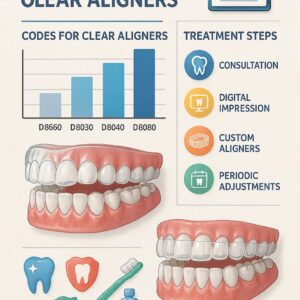
Dental Codes for Clear Aligners
What Exactly is a Dental Code?
Before we dive into the specifics of aligners, let us take a step back. In the dental world, procedures are standardized using a system called CDT codes (Current Dental Terminology). These are five-character alphanumeric codes (starting with the letter “D”) that describe specific dental procedures. Insurance companies use these codes to determine what they will pay for and what the patient is responsible for.
Think of it as a menu. The patient comes in with a problem, the dentist selects the correct “dish” (code) from the menu, and the insurance company looks at that dish to see if it is covered under the patient’s plan.
The Primary Dental Code for Clear Aligners
When it comes to clear aligner therapy (like Invisalign or other similar systems), the dental code you will hear most often is D8080.
-
Code: D8080
-
Description: Comprehensive Orthodontic Treatment of the Adolescent Dentition
Wait—adolescent? That might sound confusing if you are an adult seeking treatment. Historically, orthodontic codes were designed around age groups, but D8080 has become the standard code used for comprehensive orthodontic treatment involving clear aligners for both adolescents and adults, provided the treatment involves the full arch and aims to correct a significant malocclusion (bad bite).
However, there is a sibling code you need to know:
-
Code: D8090
-
Description: Comprehensive Orthodontic Treatment of the Adult Dentition
Important Note: While D8090 exists specifically for adults, many insurance companies process D8080 and D8090 identically in terms of coverage and benefits. The distinction often comes down to the patient’s age at the time of treatment. Always check the specific payer policies, as some plans require the adult code for patients over the age of 19.
When to Use These Codes
You use the D8000 series codes (Orthodontics) when the treatment is about movement of teeth to correct alignment and bite issues. This is different from a general dentist code used for a single procedure. Clear aligner treatment is considered a “comprehensive” service because it covers the entire mouth over an extended period (usually 6 to 24 months).
Alternative Codes: Not All Aligner Treatment is the Same
Here is where things get a bit nuanced. The clear aligner industry has exploded, and not every set of clear aligners is considered “comprehensive orthodontics.” Sometimes, a patient might need a minor touch-up, or they might be using aligners for a very simple case.
Here are some other codes you might encounter:
-
D8010: Limited Orthodontic Treatment of the Primary Dentition
-
D8020: Limited Orthodontic Treatment of the Transitional Dentition
-
D8030: Limited Orthodontic Treatment of the Adolescent Dentition
What does “Limited” mean?
“Limited” treatment usually refers to moving fewer teeth or addressing a specific issue (like closing a small gap in the front teeth) rather than correcting the entire bite. If a patient is getting aligners just for the upper arch, or just to fix a single rotated tooth, a limited code might be more appropriate than the comprehensive D8080.
The “Minor” Treatment Code: D8999
You may also see the code D8999. This is a wildcard. It stands for “Unspecified Orthodontic Procedure, by Report.”
If a dentist is providing a very minor aligner treatment—sometimes called “express” or “lite” treatment—that doesn’t fit the criteria for a full comprehensive or limited code, they might use D8999. Because it is “unspecified,” the dentist must attach a narrative (a written report) explaining exactly what was done and why. Insurance companies are often wary of this code, as it requires manual review.
Comparing the Common Aligner Codes
To make it easier to see the differences, here is a simple breakdown:
| Code | Description | Typical Use Case for Aligners |
|---|---|---|
| D8080 | Comprehensive Orthodontic Tx (Adolescent) | Full upper and lower arch treatment for teens/adults. |
| D8090 | Comprehensive Orthodontic Tx (Adult) | Full upper and lower arch treatment for patients 19+. |
| D8030 | Limited Orthodontic Tx (Adolescent) | Aligners for a minor correction (e.g., closing a small gap). |
| D8999 | Unspecified Procedure (by report) | Very minor touch-ups or “Lite” programs not fitting other codes. |
Does Insurance Cover Clear Aligners?
This is the million-dollar question. The code is just the key; the lock is your specific insurance policy.
Here is the honest truth: Orthodontic benefits vary wildly.
-
Medical vs. Dental: Clear aligners are almost always a dental benefit, not medical.
-
Orthodontic Riders: Many dental insurance plans do not include orthodontic coverage for adults. They might cover it for children under 19, but adult straightening is often considered “cosmetic.”
-
Lifetime Maximums: Even if you have orthodontic coverage, it usually comes with a separate “Lifetime Maximum.” For example, your plan might cover 50% of orthodontic treatment up to a lifetime max of $1,500. Since comprehensive orthodontics can cost between $3,000 and $8,000, insurance often covers only a portion.
-
Medical Necessity: Insurance is more likely to pay if the treatment is deemed “medically necessary” rather than purely cosmetic. If you have difficulty chewing, speech problems, or TMJ issues related to your bite, your claim has a higher chance of approval.
A Note for Patients: Do not assume your aligners are “free” just because you have insurance. Always ask your provider to do a “predetermination of benefits.” They send the code (like D8080) and the X-rays to your insurance before you start, and the insurance sends back a letter telling you exactly what they will pay.
The Difference Between In-Network and Out-of-Network
When a dental office uses the correct “dental code for clear aligners,” the reimbursement also depends on whether the dentist is “in-network” with your insurance.
-
In-Network: The dentist has signed a contract with the insurance company. They agree to a set fee, and the insurance pays a portion. This usually results in lower out-of-pocket costs for you.
-
Out-of-Network: The dentist does not have a contract. They can charge their usual fee, and your insurance will pay based on what they deem “reasonable and customary.” You may have to pay the difference.
Many high-end orthodontic practices that specialize in clear aligners choose to stay out-of-network to maintain control over their treatment quality and fees. This does not mean you cannot use your insurance; it just means the billing process looks a little different.
How the Billing Process Works
Understanding the flow of information can help demystify why certain codes are used.
-
The Diagnosis: The dentist examines your teeth, takes X-rays, photos, and scans. They determine you are a candidate for clear aligners.
-
The Treatment Plan: They decide whether the case is “Comprehensive” (D8080) or “Limited” (D8030).
-
The Predetermination: The office sends a claim to your insurance with the code, the scans, and the proposed fee. They wait for the insurance to respond.
-
The Financial Agreement: Once the insurance benefit is known, the office presents you with a financial plan. This usually involves a down payment and monthly installments, as orthodontic treatment is rarely paid in one lump sum.
-
The Claim Submission: When treatment starts, the office submits the final claim. For orthodontics, insurance companies often pay in installments (e.g., 50% down, 25% at six months, 25% at completion) to ensure the patient stays in treatment.
Why Coding Accuracy Matters
Using the wrong code can lead to a lot of headaches.
-
Denied Claims: If you use a code for a single visit (like a D code for a filling) for orthodontic treatment, it will be instantly rejected.
-
Delayed Treatment: If the code doesn’t match the attached records (X-rays/photos), the insurance company may request more information, delaying your start date.
-
Insurance Fraud: Purposefully using the wrong code to get a procedure covered is illegal. For example, billing a cosmetic aligner case under a code for “sleep apnea” treatment would be fraudulent.
The Rise of Direct-to-Consumer Aligners and Coding
You may have seen companies offering aligners sent directly to your home without visiting a dentist. How do these fit into the coding world?
Generally, they don’t. Direct-to-consumer companies often operate outside of the traditional dental insurance framework. Because there is no in-person doctor supervising the treatment, insurance companies are hesitant to cover them under traditional orthodontic codes.
If you go through a direct-to-consumer company, you will likely pay 100% out-of-pocket. However, if you experience issues and need to see a dentist to fix something, that dentist will use a code—potentially a limited orthodontic code (D8030) or a monitoring code—to bill your insurance for the repair work.
Future Trends in Aligner Coding
The dental codes are updated every year by the American Dental Association (ADA). As technology evolves, we may see more specific codes for different types of aligner therapy. Currently, the codes don’t differentiate between Invisalign, 3M Clarity, or Spark—they just describe the type of movement (comprehensive or limited).
There is also a growing conversation about integrating “teledentistry” codes with aligner treatment, which would allow for remote monitoring check-ins to be billed separately.
Frequently Asked Questions (FAQ)
1. Can I use my FSA or HSA to pay for clear aligners?
Yes. In almost all cases, Flexible Spending Accounts (FSA) and Health Savings Accounts (HSA) can be used to pay for orthodontic treatment, including clear aligners. Since the IRS considers orthodontics to be a qualified medical expense, you can use pre-tax dollars to cover your copays and monthly payments.
2. What is the difference between D8080 and D8090?
The technical difference is age. D8080 is the code for “Adolescent” dentition, while D8090 is for “Adult” dentition. In practice, many insurance companies treat them the same. Your dentist will choose the code based on your age and the specific requirements of your insurance plan.
3. My dentist said my aligners are “cosmetic.” Will insurance still pay?
If the treatment is purely cosmetic (you just don’t like the look of a slightly crooked tooth), insurance will likely deny the claim. However, if that crooked tooth causes bite issues, gum recession, or difficulty cleaning, it becomes a “functional” or “medically necessary” issue. Your dentist must document these functional problems in their notes to support the orthodontic code.
4. How much does insurance usually cover for D8080?
It varies, but a common benefit is 50% of the treatment cost, up to a lifetime maximum (often $1,000 to $2,500). For example, if your treatment is $5,000, and you have a $1,500 lifetime max, your insurance pays $1,500, and you are responsible for the remaining $3,500.
5. Can I get a refund if my treatment stops early?
This is between you and your dental provider, not the insurance code. Most orthodontic treatment agreements are for the entire treatment plan. If you stop early, the dentist has still invested in the initial setup, scans, and aligner manufacturing. Discuss the financial terms of your contract carefully before signing.
Additional Resources
Navigating dental benefits can be tricky. For official information on dental coding and terminology, the best resource is the American Dental Association (ADA). They publish the CDT Code Book annually, which is the definitive guide for all dental codes.
-
[Link to American Dental Association (ADA) – CDT Code Resource] (Note: As a writer, I recommend searching for “ADA CDT Code” on your preferred search engine to find the latest official publication or purchase the codebook).
Conclusion
Understanding the dental code for clear aligners is essential for a smooth treatment journey. The primary codes are D8080 for comprehensive adolescent treatment and D8090 for adults, though coverage depends entirely on your specific insurance plan. By working closely with your provider to verify benefits and choose the correct code, you can navigate the financial side of your smile transformation with confidence.
Disclaimer: This article is for informational purposes only and does not constitute legal, billing, or medical advice. Dental codes and insurance policies vary by provider, location, and individual plan. Always consult with your dental insurance provider and your treating dentist to verify coverage and appropriate coding for your specific situation.


