If you have ever sat down to code a crown procedure and hesitated over whether to bill for the custom tray, you are not alone. Dental coding often feels like navigating a maze, and custom trays—those essential tools used to create precise restorations or administer fluoride—are frequently the source of confusion and claim denials.
Understanding the correct “dental code for custom trays” is not just about getting paid; it is about compliance, accuracy, and ensuring your hard work in the lab or chairside is properly documented.
In this guide, we will strip away the complexity. Whether you are billing for a single crown, a full arch of implants, or a simple whitening procedure, you will learn exactly which Current Dental Terminology (CDT) codes to use, when to use them, and how to avoid the costly mistakes that trigger audits.
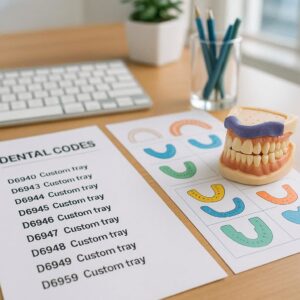
Dental Codes for Custom Trays
Table of Contents
ToggleWhat Exactly is a “Custom Tray” in Dentistry?
Before we dive into the numeric codes, we need to establish a clear definition. In dental billing, a “custom tray” is not the plastic stock tray you pull off the shelf for a quick fluoride treatment. It is a device specifically fabricated on a diagnostic cast of the patient’s mouth.
The Distinction:
-
Stock Trays: Pre-fabricated, one-size-fits-most. Usually included in the procedure cost.
-
Custom Trays: Fabricated specifically for the patient to ensure accurate impression material distribution or precise delivery of a bleaching agent.
Think of it this way: a stock tray is like buying a pair of “one-size-fits-all” socks. A custom tray is a bespoke suit, tailored perfectly to the individual. Because a custom tray requires significant labor and lab time to create from a stone model, it is a billable service.
The Core Dental Codes for Custom Trays
The CDT manual, published by the American Dental Association (ADA), provides specific codes for different types of trays. Using the wrong one can lead to immediate rejection. Here are the primary codes you need to know.
D3990: The Workhorse for Crowns and Bridges
If you are a general dentist or a prosthodontist, D3990 is likely the code you will use most often.
-
Official Descriptor: “Custom Tray”
-
Common Usage: This code is used when fabricating a custom tray for the purpose of taking impressions for indirect restorations like crowns, bridges, inlays, onlays, or partial dentures.
Important Note: D3990 is typically billed separately from the restoration itself. If you are sending a patient to a specialist (like an oral surgeon) and need to provide a custom tray for them, this is the code to use.
D6992: The Implant Precision Code
Implant dentistry requires micron-level precision. You cannot rely on a stock tray to accurately capture implant positions.
-
Official Descriptor: “Custom Abutment Tray”
-
Common Usage: This specific code is used when a custom tray is fabricated to make an impression of an implant abutment or the implant itself (implant level impressions). Because implant components are often bulky and require precise alignment to avoid distortion, this tray is custom-made to accommodate pickup impressions.
Important Note: Many dental insurance plans bundle implant procedures. However, the custom tray (D6992) is often considered a separate, reimbursable part of the surgical or restorative phase. Ensure your narrative supports the medical necessity.
D5511: The Orthodontic and Labial Arch Tray
Orthodontics and certain labial arch impressions require trays that cover specific areas differently than standard posterior trays.
-
Official Descriptor: “Labial Arch Tray”
-
Common Usage: Used primarily in orthodontics for taking impressions of the labial (lip) side of the arch, or for specific partial cases. While technically a tray, it often falls under the umbrella of “custom” when fabricated on a model for a specific patient arch form.
Bleaching Trays: D9975 and D9999 Confusion
This is where coding gets tricky. Many offices mistakenly use generic codes for whitening trays.
-
D9975: “Indirectly Fabricated Occlusal Appliance” – While sometimes used for night guards, this is not the correct code for bleaching trays. Using it for whitening is a misrepresentation of the service.
-
D9999: “Unspecified Adjunctive Procedure” – You should avoid this code at all costs for routine bleaching trays. Insurance companies view it as a “red flag” code because it lacks specificity, often leading to denials or requests for records.
The Reality: Most dental insurance plans consider cosmetic bleaching (and the associated trays) a non-covered service. Therefore, you will likely be billing the patient directly. Because of this, there is a tendency to be casual about the code. Always use the code that accurately describes the service. If you must bill insurance for a medically necessary bleaching tray (for example, for fluorosis cases), ensure you have pre-authorized the procedure and use the most accurate code available, often requiring a detailed narrative.
The “Hidden” Trays: When the Tray is Included
A crucial aspect of mastering dental coding is knowing when not to bill separately. Some procedures bundle the custom tray into the global fee.
Complete and Partial Dentures
When you look at denture codes, the tray is part of the process.
-
D5110 and D5120 (Complete Dentures): The fee for these codes includes all necessary steps: impressions, bite registration, try-ins, and delivery. The custom tray is considered a component of the impression step.
-
D5211-D5214 (Partial Dentures): Similarly, these codes are comprehensive. You cannot bill an additional D3990 for the custom tray used to take the master impression for the partial framework. The reimbursement for the partial is designed to cover that lab cost.
Denture Relines and Repairs
If you are performing a reline (D5410, D5411), you are essentially taking a new impression inside the existing denture. The denture itself acts as the tray. Billing a separate custom tray code here would be duplicative and incorrect.
Custom Trays in Prosthodontics and Implantology
For complex cases, the custom tray is not just a convenience; it is a clinical necessity. This is where documentation becomes your best friend.
Why Specialists Demand Custom Trays
When a patient is referred to an oral surgeon or a periodontist for implant placement, the general dentist often sends a custom tray.
-
The Narrative: If you are the referring doctor, your claim (or the narrative accompanying the tray) should state: “Custom impression tray fabricated for implant-level impression to ensure passive fit of final prosthesis.” This justifies the D6992 or D3990 code.
The “Pick-Up” Impression
In implantology, you often perform a “pick-up” impression where the impression copings are splinted together and then “picked up” in the impression material. A stock tray is usually too shallow or wide, leading to distortion.
-
The Solution: A custom tray (D6992) provides a rigid, perfectly spaced platform that ensures the impression material is of uniform thickness, minimizing shrinkage and distortion during the pouring of the master cast.
A Step-by-Step Guide to Billing D3990
Let’s walk through a standard crown procedure to see how D3990 fits into the workflow.
-
Diagnostic Cast: The doctor takes a preliminary impression (often with alginate in a stock tray) to create a stone model. (This step is not billed separately).
-
Tray Fabrication: The lab or dental assistant fabricates a custom tray on that stone model using acrylic or light-cured resin.
-
The Billing Event: When the patient returns for the crown preparation appointment, the doctor uses this custom tray to take the final impression.
-
Claim Submission:
-
D2740 (Crown – Porcelain/Ceramic) – or appropriate crown code.
-
D3990 (Custom Tray) – Billed separately on the same claim date of service.
-
D2952 (Core Buildup) – if applicable.
-
Payer Logic: Insurers understand that you cannot take a high-quality master impression without a proper tray. While some PPO plans may bundle D3990 into the crown fee, most traditional plans recognize it as a separate, necessary component.
Common Denials and How to Avoid Them
Receiving a denial for a custom tray code is frustrating. Here is why it happens and how to fix it.
Denial Reason 1: “Procedure Not Covered Separately”
-
The Problem: The insurance adjuster believes the tray is “included” in the crown or bridge fee.
-
The Solution:
-
Check the Contract: Review the patient’s benefit summary. Does it explicitly bundle “impression materials and trays”?
-
Appeal with a Narrative: Write a brief appeal letter. State: *”The custom tray (D3990) was fabricated on a diagnostic cast to ensure the dimensional accuracy of the final impression for the full-coverage restoration. This is a separate laboratory service distinct from the stock tray used for preliminary alginate impressions.”*
-
Denial Reason 2: Frequency Limitations
-
The Problem: You billed D3990 for a single crown, and then again for a bridge on the same arch a month later. The system flagged it.
-
The Solution: Most payers allow one custom tray per quadrant per course of treatment. If you are doing multiple restorations in the same quadrant over several months, you may need to justify why a new tray was needed (e.g., the old one was broken, or the arch form changed due to extractions).
Denial Reason 3: Missing Radiographs or Narratives
-
The Problem: You billed D6992 for an implant impression, but submitted it without the supporting documentation.
-
The Solution: Never bill complex codes in a vacuum. Attach the narrative and, if required, the periapical radiograph showing the implant body.
CDT Coding Guide: Quick Reference Table
To make your life easier, here is a quick reference table for the most common scenarios.
| Scenario | Recommended Code | Key Billing Considerations |
|---|---|---|
| Single Crown Impression | D3990 (Custom Tray) | Bill same day as crown prep (D2740, etc.). Check PPO fee schedules for bundling. |
| Full Arch Bridge Impression | D3990 (Custom Tray) | Bill per arch. Usually allowed once per quadrant. |
| Implant Level Impression | D6992 (Custom Abutment Tray) | Must be used for implant components. Requires a narrative. |
| Bleaching/Whitening Trays | (Cosmetic – Direct Patient Pay) | Use practice management software for ledger, not insurance claim forms. |
| Orthodontic Impressions | D8999 (or D5511) | Ortho fees are usually global; verify if the treatment plan includes all impressions. |
| Denture Construction | *Included in D5110/D5120* | Do not bill D3990 separately. It is part of the denture fee. |
List: Essential Documentation for Your Claim
To ensure a clean claim, ensure your notes include the following:
-
A clear description of the tray: “Light-cured acrylic custom tray fabricated on Dx cast.”
-
Medical Necessity: For implants, note: “Necessary for passive fit of implant prosthesis.”
-
Arch: Specify maxillary or mandibular.
-
Material Used: If it matters for the lab prescription.
Custom Trays vs. Other Appliances: Avoiding Code Confusion
It is easy to confuse a custom tray with other acrylic devices. Here is how to distinguish them:
-
Occlusal Guards / Night Guards (D9944-D9945): These are the final appliances worn by the patient. A custom tray is a tool used to make the final appliance or impression. They are not the same thing.
-
Stents (D5982): A surgical stent is used to guide implant placement. It is different from the impression tray (D6992) used after the implant has osseointegrated.
-
Baseplates (D5850): Used in denture fabrication to establish occlusion. These are part of the denture process (global fee).
The Future of Impression Coding: Digital vs. Traditional
As we move further into the digital age, the conversation around custom trays is evolving.
Digital Impressions (Intraoral Scanners)
When you use a digital scanner (like iTero or Trios), there is no physical impression and no physical custom tray.
-
The Coding Shift: You cannot bill D3990 for a digital scan. The cost of the scanner and the time is typically absorbed into the practice overhead and the doctor’s fee for the restoration.
-
Future Codes: As of now, there is no specific CDT code for “digital impression” separate from the restoration. It is a value-add that increases accuracy but does not generate a separate billing code.
The “Print” vs. “Press” Debate
Even in a digital workflow, you might still need a physical model. You can either 3D print a model or pour one in stone.
-
3D Printed Trays: Some labs are now designing custom trays digitally and 3D printing them. The service remains the same (a custom tray), so D3990 remains the appropriate code. The method of fabrication does not change the code.
Best Practices for Dental Billers and Coders
To master these codes, incorporate these habits into your daily routine:
-
Verify Benefits Early: When treatment planning a large case, call the insurance company and ask: “Does the plan cover custom impression trays (D3990) separately, or are they bundled into the major restoration benefits?”
-
Use the Correct Code the First Time: Do not use D9270 (unspecified implant service) for D6992. Specificity prevents audits.
-
Appeal Strategically: If D3990 is denied, appeal. It has a high success rate because it is a verifiable lab cost.
-
Educate the Doctor: Remind the clinical team that if they are spending 15 minutes fabricating a custom tray, that time and material has value and should be captured in the billing.
Conclusion
Navigating the “dental code for custom trays” landscape doesn’t have to be intimidating. By distinguishing between the workhorse code D3990 for standard crowns and bridges, the precision-focused D6992 for implants, and recognizing when trays are globally bundled, you can ensure your practice is reimbursed accurately for the labor and materials invested. Accurate coding protects your practice from audits and ensures patients receive the high-quality, precise care that custom trays provide.
Frequently Asked Questions (FAQ)
1. Can I bill D3990 and D6992 on the same day for the same patient?
Yes, if the procedures are in different arches or if one is for a crown and one is specifically for an implant component. However, billing two custom trays for the same arch on the same day would likely be considered duplicate and denied.
2. Is D3990 covered by medical insurance if the dental procedure is related to a medical condition?
Occasionally. If the dental procedure is part of a medically necessary service (e.g., pre-radiation oncology stents or trauma reconstruction), you may need to bill the associated medical insurance. You would use the medical CPT codes (which are different from CDT codes) and provide extensive documentation.
3. My dentist made a custom tray for a study model. Is that billable?
Generally, no. Study models (D0470) are diagnostic. If the tray is made specifically to create the study model, it is usually included in the diagnostic service fee.
4. What happens if I use the wrong code?
Using the wrong code can lead to claim denials, delayed payments, or, in cases of consistent miscoding (like using an implant code for a standard crown), it can trigger a fraud investigation or audit from the insurance carrier.
5. Do I need to include photos of the custom tray?
While not usually required for standard claims (D3990), for complex implant claims (D6992), including intraoral photos of the tray in place with the impression material can expedite the appeal process if the claim is initially denied.
Additional Resource
For the most up-to-date information on coding rules, it is essential to consult the official source. We highly recommend reviewing the latest edition of the ADA’s Current Dental Terminology (CDT Manual). You can find it directly through the American Dental Association’s publishing division: Visit the ADA Catalog for the Official CDT Code Book (Please verify the current URL as this is subject to change by the ADA).
Disclaimer: This article is for informational purposes only and does not constitute legal or billing advice. Coding and reimbursement policies vary by payer, geographic region, and individual patient contracts. Always verify current coding rules with the applicable insurance carrier and consult with a certified dental coding specialist for complex cases.