
If you have recently finished orthodontic treatment or are looking for a solution to replace a missing tooth, you have likely encountered the term “Essix retainer.” These clear, removable appliances are a staple in modern dentistry. However, when it comes to the administrative side of things—specifically, insurance billing—things can get a little hazy.
You might be searching for the exact “dental code for essix retainer with tooth” and wondering why it isn’t as straightforward as it seems. You are not alone. This confusion is one of the most common questions in dental front offices and for patients trying to understand their benefits.
This guide aims to clear up that confusion once and for all. We will explore the nuances of dental procedure codes (Current Dental Terminology, or CDT codes), why a simple Essix retainer differs from one that replaces a tooth, and how to ensure your claim is processed smoothly. Whether you are a dentist, a office manager, or a patient, this article will provide you with the realistic, practical information you need.
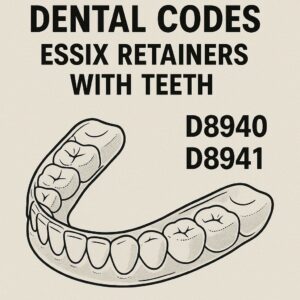
Dental Codes for Essix Retainers with Teeth
What is an Essix Retainer? A Quick Overview
Before diving into the complex world of codes, it is essential to understand what we are actually talking about. An Essix retainer is a type of orthodontic retainer made from a thin, transparent plastic material. It is vacuum-formed over a model of a patient’s teeth.
There are generally two types of Essix retainers:
-
The Standard Essix: This retainer covers the entire arch of teeth. Its primary purpose is to hold teeth in their new positions after braces or Invisalign treatment. It acts as a “seatbelt” for your teeth, preventing them from shifting back to their original positions.
-
The Essix with a Pontic (False Tooth): This is a variation where a false tooth (called a pontic) is attached to the clear retainer. This serves a dual purpose: it retains the alignment of the surrounding teeth and fills the gap of a missing tooth for aesthetic and functional reasons.
It is this second type—the Essix retainer with a tooth—that requires careful coding. It is no longer just a “retainer”; it is a combination of a retainer and a flipper (a type of partial denture).
The Core Dilemma: Why Is There No Single “Perfect” Code?
If you type “dental code for essix retainer with tooth” into a search engine, you might get conflicting answers. This is because the American Dental Association (ADA) does not have one single code that says “Essix retainer with a false tooth.” Instead, the correct code depends entirely on the reason the appliance is being made and the specific components involved.
Think of it like ordering a vehicle. If you need to carry lumber, you might code it as a “truck.” If you need to carry a family, you might code it as an “SUV.” They are both cars, but their function dictates the classification.
Similarly, an Essix retainer with a tooth can be classified in two main ways:
-
As an orthodontic retainer with a modified component.
-
As a removable partial denture (a prosthetic device).
Choosing the wrong code can lead to claim denials, reduced insurance payouts, or even accusations of insurance fraud. Let’s break down the specific codes used most frequently.
The Primary CDT Codes for Essix Retainers with Teeth
Based on the current CDT manual (D9999 and prior versions), there are three main codes you will encounter when dealing with an Essix retainer that includes a tooth replacement.
D5982: The “Workhorse” Code for Surgical Stent
This is arguably the most commonly discussed code in forums and dental offices for this specific appliance. However, there is a significant caveat: D5982 is technically defined as a “Surgical Stent.”
-
What it is: Originally, this code was designed for a device used to guide surgical procedures, often in implant placement.
-
How it applies: Over time, dental billers began using D5982 for Essix retainers with pontics because it describes a process of creating a “processed” appliance. When a lab adds a tooth to an Essix retainer, it is technically “processed” onto the plastic.
-
Realistic Use: Many insurance companies have accepted this code for Essix retainers with pontics for years because there was no better alternative. However, it is not always the most accurate descriptor.
When to potentially use D5982:
You might consider this code if the appliance is relatively simple and the primary purpose is to hold space and provide a temporary tooth while a more permanent solution (like an implant) is being finalized. It is often used for interim appliances.
Warning: Because it is a “stent” code, some insurance payers may deny it, stating that it is not a covered benefit for orthodontic retention or tooth replacement. Always check with the specific insurance carrier first.
D5919: The “Facial Moulage” Code (Less Common)
This code stands for “Facial Moulage (Sectional).” It is a prosthetic code.
-
What it is: In the past, this was used for creating facial prosthetics (like artificial ears or noses).
-
How it applies: It has been used by some creative billers for Essix retainers with teeth because it implies the creation of a prosthetic component (the tooth) on a base.
-
Realistic Use: This is a long shot and generally not recommended for standard Essix retainers. It is more likely to be flagged and denied than accepted. Stick to more conventional codes unless you have specific prior authorization from the insurance company to use this.
D5211 and D5212: The Partial Denture Codes
This is where we move from “retainer” territory to “prosthetic” territory.
-
D5211 (Maxillary Partial Denture – Resin Base): A removable partial denture for the upper arch with a base made of resin.
-
D5212 (Mandibular Partial Denture – Resin Base): The same but for the lower arch.
Why these codes matter:
If the Essix appliance is designed to replace multiple missing teeth and is intended for long-term use, it is functionally a temporary or transitional partial denture. The clear Essix material acts as the “resin base,” and the false tooth (or teeth) are the replacements.
The Key Difference:
If the appliance covers the entire palate or alveolar ridge (the bone that holds the teeth) and is primarily responsible for restoring the ability to chew and replacing teeth for the long term, it is a partial denture, not a retainer.
Using a partial denture code often results in higher coverage from dental insurance plans, as prosthetics are a standard benefit, whereas orthodontic retainers may not be covered post-treatment.
D8999: The Unspecified Code (Use with Caution)
This is the catch-all code for orthodontic appliances. D8999 (Unspecified Orthodontic Procedure) .
-
What it is: A “miscellaneous” code used when no other code accurately describes the procedure.
-
How it applies: If you have an Essix retainer with a tooth that is clearly for orthodontic retention (holding teeth in place after braces) but happens to have a pontic for aesthetic reasons, D8999 might be the most honest code.
-
The Problem: Insurance companies hate unspecified codes. They almost always require a detailed narrative, photographs, and models to justify the claim. They also often default to a “no coverage” position because the procedure isn’t explicitly listed in the patient’s benefits contract.
Realistic Advice: Only use D8999 if you have exhausted all other options and are prepared to submit a robust appeal with supporting documentation.
Comparative Table: Choosing the Right Code
To make this decision easier, here is a comparative guide to help you visualize which code might fit your specific scenario.
| Scenario Description | Recommended Code(s) | Rationale | Insurance Expectation |
|---|---|---|---|
| Post-Orthodontic Retention: Patient just finished braces. You make an Essix to hold teeth. It includes one pontic to fill a space where a tooth is missing (hypodontia). | D8999 (Unspecified Ortho) or D5982 (Surgical Stent) | The primary purpose is orthodontic retention. The pontic is secondary. D8999 is honest, D5982 is a common workaround. | May deny ortho codes if treatment is complete. May cover as part of global ortho fee. |
| Temporary Tooth Replacement: Patient is waiting for an implant to heal (3-6 months). They need a tooth in the gap for aesthetics. | D5982 | This is a temporary, interim appliance. It is not a long-term prosthetic. D5982 fits the “interim” nature well. | Often covered under major medical or as a one-time “interim appliance” benefit. |
| Long-Term Tooth Replacement: Patient has a missing tooth but cannot afford an implant or bridge right now. They need a functional, aesthetic replacement for the next few years. | D5211 / D5212 (Transitional Partial Denture) | The appliance is now functioning as a prosthesis. It replaces a tooth for chewing and appearance over a long period. | Subject to prosthetic maximums and deductibles. Often covered at 50%. |
| Multiple Missing Teeth: Patient is missing 3+ teeth in an arch. You create an Essix-like appliance (clear retainer) with multiple false teeth. | D5211 / D5212 | This is a partial denture. The fact that it is made of thin Essix material doesn’t change its prosthetic function. | Standard partial denture coverage. |
| Retainer with a “Spacer”: The “tooth” is just a plastic bump to hold space for a permanent tooth to erupt (in a child). | D5999 (or ortho space maintainer codes) | This is a space maintainer, not a prosthetic tooth. Consult pediatric codes. | Often covered under preventive or orthodontic benefits for children. |
Step-by-Step: How to Determine the Correct Code
If you are sitting in the dental office looking at a prescription for an “Essix with tooth,” follow this simple flowchart in your mind.
Step 1: Identify the Primary Purpose
Ask the doctor: “Why are we making this?”
-
Is it to hold teeth in place after orthodontic treatment? (Go to Step 2A)
-
Is it to replace a missing tooth for a patient who is not currently in orthodontic treatment? (Go to Step 2B)
Step 2A: The Orthodontic Route
If the primary purpose is orthodontic retention:
-
Is the patient still in their active treatment phase (global fee)? If yes, this may not be billed separately.
-
Is the patient out of their active phase? If yes, you need to bill for a new retainer.
-
Code: D8999 (with a clear narrative explaining the addition of the pontic for aesthetics/function).
Step 2B: The Prosthetic Route
If the primary purpose is tooth replacement:
-
How long is it expected to last?
-
Short-term (< 6 months): Code D5982 (Interim appliance).
-
Long-term (> 6 months): Code D5211/D5212 (Partial denture).
-
Step 3: Verify with the Payer
Before submitting the claim, call the insurance company. Do not just rely on the code. Ask them:
“We are planning to fabricate a clear thermoplastic retainer that will also replace a missing tooth using a processed pontic. Would this be considered under the patient’s prosthetic benefits (like a partial denture) or their orthodontic benefits? Which code would you prefer we use for processing?”
Getting a reference number for this conversation can save you hours of work later if the claim is denied.
The Importance of Documentation and Narrative
When dealing with non-standard coding situations like an Essix retainer with a tooth, the procedure code is only half the battle. The narrative (the explanation you attach to the claim) is equally important.
A strong narrative should include:
-
Medical/Dental Necessity: Why does the patient need this specific appliance?
-
Example: “Patient presents with agenesis of tooth #10. To prevent supra-eruption of opposing dentition and drifting of adjacent teeth #9 and #11, while providing acceptable esthetics during implant site development, an interim removable appliance with a processed pontic is required.”
-
-
Description of the Appliance: Describe exactly what was made.
-
Example: “A vacuum-formed thermoplastic retainer was fabricated on the maxillary arch. A pre-formed pontic tooth was processed and bonded into the edentulous space #10 to create a transitional tooth replacement.”
-
-
Supporting Evidence:
-
Send intraoral photos showing the missing tooth space.
-
Send photos of the model with the appliance.
-
Send radiographs showing the need (e.g., bone healing for an implant).
-
“In dentistry, the story you tell the insurance company is just as important as the code you use. A well-written narrative can turn a denied claim into a paid one.” – Common wisdom from Dental Billers.
Important Notes for Dental Professionals
-
Lab Fees: If you send this case to a lab to have the tooth processed onto the Essix, your lab fee will likely be higher than a standard retainer. Ensure your doctor’s fee accounts for this increased cost.
-
Patient Communication: Be upfront with the patient. Explain that because this is a hybrid appliance, their insurance might cover it differently than a standard retainer or a standard flipper. Provide them with a written estimate that explains the potential out-of-pocket cost.
-
State Regulations: Coding can sometimes be interpreted differently by state Medicaid programs. Always check your specific state’s dental manual for guidance on “removable appliances” and “retainers.”
Important Notes for Patients
If you are a patient reading this, here is what you need to know:
-
Your Insurance May Not Cover It: Many dental insurance plans consider retainers a “cosmetic” or post-orthodontic expense that isn’t covered once your braces are off. If the appliance is replacing a tooth, it may fall under a different category with a waiting period.
-
Get a Pre-Treatment Estimate: Ask your dentist to send a “pre-determination” or “pre-authorization” to your insurance company before the work is done. This will tell you exactly how much (if anything) they will pay.
-
The Code is the Dentist’s Job: You don’t need to worry about the specific code (D5982, D5211, etc.). Your job is to communicate your needs clearly to your dentist. They will handle the technical coding.
Additional Considerations: When the “Tooth” is for Space Maintenance
There is another scenario that sometimes confuses people: using an Essix-type retainer to hold space for a permanent tooth that hasn’t erupted yet (common in children). In this case, the “tooth” on the retainer isn’t really a prosthetic tooth; it’s a space maintainer.
For these cases, look into codes like:
-
D1510 (Space maintainer – fixed – unilateral)
-
D1520 (Space maintainer – fixed – bilateral)
-
D1570 (Space maintainer – removable – unilateral)
A removable space maintainer made of Essix material with a plastic tooth or spacer would fall under a removable space maintainer code, not the prosthetic codes listed above.
Conclusion
Finding the right dental code for an Essix retainer with a tooth is a puzzle, not a simple lookup. The solution depends on whether the appliance acts as a retainer or a prosthetic. By focusing on the primary purpose—retention versus long-term replacement—you can confidently choose between codes like D5982 for interim use or D5211 for a true partial denture. Always pair your chosen code with a detailed narrative to ensure the claim is processed accurately and fairly.
Frequently Asked Questions (FAQ)
1. Is D5982 the correct code for an Essix retainer with a false tooth?
It is the most commonly used code, but it is technically for a “surgical stent.” It works best when the appliance is temporary (interim). For long-term use, a partial denture code (D5211/D5212) is more accurate.
2. Will my insurance cover an Essix retainer that replaces a missing tooth?
Coverage varies widely. If it is considered a retainer (orthodontic), it may not be covered if your orthodontic benefits have expired. If it is considered a partial denture (prosthetic), it will likely be subject to your annual deductible and prosthetic maximum (often 50% coverage).
3. Can I use the same code for an upper and lower Essix with teeth?
Yes, but you must use the arch-specific code. For the upper arch, you would use D5211 (if billing as a partial). For the lower arch, you would use D5212. Modifiers are generally not used for this distinction; the code itself is arch-specific.
4. What if my insurance denies the claim?
Don’t give up. Review the denial reason. Often, it’s because the code doesn’t match the insurer’s internal guidelines. You can file an appeal with a strong narrative, photos, and a letter from your dentist explaining why the appliance was medically necessary.
5. Is an Essix retainer with a tooth considered a “flipper”?
Functionally, yes. A “flipper” is a colloquial term for a temporary partial denture. An Essix with a tooth is a modern, thinner version of a traditional acrylic flipper. In coding terms, they are often treated the same.
Disclaimer: This article is intended for informational purposes only and does not constitute legal or billing advice. Dental coding rules and insurance policies vary by provider, location, and plan. Always verify specific coding requirements with the relevant insurance payer and consult with a professional dental billing specialist before submitting claims.


