
If you are a dental professional, a student, or even a patient trying to decipher a complex treatment plan, you know that the world of dental coding can feel like a foreign language. It gets even more specific—and sometimes confusing—when you move from placing a new implant to managing one that is already in place.
So, you have a patient sitting in your chair. They have an implant that was placed years ago, maybe by a different dentist. Now, they need something done. Perhaps the crown is loose, the gum tissue is inflamed, or they are simply here for their regular check-up. What is the correct dental code for an existing implant?
This is not a one-size-fits-all answer. The code depends entirely on the procedure being performed. Is it a routine cleaning? A repair? A surgical revision?
In this comprehensive guide, we will strip away the complexity. We will walk through the most common scenarios involving existing implants and the precise CDT (Current Dental Terminology) codes to use. Whether you are looking for the code to maintain it, fix it, or take an image of it, you will find clear, realistic answers here.
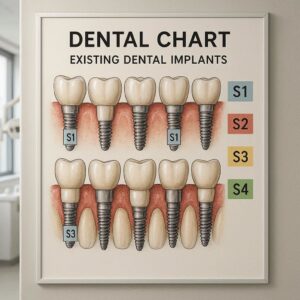
Dental Codes for Existing Implants
Understanding the D6000 Series: It’s All About the Prosthesis
Before we dive into the specifics, we need to establish a fundamental concept in implant coding. The American Dental Association (ADA) organizes implant codes into series. When we talk about an “existing implant,” we are usually past the surgical placement codes (D6000-D6199). We are now in the world of the prosthetics—the parts you can see and touch.
The most common mistake in coding for existing implants is using a code for a natural tooth procedure on an implant. They are not interchangeable. Insurance companies and the ADA have specific codes designed precisely for implant-supported restorations.
The Difference Between “Implant” and “Abutment” and “Prosthesis”
To code correctly, you must understand the anatomy of what you are working on:
-
The Implant Fixture: The metal post (usually titanium) that is surgically placed into the jawbone. This is the “existing implant” foundation.
-
The Abutment: The connector piece that sits on top of the implant fixture. It can be stock (prefabricated) or custom-made. The crown, bridge, or denture attaches to this.
-
The Prosthesis: The actual artificial tooth/teeth. This could be a crown (D6066), a bridge (D6068-D6071), or an overdenture.
When you are treating an existing implant, you are almost always coding for work done on the abutment, the prosthesis, or the surrounding tissue.
The Core Codes: Maintaining and Servicing an Existing Implant
Let’s look at the most frequent reasons a patient with an existing implant will need a dental procedure and the correct codes to describe that work.
1. The Periodic Check-Up: The Diagnostic Code (D0190)
An existing implant doesn’t change the need for a comprehensive exam. However, if a patient comes in specifically because they are concerned about an implant they already have, or you are doing a focused evaluation of that implant during a hygiene visit, you need the right code.
-
D0190: Screening of a Patient. This is a focused intraoral examination of an implant or specific area, not a comprehensive full-mouth evaluation. It is perfect for when a patient points to an implant and says, “It doesn’t feel right,” and you need to do a targeted check.
2. The Professional Cleaning: Implant Maintenance (D6080)
This is arguably the most common “dental code for existing implant” that practices search for. You cannot clean an implant the same way you clean a natural tooth. Using metal scalers on an implant can scratch the titanium surface, creating a rough area where bacteria thrive. This leads to peri-implantitis (implant infection).
Therefore, the standard “prophylaxis” code (D1110) is generally not appropriate for an implant.
-
D6080: Implant Maintenance Procedures, Including Removal of Prosthesis, When Performed, and Cleansing of Implant and Abutment.
This is your go-to code.
-
What it covers: Debridement (cleaning) of the implant surfaces, using specialized plastic or titanium-tipped instruments. It also includes polishing the prosthesis and checking for mobility.
-
Important Note: The code includes the “removal of the prosthesis, when performed.” If the crown is screw-retained and you take it out to clean underneath, this code covers that work. If it is cemented, you clean around it as best as possible, and the code still applies.
3. Taking a Picture: The Radiograph Code (D0220, D0230)
Just like with natural teeth, we need to see what is going on below the gum line. Bone loss around an implant is a silent disease. Radiographs are essential for monitoring an existing implant’s health.
-
D0220: Intraoral – Periapical First Radiographic Image. This is a single, focused image. Perfect for checking the bone level around one specific implant.
-
D0230: Intraoral – Periapical Each Additional Image. If you need to check two adjacent implants, you would use D0220 for the first and D0230 for the second.
4. The Soft Tissue Check: Periodontal Evaluation (D4999)
Sometimes, the gum tissue around an existing implant looks angry. It bleeds when probed, or there is a deep pocket. While we have specific codes for periodontal disease on natural teeth, probing around an implant is a diagnostic service.
-
D4999: Unspecified Periodontal Procedure, by Report.
This is a “catch-all” code, but it requires a narrative. If you perform a detailed probing and evaluation of the peri-implant tissues because you suspect peri-implant mucositis or peri-implantitis, you would use D4999 and attach a narrative explaining:-
“Detailed peri-implant evaluation performed on implant #19. Six-site probing revealed pocket depths of 5-7mm with bleeding on probing. Diagnosis: Peri-implant mucositis.”
-
Important Note for Readers: Always attach a clear, concise narrative when using “by report” codes. This tells the insurance company exactly what you did and why, increasing the chance of reimbursement.
5. The Annual Check-Up: Covered or Not?
It is a common question: “Does insurance cover a cleaning on an implant?” The answer varies wildly. Many PPO plans will cover D6080 (implant maintenance) once per year, sometimes with the same frequency as a standard prophy (twice a year). However, some plans specifically exclude implant maintenance. Always verify the patient’s benefits before the appointment. A quick phone call to the insurance company can save you and your patient a nasty surprise on the bill.
When Things Go Wrong: Repair and Revision Codes for Existing Implants
Implants have a high success rate, but they are not indestructible. Screws loosen, porcelain chips, and abutments break. When this happens, you need specific codes to describe the repair.
Repairing the Prosthesis (Crown or Bridge)
If the implant crown is intact but the abutment screw is loose, or if the porcelain on the crown fractures, you are performing a repair.
-
D6090: Repair Implant-Supported Prosthesis, By Report.
-
When to use it: This code covers a wide range of repairs. Maybe the acrylic on an implant overdenture has cracked. Maybe the metal framework of a hybrid denture needs adjustment. Because it is “by report,” you must describe the repair in detail.
-
Example Narrative: “Porcelain fracture on the buccal cusp of implant crown #30. Surface polished and composite material was used to rebuild the cusp and contour.”
-
-
D6091: Replace One Section of a Implant-Supported Prosthesis (Crown), Not Including the Entire Crown.
-
When to use it: This is more specific than D6090. Think of it as repairing a part of the tooth, like adding a composite veneer to fix a chip, without remaking the whole crown.
-
Replacing a Loose or Lost Part
Sometimes, a repair isn’t enough. Sometimes, a part is lost or broken beyond simple repair.
-
D6094: Abutment Crown, Porcelain Fused to Metal (for an existing implant). You use this code when the entire crown is being remade. The implant fixture itself is healthy, but the old crown is failing, and you need to fabricate and place a brand new one.
-
D6095: Repair Implant Abutment, By Report.
-
When to use it: The abutment itself is damaged (e.g., the screw hole is stripped, or it has a crack). You are attempting to fix the existing abutment rather than replace it. A narrative is required.
-
-
D6096: Remove Broken Implant Retaining Screw.
-
When to use it: This is a very specific and satisfying code! A screw has snapped off inside the implant. This procedure involves using a special kit to drill out the old screw and place a new one. This is a distinct surgical procedure worthy of its own code.
-
Comparing Repair Scenarios
To make this clearer, here is a quick guide to choosing the right code for a common problem:
| Scenario | What Happened? | Recommended Code | Why? |
|---|---|---|---|
| The Loose Crown | The screw that holds the crown to the implant is loose. The crown and abutment are fine. | D6090 (with narrative) | You are tightening or replacing the screw. This is a repair of the prosthesis assembly. |
| The Chipped Tooth | A small piece of porcelain on the implant crown has broken off. | D6091 | You are replacing a section of the crown (the chipped part) with composite, not remaking the entire thing. |
| The Failed Crown | The crown has a large crack through the middle, or the porcelain is fracturing repeatedly. | D6094 | The entire crown needs to be remade from scratch. This is a new restoration. |
| The Snapped Screw | During a check-up, you find the retaining screw has broken inside the implant. | D6096 | This is a specific procedure to surgically remove the broken piece. |
Surgical Revisions: Treating the Implant Site
An existing implant isn’t always just a restorative case. Sometimes, the biological tissues around it fail. This is where surgical codes come back into play, even years after the implant was placed.
Treating Diseased Tissue: Peri-Implantitis
When infection and inflammation cause bone loss around an implant, we call it peri-implantitis. Treating this requires surgical intervention.
-
D6100: Debridement, Perlimplantitis, Surgical Access. This involves opening up the gum tissue (a flap), cleaning the contaminated implant surface, decontaminating it (with special chemicals or lasers), and then closing the tissue back up. This is a major procedure and requires a clear diagnosis and narrative.
-
D6085: Implant/abutment Interim Prosthesis. While not a treatment for disease itself, you might need to place a temporary crown or bridge (an interim prosthesis) while the tissues heal from peri-implantitis surgery.
Soft Tissue Grafting
Sometimes, the gum tissue around an implant recedes, leading to an aesthetic problem or exposed metal. This can be fixed with a graft.
-
D4266: Gingival Gingivoplasty – Each Additional Tooth/Implant in Graft. This code is specifically designated for soft tissue grafting at an implant site. It covers procedures to increase the width of attached gingiva or cover an exposed margin.
Removing the Implant
In the worst-case scenario, if an implant has failed due to advanced peri-implantitis, fracture, or lack of osseointegration (fusion to the bone), it must be removed.
-
D6100: This code is also used for implant removal. Interestingly, the same code used for surgical debridement (D6100) is often used for removal. The context and your narrative differentiate them.
-
Narrative for Removal: “Implant #19 mobile. Diagnosis: Failed osseointegration. Surgical removal of implant fixture performed under local anesthesia.”
-
-
D6102: Debridement and Bone Graft for Implant Site. After removing a failed implant, you often need to clean out the infected tissue and place a bone graft to preserve the ridge for a future implant. This code combines both the debridement and the grafting procedure.
The Art of the Narrative: Why Your Words Matter
Throughout this guide, you have seen the phrase “By Report” and the constant recommendation to “add a narrative.” In the world of implant coding, your written explanation is your strongest tool.
Insurance claims processors are not dentists. They are looking at codes and reading notes. A strong narrative bridges the gap between the procedure and the code.
How to Write a Winning Narrative
-
Be Specific: Don’t just say “Repaired implant.” Say “Removed screw-retained crown from implant #30, cleaned abutment screw, applied torque wrench to 35 Ncm, and reseated crown.”
-
State the Medical Necessity: Why was this done? “Patient presented with complaint of loose crown on implant #30. Radiograph confirmed abutment screw loosening. Procedure performed to tighten screw and stabilize restoration, preventing further damage to the implant components.”
-
Describe the Anatomy: If you are working on an existing implant with a custom abutment, mention it. “The implant-supported PFM crown #19, attached to a titanium custom abutment, was…”
-
Include Diagnosis Codes: Link your procedure to a diagnosis. For a repair, use a code for a “defective restoration” (K08.5 in ICD-10). For peri-implantitis, use K10.91 (Peri-implantitis).
Summary: A Quick Reference for Dental Code for Existing Implant
To help you navigate your daily workflow, here is a simple list of the most common codes discussed, organized by scenario.
Diagnostic & Preventive Care:
-
D0190: Screening of a Patient (focused implant check)
-
D0220/D0230: Periapical Radiographs
-
D6080: Implant Maintenance (the cleaning code)
-
D4999: Unspecified Periodontal Procedure, by Report (for detailed probing/evaluation)
Restorative Repairs & Replacements:
-
D6090: Repair Implant-Supported Prosthesis, by Report
-
D6091: Replace One Section of an Implant-Supported Prosthesis
-
D6094: Abutment Crown (for a completely new crown)
-
D6095: Repair Implant Abutment, by Report
-
D6096: Remove Broken Implant Retaining Screw
Surgical Intervention:
-
D6085: Implant/Abutment Interim Prosthesis (temporary)
-
D6100: Debridement, Peri-implantitis, Surgical Access / Removal of Implant
-
D6102: Debridement and Bone Graft for Implant Site
-
D4266: Gingival Gingivoplasty – Each Additional Tooth/Implant in Graft
Conclusion
Mastering the dental code for an existing implant is less about memorizing a single number and more about understanding a system. The correct code is dictated by the action you are taking—whether it is maintaining the health of the peri-implant tissues (D6080), repairing a damaged component (D6090), or surgically addressing a failing site (D6100). By differentiating between the implant fixture, the abutment, and the prosthesis, and by mastering the art of the descriptive narrative, you can ensure accurate billing, clear communication with insurance providers, and transparent conversations with your patients about their long-term implant health.
Frequently Asked Questions (FAQ)
1. Can I use a regular prophy code (D1110) to clean an implant crown?
Generally, no. Standard metal scalers can scratch the implant and abutment surfaces, leading to future bacterial problems. The correct code for cleaning an existing implant is D6080 (Implant Maintenance) .
2. What is the code for a loose implant crown?
If the crown itself is intact but loose due to a screw issue, you would use D6090 (Repair Implant-Supported Prosthesis, By Report) and attach a narrative explaining that you tightened the abutment or retaining screw.
3. My patient needs a whole new crown on their old implant. What code do I use?
Since the implant is existing and healthy, you are only replacing the visible part. The correct code is D6094 (Abutment Crown) . This covers the fabrication and placement of the new crown onto the existing implant abutment (or includes a new abutment, depending on the specific lab work and plan).
4. Does insurance cover x-rays of an existing implant?
Yes. Diagnostic radiographs are a standard part of dental care. You would use the standard periapical codes, D0220 (first image) or D0230 (additional images), to bill for x-rays of an implant.
5. What does “By Report” mean next to an implant code?
“By Report” (often abbreviated as BR) means the code is not self-explanatory. You must submit a written narrative along with the claim. This narrative must describe the procedure in detail, why it was necessary, and what was accomplished. This is common for repairs and complex procedures (like D6090 or D6100).
Disclaimer:
This article is for informational purposes only and does not constitute legal or financial advice. Dental coding standards (CDT codes) are updated annually by the ADA. Always verify codes with the current CDT manual and consult with your insurance provider or a professional coding specialist before submitting claims. Coverage policies vary significantly between plans.


