
If you’ve recently been told by your dentist that you or your child has an extra tooth—a supernumerary tooth—you probably have a lot of questions. Not only are you wondering about the procedure itself, but you’re also likely staring at a treatment plan full of numbers and jargon. It can look like alphabet soup.
One of the most common questions we hear is, “What is the dental code for ext of supernumerary tooth?”
Understanding this code is crucial because it directly impacts your insurance coverage and your out-of-pocket costs. Whether it’s a mesiodens (the most common type, located behind the front teeth) or an extra molar, you need to know how this procedure is classified.
In this guide, we’ll strip away the confusion. We’ll look at the specific Current Dental Terminology (CDT) codes used by dentists and insurance companies, explain why the location of the tooth matters, and give you the knowledge you need to navigate your dental benefits with confidence.
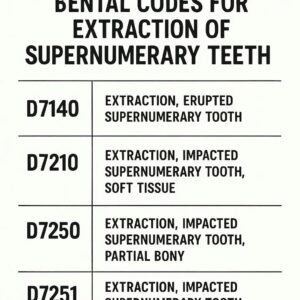
Dental Codes for Extraction of Supernumerary Teeth
What is a Supernumerary Tooth? (A Quick Overview)
Before we dive into the codes, let’s briefly touch on the “what” and “why.” A supernumerary tooth is exactly what it sounds like: an extra tooth beyond the normal 20 baby teeth or 32 permanent teeth.
These teeth can appear in various shapes and locations:
-
Mesiodens: A small, peg-like tooth that forms between the two upper front teeth. This is the most common type.
-
Paramolar: An extra tooth located towards the cheek side (buccal) or behind (distal) the molar teeth.
-
Distomolar: An extra tooth that forms behind the third molar (wisdom tooth).
Why do they need to come out? Supernumerary teeth can cause a host of problems, including crowding, preventing permanent teeth from erupting (impacting them), causing root resorption of neighboring teeth, and even forming cysts.
Important Note: Because these teeth are abnormal in position and structure, their extraction is rarely considered a simple, routine pull. This complexity is reflected in the dental codes used.
Decoding the Main Event: The Dental Code for Ext of Supernumerary Tooth
When you look at your treatment plan, you won’t just see one code. You’ll see a procedure code (the CDT code) and potentially a narrative description. For the extraction of a supernumerary tooth, there isn’t just one single “magic” code. The correct code depends entirely on where the tooth is and how difficult it is to remove.
The most common codes used are D7240 and D7250.
Let’s break these down.
D7240: Removal of Impacted Supernumerary Tooth
This is arguably the most frequently used code for this procedure. It specifically refers to the removal of a supernumerary tooth that is impacted, meaning it is stuck beneath the gum and bone and hasn’t erupted into the mouth.
-
What it covers: Surgical access to the tooth, which often involves raising a “flap” of gum tissue (an incision), removing some bone to expose the tooth, sectioning the tooth into pieces for easier removal, and then suturing (stitching) the site closed.
-
When it’s used: This is the go-to code for a mesiodens buried in the palate or an extra tooth blocking a permanent tooth from coming in.
D7250: Removal of Residual Supernumerary Tooth, Performing Surgery
This code is slightly different. It is used when a tooth has already been removed, but a root fragment or a piece of the supernumerary tooth remains. It is also used for the removal of a supernumerary tooth that requires surgery but may not be classified as a standard “impacted tooth” removal, often because it’s in a tricky spot or associated with a pathology.
-
What it covers: The surgical exploration and removal of the remaining tooth structure or a tooth that is difficult to access due to previous surgery or anatomical location.
-
When it’s used: Imagine a supernumerary tooth was partially removed years ago, but a small piece of root was left behind and is now causing an infection. The dentist would use D7250 to remove that residual piece.
Why Isn’t a Simple Extraction Code Used?
You might wonder why dentists don’t use codes like D7140 (extraction, erupted tooth or exposed root) or D7210 (surgical extraction of erupted tooth). The answer is simple: anatomy.
A supernumerary tooth, by its very nature, is an anomaly. It is rarely in the correct position. It might be:
-
Inverted (growing upside up).
-
Horizontal.
-
Located high up in the palate or deep in the jawbone.
Removing it requires a surgical approach, hence the use of surgical codes. Using a simple extraction code for a complex surgical procedure would be insurance fraud and would drastically under-compensate the dentist for the time and skill required.
Comparison of Extraction Codes
To make this clearer, let’s look at how these codes stack up against each other in a simple table. This will help you understand why your dentist chose a specific code.
| CDT Code | Description | Typical Scenario | Complexity | Anesthesia/Sedation |
|---|---|---|---|---|
| D7140 | Extraction, erupted tooth or exposed root | A loose baby tooth, or a fully visible adult tooth with simple roots. | Low | Local anesthesia usually sufficient. |
| D7210 | Extraction, erupted tooth requiring removal of bone | A tooth that is visible but broken down, requiring the gum to be lifted and some bone removed. | Moderate | Local anesthesia. |
| D7240 | Removal of impacted supernumerary tooth | An unerupted extra tooth (like a mesiodens) completely covered by gum and bone. | High | Often requires IV sedation or general anesthesia. |
| D7250 | Removal of residual supernumerary tooth, performing surgery | Removal of a root tip or fragment left from a previous extraction. | Moderate to High | Local anesthesia, possibly sedation. |
Factors Influencing the Code and the Cost
Several variables determine whether a dentist uses D7240, D7250, or another related code. Understanding these factors will help you have a more informed conversation with your dental office.
1. Location, Location, Location
The position of the tooth is the primary driver.
-
Anterior (Front of the mouth): A mesiodens in the maxilla (upper jaw) is almost always D7240. It requires lifting the gum to access the palate or the area behind the front teeth.
-
Posterior (Back of the mouth): An extra tooth near the molars might be more accessible, but if it’s blocking a wisdom tooth, it will likely still be an impacted surgical removal.
2. Age of the Patient
-
Children: Removing a supernumerary tooth in a child is often done to prevent orthodontic problems. Because children’s bone is softer and their teeth are still developing, the surgery can be delicate. The code remains D7240, but the narrative on the claim might mention “to permit eruption of permanent tooth.”
-
Adults: Extraction in adults can be more complicated as the bone is denser and the roots are fully formed. The same code applies, but the complexity—and therefore the fee—might be higher.
3. Associated Procedures
Often, the extraction is not the only procedure.
-
Surgical Exposure (D7280): Sometimes, instead of removing the supernumerary tooth, the dentist or oral surgeon will expose it and bond an orthodontic bracket to it so an orthodontist can pull it into the correct position. This is rare for supernumerary teeth, but it happens.
-
Biopsy (D7286): If the sac surrounding the unerupted supernumerary tooth (the dental follicle) is large, the doctor may send it to a lab to ensure it is not cystic or tumorous.
Navigating Insurance Claims for Supernumerary Extractions
This is where things can get tricky. Dental insurance is designed for routine, predictable care. Supernumerary teeth are, by definition, not routine.
Medical vs. Dental Insurance
A supernumerary tooth is a developmental anomaly. Because it is a condition present from birth (a congenital anomaly), there is a chance that your medical insurance may cover part of the procedure, especially if it is causing a significant health issue like a cyst, infection, or interfering with sinus cavities.
-
The “Medical Necessity” Argument: For medical insurance to pay, the procedure must be deemed medically necessary, not just dentally necessary. Your surgeon’s office will need to write a strong letter of medical necessity.
-
Coordination of Benefits: Usually, the claim is first sent to dental insurance. If dental insurance denies it or has low maximums, the office may then try to file it with your medical insurance. This is common for procedures like D7240.
Common Insurance Scenarios
-
Dental Insurance Covers It (with Limitations): Most dental plans will cover surgical extractions, but they often have a waiting period for major procedures. They will apply the cost to your annual maximum (typically $1,000 – $2,000). Since a D7240 can easily cost $500-$1,000+, it can eat up a huge chunk of your annual benefits.
-
Dental Insurance Downcodes It: This is a major frustration. An insurance company might receive a claim for D7240 and say, “We don’t think this was an impacted supernumerary tooth. We’re going to ‘downcode’ it to D7210 or D7140 and pay based on that lower fee.” This leaves you with a higher balance. If this happens, your dentist can appeal with x-rays and a narrative.
-
Dental Insurance Denies It as “Not a Covered Benefit”: Some basic plans explicitly exclude “congenital anomalies.” In this case, you would be responsible for the full fee, which is why it’s vital to check your policy.
Reader Note: Always ask your dental office to provide a predetermination of benefits. This is a free service where they send the treatment plan (with the D7240 code) to your insurance company before the procedure. The insurance company sends back an estimate of what they will pay. This gives you zero surprises.
The Procedure: What to Expect When Using Code D7240
Knowing the code is one thing; knowing what happens during the appointment can ease your anxiety. Here is a realistic walkthrough of a typical supernumerary tooth removal.
Before the Procedure: Consultation
-
The dentist or oral surgeon will review your x-rays, usually a panoramic x-ray or a CBCT (3D scan) to pinpoint the exact location of the extra tooth and its relationship to nearby nerves and teeth roots.
-
They will discuss anesthesia options. Because D7240 is surgical, many patients opt for IV sedation or general anesthesia, especially for children or multiple extractions.
The Day of Surgery
-
Anesthesia: You will be made comfortable with your chosen method of sedation or local anesthesia.
-
Incision: The surgeon makes a small incision in the gum tissue to create a “flap” and expose the bone underneath.
-
Bone Removal (Ostectomy): Using a high-speed handpiece, the surgeon carefully removes a small window of bone to reveal the impacted supernumerary tooth.
-
Tooth Removal: The tooth is often delivered in one piece. If it is large or in a dangerous position, the surgeon may cut it (section) into smaller pieces to remove it safely and minimize bone removal.
-
Cleaning: The empty socket (hole) is thoroughly cleaned to remove the dental follicle sac.
-
Closure: The gum flap is placed back into its original position and sutured closed with stitches. These may be dissolvable or require removal in a week or two.
Aftercare (Post-Op)
-
You will experience some swelling and discomfort, which is managed with ice packs and prescribed or over-the-counter pain medication.
-
A soft food diet is recommended for a few days.
-
Strict oral hygiene is needed to keep the area clean but avoid the surgical site.
List: 5 Critical Questions to Ask Your Dentist
To ensure you are fully prepared for your procedure using the dental code for ext of supernumerary tooth, print this list and take it to your consultation.
-
“Which specific code are you using for the extraction?”
-
Why: This confirms whether it’s D7240 or something else and allows you to research it.
-
-
“Has a predetermination been sent to my insurance company?”
-
Why: This is the only way to know your financial responsibility for sure.
-
-
“Is there any chance my medical insurance could help cover this?”
-
Why: If the tooth is deeply impacted or near a sinus, the surgeon’s office might have a protocol for this.
-
-
“Will this be done under local anesthesia, or do you recommend sedation?”
-
Why: D7240 can be lengthy; understanding the anesthesia helps you prepare logistically (need for a driver, etc.).
-
-
“How will this affect the surrounding teeth, especially if this was blocking a permanent tooth?”
-
Why: You need a long-term plan, often involving an orthodontist, to ensure the space closes correctly.
-
Cost Estimates for D7240 and D7250
Without insurance, the cost can vary widely based on your geographic location and the complexity of the case. Here is a realistic breakdown:
-
D7240 (Removal of Impacted Supernumerary):
-
General Dentist: $400 – $700
-
Oral Surgeon: $600 – $1,200+
-
-
D7250 (Removal of Residual Supernumerary):
-
General Dentist: $350 – $600
-
Oral Surgeon: $500 – $1,000
-
-
Anesthesia/Sedation Fees:
-
Local Anesthesia: Usually included in the procedure cost.
-
IV Sedation/General Anesthesia: $400 – $1,000+ extra, depending on duration.
-
Conclusion
Understanding the dental code for ext of supernumerary tooth—primarily D7240—empowers you to navigate the financial and procedural aspects of your care. This surgical code reflects the complexity of removing an extra tooth that lies beneath the surface. By asking the right questions and verifying your insurance benefits, you can ensure a smooth process from diagnosis to recovery.
Frequently Asked Questions (FAQ)
Q1: Is D7240 considered a major or basic dental service?
A: Most dental insurance plans classify D7240 (and D7250) as a major restorative service. This means it often has a higher coinsurance (you pay a larger percentage) and may have a separate waiting period than basic services like fillings.
Q2: Can a general dentist perform a D7240, or do I need an oral surgeon?
A: Yes, many general dentists are trained and comfortable removing supernumerary teeth, especially straightforward ones. However, if the tooth is very deep, near a nerve, or if the patient is very young or anxious, they will likely refer you to an oral surgeon for safety and sedation options.
Q3: What if my supernumerary tooth has already erupted into the mouth?
A: If the tooth is fully visible, the code might change. While it is still an abnormal tooth, if it is erupted and the roots are simple, the dentist might use D7210 (surgical extraction of an erupted tooth). However, due to the odd root shape common in supernumerary teeth, they may still use D7240 to be safe. The x-ray determines the final code.
Q4: Why did my insurance pay less than I expected for the D7240?
A: The most common reason is that your plan has a low annual maximum and you may have already used some of it. Another reason is “downcoding,” where the insurance company reviews the x-rays and decides a less complex code was more appropriate, or they apply a “benefit limitation” for congenital conditions. Contact your insurance company for a detailed explanation of benefits (EOB).
Disclaimer: This article is for informational purposes only and does not constitute medical or legal advice. Dental codes, insurance policies, and coverage vary by provider and plan. You should always consult with your dental insurance provider and your dentist to verify coverage and the appropriate procedure codes for your specific situation.


