If you’re involved in the global trade of dental supplies—whether you’re a manufacturer in Pakistan, a distributor in Germany, or a dental clinic owner importing directly from the United States—you’ve likely encountered a small but mighty hurdle: the dental instrument HS code.
At first glance, it’s just a number. But get it wrong, and you could face seized shipments, unexpected tariffs, or frustrated clients. This guide is here to demystify that number. We’ll walk through everything you need to know, from the basic structure of the codes to specific classifications for drills, chairs, and implants.
Let’s turn this complex topic into a clear, manageable roadmap for your business.
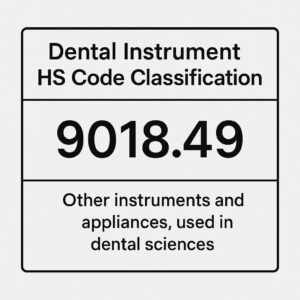
Dental Instrument HS Code Classification
Chapter 1: What is an HS Code and Why Does It Matter for Dental Instruments?
Before we dive into the specific digits for dental tools, let’s establish a solid foundation. Understanding the “why” behind the numbers makes the entire classification process much more intuitive.
The Universal Language of Trade
Imagine trying to order a coffee in a country where you don’t speak the language. You might point, you might gesture, but there’s a high chance you’ll end up with a tea. International trade faced a similar problem for centuries. Every country had its own system for classifying goods, leading to mass confusion at borders.
Enter the Harmonized System (HS) . Managed by the World Customs Organization (WCO), this is a standardized numerical method of classifying traded products. It’s used by more than 200 countries and economies as a foundation for their customs tariffs and for the collection of international trade statistics.
Think of it as the universal language for goods. No matter where you are in the world, a product classified under a specific six-digit HS code is, in theory, the same product.
Why You Can’t Afford to Ignore It
For anyone shipping dental instruments across borders, the HS code is non-negotiable. Here’s why it’s so critical:
-
Determines Duties and Taxes: This is the big one. The HS code directly dictates the tariff rate applied to your goods. A code for a simple steel probe will likely have a different duty rate than a code for a complex, electronic laser device. Getting it wrong could mean overpaying (hurting your profit margin) or underpaying (leading to fines and penalties from customs authorities).
-
Ensures Smooth Clearance: Customs officials use the HS code to identify what’s in your shipment. A correct code signals that you are a compliant and transparent trader, making it more likely your goods will clear quickly. An incorrect or vague code raises a red flag, often leading to physical inspections, delays, and storage fees.
-
Tracks Trade Data: Governments and international organizations use HS code data to monitor trade flows, analyze markets, and make economic policy decisions. By using the correct code, you’re contributing to accurate global trade data.
-
Compliance with Regulations: Certain dental instruments, especially those that are sterile or contain electronic components, may be subject to specific regulations. The HS code helps customs and other regulatory bodies (like the FDA in the U.S. or the European Medicines Agency) identify shipments that may require additional permits or inspections.
Important Note: While the first six digits of an HS code are standardized globally, countries can add additional digits for further classification, typically for tariff and statistical purposes. For example, the U.S. uses a 10-digit number called the HTSUS (Harmonized Tariff Schedule of the United States). Always check your destination country’s specific tariff schedule.
Chapter 2: Deconstructing the Dental Instrument HS Code
Now, let’s look under the hood. How is a dental instrument HS code actually built? The code is hierarchical, meaning each additional pair of digits provides a more specific description of the product.
We can understand this best by looking at the chapter where most dental instruments live: Chapter 90.
The Hierarchy of a Code
Most dental instruments fall under Chapter 90, which covers “Optical, photographic, cinematographic, measuring, checking, precision, medical or surgical instruments and apparatus; parts and accessories thereof.”
Here’s how a typical code breaks down, using a common dental drill as an example:
-
HS Code Example: 9018.41
-
90 (Chapter): This tells us we are in the realm of precision instruments—medical, optical, or technical devices.
-
18 (Heading): This narrows it down within Chapter 90 to “Instruments and appliances used in medical, surgical, dental or veterinary sciences.”
-
41 (Subheading): This provides the specific classification for the product. In this case,
9018.41is the dedicated subheading for “Dental drill engines, whether or not combined on a single base with other dental equipment.”
The Anatomy of a Full Classification
Let’s illustrate this with a practical table comparing different types of dental products. Notice how the code becomes more specific as it expands.
| Product Description | HS Code (First 6 digits) | Chapter (2-digit) | Heading (4-digit) | Subheading (6-digit) |
|---|---|---|---|---|
| Basic Dental Chair | 9018.49 | 90 – Precision Instruments | 9018 – Medical/Dental Instruments | 9018.49 – Other instruments and appliances, used in dental sciences |
| Diamond Dental Bur | 9018.49 | 90 – Precision Instruments | 9018 – Medical/Dental Instruments | 9018.49 – Other instruments and appliances, used in dental sciences |
| Dental X-Ray Machine | 9022.13 | 90 – Precision Instruments | 9022 – Apparatus based on X-rays | 9022.13 – Apparatus based on X-rays, for dental uses |
| Sterilizer (Autoclave) | 8419.20 | 84 – Machinery & Mechanical Appliances | 8419 – Machinery for treating materials by temperature change | 8419.20 – Medical, surgical or laboratory sterilizers |
As you can see, not everything related to a dentist’s office falls under the 9018 umbrella. Sterilizers, for instance, are classified under machinery (Chapter 84) because their function (sterilizing via heat/pressure) is considered a mechanical process, even though they are used in a medical setting.
Chapter 3: The Essential List: Common Dental Instrument HS Codes
This is the section you’ll likely bookmark. Below is a categorized list of common dental products and their associated 6-digit HS codes. Remember, this is a guide, and final classification may depend on the specific materials, function, and accessories included with your product.
3.1. General Operative and Surgical Instruments
This category covers the vast majority of handheld tools a dentist uses.
-
9018.49 – Instruments and appliances, used in dental sciences, Other:
This is the “catch-all” for a huge range of non-powered, hand-held instruments.-
Examples: Mouth mirrors, explorers, probes, tweezers, scalpels, curettes, scalers (hand-operated), excavators, pluggers, carvers, forceps for tooth extraction, elevators.
-
-
9018.90 – Instruments and appliances used in medical, surgical, dental or veterinary sciences, other:
-
Examples: This can sometimes include more complex combined instruments or those that don’t fit neatly elsewhere, but
9018.49is the primary home for dental hand tools.
-
3.2. Rotary Instruments and Attachments
This is where we get into the drills and their components.
-
9018.41 – Dental drill engines, whether or not combined on a single base with other dental equipment:
-
Examples: The main control unit for a handpiece, including the motor and often the foot pedal. This code covers the “engine” that powers the drill.
-
-
9018.49 – Instruments and appliances, used in dental sciences, Other:
-
Examples: Dental handpieces (the part the dentist holds) are often classified here, as they are the instrument that attaches to the engine. However, they can sometimes be classified with the engine if they are a dedicated, inseparable unit.
-
-
9018.49 – Instruments and appliances, used in dental sciences, Other (for burs and similar tools):
-
Examples: Diamond burs, carbide burs, polishing points, mandrels. These are considered the “consumable” tools that fit into the handpiece.
-
3.3. Dental Equipment and Furniture
Larger items that furnish a dental practice fall under a mix of chapters.
-
9018.49 – Instruments and appliances, used in dental sciences, Other:
-
Examples: Dental lights (operating lights) are often classified here as they are a direct accessory for dental procedures.
-
-
9402.90 – Medical, surgical, dental or veterinary furniture (e.g., operating tables, examination tables, hospital beds with mechanical fittings):
-
Examples: Dental chairs and dentist stools. Because their primary function is as furniture, even highly specialized chairs, they live in Chapter 94.
-
-
8419.20 – Medical, surgical or laboratory sterilizers:
-
Examples: Autoclaves used to sterilize instruments.
-
3.4. Imaging and Diagnostic Equipment
Modern dentistry relies heavily on technology.
-
9022.13 – Apparatus based on the use of X-rays, for dental uses:
-
Examples: Intraoral X-ray machines, panoramic X-ray machines (OPGs), cephalometric X-ray systems.
-
-
9018.49 – Instruments and appliances, used in dental sciences, Other:
-
Examples: Some diagnostic devices, like pulp testers, are classified here. However, more complex electronic diagnostic tools may fall under
9018.19(Electro-diagnostic apparatus…).
-
3.5. Implants, Prosthetics, and Materials
This area requires careful attention, as raw materials and finished products have different classifications.
-
9021.29 – Artificial parts of the body, Other:
-
Examples: Dental implants (the artificial tooth root surgically placed into the jawbone).
-
-
9021.10 – Orthopaedic or fracture appliances:
-
Examples: This could include items related to dental splints or specific maxillofacial appliances.
-
-
3006.40 – Dental cements and other dental fillings; bone reconstruction cements:
-
Examples: Filling materials, cements for crowns and bridges, bonding agents. These are classified as pharmaceutical or chemical products.
-
-
9021.21 – Artificial teeth:
-
Examples: Dentures (full or partial), individual artificial teeth used in dentures.
-
-
3824.99 – Prepared binders for foundry moulds or cores; chemical products and preparations of the chemical or allied industries (including those consisting of mixtures of natural products), not elsewhere specified or included:
-
Examples: Dental waxes, impression materials (like alginate or silicone), and other preparatory substances often fall here.
-
Quick Reference Comparison Table
| Category | Product Examples | Likely HS Code (6-digit) |
|---|---|---|
| Hand Instruments | Mirrors, probes, scalers, forceps | 9018.49 |
| Rotary Instruments | Handpieces, motors, foot controls | 9018.41 or 9018.49 |
| Rotary Consumables | Burs, discs, polishing points | 9018.49 |
| Furniture | Patient chairs, operator stools | 9402.90 |
| Sterilization | Autoclaves, ultrasonic cleaners | 8419.20 |
| X-Ray Imaging | Intraoral, panoramic X-ray units | 9022.13 |
| Implants | Titanium screw fixtures | 9021.29 |
| Prosthetics | Dentures, artificial teeth | 9021.21 |
| Consumable Materials | Cements, impression materials, waxes | 3006.40 or 3824.99 |
Chapter 4: The Art of Classification: A Step-by-Step Guide
Classifying a product isn’t always a simple “look-up” task. It requires a methodical approach. Here’s a simple workflow you can use.
Step 1: Gather Complete Product Information
Before you even look at the HS code book, you need to know your product inside and out. Customs officials will expect you to have this information. Create a checklist:
-
What is its primary function? What does it do? (e.g., cuts tooth structure, takes an X-ray, sterilizes tools).
-
What is it made of? (e.g., stainless steel, plastic, a combination, titanium).
-
How does it work? Is it powered by electricity, battery, or hand-operated?
-
Is it sterile? Is it packaged and labeled as “sterile”?
-
Is it a complete unit or a part/accessory? Does it function on its own, or is it a replacement part for a larger machine? (Parts often have their own specific codes or follow the code of the main machine).
-
Does it come with accessories? If an item is sold as a “kit,” the entire kit’s classification is determined by its essential character (the main component).
Step 2: Consult the General Interpretative Rules (GIRs)
The HS system has six General Interpretative Rules that provide a legal framework for classification. For most everyday items, you’ll rely heavily on GIR 1: “Classification shall be determined according to the terms of the headings and any relative Section or Chapter Notes.”
This means you must read the legal text of the headings and the notes that precede each chapter. These notes are crucial. For example, the notes for Chapter 90 specifically exclude items like “supporting furniture” (which is why dental chairs are in Chapter 94).
Step 3: Narrow Down the Chapter and Heading
Using the product information you gathered, start browsing the chapters.
-
Does it operate mechanically? → Look in Sections XIV-XXI (Chapters 84-97).
-
Is it a precision/scientific/medical instrument? → Go to Chapter 90.
-
Is it a chemical compound or mixture? → Look in Section VI (Chapters 28-38).
Once you’ve found the likely chapter, read the 4-digit headings. For a dental hand scaler, you would land on Heading 9018: “Instruments and appliances used in medical, surgical, dental or veterinary sciences…” . This is a perfect match.
Step 4: Find the Correct 6-Digit Subheading
Now, drill down into the 6-digit subheadings under your chosen heading. Under 9018, you’ll find a list:
-
9018.11 – Electro-cardiographs
-
9018.19 – Other electro-diagnostic apparatus
-
9018.41 – Dental drill engines…
-
9018.49 – Other
-
…and so on.
Your hand scaler is not a drill engine, so it isn’t 9018.41. It is an “other” instrument used in dental sciences, making 9018.49 the correct choice.
Step 5: Verify with Destination Country’s Tariff
Finally, go to the customs website of the country you are shipping to (e.g., for the U.S., visit the USITC website to find the HTSUS). Enter your 6-digit code to see the full 8- or 10-digit code and its associated duty rate. This step is vital for accurate invoicing.
Chapter 5: Advanced Topics and Tricky Classifications
Not everything is straightforward. Here are some common scenarios where classification gets a little more complex.
Kits and Sets
What if you sell a “Dental Extraction Kit” containing a pair of forceps, an elevator, and a scaler, all in a sterile tray?
According to GIR 3, when goods are put up in sets for retail sale, they are classified by the component that gives them their essential character. In this case, the forceps are likely the most important item, and you would classify the entire kit under the code for forceps (9018.49).
Note: If the tray itself is a specially designed, durable instrument tray, it might need separate consideration. If it’s just basic packaging, it’s part of the set.
Parts and Accessories
Classifying a replacement part can be tricky. The general rule is:
-
Parts that are solely or principally used with a particular machine are generally classified with that machine. So, a specific circuit board for a panoramic X-ray machine would likely be classified under
9022.90(Parts and accessories for X-ray apparatus). -
Accessories that are interchangeable and not integral to the machine’s core function might have their own classification. However, many accessories are also classified with the parent machine.
The “Mixed Materials” Challenge
Consider a dental bib clip. It’s a small metal clip used to hold a patient bib in place. Is it a dental instrument? Or is it a general metal article?
-
If it’s a simple, non-sterile clip: It might be classified as a base metal article under Chapter 83 (Miscellaneous articles of base metal).
-
If it’s a sterile, single-use clip packaged specifically for dental procedures: It might be argued that it is a dental supply, potentially falling under
9018.49or a related code for consumables.
In cases of ambiguity, the product’s intended use and how it is presented (e.g., sterile packaging with medical instructions) can influence the final classification.
Chapter 6: Best Practices for Avoiding Costly Mistakes
You’ve done your homework. Here’s how to put it into practice and protect your business.
-
Document Everything: Keep a file for every product you ship, containing the product description, technical specifications, a photograph, and the HS code you’ve assigned to it along with your reasoning. If customs ever questions you, this documentation is your best defense.
-
Don’t Rely on Memory: HS codes can and do change. The WCO reviews the system every five years, and countries can modify their tariffs at any time. Always verify the code at the time of shipment.
-
Use a Customs Broker: For high-volume or high-value shipments, a licensed customs broker is an invaluable investment. They are experts in the latest regulations for their country and can handle the entire clearance process on your behalf.
-
Get a Binding Ruling: If you are unsure about a high-value or unusual product, you can apply for a Binding Tariff Information (BTI) in the EU or a Binding Ruling in the U.S. This is a legal, official decision from customs on how to classify your product, giving you total peace of mind.
-
Be Specific on Your Invoice: Don’t just put “Dental Instruments” on your commercial invoice and list the code. Include a detailed description that matches your internal documentation. For example, instead of “Misc. dental tools,” write “Stainless steel dental curettes, hand-operated.” This helps the clearing agent and customs officer confirm your classification.
Important Note: While this guide provides a comprehensive overview, the information contained here is for general informational purposes only and does not constitute legal or professional advice. Customs regulations are complex and subject to change. You should always consult with a qualified customs broker or trade attorney for advice tailored to your specific situation and shipment.
Frequently Asked Questions (FAQ)
Q1: What is the HS code for a simple dental mouth mirror?
A: A standard, non-electronic dental mouth mirror is classified under 9018.49.
Q2: My dental chair has a built-in light and a small x-ray viewer. Does that change its code?
A: While it has integrated features, its primary function remains as “dental furniture.” It would still be classified under 9402.90. The lights and x-ray viewer are considered accessories to the chair. If the light were a separate, standalone unit, it would likely be under 9018.49.
Q3: What is the difference between 9018.41 and 9018.49?
A: 9018.41 is specifically for “dental drill engines.” This is the motor unit that drives the drill. 9018.49 is for “other” dental instruments, which includes the handpieces that attach to the engine, as well as all the non-powered hand tools.
Q4: How can I find the duty rate for my product in a specific country?
A: Once you have your 6-digit HS code, you need to look up the destination country’s national tariff. For example, for the U.S., you would go to the United States International Trade Commission (USITC) website and search for your 6-digit code to find the full 10-digit HTSUS number and its associated duty rate.
Q5: Are disposable gloves classified as dental instruments?
A: Not typically. Gloves are usually classified based on their material. For example, latex or nitrile examination gloves are often found in Chapter 40 (Rubber) or Chapter 39 (Plastics), under codes like 4015.11 (Surgical gloves of vulcanized rubber) or 3926.20 (Plastic gloves).
Q6: I’m shipping a sample of a new dental tool. Do I still need an HS code?
A: Yes. Even samples, prototypes, or goods of no commercial value require an HS code for customs clearance. Using a generic code for “samples” can sometimes cause issues, so it’s best to classify them as accurately as possible, often noting their value as “NCV” (No Commercial Value).
Additional Resources
To ensure you have the most up-to-date information for your specific country, here are some official resources:
-
World Customs Organization (WCO): The official source for the Harmonized System.
-
United States International Trade Commission (USITC): For the full HTSUS (10-digit codes and duty rates for imports to the U.S.).
-
European Union’s TARIC Database: For customs information and duty rates for all EU member states.
-
UK Trade Tariff: For specific information on importing goods into the United Kingdom.
Conclusion
Mastering the dental instrument HS code is not just about bureaucratic compliance; it’s a fundamental aspect of running a successful global business. By understanding the structure of the code, knowing where to find the most common classifications, and following a methodical approach, you can navigate international shipping with confidence. Remember that accuracy prevents delays, controls costs, and builds trust with both your customers and customs authorities. Always verify, always document, and when in doubt, seek expert advice to keep your valuable shipments moving smoothly across borders.