
Have you ever looked in the mirror and felt that your teeth look a little… short? Or maybe when you smile, you feel like you show too much gum tissue? You are not alone. This is one of the most common aesthetic concerns people have. The good news is that there is a straightforward dental procedure that can fix this imbalance. It is called gingival contouring, or gum reshaping.
But if you have started researching this procedure, you have likely stumbled into a confusing maze of insurance forms and dental codes. You might be asking yourself: What is the exact code my dentist will use? Will my insurance cover it? Is it medical or cosmetic?
This guide is designed to answer all those questions and more. We will focus specifically on the gingival contouring ADA code, breaking down what it means, when it is used, and how it affects your out-of-pocket costs. By the end of this article, you will be equipped with the knowledge to have an informed conversation with your dentist and your insurance provider.
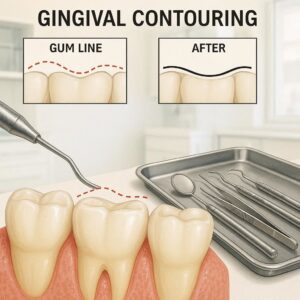
Gingival Contouring ADA Code
What Exactly is Gingival Contouring?
Before we dive into the technical world of dental codes, let’s talk about the procedure itself. Gingival contouring, sometimes called gum contouring or gum reshaping, is a dental procedure used to reshape the gum tissue around your teeth.
Think of your gums as a picture frame and your teeth as the artwork. Sometimes the frame is too thick or uneven, covering up parts of the art. Gingival contouring carefully trims away excess gum tissue to reveal more of the tooth structure. This creates a more balanced, harmonious, and aesthetically pleasing smile.
The “Gummy Smile” Solution
The most common reason people seek this treatment is to correct a “gummy smile.” This is when a person shows a significant amount of gum tissue above their teeth when smiling. The goal is to reduce the height of the gums to make the teeth appear longer and more proportional.
Beyond Aesthetics: Health Benefits
While the visual results are often the main draw, there are legitimate functional reasons for this procedure:
-
Improved Oral Hygiene: If your gum tissue is overgrown (a condition called gingival hyperplasia), it can create pockets where food and bacteria get trapped. Reshaping the gums makes it easier to brush and floss effectively, reducing the risk of decay and gum disease.
-
Crown Lengthening: In restorative dentistry, if a tooth is broken or decayed below the gum line, a dentist needs to expose more of the tooth structure to place a crown. This is a functional gingival contouring procedure.
-
Reducing Inflammation: Excess gum tissue is more prone to chronic inflammation and irritation. Trimming it back can lead to healthier, pinker gums.
The Heart of the Matter: The Gingival Contouring ADA Code (D4249)
Now, let’s get to the core of this article. In the world of dentistry and insurance, everything is about codes. The American Dental Association (ADA) maintains a standardized code set called CDT (Current Dental Terminology). These codes are used by dentists to file claims with insurance companies.
The primary code used for aesthetic gum reshaping is D4249.
Understanding CDT Code D4249
The official descriptor for D4249 is: “Clinical crown lengthening – soft tissue.”
Let’s break that down:
-
Clinical Crown Lengthening: This refers to the procedure of making the visible part of the tooth (the clinical crown) longer.
-
Soft Tissue: This specifies that the procedure involves only the gums. It does not involve reshaping the underlying bone.
When your dentist uses code D4249, they are telling the insurance company: “We performed a procedure to remove excess gum tissue to expose more of the tooth structure, and we only worked on the gums.”
When is D4249 Used?
This specific code is typically used in two scenarios:
-
Aesthetic Reasons: To correct a gummy smile.
-
Functional Reasons: To expose more tooth structure for a filling or crown, but only if the bone does not need to be cut.
Important Note: If the procedure requires reshaping the bone underneath the gums to support a crown or fix a defect, a different code is used, usually D4265 (surgical crown lengthening – hard tissue). We will compare these later.
Why the Code Matters to You
Understanding this code is your secret weapon. It allows you to:
-
Verify your dental treatment plan: Check your paperwork to ensure the correct code is listed.
-
Call your insurance company: You can ask specifically, “What is my coverage for procedure code D4249?” instead of getting vague answers about “gum surgery.”
-
Understand your bill: When you see D4249 on your Explanation of Benefits (EOB), you will know exactly what it refers to.
Gingival Contouring ADA Code vs. Other Common Codes
It is easy to get these codes mixed up. To help you navigate your treatment plan, here is a simple comparison table. This will help you understand exactly what your dentist is proposing.
| CDT Code | Procedure Name | Description | Typical Use Case |
|---|---|---|---|
| D4249 | Clinical Crown Lengthening – Soft Tissue | Reshaping/removing gum tissue only. | Gummy smile correction; exposing tooth for a crown when bone is untouched. |
| D4210 | Gingivectomy or Gingivoplasty | Surgical removal or reshaping of gum tissue, often to treat disease. | Removing diseased or overgrown tissue caused by medications or neglect. |
| D4265 | Surgical Crown Lengthening – Hard Tissue | Reshaping both gum tissue and the underlying bone. | Preparing a tooth broken below the gum line for a crown. |
| D4341 | Periodontal Scaling and Root Planing | Deep cleaning below the gum line to treat gum disease. | Treating active periodontitis (gum infection). |
Key Takeaway: Code D4249 is your go-to for aesthetic gum lifts. If your dentist mentions bone work, you are likely looking at D4265, which is a more involved surgical procedure.
Is It Medical or Cosmetic? The Insurance Dilemma
This is the million-dollar question. Whether your insurance will pay for your gingival contouring procedure depends entirely on how the dentist “codes” it and the reason for the treatment.
The Cosmetic Stigma
Insurance companies are in the business of managing risk, not funding smiles. Therefore, if the primary purpose of the procedure is to improve the appearance of your smile, it will almost universally be classified as cosmetic and not covered by your dental insurance. You will be responsible for 100% of the cost.
The Medical Necessity Argument
However, there are situations where gingival contouring is considered medically necessary. This is where the skill of your dental office in documenting your case comes into play. If the excess gum tissue is:
-
Causing chronic pain or irritation.
-
Making it impossible to properly clean your teeth, leading to decay.
-
A result of medication-induced overgrowth.
-
Necessary to place a crown on a decayed or fractured tooth.
…then the procedure may be considered medically necessary. In these cases, your insurance may cover a portion of the cost, just as they would for a filling or a crown.
What to do:
Always ask your dentist’s office to perform a “predetermination of benefits.” They will send the treatment plan (with the D4249 code) and supporting documentation (x-rays, photos, notes) to your insurance company before the procedure. The insurance company will send you a letter stating exactly how much they will pay, if anything. This prevents surprise bills.
The Gingival Contouring Procedure: Step-by-Step
If you have decided to move forward with the procedure, it helps to know what is going to happen. The experience is usually straightforward and far less intimidating than it sounds.
1. The Consultation and Diagnosis
Your dentist will examine your smile, take measurements, and possibly use a tool to show you a digital simulation of what your smile could look like after the procedure. They will review your medical history and take x-rays to ensure the bone levels are healthy.
2. Anesthesia
On the day of the procedure, the dentist will apply a topical numbing gel to your gums. Once you are numb, they will inject a local anesthetic (like Novocaine). You will be awake, but you will feel no pain—only pressure and vibration.
3. The Reshaping
Using a soft tissue laser or a traditional scalpel, the dentist will carefully trim away the excess gum tissue. They sculpt a new, even gum line that follows the natural curvature of your teeth.
-
Laser: Lasers are becoming the gold standard. They cauterize the tissue as they cut, which means less bleeding, less swelling, and a faster recovery.
-
Scalpel: This traditional method is very precise. It may involve a few sutures (stitches) and can have a slightly longer healing time.
4. Post-Procedure Care
Once the desired shape is achieved, the area is cleaned. If a laser was used, you might have a “frosted” appearance on the gums, which is normal. If a scalpel was used, a periodontal dressing (a soft, putty-like bandage) may be placed over the gums for protection.
Recovery and Aftercare: What to Expect
Healing from gum contouring is generally quick, especially compared to other dental surgeries.
The First 24-48 Hours
-
Mild Discomfort: You can expect some soreness. Over-the-counter pain relievers like ibuprofen are usually sufficient.
-
Swelling: Some slight swelling is normal. Applying an ice pack to the outside of your face for 10-20 minutes at a time can help.
-
Bleeding: Minor oozing is possible. If it occurs, bite gently on a moist gauze pad.
-
Diet: Stick to soft foods. Think yogurt, smoothies, scrambled eggs, and soup. Avoid anything spicy, crunchy, or hot.
Days 3-7
-
Healing: The tissue will start to look pinker and heal. You may notice a “whitish” film over the area—this is new tissue forming and is a good sign.
-
Oral Hygiene: You can resume gentle brushing, but be very careful around the surgical site. Your dentist may recommend a prescription mouthwash like chlorhexidine to keep the area clean.
Long-Term Care
Once the gums are fully healed (usually after a few weeks), you will see your final results. To maintain them:
-
Excellent Oral Hygiene: Brush and floss meticulously to prevent inflammation.
-
Regular Cleanings: See your hygienist as recommended to keep your gums healthy.
A Note on “Black Triangles”: After gum contouring, especially between teeth, you might notice small triangular gaps. This is normal and happens because the gum tissue has been reshaped. In some cases, your dentist may discuss options to close these if they are a cosmetic concern.
Cost Analysis: How Much Will It Really Cost?
Pricing for dental procedures varies widely based on your location, the dentist’s expertise, and the complexity of your case. However, having a ballpark figure is helpful for budgeting.
-
Average Cost Range: For a standard gingival contouring procedure on 6 to 8 front teeth (a full smile makeover), the cost typically ranges from $50 to $350 per tooth.
-
Per-Quadrant Pricing: Some dentists charge per “quadrant” (half of the upper or lower jaw). This can range from $500 to $4,000 depending on the complexity.
Factors That Influence Price
-
Technology Used: Laser procedures are often more expensive than traditional scalpel surgery because of the cost of the equipment and the advanced training required.
-
Extent of the Procedure: Reshaping just two teeth will cost significantly less than a full arch contouring.
-
Geographic Location: Dental fees in major metropolitan areas like New York or Los Angeles are generally higher than in rural areas.
-
Dentist’s Specialty: A Periodontist (gum specialist) may charge more than a General Dentist for this procedure.
Payment Options
-
Cash/Check/Credit Card: Most offices offer a discount for paying in full on the day of service.
-
Dental Discount Plans: These are not insurance, but membership plans that offer reduced fees for services.
-
Third-Party Financing: Companies like CareCredit offer healthcare credit cards with promotional financing options (e.g., 6 or 12 months interest-free).
Frequently Asked Questions (FAQ)
Q: Is gingival contouring painful?
A: Most patients report very little pain. The procedure itself is done under local anesthesia, so you won’t feel any cutting. Post-procedure soreness is usually mild and easily managed with over-the-counter pain medication.
Q: How long does the procedure take?
A: It is surprisingly fast. Reshaping the front six teeth typically takes between one and two hours.
Q: How long do the results last?
A: The results are permanent. The gum tissue that is removed does not grow back. However, if you have poor oral hygiene and your gums become inflamed, they can swell and change shape, potentially compromising the result.
Q: Can anyone get gum contouring?
A: Not everyone is a candidate. You need to have healthy gums and sufficient bone support. If you have active gum disease (periodontitis), that must be treated first.
Q: Will my gums grow back?
A: No. Once the gum tissue is surgically removed or lasered away, it is gone for good. This is why it is so important to choose an experienced dentist.
Q: What is the difference between a gingivectomy and gingival contouring?
A: While the actions are similar, the intent is different. A gingivectomy (code D4210) is usually performed to remove diseased tissue. Gingival contouring (code D4249) is primarily performed to improve the aesthetics or function of a healthy tooth.
Additional Resource
For the most authoritative and up-to-date information on dental procedures and codes, you should always refer to the source. The American Dental Association (ADA) publishes the CDT code set. You can learn more about how these codes are structured and maintained on their official website.
Link to the American Dental Association’s CDT page
Note: This link leads to the ADA’s official page for the Current Dental Terminology code set, the definitive source for dental coding information.
Conclusion
Navigating the world of dental codes can feel overwhelming, but understanding the gingival contouring ADA code (D4249) is your first step toward taking control of your dental health and smile aesthetics. Whether you are looking to correct a gummy smile or prepare a tooth for a restoration, knowing the difference between soft tissue and hard tissue procedures is crucial for discussing costs with your dentist and insurance provider. Remember, while insurance coverage for cosmetic procedures is rare, medical necessity can change the game.
Disclaimer: This article is for informational purposes only and does not constitute medical or dental advice. The information contained herein is not a substitute for professional consultation with a qualified dentist or healthcare provider. Always seek the advice of your dentist or other qualified health provider with any questions you may have regarding a medical condition or treatment.


