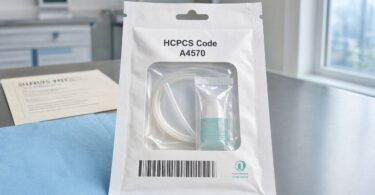
The treatment of chronic wounds, particularly those that fail to heal with standard care, represents a significant challenge in modern medicine. Conditions like diabetic foot ulcers, venous leg ulcers, and pressure injuries affect millions of patients, leading to pain, disability, and even amputation. Advances in wound care have led to the development of advanced biological therapies known as skin substitutes.
These products are designed to promote healing by providing a scaffold for new tissue growth or by delivering growth factors directly to the wound bed. In the HCPCS Level II coding system, skin substitutes are billed using “Q” codes. HCPCS code Q4106 is one such code that has been historically used in this space.
This comprehensive guide will explore HCPCS code Q4106 in detail. We will discuss what this code represents, the clinical context for its use, the complex billing rules that govern it, and the documentation required to secure reimbursement.

HCPCS Code Q4106
What is HCPCS Code Q4106?
The “Q” codes in HCPCS are a diverse group of temporary codes used for various services and supplies that do not fit neatly into other categories. In the realm of wound care, the Q41xx series is specifically designated for skin substitute grafts and cellular and tissue-based products (CTPs).
The official description for HCPCS code Q4106 is: “Dermagraft, per square centimeter.”
Let’s break down what this code represents:
-
Dermagraft: This is the brand name of a specific, bioengineered skin substitute. It is not a generic term. Dermagraft is a cryopreserved human fibroblast-derived dermal substitute. In simple terms, it is a living tissue product made from human skin cells (fibroblasts) grown on a dissolvable mesh scaffold.
-
Per square centimeter: This is the billing unit. Unlike a drug that is billed per milligram, skin substitutes are billed based on the surface area of the wound they are used to cover. For each square centimeter of Dermagraft applied to the patient’s wound, you bill one unit of Q4106.
Understanding the Product:
Dermagraft is used to treat chronic, full-thickness wounds, most notably diabetic foot ulcers. The living human fibroblasts in Dermagraft secrete growth factors, collagen, and other proteins that stimulate the patient’s own body to heal the wound. It is considered an “advanced wound care” product, a step above basic dressings and topical agents.
The Clinical Context: When is Q4106 Used?
Q4106 is not for everyday scrapes or minor cuts. It is reserved for complex, chronic wounds that have failed to respond to standard, conservative treatment. The goal is to kickstart the healing process in a wound that is “stalled.”
Here are the primary clinical scenarios where a provider might use a product like Dermagraft (and bill Q4106):
1. Diabetic Foot Ulcers (DFUs)
This is the flagship indication for Dermagraft. Patients with diabetes often develop neuropathic foot ulcers that are extremely difficult to heal due to poor circulation, high blood sugar, and pressure on the foot. These ulcers can persist for months or years. Dermagraft is applied directly to the ulcer to promote tissue growth and closure. Healing these ulcers is critical to preventing infection, gangrene, and ultimately, amputation.
2. Venous Leg Ulcers (VLUs)
Venous leg ulcers are caused by poor blood flow in the veins of the legs. They are often large, weepy, and painful. While compression therapy is the standard of care, some ulcers fail to heal. Skin substitutes like Dermagraft can be used to stimulate healing in these stubborn wounds.
3. Other Chronic Wounds (Off-Label)
While less common, these products may be used for other types of chronic wounds, such as pressure injuries (bedsores) or surgical wounds that have broken down. However, billing for these indications may face stricter scrutiny from payers.
The “Standard of Care” Rule:
Before a provider can justify using an expensive skin substitute, they must demonstrate that the patient has failed a trial of standard wound care. This typically includes:
-
Sharp debridement (removing dead tissue).
-
Offloading (taking pressure off the wound, e.g., with a special boot).
-
Moist wound healing dressings.
-
Infection control.
If the wound shows no significant improvement after a defined period (often 4 weeks) of this standard care, the provider can then consider an advanced therapy like Dermagraft.
The Billing Mechanics: Units, Frequency, and Application
Billing for Q4106 requires precision. The unit of “per square centimeter” means the provider must meticulously measure the wound before applying the product.
1. Calculating Units
The provider must calculate the surface area of the wound in square centimeters (sq cm). The simplest method is to multiply the greatest length by the greatest width (Length x Width = Area in sq cm).
Example:
-
A diabetic foot ulcer measures 3 cm long and 2 cm wide.
-
The area is 3 x 2 = 6 square centimeters.
-
The provider applies one sheet of Dermagraft, trimmed to cover the entire wound bed.
-
You would bill 6 units of Q4106.
The Product Size: Dermagraft comes in specific sizes (e.g., a 5 cm x 7.5 cm sheet). The provider should only bill for the surface area of the wound that was covered. If the wound is 6 sq cm and the sheet is 37.5 sq cm, you bill 6 units. Do not bill for the excess product that was trimmed away and discarded (unless specific payer rules for wastage apply, which is rare for these products).
2. Frequency of Application
Dermagraft is typically applied once per week. The treatment protocol may involve multiple applications over several weeks (e.g., up to 8 applications) until the wound heals. Each application on a separate date of service is billed separately.
3. The Application Procedure
You must remember that Q4106 is for the product (the Dermagraft). The physician’s work to prepare the wound, apply the graft, and secure it is a separate procedure, billed with a CPT code.
-
The CPT codes for skin substitute application are:
-
15271: Application of skin substitute graft to trunk, arms, legs, total wound surface area up to 100 sq cm.
-
15275: Application of skin substitute graft to trunk, arms, legs, total wound surface area greater than or equal to 100 sq cm.
-
15277: Application of skin substitute graft to face, scalp, eyelids, mouth, neck, ears, orbits, genitalia, hands, feet, and/or multiple digits.
-
Example of a Complete Claim:
A physician applies Dermagraft to a 6 sq cm diabetic foot ulcer on the patient’s right foot.
-
CPT 15277 (for the application work on the foot).
-
Q4106 x 6 units (for the Dermagraft product).
Documentation: The Key to Reimbursement
Skin substitutes are high-cost items. Medicare and commercial payers scrutinize these claims intensely. The documentation must tell a clear, compelling story of why the product was medically necessary.
Here is a “Documentation Checklist” for Q4106:
-
The Wound Evaluation:
-
The type of wound (e.g., diabetic foot ulcer).
-
The location of the wound.
-
The size (length, width, depth) at the time of application.
-
The stage or grade of the wound.
-
The appearance of the wound bed (e.g., granulation tissue, necrosis).
-
-
The History of Failed Treatment:
-
Documentation of the duration of the wound (e.g., “wound present for 6 weeks”).
-
A log of prior treatments. The notes must show that the patient was compliant with standard care (debridement, offloading, moisture-retentive dressings) and that the wound did not improve.
-
“The patient has been treated with sharp debridement and hydrocolloid dressings for 4 weeks with no reduction in wound size. Therefore, advanced therapy with Dermagraft is indicated.”
-
-
The Physician’s Order:
-
A clear order for the specific product (Dermagraft) and the amount to be applied.
-
-
The Application Note:
-
A procedure note detailing the preparation of the wound, the exact size of the product used, and how it was secured.
-
-
Photographs (Highly Recommended):
-
Many payers appreciate or require photographic evidence of the wound before and after application. This is powerful evidence of medical necessity.
-
Important Warning: Do not bill for Q4106 if the wound is infected or if the provider merely “sprinkled” the product on the wound without proper debridement. The product must be applied to a clean, viable wound bed.
Reimbursement and Cost Considerations
The reimbursement for Q4106 varies significantly depending on the payer and the site of service.
1. The Physician Office Setting
In an office, the claim is submitted on a CMS-1500 form. Payment for the product (Q4106) is typically based on the Average Sales Price (ASP) or a contracted rate. The application procedure (CPT) is paid separately under the Physician Fee Schedule.
2. The Hospital Outpatient Setting
In a hospital-based wound care center, the rules change. Under the Hospital Outpatient Prospective Payment System (OPPS), many skin substitutes are packaged into the payment for the application procedure (the APC). This means the hospital does not receive a separate payment for Q4106; the cost of the product is bundled into the payment for the clinic visit and the procedure. Some high-cost products may be separately payable, but the rules change frequently.
3. The Cost of the Product
The cost of Dermagraft to the provider can be significant. Therefore, it is critical to verify the patient’s benefits and obtain prior authorization if required before applying the product. If the payer denies the claim, the provider (or the patient) is left with a very expensive bill.
Common Billing Errors and Pitfalls
| Error | Description | How to Avoid |
|---|---|---|
| Incorrect Wound Measurement | Billing for more units of Q4106 than the wound’s surface area. | Have a second staff member verify the length and width measurements at the time of application. |
| Missing Failed Treatment History | The claim is denied because the chart lacks documentation of failed standard care. | Use a wound care flow sheet that tracks each visit, the treatment provided, and the wound measurements over time. |
| Billing for the Wrong Product | Using Q4106 when a different skin substitute was actually applied. | Always check the product packaging and verify the HCPCS code match. There are dozens of Q-codes for different products (e.g., Q4101 for Apligraf). |
| Billing for Wastage | Billing for the entire sheet of Dermagraft when only a small portion was used. | Bill only for the square centimeters applied to the wound. Wastage is generally not payable for these products. |
| Not Billing the Application CPT | Submitting a claim for the product only, forgetting to bill for the physician’s work. | Ensure the claim includes both the product code (Q4106) and the appropriate surgical application code (e.g., 15277). |
A Comparison of Common Skin Substitute Codes
To ensure you are using the correct code, it helps to see Q4106 next to other common products.
| HCPCS Code | Product Name (Brand) | Description / Cell Type |
|---|---|---|
| Q4106 | Dermagraft | Bioengineered human fibroblast-derived dermal substitute. |
| Q4101 | Apligraf | Bilayered skin substitute (contains both epidermal and dermal layers). |
| Q4121 | TheraSkin | Cryopreserved human skin allograft. |
| Q4132 | Grafix CORE | Cryopreserved placental membrane. |
| Q4158 | Kerecis Omega3 | Fish skin graft. |
Pro-Tip: The “Q” code list for skin substitutes is constantly evolving. Products come and go from the market. Always verify with your payer or the product manufacturer that the code you are using is current and correct for the specific product you have in your inventory.
The Role of Prior Authorization
Given the high cost of skin substitutes, many commercial insurers and Medicare Advantage plans require Prior Authorization (PA) before the application can be performed. This process involves submitting the patient’s clinical history, wound measurements, and a treatment plan to the insurer for approval.
If you proceed without PA and the claim is denied, you cannot bill the patient (if they have signed an Advance Beneficiary Notice). It is always best practice to check the patient’s benefits and obtain PA before the procedure date. This protects both the patient and the practice from unexpected financial burdens.
Conclusion
HCPCS code Q4106 represents a specific, advanced biological product—Dermagraft—used to stimulate healing in chronic wounds like diabetic foot ulcers. Its billing unit is per square centimeter, making accurate wound measurement a critical skill. Successful reimbursement for this code depends not only on correct measurement but on meticulous documentation of the patient’s failed response to standard care and a clear demonstration of medical necessity.
By understanding the product, following the documentation checklist, and navigating the payer-specific rules around prior authorization and packaging, providers and billing teams can successfully incorporate this advanced wound care therapy into their practice. This ensures that patients with stubborn, debilitating wounds have access to the treatment they need to heal and avoid more severe outcomes like amputation.
Frequently Asked Questions (FAQ) About HCPCS Code Q4106
Q: What is Dermagraft made of?
A: Dermagraft is made from human fibroblasts (skin cells) grown on a biocompatible mesh scaffold. The cells are derived from donated human tissue (usually from neonatal foreskin) and are cryopreserved.
Q: Can I bill Q4106 for a regular cut or scrape?
A: No. Q4106 is only for chronic, non-healing wounds that have failed standard care. It is not medically necessary for acute, simple wounds.
Q: How do I measure a wound for Q4106 billing?
A: Measure the greatest length and the greatest width of the wound in centimeters. Multiply these two numbers together to get the surface area in square centimeters. This is the number of units you bill.
Q: Does Q4106 include the cost of the doctor’s visit to apply the graft?
A: No. Q4106 is just for the product. The work of the application is billed separately using a CPT code like 15271 or 15277.
Q: Why was my claim for Q4106 denied for not being medically necessary?
A: This usually happens when the patient’s chart does not show a documented history of failed standard wound care (like debridement, offloading, and moist dressings) for a sufficient period (often 4 weeks) before the skin substitute was used.
Additional Resource
For more information on evidence-based wound care and the use of skin substitutes, you can consult the Wound, Ostomy, and Continence Nurses Society (WOCN) . They provide clinical guidelines and resources for professionals treating patients with chronic wounds.
Link to WOCN Society