In the modern diagnostic landscape, the computed tomography (CT) scan of the chest stands as a pivotal tool, offering an unparalleled, cross-sectional view into the intricate architecture of the thorax. For clinicians, it is a window into pathology, guiding diagnosis and treatment. For the medical coder, however, the radiologist’s report of an “abnormal CT scan” is not an endpoint, but the beginning of a complex investigative journey. The simple phrase “abnormal CT scan of chest” belies a universe of specific findings—each with distinct etiologies, clinical implications, and, crucially, distinct ICD-10-CM codes. Accurate coding in this realm is not merely an administrative task; it is a critical function that directly impacts patient care continuity, reimbursement integrity, clinical research data, and public health statistics. This exhaustive guide, crafted for medical coders, health information management (HIM) professionals, billing specialists, and students, delves deep into the nuanced art and science of translating descriptive radiological findings into precise, compliant ICD-10-CM codes. We will move beyond the generic sign-and-symptom code to explore the pathways that lead to definitive diagnosis-based coding, ensuring your coding practices are as sharp and detailed as the CT images themselves.
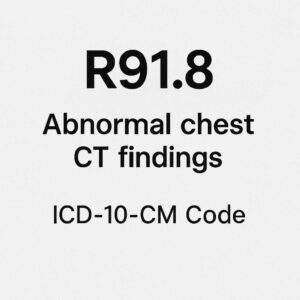
ICD-10-CM Code for Abnormal Chest CT Findings
2. The Foundational Challenge: Why “Abnormal CT Scan” is Not a Diagnosis
A fundamental principle in medical coding is to code to the highest level of specificity known for the encounter. An “abnormal finding” is, by definition, a sign or symptom—an observation that points toward an underlying condition but does not name it. The ICD-10-CM coding system is designed to capture morbidity, the disease state itself. Therefore, while there are codes for abnormal findings (found primarily in Chapter 18: Symptoms, Signs, and Abnormal Clinical and Laboratory Findings), their use is governed by strict guidelines.
The Official Coding Guideline (Section IV, H): “Codes that describe symptoms and signs, as opposed to diagnoses, are acceptable for reporting purposes when a related definitive diagnosis has not been established (confirmed) by the provider.”
This means the code for an abnormal radiological finding is a placeholder. It is used when:
-
The CT scan reveals an abnormality, but its cause remains undiagnosed after the encounter.
-
The finding is incidental and unrelated to the reason for the visit, and no further workup is conducted during that encounter.
-
The physician’s documentation does not provide a more specific diagnosis.
The coder’s mission is always to look for a definitive diagnosis first. Only when that is unavailable should one retreat to the appropriate sign/symptom code.
3. The Hierarchy of Codes: From Signs & Symptoms to Definitive Diagnoses
Think of ICD-10-CM coding for an abnormal CT as a pyramid:
-
Apex (Most Specific): Definitive Diagnosis Codes (Chapters 1-17). Examples: C34.11 (Malignant neoplasm of upper lobe, right bronchus or lung), J18.9 (Pneumonia, unspecified organism), I26.99 (Other pulmonary embolism without acute cor pulmonale).
-
Middle Layer: Sign/Symptom Codes for Specific Findings (Chapter 18). Examples: R91.1 (Solitary pulmonary nodule), R91.8 (Other nonspecific abnormal finding of lung field).
-
Base (Least Specific): General Abnormal Findings (Chapter 18). Example: R93.89 (Abnormal findings on diagnostic imaging of other specified body structures).
Your coding goal is to climb this pyramid based on the available documentation.
4. Chapter 1: The Entry Point – ICD-10-CM Category R91 (Abnormal Findings on Diagnostic Imaging of the Lung)
When a definitive diagnosis cannot be assigned, you will often land in R91. This category is your primary tool for nonspecific pulmonary imaging findings.
-
R91.0 – Solitary pulmonary nodule: This is a distinct, round lesion less than 30mm in diameter surrounded by lung parenchyma. The code is specific to a single nodule. It is used when the nodule is newly discovered, of uncertain etiology, and the physician has not yet rendered a diagnosis (e.g., “granuloma” or “suspicious for malignancy”).
-
R91.1 – Other nonspecific abnormal finding of lung field: This is a broader code. It can capture multiple nodules, an ill-defined opacity, a mass (though mass often prompts a more specific working diagnosis), or other unspecified anomalies.
-
R91.8 – Other nonspecific abnormal finding of lung field: This is the most commonly used code for a generic “abnormal chest CT.” It encompasses findings like:
-
Atelectasis (if not specified as postoperative or due to a known cause)
-
Unspecified infiltrates
-
Unspecified density
-
The generic phrase “abnormal CT scan of chest” when no further detail is provided.
-
Crucial Note: If the report describes a pattern suggestive of a specific condition (e.g., “findings consistent with interstitial lung disease” or “likely pneumonia”), but the physician does not document that diagnosis, you must query the provider. Do not assume a diagnosis from the radiology report alone.
5. Chapter 2: Coding Specific Pulmonary Abnormalities
Here we explore common findings and how they are coded before a definitive diagnosis is confirmed.
Pulmonary Nodules and Masses
-
Solitary Pulmonary Nodule (SPN): R91.0. As above.
-
Multiple Pulmonary Nodules: R91.1. The etiology could be metastatic disease, granulomatous disease, etc. If the physician documents “likely metastatic,” but the primary is unknown, you may still be in R91.1 or a code for secondary lung cancer (C78.0-) if the physician is confident stating it’s metastatic.
-
Lung Mass: This term often implies a lesion >30mm. While often coded to R91.1 initially, it strongly prompts a query for a working diagnosis (e.g., “suspected lung cancer”).
Ground-Glass Opacities (GGO) and Consolidations
-
These are descriptive patterns, not diagnoses.
-
Nonspecific GGO: Often R91.1. The cause could be infection, inflammation, edema, or early neoplasm.
-
Consolidation: Suggests airspace filling. If documented as “consolidation, likely pneumonia” without a definitive pneumonia diagnosis, use R91.1. If the physician diagnoses pneumonia, then code to J18.-.
Interstitial Lung Disease (ILD) Patterns
-
Findings like reticulation, honeycombing, traction bronchiectasis suggest ILD.
-
If the radiologist suggests “ILD pattern” and the physician has not specified a type (e.g., IPF, sarcoidosis), the appropriate code is R91.1 or sometimes J98.4 (Other disorders of lung) based on documentation. A query is essential.
Atelectasis and Collapse
-
This is a common incidental finding. Code first the cause if known (e.g., lung cancer with post-obstructive atelectasis). If it’s an unspecified, minor finding, R91.8 is appropriate.
Pleural Effusions
-
Pleural effusion is a finding, not a final diagnosis.
-
If the cause is undiagnosed, use R91.1 (if implying associated lung abnormality) or the specific symptom code J91.8 (Pleural effusion in other conditions classified elsewhere). The underlying cause (e.g., heart failure, malignancy, infection) must be coded first if known.
Mediastinal and Hilar Abnormalities
-
These fall outside the lung field.
-
For lymphadenopathy (enlarged lymph nodes), use R59.- (Enlarged lymph nodes).
-
For other unspecified mediastinal abnormalities, use R93.1 (Abnormal findings on diagnostic imaging of other intrathoracic organs).
6. Chapter 3: When the CT Reveals Specific Diseases
This is the goal: moving from finding to diagnosis.
-
Infectious Processes:
-
Pneumonia: Code to J12-J18. The CT finding of consolidation becomes J18.9 if unspecified.
-
Lung Abscess: J85.2.
-
Tuberculosis: A15.0 (Respiratory tuberculosis, confirmed by culture).
-
-
Malignancies:
-
Primary Lung Cancer: C34.-. The CT finding of a mass is now defined.
-
Metastatic Cancer to Lung: C78.0-. The primary site must also be coded (e.g., C18.9 for colon cancer).
-
-
Chronic Conditions:
-
COPD/Emphysema: J43.9 or J44.-. CT can visually confirm emphysematous changes.
-
Bronchiectasis: J47.-.
-
-
Vascular Findings:
-
Pulmonary Embolism (PE): I26.-. This is a definitive diagnosis made by CT Pulmonary Angiography (CTPA).
-
Aortic Aneurysm: I71.-.
-
7. Chapter 4: The Imperative of Clinical Correlation
The radiology report is one piece of the puzzle. The final diagnosis resides with the treating physician. The coder must review the entire medical record, especially the physician’s assessment and plan. A radiologist may state “findings are highly suspicious for malignancy,” but the treating physician may document “lung mass for further workup.” In that case, you cannot code cancer. You must code the sign (R91.1) and reflect the plan. When in doubt, query.
8. Chapter 5: The Coding Workflow – A Step-by-Step Methodology
-
Obtain the Documents: Secure the complete radiology report and the physician’s progress note/assessment for the encounter.
-
Identify the Primary Reason for the Study: Why was the CT ordered? This guides code sequencing.
-
Analyze the Radiologist’s “Impressions” or “Conclusion”: This section summarizes the key findings.
-
Cross-Reference with Physician’s Diagnosis: Does the physician state a definitive diagnosis that explains the findings?
-
Assign the Code:
-
If YES (Definitive Dx): Code the disease (Chapters 1-17). You may not need an R code at all.
-
If NO (No Definitive Dx): Code the most specific sign/symptom from Chapter 18 (e.g., R91.0, R91.1, R91.8).
-
-
Sequence Correctly: The first-listed code should represent the reason for the encounter.
-
Query if Needed: If the documentation is conflicting or ambiguous, initiate a formal query.
9. Essential Tables for Reference
ICD-10-CM Decision Matrix for Common Chest CT Abnormalities
| CT Finding (From Report) | Physician’s Final Diagnosis | Primary ICD-10-CM Code | Chapter & Notes |
|---|---|---|---|
| “Solitary pulmonary nodule, 8mm” | “Pulmonary nodule, etiology unknown, follow-up in 6 months.” | R91.0 (Solitary pulmonary nodule) | Ch. 18. Use when no definitive diagnosis is made. |
| “Multiple bilateral pulmonary nodules” | “Probable metastatic disease, primary unknown.” | R91.1 (Other nonspecific finding) | Ch. 18. Avoid C78.0- unless physician confirms “metastatic.” |
| “Lobar consolidation” | “Community-acquired pneumonia.” | J18.9 (Pneumonia, unspecified) | Ch. 10. The finding is now explained by a disease code. |
| “Ground-glass opacities” | “Atypical pneumonia vs. hypersensitivity pneumonitis, rule out.” | R91.1 | Ch. 18. Differential diagnoses are not coded. |
| “Large pleural effusion” | “Pleural effusion, likely due to CHF.” | I50.9 (Heart failure) & J91.8 (Pleural effusion) | Ch. 9 & 10. Code cause first, then manifestation. |
| “Pulmonary embolism in right lower lobe artery” | “Acute pulmonary embolism.” | I26.99 (Other pulmonary embolism) | Ch. 9. A definitive vascular diagnosis. |
| “Mediastinal lymphadenopathy” | “Lymphadenopathy, monitor.” | R59.9 (Enlarged lymph nodes, unspecified) | Ch. 18. |
| “Emphysematous changes” | “COPD with emphysema.” | J43.9 (Emphysema, unspecified) | Ch. 10. |
| “Bronchiectasis in lower lobes” | “Bronchiectasis.” | J47.9 (Bronchiectasis, uncomplicated) | Ch. 10. |
| “Incidental minimal atelectasis” | “No acute pulmonary disease.” | R91.8 | Ch. 18. Often used for incidental, minor atelectasis. |
| *border=1* |
10. Advanced Scenarios and Pitfalls to Avoid
-
Incidentalomas: An adrenal nodule found on a chest CT is coded to R93.6 (Abnormal finding on diagnostic imaging of adrenal gland), not a lung code.
-
History of Cancer: A patient with a history of lung cancer and a new nodule may be coded to Z85.118 (Personal history of other malignant neoplasm of bronchus and lung) along with R91.0 for the new finding.
-
Post-Treatment Changes: Radiation fibrosis or postsurgical changes are not “abnormal” in the disease sense. Code to Z98.89 (Other specified postprocedural states) or a specific complication code if applicable.
-
Pitfall: Coding the Impression, Not the Diagnosis. Never code a radiologist’s “differential diagnosis” (e.g., “likely pneumonia”) as if it is confirmed.
11. Conclusion
Accurate ICD-10-CM coding for an abnormal chest CT scan hinges on the critical distinction between a descriptive radiological finding and a clinician’s definitive diagnosis. The journey from the generic R91.8 to a precise disease code requires meticulous review of both the imaging report and the physician’s clinical assessment. By adhering to a structured workflow, leveraging codes like R91.0 and R91.1 for uncertain findings, and never hesitating to query for clarity, coders ensure the medical record accurately reflects patient care, supports appropriate reimbursement, and contributes to reliable health data.
12. Frequently Asked Questions (FAQs)
Q1: The radiologist’s report says “findings consistent with pneumonia.” Can I code J18.9?
A: No, not unless the treating physician documents “pneumonia” as a diagnosis in their assessment. The radiologist provides an interpretation, but the treating physician establishes the diagnosis. Code R91.1 and consider a query.
Q2: A CT shows “likely metastatic nodules.” The patient has a known breast cancer. Is it C78.0 or R91.1?
A: This requires clinical judgment. If the oncologist reviews the scan and agrees/confirms metastatic disease, code C78.0 (Secondary malignant neoplasm of lung) along with the breast cancer code (C50.-). If the physician is more cautious (“suspicious for metastasis”), R91.1 may be appropriate until confirmation.
Q3: How do I code a follow-up CT for a known nodule?
A: The reason for the encounter is surveillance. Use a code for the condition being followed. If it’s a nodule of unknown etiology, use R91.0 or R91.1. If it’s a history of cancer, use Z08 (Encounter for follow-up examination after completed treatment) as the first-listed code, followed by the history of cancer code (Z85.-) and the finding code (R91.0).
Q4: The CT report lists 5 different findings (e.g., nodule, effusion, atelectasis). Do I code all?
A: Yes, but follow coding guidelines for sequencing. Code first the condition that is the primary reason for the study. Code all additional findings that require clinical attention or are integral to the care.
13. Additional Resources
-
Centers for Disease Control and Prevention (CDC) – ICD-10-CM Official Guidelines for Coding and Reporting: https://www.cdc.gov/nchs/icd/icd-10-cm.htm (The authoritative source for rules).
-
American Health Information Management Association (AHIMA): https://www.ahima.org/ (Offers educational resources, journals, and networking for coders).
-
American Academy of Professional Coders (AAPC): https://www.aapc.com/ (Provides certification, training, and coding news).
Disclaimer: *This article is intended for informational purposes only and is not a substitute for professional medical coding advice, clinical guidance, or physician consultation. Medical coding is complex and context-dependent. Always consult the latest official ICD-10-CM coding guidelines, payer-specific policies, and the complete medical record for accurate code assignment.*
Date: December 24, 2025
Author: Medical Coding & Radiology Analysis Team