In the intricate ecosystem of modern healthcare, two languages converge with profound consequences for patient outcomes and system viability: the language of clinical medicine and the language of medical coding. At the heart of this convergence lies a condition that is as clinically urgent as it is administratively complex—Acute Metabolic Encephalopathy. This neurological crisis, born from systemic metabolic failure, demands swift diagnosis and intervention. Yet, its accurate translation into the alphanumeric lexicon of the International Classification of Diseases, 10th Revision, Clinical Modification (ICD-10-CM) is a task of equal criticality, fraught with nuance and significant implications.
This article embarks on a deep exploration of this critical juncture. It is designed not merely as a lookup guide for a code, but as a comprehensive, 360-degree examination of acute metabolic encephalopathy through the dual lenses of clinician and coder. We will dissect its pathophysiology, unravel the complexities of its ICD-10-CM representation (principally codes G93.41 and G93.49), and illuminate the pivotal role of precise clinical documentation. For healthcare providers, accurate coding translates to appropriate reimbursement, accurate quality metrics, and valuable data for research. For the healthcare system at large, it ensures integrity in reporting and resource allocation. Most importantly, at its core, accurate coding is a reflection of accurate patient care. A mis-coded encephalopathy can obscure the true severity of illness, skew hospital performance data, and ultimately impede the collective understanding of this serious condition. Prepare for a detailed journey into the storm within the brain and the system tasked with classifying it.
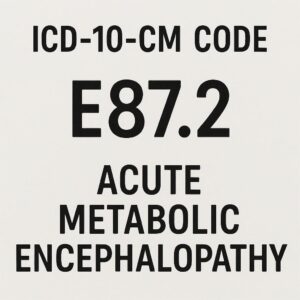
ICD-10-CM Code for Acute Metabolic Encephalopathy
2. Understanding the Enemy: What is Acute Metabolic Encephalopathy?
Acute Metabolic Encephalopathy is not a primary disease of the brain’s structure, but rather a diffuse functional impairment of cerebral metabolism. It is characterized by an acute or subacute onset of global cognitive dysfunction—a “delirium”—directly resulting from an underlying systemic metabolic disturbance, toxicity, or organ failure. Think of the brain as a sophisticated supercomputer. Metabolic encephalopathy occurs when this computer’s power supply becomes unstable (e.g., hypoglycemia), its cooling system fails (e.g., hyperthermia), or it is flooded with corrupted data (e.g., toxins like ammonia in liver failure). The hardware is intact, but the operating environment is catastrophically compromised.
The key descriptors are:
-
Acute: Signifying a rapid onset, typically over hours to days, distinguishing it from chronic, progressive dementias.
-
Metabolic: Indicating the origin is a biochemical derangement external to the central nervous system itself.
-
Encephalopathy: Denoting a global disturbance in brain function, affecting consciousness, cognition, and often the sleep-wake cycle.
It is a syndrome—a final common pathway for a multitude of insults. Its reversibility is contingent upon the timely identification and correction of the underlying cause. Delay can lead to permanent neuronal injury or death.
3. The Pathophysiology: A Storm in the Brain
To code accurately, one must understand the “why.” The pathophysiology of metabolic encephalopathy involves a disruption of the delicate homeostatic balance required for normal neuronal function.
-
Energy Failure: Neurons are voracious consumers of glucose and oxygen. Hypoglycemia or hypoxia (from severe respiratory or cardiac failure) starves neurons of fuel, leading to rapid failure of energy-dependent processes like maintaining ion gradients.
-
Neurotransmitter Imbalance: Systemic illnesses alter precursor availability or mimic neurotransmitters. For example, in liver failure, accumulated ammonia leads to increased synthesis of glutamine in astrocytes (brain cells), which causes cellular swelling and disrupts the balance of excitatory (glutamate) and inhibitory (GABA) signals.
-
Cerebral Edema: Astrocyte swelling (as in hepatic encephalopathy or hyponatremia) or cytotoxic edema can increase intracranial pressure, further compromising cerebral blood flow.
-
Direct Toxicity: Substances like urea (renal failure), drugs (sedatives, illicit drugs), or alcohol can directly interfere with neuronal membrane function or synaptic transmission.
-
Electrolyte & Acid-Base Derangements: The brain is exquisitely sensitive to pH and electrolyte concentrations (sodium, calcium, magnesium). Shifts disrupt membrane potentials and the propagation of electrical impulses.
This multifaceted assault results in the clinical picture of delirium: impaired attention, disorganized thinking, and altered consciousness.
4. Clinical Presentation: Recognizing the Signs and Symptoms
The presentation can range from subtle to overt. Documentation of these symptoms is the raw material from which coders build the diagnosis.
-
Core Features: Fluctuating course; worse at night (“sundowning”).
-
Cognitive Impairment: Disorientation (to person, place, time), memory deficits, slowed thought processing.
-
Attention Deficit: Inability to focus, maintain, or shift attention. Easily distracted.
-
Altered Level of Consciousness: Can range from hyperalert agitation and hallucinations (hyperactive delirium) to profound lethargy and stupor (hypoactive delirium—often missed). A mixed state is common.
-
Psychomotor Changes: Restlessness, aggression, or marked sluggishness.
-
Sleep-Wake Cycle Disruption: Daytime drowsiness, nighttime insomnia or agitation.
-
Neurological Signs: Asterixis (“liver flap”—a coarse tremor of the wrist when extended), myoclonus (sudden muscle jerks), dysarthria (slurred speech), and primitive reflexes may be present in advanced cases.
The Confusion Assessment Method (CAM) is a widely used, validated tool for diagnosing delirium and its features should be referenced in notes.
5. Common Etiologies: The Root Causes
ICD-10-CM demands specificity. Coding “acute metabolic encephalopathy” alone is insufficient; the underlying cause must be identified and coded. Major categories include:
-
Hepatic Encephalopathy: Due to acute or chronic liver failure; ammonia is a key culprit.
-
Uremic Encephalopathy: Associated with acute or chronic kidney injury; accumulation of uremic toxins.
-
Septic Encephalopathy: A common complication of severe sepsis, driven by inflammatory cytokines, endothelial dysfunction, and possible micro-thrombi.
-
Hypoxic-Ischemic Encephalopathy: From cardiac arrest, respiratory failure, or severe shock.
-
Electrolyte & Acid-Base Disorders: Hyponatremia, hypercalcemia, severe acidosis or alkalosis.
-
Endocrine Disorders: Diabetic ketoacidosis, hyperosmolar hyperglycemic state, myxedema coma, thyrotoxicosis.
-
Deficiency States: Thiamine (Wernicke’s encephalopathy), Vitamin B12.
-
Toxic/Drug-Induced: Alcohol withdrawal, sedative-hypnotics, opioids, illicit substances, chemotherapy agents, polypharmacy in the elderly.
-
Other Metabolic: Acute porphyria, inborn errors of metabolism.
6. The Cornerstone of Coding: Clinical Documentation
This cannot be overstated: The medical record is the source of truth. Coders cannot infer, assume, or diagnose. They can only translate what is explicitly documented by the treating provider. High-quality documentation for acute metabolic encephalopathy must include:
-
The Specific Diagnosis: “Acute metabolic encephalopathy,” “septic encephalopathy,” “uremic encephalopathy,” etc.
-
Temporal Context: “Acute,” “acute on chronic,” or “chronic.”
-
Severity: Descriptors like “mild,” “moderate,” “severe,” or “coma.” This can impact HCC risk scores.
-
Etiology/Association: A clear link to the underlying cause. Phrases like “secondary to,” “due to,” “attributed to,” or “in the setting of” are crucial.
-
Clinical Findings: Documentation of the symptoms (confusion, agitation, asterixis) and any diagnostic assessments (CAM-positive, abnormal labs, EEG findings).
-
Treatment: Is the encephalopathy being actively managed? (e.g., “initiating lactulose for hepatic encephalopathy,” “correcting hyponatremia”).
Poor Documentation: “Patient confused.”
Excellent Documentation: “Patient diagnosed with acute, moderate metabolic encephalopathy secondary to uremia from newly recognized acute kidney injury (Cr 4.2). CAM-positive with fluctuating disorientation to time/place, lethargy, and asterixis. Nephrology consulted for emergent dialysis.”
7. Navigating the ICD-10-CM Code Set: G93.41 and G93.49
Here we arrive at the core codes. They reside in Chapter 6: Diseases of the Nervous System (G00-G99), under the block “Other disorders of brain” (G93).
-
G93.41 – Metabolic encephalopathy
-
This is the default code for metabolic encephalopathy. According to the ICD-10-CM Official Guidelines for Coding and Reporting, this code is used when the specific type of metabolic encephalopathy is not documented or does not have its own unique code. It is a broad category.
-
-
G93.49 – Other encephalopathy
-
This code is used for encephalopathies not elsewhere classified. This is where many specified metabolic encephalopathies are reported if there is no more specific code. For example, “septic encephalopathy” or “toxic metabolic encephalopathy” are often coded to G93.49, as there are no specific codes for them under G93.41 or elsewhere. It is essential to check the Alphabetic Index under “Encephalopathy” for guidance.
-
Crucial Distinction: There is often confusion with code G92 (Toxic encephalopathy), which is reserved for chronic, permanent brain damage due to toxins (e.g., long-term heavy metal exposure, chronic solvent abuse). Acute, reversible toxic-metabolic encephalopathy from a systemic illness or medication is NOT G92; it is typically G93.49.
ICD-10-CM Coding Guide for Common Encephalopathy Types
| Clinical Diagnosis (as Documented) | Primary ICD-10-CM Code | Code Notes & Sequencing |
|---|---|---|
| Acute Metabolic Encephalopathy, unspecified | G93.41 | Use when no specific type is documented. |
| Septic Encephalopathy | G93.49 | Code first the underlying infection (e.g., A41.9 Sepsis). |
| Toxic Metabolic Encephalopathy (acute, due to medications/illness) | G93.49 | Code also the toxin/drug (T-codes) or underlying condition. |
| Uremic Encephalopathy | G93.41 | Code first the underlying chronic kidney disease (N18.-) or acute kidney injury (N17.-). |
| Hepatic Encephalopathy | K72.90 | This is a crucial exception. Hepatic encephalopathy has its own code in Chapter 11 (Digestive). Code K72.90 (Hepatic failure, unspecified with coma) or K72.91 (… without coma). Do NOT use G93.41. |
| Hypoglycemic Encephalopathy | E16.1 | Code from Chapter 4 (Endocrine). “Other hypoglycemia” covers drug-induced or unspecified. |
| Anoxic/Hypoxic Brain Injury | G93.1 | Distinct from metabolic; used after cardiac arrest, drowning. |
| Wernicke’s Encephalopathy | E51.2 | Thiamine deficiency. Code from Chapter 4. |
| Chronic Traumatic Encephalopathy | G31.09 | Not metabolic. For history of repetitive head trauma. |
| Toxic Encephalopathy (Chronic) | G92 | For permanent damage from long-term toxin exposure. |
8. The Sequencing Conundrum: Principal Diagnosis, Comorbidity, or MCC?
Sequencing—determining which code is listed first—is governed by the ICD-10-CM Official Guidelines and is vital for DRG assignment.
-
Principal Diagnosis: The condition established after study to be chiefly responsible for the admission. If a patient is admitted for management of acute metabolic encephalopathy (e.g., a delirious patient brought to the ER), the encephalopathy may be the principal diagnosis (PDx). Example: PDx G93.49 (Septic encephalopathy), secondary diagnosis A41.9 (Sepsis).
-
When the Cause is the PDx: More commonly, the patient is admitted for the underlying illness, and the encephalopathy develops as a complication. The underlying cause is sequenced as PDx. Example: A patient admitted with septic shock (PDx: R65.21, A41.9) who develops encephalopathy. PDx: A41.9, secondary: R65.21, secondary: G93.49.
-
MCC/CC Status: Acute metabolic encephalopathy (G93.41, G93.49) is nearly always considered a Major Complication/Comorbidity (MCC) or at least a Comorbidity (CC). This dramatically increases the relative weight and reimbursement of the assigned Diagnosis-Related Group (DRG). Hepatic encephalopathy (K72.90-) is also a powerful MCC. Accurate identification is therefore financially significant for hospitals.
9. Specificity is King: Linking Encephalopathy to its Cause
Coders must build a complete picture. Using G93.41 or G93.49 alone is rarely sufficient. A combination of codes tells the full story:
-
Code the Encephalopathy: Assign G93.41 or G93.49 as appropriate.
-
Code the Underlying Cause: Always assign a code for the causal condition.
-
Sepsis (A40.-, A41.-)
-
Acute Kidney Injury (N17.-) or Chronic Kidney Disease (N18.-)
-
Hyponatremia (E87.1)
-
Hypercalcemia (E83.52)
-
Diabetic ketoacidosis (E10.10-E13.11)
-
Substance use (F10-F19) or poisoning (T36-T50)
-
-
Follow Official Guidelines: For hepatic encephalopathy, code K72.90-, not G93.41. For uremic encephalopathy, code first the kidney disease (N17.- or N18.-), then G93.41.
10. Case Studies: Applying the Codes in Real-World Scenarios
Case 1: The Septic Patient
-
Presentation: 78F admitted with fever, hypotension, and AMS. Urinalysis positive for UTI. CAM-positive, lethargic.
-
Documentation: “Severe sepsis with septic shock. Acute metabolic encephalopathy secondary to sepsis.”
-
Coding:
-
PDx: A41.9 (Sepsis, unspecified organism)
-
Secondary: R65.21 (Severe sepsis with septic shock)
-
Secondary: G93.49 (Other encephalopathy) – specified as septic
-
Secondary: N39.0 (UTI)
-
-
DRG Impact: The sepsis (MCC) + encephalopathy (MCC) will group to a high-severity DRG.
Case 2: The Hyponatremic Elderly Patient
-
Presentation: 85M from nursing home, found confused. Labs: Na 118 mEq/L.
-
Documentation: “Symptomatic severe hyponatremia with acute metabolic encephalopathy.”
-
Coding:
-
PDx: E87.1 (Hypo-osmolality and hyponatremia)
-
Secondary: G93.41 (Metabolic encephalopathy)
-
-
Note: Encephalopathy is directly linked to the electrolyte disorder.
Case 3: Hepatic Decompensation
-
Presentation: 55M with cirrhosis, ascites, now confused and asterixis present.
-
Documentation: “Acute on chronic hepatic encephalopathy, grade 2.”
-
Coding:
-
PDx: K72.91 (Hepatic failure, unspecified without coma) or K76.82 (Hepatorenal syndrome) if present.
-
Secondary: K70.30 (Alcoholic cirrhosis)
-
DO NOT CODE G93.41. K72.91 encompasses the encephalopathy.
-
11. The Impact on Reimbursement: DRGs and HCCs
-
Diagnosis-Related Groups (DRGs): Inpatient payments are based on DRGs, which bundle similar clinical cases and resource costs. The presence of an MCC or CC shifts a case to a higher-weighted, higher-paying DRG. G93.41/G93.49 are potent CC/MCC drivers. For example, a pneumonia DRG (without CC/MCC) may pay $5,000. The same pneumonia with acute metabolic encephalopathy (an MCC) may pay $9,000, reflecting the increased care complexity.
-
Hierarchical Condition Categories (HCCs): Used in risk-adjusted payment models like Medicare Advantage. Conditions are assigned risk scores based on projected healthcare costs. Metabolic encephalopathy is a high-risk condition. Accurate coding ensures the health plan receives appropriate capitation payments to manage the patient’s care, which is typically more complex and expensive.
12. Common Documentation Pitfalls and How to Avoid Them
-
“Encephalopathy” Alone: Query the provider for type: “metabolic,” “toxic,” “anoxic?”
-
“Altered Mental Status” (AMS): This is a symptom, not a diagnosis. Query for the underlying diagnosis (delirium, encephalopathy).
-
“Delirium” vs. “Encephalopathy”: Often used interchangeably clinically. From a coding perspective, delirium (F05, R41.0) is a symptom-based diagnosis, while encephalopathy is an etiologic diagnosis. If the cause is known (metabolic, toxic), encephalopathy is more specific. Query for clarity: “Can the delirium be attributed to a metabolic cause?”
-
Linking Causality: Documentation must explicitly link the encephalopathy to its cause. A query may be needed: “Is the encephalopathy due to sepsis/hyponatremia/uremia?”
-
Chronic vs. Acute: Documenting “chronic encephalopathy” may refer to a static condition like prior anoxic injury. Query for acuity if there is an acute exacerbation.
13. The Role of the Physician Advisor and Clinical Documentation Integrity (CDI)
A robust CDI program is essential. CDI specialists (often nurses) review records concurrently (during admission) and work with physicians to clarify documentation. They send respectful, non-leading queries:
-
“Based on the documented CAM-positive delirium in the setting of severe hyponatremia (Na 118), can you confirm a diagnosis of acute metabolic encephalopathy?”
-
“The patient has hepatic cirrhosis and new-onset confusion with asterixis. Can you specify if this is acute hepatic encephalopathy?”
The Physician Advisor acts as a bridge, educating clinical staff on the importance of specificity for patient care, quality reporting, and accurate coding.
14. Beyond ICD-10: The Future of Coding and Patient Care
The transition to ICD-11 (already live for mortality reporting) is on the horizon. It offers a more structured, digital-friendly format. The condition is found under “8E47.0 Metabolic encephalopathy.” ICD-11 allows for richer clustering of causal codes. Furthermore, the rise of Artificial Intelligence (AI) and Natural Language Processing (NLP) promises to assist in identifying documentation gaps and suggesting clarifications in real-time. However, the core principle remains: the narrative in the chart, written by a human clinician for human care, is the foundation. Technology will augment, not replace, clinical reasoning and precise communication.
15. Conclusion
Navigating ICD-10-CM coding for acute metabolic encephalopathy is a critical skill that sits at the nexus of clinical accuracy and healthcare system integrity. It requires a deep understanding of the condition’s pathophysiology, a mastery of the nuanced code set (G93.41, G93.49, and key exceptions like K72.90), and an unwavering commitment to the principles of specific, linked clinical documentation. When performed correctly, it ensures patients are accurately represented, hospitals are fairly reimbursed for complex care, and the data generated fuels better research and public health understanding. In the end, every code tells a patient’s story; our duty is to ensure that story is complete and true.
16. Frequently Asked Questions (FAQs)
Q1: What is the difference between G93.41 and G93.49?
A: G93.41 is for “Metabolic encephalopathy” when a more specific type isn’t documented. G93.49 is “Other encephalopathy” and is used for specified types that don’t have their own unique code elsewhere, such as “septic encephalopathy” or “toxic metabolic encephalopathy.” Always follow the Alphabetic Index.
Q2: When do I use code K72.90 instead of G93.41?
A: Always use K72.90 (or K72.91) for hepatic encephalopathy. This is a non-negotiable rule in ICD-10-CM. Hepatic encephalopathy has its own code in the Digestive Diseases chapter. G93.41 should not be used in this case.
Q3: Is acute metabolic encephalopathy always an MCC?
A: While not every single case is automatically an MCC per the definition list, in practice, G93.41 and G93.49 are virtually always mapped as either an MCC or a CC due to the significant resources required for management. Always verify with your current DRG grouper software.
Q4: How do I code encephalopathy due to multiple causes?
A: Code the encephalopathy once (G93.41/49) and code all relevant underlying causes (e.g., sepsis and acute kidney injury). The PDx should be the reason for admission.
Q5: What if the physician only documents “delirium”?
A: Code F05 Delirium due to known physiological condition or R41.0 Disorientation if unspecified. However, this may not capture the full severity. A CDI query is recommended to ask if the delirium is attributable to a documented metabolic/toxic cause, which would allow for the more specific (and higher severity) encephalopathy code.
Q6: Can G93.41 be used as a principal diagnosis?
A: Yes, if the acute metabolic encephalopathy is the condition that occasioned the admission after study. For example, a patient admitted from the ER for workup and management of new-onset acute confusion that is determined to be metabolic encephalopathy.
17. Additional Resources
-
CDC ICD-10-CM Official Guidelines: https://www.cdc.gov/nchs/icd/icd-10-cm.htm – The absolute authority for coding rules.
-
American Hospital Association (AHA) Coding Clinic: The official source for advice and guidance on ICD-10-CM coding issues (subscription required).
-
American Health Information Management Association (AHIMA): https://www.ahima.org – Provides education, best practices, and advocacy for coding professionals.
-
National Institute of Neurological Disorders and Stroke (NINDS) – Encephalopathy Information Page: https://www.ninds.nih.gov/health-information/disorders/encephalopathy – For clinical background.
-
Confusion Assessment Method (CAM) Tool: https://www.hospitalmedicine.org/globalassets/clinical-topics/clinical-pdf/cam-confusion-assessment-method-english.pdf – The standard for diagnosing delirium.
Disclaimer: This article is for informational and educational purposes only. It is not a substitute for professional medical coding advice, clinical guidance, or the latest official coding resources. Always consult the current ICD-10-CM code set, official coding guidelines, and physician documentation for accurate coding. The author and publisher assume no responsibility for errors or omissions, or for any outcomes related to the use of this information. Date of Article: December 24, 2025.