In the vast, intricate universe of medical coding, where every diagnosis, procedure, and outcome is translated into an alphanumeric language, few code sets carry as much clinical nuance and real-world impact as those for mental health. At the intersection of human experience and clinical classification lies the coding of anxiety disorders. An ICD-10-CM code for anxiety is far more than a mere administrative checkbox; it is a data point that influences treatment pathways, justifies medical necessity to insurers, shapes public health statistics, and, ultimately, touches the lives of millions seeking help for one of the most common mental health conditions worldwide.
For the medical coder, accurately capturing anxiety represents a significant challenge. It requires a discerning eye that can differentiate between transient worry and a pathological disorder, between a primary mental health diagnosis and anxiety secondary to a medical condition, and between the specific subtypes that guide therapeutic intervention. This article delves deep into the ICD-10-CM landscape for anxiety disorders. We will move beyond simple code look-ups to explore the clinical reasoning behind code assignment, the pivotal role of provider documentation, the common pitfalls that can lead to denials or audits, and the ethical responsibility embedded in precise coding. Whether you are a seasoned coder, a healthcare provider, a student, or a patient seeking to understand your medical record, this comprehensive guide aims to illuminate the critical pathway from symptomatic distress to accurate diagnostic code.
ICD-10-CM Code for Anxiety Disorders
2. Chapter 5: Mental, Behavioral and Neurodevelopmental Disorders (F01-F99)
Anxiety disorders are classified within Chapter 5: Mental, Behavioral and Neurodevelopmental Disorders. Codes in this chapter begin with the letter ‘F’. The general coding notes for this chapter are paramount and often overlooked, leading to errors.
Essential Chapter-Specific Guidelines:
-
Use an additional code to identify: Any associated underlying physiological condition, physical disorder, or disease. For example, if anxiety is directly caused by hyperthyroidism, both codes are required.
-
Code first the underlying disease: If the mental disorder is due to a physiological condition (e.g., anxiety disorder due to known physiological condition, F06.4), you must code the physiological condition first. This is a critical sequencing rule.
-
Excludes Notes: ICD-10-CM’s Excludes1 and Excludes2 notes are legal instructions. For anxiety, key distinctions must be made. For instance, the anxiety disorders block (F40-F41) has an Excludes2 note for “neurotic depression (F34.1)”. This means depression with anxious features is not classified here, guiding you to a different part of the chapter.
3. The Anxiety Disorder Family: A Code for Every Presentation
Anxiety is not monolithic. ICD-10-CM reflects the spectrum of clinical presentations through specific codes. Selection depends entirely on the provider’s documented diagnosis.
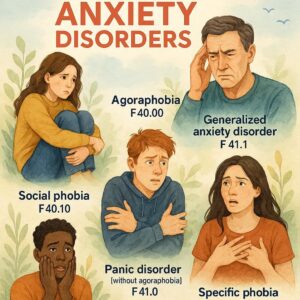
F41.1: Generalized Anxiety Disorder (GAD)
This is the code for excessive, uncontrollable worry about everyday things more days than not for at least six months, accompanied by physical symptoms like restlessness, fatigue, difficulty concentrating, irritability, muscle tension, or sleep disturbance. Documentation must specify “generalized anxiety disorder” or “GAD.” Vague terms like “chronic anxiety” may lead to a less specific code.
F40.10: Social Phobia, Unspecified
This code is for marked fear or anxiety about one or more social situations where the individual is exposed to possible scrutiny by others. The “unspecified” descriptor is used when the documentation states “social phobia” or “social anxiety disorder” but does not specify if it’s generalized or related to performance only (e.g., public speaking). For performance-only phobia, see F40.248.
F40.00 – F40.02: Agoraphobia
Agoraphobia is fear or avoidance of situations where escape might be difficult or help unavailable in the event of panic-like symptoms. Coding requires a fifth digit to specify the presence of panic attacks.
-
F40.00: Agoraphobia, unspecified (panic attacks not specified)
-
F40.01: Agoraphobia with panic disorder
-
F40.02: Agoraphobia without panic disorder
Documentation must clearly link the avoidance behavior to agoraphobic fears, not just a preference.
F41.0: Panic Disorder [Episodic Paroxysmal Anxiety]
This is for recurrent, unexpected panic attacks—sudden surges of intense fear or discomfort that peak within minutes. A key diagnostic criterion is persistent worry about having more attacks or maladaptive change in behavior related to the attacks. A single panic attack is not a codable panic disorder.
Specific Phobias (F40.2xx)
These involve marked fear or anxiety about a specific object or situation (e.g., animals, heights, flying, blood). Codes require a fifth and sixth character for specificity.
-
F40.210: Fear of flying
-
F40.218: Other situational phobia (e.g., elevators, enclosed places)
-
F40.230: Fear of blood
-
F40.248: Fear of speaking in public (a type of social phobia)
Other Specified & Unspecified Anxiety Disorders (F41.8, F41.9)
These are essential “bucket” codes used when the provider’s documentation is incomplete or the presentation is mixed.
-
F41.8 (Other specified anxiety disorders): Used when the provider specifies a type of anxiety not captured elsewhere (e.g., “mixed anxiety and depressive disorder” when criteria for both are met but neither is predominant). The specific type must be documented.
-
F41.9 (Anxiety disorder, unspecified): This is the equivalent of “anxiety, not otherwise specified (NOS).” It is used when the documentation is limited to a generic term like “anxiety” or “anxiety state” without further specification. This is often a target for clinical documentation improvement (CDI) queries.
4. The Critical Distinction: Adjustment Disorder with Anxiety (F43.22)
This is one of the most important differentiations in mental health coding. F43.22 (Adjustment disorder with anxiety) is used when the emotional or behavioral symptoms (anxiety, worry, nervousness) are a maladaptive reaction to an identifiable psychosocial stressor (e.g., divorce, job loss, illness) and occur within 3 months of the stressor’s onset. The symptoms are clinically significant but do not meet the criteria for another specific anxiety disorder and are not merely an exacerbation of a pre-existing condition.
Coding Rule: The stressor itself can be coded separately (e.g., Z63.0 for relationship distress) if it is relevant to care.
5. Documentation is King: What Coders Need to See in the Record
Coders cannot infer or assume. The patient’s record must provide clear, unambiguous evidence. Key documentation elements include:
-
A definitive diagnostic statement: “Diagnosis: Generalized Anxiety Disorder” is ideal.
-
Supporting symptoms and criteria: Notes describing duration (“for the past 8 months”), specific symptoms (“excessive worry about work and family health”), and impact (“causing significant sleep disturbance”).
-
Rule-out vs. Confirmed Diagnosis: A “rule-out” diagnosis is never coded as confirmed. It may be reported as a sign/symptom (e.g., R45.81, Worry) while the diagnostic workup proceeds.
-
Severity and Specificity: Specifiers like “mild,” “moderate,” or “severe” can be important for treatment planning but do not typically change the ICD-10-CM code. Specificity of phobia type is required for 5th/6th characters.
6. Navigating Complexity: Co-morbidities, Rule-Outs, and Medical Causes
-
Co-morbidities: It is common for anxiety to co-occur with other conditions like Major Depressive Disorder (F32.x, F33.x) or Substance Use Disorders (F10-F19). Both/all diagnoses should be coded, sequencing based on the reason for the encounter.
-
Anxiety Due to Another Medical Condition (F06.4): This is used when the anxiety is a direct physiological consequence of a general medical condition (e.g., hyperthyroidism, pheochromocytoma, COPD). Code first the underlying physiological condition.
-
Substance-Induced Anxiety Disorder: Anxiety caused by substance intoxication or withdrawal has specific codes within the F10-F19 blocks, with a fourth or fifth character specifying the presence of anxiety.
7. The Table of Essential Anxiety Codes
Below is a quick-reference table for the most commonly used ICD-10-CM anxiety codes.
| ICD-10-CM Code | Description | Clinical Context & Documentation Requirements |
|---|---|---|
| F41.1 | Generalized Anxiety Disorder | Documented GAD. Chronic, excessive worry + physical symptoms for ≥6 months. |
| F40.00 | Agoraphobia, unspecified | Avoidance of situations due to fear of inability to escape/help. Panic attacks not specified. |
| F40.01 | Agoraphobia with panic disorder | Agoraphobia criteria met and comorbid recurrent panic attacks. |
| F41.0 | Panic Disorder [Episodic Paroxysmal Anxiety] | Recurrent, unexpected panic attacks with persistent concern or behavior change. |
| F40.10 | Social Phobia, Unspecified | Fear of social/performance situations. Not specified as performance-only. |
| F40.248 | Fear of speaking in public | A specific type of social anxiety limited to public speaking. |
| F40.210 | Fear of flying | Specific phobia, situational type. |
| F41.8 | Other specified anxiety disorders | e.g., “Mixed anxiety and depressive disorder” (as specified by provider). |
| F41.9 | Anxiety disorder, unspecified | Generic “anxiety” without further specification. Use when documentation is limited. |
| F43.22 | Adjustment disorder with anxiety | Maladaptive anxiety reaction to identifiable stressor within 3 months. |
| F06.4 | Anxiety disorder due to known physiological condition | Code first the underlying condition (e.g., E05.90, Hyperthyroidism). |
| R45.81 | Worry | Sign/symptom code, not a diagnosis. Used for “ruling out” anxiety disorders. |
8. From Assessment to Code: A Clinical Vignette
Scenario: A 35-year-old patient presents to their primary care provider reporting 9 months of constant, excessive worry about finances, job performance, and their children’s safety. They report difficulty controlling the worry, persistent muscle tension, irritability, and insomnia 4-5 nights per week. The provider’s assessment states: “Generalized Anxiety Disorder, moderate severity.”
Coding Process:
-
Locate the Diagnosis: The provider has given a definitive diagnosis: “Generalized Anxiety Disorder.”
-
Verify Specificity: The diagnosis is specific; it is not “anxiety NOS.”
-
Check the Alphabetical Index: Under “Anxiety,” you find “generalized F41.1.”
-
Verify in the Tabular List: Turn to F41.1. Review any excludes notes (none that contradict). Confirm code is valid.
-
Assign the Code: F41.1 is assigned.
-
Consider Co-morbidities or Additional Codes: In this vignette, none are indicated. No additional code for “moderate” is needed.
Result: The accurate, billable code is F41.1.
9. Compliance Pitfalls and Audit Triggers
-
Overusing F41.9: Habitually using “unspecified” when the documentation supports a more specific code is a red flag. It suggests poor documentation or lack of coder proficiency.
-
Ignoring Excludes Notes: Coding both F41.1 and F34.1 (Dysthymia) when the provider documents “anxious distress” as part of a depressive disorder could be incorrect based on excludes notes.
-
Coding Rule-Outs: Submitting a definitive anxiety disorder code (e.g., F41.0) when the record only states “rule out panic disorder” is a serious compliance error.
-
Incorrect Sequencing with F06.4: Failing to code the physiological condition first when anxiety is due to a medical condition violates coding guidelines.
10. Looking Ahead: ICD-11 and the Future of Mental Health Coding
The World Health Organization’s ICD-11, which some countries have begun implementing, brings significant changes to the classification of anxiety disorders. While the U.S. continues to use ICD-10-CM, awareness of ICD-11 is valuable. Key shifts include:
-
Reorganization: Grouping anxiety and fear-related disorders together, separating them from obsessive-compulsive and stress-related disorders.
-
Refined Definitions: Updating diagnostic guidelines to reflect contemporary clinical understanding.
-
New Entities: Formalizing diagnostic categories that were previously in “other specified” sections.
The transition to ICD-11-CM in the U.S. will eventually require comprehensive re-education for coders and providers alike.
11. Conclusion
Accurate ICD-10-CM coding for anxiety disorders is a specialized skill that bridges clinical psychiatry and health information management. It demands a meticulous understanding of diagnostic criteria, a thorough analysis of clinical documentation, and strict adherence to coding guidelines. By moving beyond simple code assignment to grasp the clinical stories behind codes like F41.1, F43.22, and F06.4, medical coders become vital contributors to quality patient care, valid health data, and a financially sustainable healthcare system. In the nuanced world of mental health, precision in coding is not just an administrative task—it is a fundamental component of ethical and effective treatment.
12. Frequently Asked Questions (FAQs)
Q1: What is the difference between F41.1 (GAD) and R45.81 (Worry)?
A: F41.1 is a billable diagnosis for a recognized mental disorder meeting specific duration and symptom criteria. R45.81 is a symptom code used when a patient reports worry, but a definitive anxiety disorder diagnosis has not been made (e.g., during a work-up).
Q2: Can I code both panic disorder (F41.0) and GAD (F41.1) together?
A: Yes, if the provider documents both as co-occurring, distinct conditions. However, in clinical practice, GAD is often diagnosed when panic attacks are not present. If panic attacks are part of the presentation, the provider must clarify if they meet the full criteria for panic disorder.
Q3: How do I code “situational anxiety” or “test anxiety”?
A: If it is a temporary, non-pathological reaction, it may not be a codable disorder. If it is severe and meets criteria for a specific phobia (e.g., test-taking as a performance situation), it could be F40.248 (if fear is specifically of scrutiny) or F40.218 (other situational phobia). Often, transient situational anxiety is not assigned a mental disorder code.
Q4: My provider documents “anxiety.” No other details. What code do I use?
A: You must use F41.9 (Anxiety disorder, unspecified). This is a prime opportunity for a Clinical Documentation Improvement (CDI) query to ask the provider for a more specific diagnosis.
Q5: Where can I find the absolute, official coding rules?
A: The definitive sources are the annual ICD-10-CM Official Guidelines for Coding and Reporting (from the CDC and CMS) and the current year’s ICD-10-CM code set. These are publicly available on the CMS website.
Date: December 29, 2025
Author: DeepSeek Medical Coding Resources
Disclaimer: *This article is intended for educational and informational purposes only. It is not a substitute for professional medical advice, diagnosis, or treatment, nor does it constitute official coding guidance. Always consult the latest official ICD-10-CM code sets, CMS guidelines, and your facility’s coding policies for definitive coding direction.*