The human foot is a biomechanical marvel—a complex structure of 26 bones, 33 joints, and over a hundred muscles, tendons, and ligaments, all engineered to bear the full weight of the body and propel it through space. When pain strikes one foot, it is a significant impediment. When it strikes both, it can be utterly debilitating, upending mobility, employment, and quality of life. For the patient presenting with “bilateral foot pain,” this complaint is the starting point of a clinical narrative. For the medical coder, it is the beginning of a precise and critical translation process.
In the world of medical documentation and reimbursement, the simple phrase “bilateral foot pain” is not a conclusion but a question. It is a symptom begging for an etiology. Assigning the correct International Classification of Diseases, Tenth Revision, Clinical Modification (ICD-10-CM) code is far more than an administrative task; it is the act of defining the patient’s condition for the medical record, for population health statistics, and for the complex machinery of healthcare financing. The code M79.67 (Pain in foot and toes) may seem like the obvious endpoint, but its application is governed by strict rules and is often merely a placeholder on the journey to a definitive diagnosis.
This article embarks on a comprehensive exploration of bilateral foot pain through the lens of ICD-10-CM coding. We will dissect the coding guidelines, delve into the vast differential diagnosis that transforms a symptom into a specific disease code, and examine the profound clinical and financial consequences of coding accuracy. Our goal is to bridge the gap between the clinician’s assessment and the coder’s mandate, ensuring that the story of the patient’s suffering is told completely, accurately, and in the language that the healthcare system understands. This is a deep dive into a seemingly simple code, revealing the intricate world of medical specificity that lies beneath.
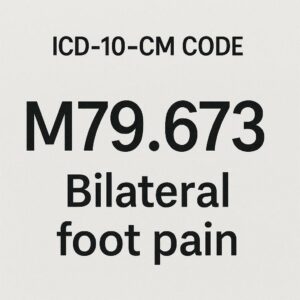
ICD-10-CM code for bilateral foot pain
Chapter 1: The Landscape of Pain – Understanding the Symptom Code M79.67
The ICD-10-CM code M79.67 belongs to Chapter 13: Diseases of the Musculoskeletal System and Connective Tissue, specifically under the category “Other soft tissue disorders.” Its official description is “Pain in foot and toes.” This code is used when pain is documented as the primary reason for the encounter and a more specific diagnosis has not been established or is not applicable.
The Official Guidelines and “Unspecified” Nature:
The ICD-10-CM Official Guidelines for Coding and Reporting state that codes from category M79 (Other and unspecified soft tissue disorders) “should be used only when no more specific diagnosis is available.” This immediately positions M79.67 as a default or temporary code. It carries the connotation of “unspecified” pain, which, from both a clinical and reimbursement perspective, is a lower-value piece of information than a definitive pathological diagnosis like “Gout” or “Plantar fasciitis.”
The “Significant, Separately Identifiable” Rule:
A cornerstone of coding practice is that symptom codes should not be assigned when a definitive diagnosis is documented. Crucially, code M79.67 should not be used if the bilateral foot pain is:
-
An integral part of a known disease process (e.g., the pain of diabetic polyneuropathy is a direct symptom of the diabetes complication).
-
Routine or expected postoperative pain.
The exception is if the pain is significant, separately identifiable, and requires additional evaluation or treatment beyond the management of the underlying condition. In such rare cases, both codes may be reported, with the underlying condition sequenced first.
Sequencing and Its Implications:
Sequencing—the order in which codes are listed—is paramount. If bilateral foot pain is the sole reason for the encounter and no cause is determined, M79.67 would be the first-listed (primary) diagnosis. If, during the encounter, a cause is identified (e.g., bilateral pes planus), the code for the cause (M21.4-, Flat foot) becomes primary, and M79.67 would generally not be reported unless it meets the “separately identifiable” criterion, which it rarely does in this context.
Chapter 2: Beyond the Symptom – The Critical Need for a Definitive Diagnosis
Relying solely on M79.67 is clinically and financially inadequate. A symptom code tells what the patient feels; a definitive diagnosis code tells why.
Why M79.67 is Often Insufficient:
-
Clinical Ambiguity: It provides no guidance for treatment. The management of gout is radically different from the management of a stress fracture or rheumatoid arthritis.
-
Poor Risk Adjustment: In value-based care models, populations are risk-stratified based on diagnoses. “Foot pain” does not indicate severity or complexity, whereas “diabetic peripheral angiopathy with gangrene” does.
-
Hindered Research: Public health data relying on symptom codes is of limited use for tracking disease prevalence or outcomes.
The Clinical Coder’s Role in Querying:
When a provider’s documentation only states “bilateral foot pain,” the coder’s responsibility is not to assume but to clarify. This is done through a provider query. A respectful, non-leading query is a mark of professional coding. For example:
-
“The note documents bilateral foot pain. Could you please specify the etiology, such as osteoarthritis, plantar fasciitis, or neuropathy, based on your clinical assessment?”
This collaborative process is essential for achieving coding accuracy and completing the clinical picture.
Chapter 3: Unilateral vs. Bilateral – Navigating the Laterality Distinction
ICD-10-CM introduced a critical specificity: laterality. This is where bilateral conditions require careful attention.
A Fundamental Principle: Many ICD-10-CM codes specify right, left, or bilateral. If a code for a bilateral site is available, it must be used. You cannot report two unilateral codes (e.g., right and left) for a condition that has a distinct bilateral code, unless the guidelines specifically instruct you to do so (which is rare).
Code M79.67 and Laterality: The code M79.67 is unilateral. The 6th character “7” indicates “ankle and foot.” There is no 5th character to specify side. Therefore, for bilateral foot pain as a symptom, you must report two codes:
-
M79.671 – Pain in right foot and toes
-
M79.672 – Pain in left foot and toes
This is a key distinction from many definitive diagnosis codes which offer a bilateral option.
Clinical Scenario Application:
-
Diagnosis: Bilateral plantar fasciitis. The code for plantar fasciitis is M72.2. Its 6th character specifies laterality: .1 (right), .2 (left), .3 (bilateral). You would report M72.23 – Plantar fascial fibromatosis, bilateral.
-
Diagnosis: Bilateral primary osteoarthritis of the first metatarsophalangeal (MTP) joint. The code is M19.07. The 5th character specifies laterality: 1 (right), 2 (left), 3 (bilateral). You would report M19.03 – Primary osteoarthritis, ankle and foot, bilateral.
Laterality Coding Examples for Common Bilateral Foot Conditions
| Condition | ICD-10-CM Code Category | Unilateral Right Code | Unilateral Left Code | Bilateral Code | Symptom Code for Pain (if separately applicable) |
|---|---|---|---|---|---|
| Plantar Fasciitis | M72.2- | M72.21 | M72.22 | M72.23 | M79.671 & M79.672 |
| Primary Osteoarthritis | M19.0- | M19.01 | M19.02 | M19.03 | M79.671 & M79.672 |
| Pes Planus (Flat foot) | M21.4- | M21.41- | M21.42- | M21.43- | M79.671 & M79.672 |
| Rheumatoid Arthritis | M05.64-, M06.24- | M05.641/M06.241 | M05.642/M06.242 | M05.643/M06.243 | Usually not coded |
| Pain as Sole Diagnosis | M79.67- | M79.671 | M79.672 | No single code | M79.671 & M79.672 |
Chapter 4: A Diagnostic Odyssey – Common Etiologies of Bilateral Foot Pain
The differential diagnosis for bilateral foot pain is extensive. A proficient coder must understand these conditions to recognize them in documentation.
Musculoskeletal Origins:
-
Plantar Fasciitis (M72.23): Inflammation of the plantar fascia. Bilateral involvement is common, especially in individuals with contributing factors like tight calf muscles or prolonged standing.
-
Osteoarthritis (M19.03, M19.13, M19.23): Degenerative joint disease. Commonly affects the first MTP joint (hallux rigidus) and the midfoot. Bilateral presentation is frequent.
-
Stress Fractures (M84.37-): Overuse injuries, often in runners or military recruits. Bilateral metatarsal stress fractures can occur.
-
Pes Planus / Pes Cavus (M21.4- / M21.5-): Structural deformities (flat foot or high-arched foot) that alter biomechanics and often cause bilateral, diffuse pain.
Systemic & Inflammatory Diseases:
-
Rheumatoid Arthritis (M05.643, M06.243): An autoimmune disease that symmetrically attacks peripheral joints, including those in the feet. Bilateral involvement is a hallmark.
-
Gout (M10.07-, M10.17-, etc.): A crystal arthropathy causing intensely painful flares. While often starting in one big toe (podagra), it can become polyarticular and bilateral.
-
Diabetic Complications (E11.40-E11.42, E11.51): Diabetic polyneuropathy (E11.42) causes bilateral, symmetric burning, tingling, or pain. Diabetic peripheral arthropathy (Charcot foot, E11.610-E11.615) is a destructive joint process.
Neurological & Vascular Pathologies:
-
Tarsal Tunnel Syndrome (G57.53): Compression of the tibial nerve in the tarsal tunnel. Can be bilateral, causing pain, burning, and tingling on the plantar aspect.
-
Peripheral Artery Disease (I73.9): Claudication (calf, foot, or buttock pain with walking) can manifest as bilateral foot pain or cramping, especially in smokers and diabetics.
Chapter 5: The Clinician’s Roadmap – History, Exam, and Diagnostic Studies
Accurate coding depends on detailed documentation of the clinical evaluation.
The History: Documentation should note onset (acute vs. chronic), character (burning, aching, sharp), aggravating/alleviating factors (weight-bearing, rest, specific shoes), and associated systemic symptoms (morning stiffness suggesting RA, dietary triggers for gout).
Physical Exam: Findings like point tenderness (plantar fascia insertion, metatarsal heads), swelling (MTP joints in RA), erythema (gout), structural deformity (pes planus), sensory deficits (neuropathy), and pulses (PAD) must be recorded.
Diagnostic Studies:
-
X-rays: Essential for OA, stress fractures, structural deformities.
-
MRI: For soft tissue detail (plantar fasciitis, tendon tears, osteonecrosis).
-
Ultrasound: Can visualize plantar fascia thickness, tenosynovitis.
-
Laboratory Tests: Uric acid (gout), Rheumatoid factor/anti-CCP (RA), HbA1c (diabetes), ESR/CRP (inflammation).
The results of these studies are what allow the provider to move from “bilateral foot pain (M79.67×2)” to a definitive diagnosis code.
Chapter 6: The Financial and Compliance Implications of Coding Accuracy
Inaccurate coding is not a clerical error; it has real-world consequences.
Risk of Claim Denials: Payers often deny or downcode claims that list only symptom codes when a more specific diagnosis is clinically indicated. They view it as incomplete documentation that fails to justify the medical necessity of services rendered (e.g., physical therapy, advanced imaging).
Impact on DRG Assignment: In inpatient settings, diagnoses drive Diagnosis-Related Group (DRG) assignment, which determines the bundled payment. A non-specific code like M79.67 carries minimal weight, whereas a code for a major complication or comorbidity (MCC) like a diabetic foot ulcer with osteomyelitis drastically increases reimbursement to reflect the higher resource utilization.
Audit Risks: Both internal and external (RAC, OIG) auditors target unspecified codes. Over-reliance on M79.67 without supporting documentation of a workup to find a cause can be flagged as poor documentation practices, leading to recoupments and potential penalties.
Chapter 7: Case Studies – From Clinic Note to Final Code
Case 1: The Bilateral Heel Pain
-
Presentation: A 45-year-old teacher complains of sharp pain in both heels, worst with the first steps in the morning and after prolonged standing.
-
Exam: Maximal tenderness at the medial calcaneal tubercle bilaterally. Negative Tinel’s sign. Good pulses.
-
Assessment: Bilateral plantar fasciitis.
-
ICD-10-CM Code: M72.23 (Plantar fascial fibromatosis, bilateral). M79.67x is not reported, as the pain is integral to the diagnosed condition.
Case 2: The Diabetic Patient with Progressive Foot Pain
-
Presentation: A 60-year-old with Type 2 DM presents with 6 months of bilateral, burning foot pain, worse at night, with numbness.
-
Exam: Diminished sensation to monofilament testing in a stocking distribution bilaterally. No ulcers. Foot deformities noted.
-
Assessment: Diabetic symmetric polyneuropathy with associated bilateral foot pain.
-
ICD-10-CM Code: E11.42 (Type 2 diabetes mellitus with diabetic polyneuropathy). Again, the pain code is not added, as neuropathy is the definitive cause.
Case 3: The Arthritic Metatarsalgia
-
Presentation: A 70-year-old with bilateral forefoot pain, describing it as a deep ache in the balls of both feet, worsening with walking.
-
Exam: Tenderness and mild swelling over the 2nd-3rd MTP joints bilaterally. Crepitus with motion. X-rays show joint space narrowing and osteophytes.
-
Assessment: Bilateral primary osteoarthritis of the MTP joints.
-
ICD-10-CM Code: M19.03 (Primary osteoarthritis, ankle and foot, bilateral).
Chapter 8: Treatment Pathways Linked to Diagnosis Codes
The assigned ICD-10-CM code directly informs and justifies the treatment plan.
-
M72.23 (Plantar Fasciitis): Justifies prescription of heel stretches, night splints, custom orthotics, and possibly corticosteroid injections or physical therapy.
-
M10.071 (Gout, right ankle/foot): Justifies urate-lowering therapy (allopurinol), NSAIDs, colchicine, and dietary counseling.
-
E11.42 (Diabetic Neuropathy): Justifies neuropathic pain medication (gabapentin, duloxetine), comprehensive foot care education, and therapeutic footwear.
-
M79.671/672 (Pain, unspecified): Justifies only a very limited, generalized workup and conservative measures, often leading to a follow-up appointment for further evaluation.
Conclusion: The Foundation of Care
Bilateral foot pain is a common gateway to a complex diagnostic landscape. The journey from the symptom code M79.67 to a precise, laterality-specific diagnosis code is more than a billing requirement—it is the foundation of effective patient care, accurate epidemiological data, and a financially sustainable practice. Mastery of this process requires diligent documentation, knowledgeable coding, and continuous collaboration between clinicians and health information professionals.
Frequently Asked Questions (FAQs)
Q1: Can I always use M79.67 for foot pain?
A: No. It should only be used when a more specific diagnosis cannot be made after appropriate evaluation. It is a symptom code of last resort.
Q2: How do I code bilateral foot pain when no cause is found?
A: You must report two codes: M79.671 (Pain in right foot and toes) and M79.672 (Pain in left foot and toes).
Q3: What is the biggest mistake coders make with bilateral conditions?
A: Using two unilateral codes when a single bilateral code exists (e.g., using M72.21 and M72.22 instead of M72.23). Always check the code extensions for a bilateral option (.3, .43, .53, etc.) first.
Q4: My provider documented “bilateral foot pain due to osteoarthritis.” What codes do I use?
A: You code only the definitive diagnosis: the appropriate code for osteoarthritis of the foot with the bilateral laterality character (e.g., M19.03). The “pain” is not separately reported.
Q5: Does a diagnosis of “bilateral metatarsalgia” get a more specific code than M79.67?
A: Yes. Metatarsalgia (M77.4-) has its own code set with laterality: M77.41 (right), M77.42 (left), M77.43 (bilateral). You would use M77.43.
Additional Resources
-
CDC ICD-10-CM Official Guidelines: https://www.cdc.gov/nchs/icd/icd-10-cm.htm (The authoritative source for coding rules).
-
American Academy of Professional Coders (AAPC): https://www.aapc.com/ (Provides certification, training, and resources for medical coders).
-
American Podiatric Medical Association (APMA): https://www.apma.org/ (Clinical resources on foot and ankle conditions).
-
American College of Foot and Ankle Surgeons (ACFAS): https://www.acfas.org/ (Patient
Disclaimer: This article is for informational purposes only and is not a substitute for professional medical advice, diagnosis, or treatment. Always seek the advice of your physician or other qualified health provider with any questions you may have regarding a medical condition or coding. Medical coding is complex and requires ongoing education; always consult the latest official ICD-10-CM coding guidelines and payer-specific policies.
Date: December 27, 2025
Author: Medical Coding & Orthopedic Review