In the intricate world of medical coding, few diagnoses demand as much nuanced understanding as Chronic Obstructive Pulmonary Disease (COPD). It is not merely a matter of selecting “J44.9” and moving on. The ICD-10-CM coding system for COPD represents a sophisticated language that bridges clinical reality with administrative function. A single, accurately assigned code tells a multifaceted story: it captures the patient’s current disease state (stable, exacerbated, infected), influences the severity of illness metrics that drive hospital rankings, determines the appropriateness of resource allocation, and ultimately, ensures justified reimbursement. An error in this code can trigger audits, lead to claim denials, skew population health data, and obscure the true picture of a patient’s health journey.
This article is designed to be the definitive resource for medical coders, health information management (HIM) professionals, clinical documentation integrity (CDI) specialists, and even practicing clinicians who seek to understand the impact of their notes. We will embark on a detailed exploration that exceeds superficial guidelines, delving into the clinical rationale behind each code, dissecting complex documentation scenarios, and illuminating the direct link between precise terminology and financial integrity. With COPD affecting millions and representing a significant burden on healthcare systems globally, mastery of its classification is not just a technical skill—it is a cornerstone of quality healthcare administration.
ICD-10-CM Code for COPD
2. Understanding COPD: A Brief Clinical Foundation for Coders
To code accurately, one must understand the disease. COPD is an umbrella term for progressive, irreversible lung conditions that cause airflow obstruction and breathing-related problems. The two primary contributors are:
-
Chronic Bronchitis: Defined clinically as a productive cough on most days for at least three months in two consecutive years. It involves inflammation and thickening of the bronchial tubes.
-
Emphysema: A condition characterized by damage to the alveoli (air sacs) in the lungs, leading to loss of elasticity and hyperinflation.
Most patients have a mix of both. The key concepts for coders are chronicity (it is a long-term condition), irreversibility (the obstruction does not fully resolve), and exacerbation (a critical concept in coding).
3. The J44.x Family: Navigating the Core Hierarchy
The ICD-10-CM category J44: Other chronic obstructive pulmonary disease is the home for COPD codes. It excludes asthma but includes conditions like chronic asthmatic bronchitis. Understanding its hierarchy is essential.
Parent Code Notes for J44:
-
Includes: Chronic bronchitis with airway obstruction, chronic obstructive asthma, chronic obstructive tracheobronchitis, emphysematous bronchitis.
-
Excludes1: Chronic obstructive bronchitis without further specification (coded to J42), Emphysema without mention of chronic bronchitis (J43.-), and most critically, Asthma (J45.-).
-
Excludes2: Bronchiectasis (J47.-), Chronic bronchitis NOS (J42).
This framework immediately directs the coder. If the documentation only says “emphysema,” you go to J43.-. If it says “chronic bronchitis” without qualification, you go to J42. COPD coding requires a linkage of these conditions or the use of the umbrella term “COPD.”
4. Deep Dive into J44.0: COPD with Acute Lower Respiratory Infection
Code: J44.0 (Chronic obstructive pulmonary disease with acute lower respiratory infection)
This code is used when a patient with underlying COPD develops an acute infectious process in the lower airways (e.g., bronchi, lung parenchyma). The infection is an acute overlay on the chronic condition.
-
Clinical Scenario: A patient with known COPD presents with increased dyspnea, increased sputum volume, and change in sputum color (e.g., to yellow or green). They may have fever. The physician diagnoses “COPD with acute bronchitis” or “COPD exacerbation due to pneumonia.”
-
Documentation Essentials: The provider’s note must explicitly link the acute infection to the COPD state. Phrases like “COPD with superimposed acute bronchitis” or “acute pneumonic exacerbation of COPD” are ideal.
-
Coding Logic: You would not assign a separate code for the acute bronchitis (J20.9) or pneumonia (J18.9) in addition to J44.0. The code J44.0 is a combination code that captures both the chronic condition and the acute infection.
-
Key Distinction from J44.1: The presence of a confirmed or suspected infectious agent is the differentiator. If the exacerbation is attributed to infection, J44.0 is typically correct. If the cause is pollution, non-compliance with inhalers, or unknown, it likely falls under J44.1.
5. Deep Dive into J44.1: COPD with Acute Exacerbation
Code: J44.1 (Chronic obstructive pulmonary disease with acute exacerbation)
An exacerbation is defined as an acute worsening of respiratory symptoms beyond normal day-to-day variation that leads to additional therapy. This is the most critical code in the set for capturing healthcare utilization.
-
Clinical Scenario: A patient with COPD presents to the ER with sudden-onset severe shortness of breath, wheezing, and chest tightness. They require nebulizer treatments, systemic corticosteroids, and possibly hospitalization. The cause may be non-infectious (e.g., allergen exposure) or the infectious cause is not specified or confirmed.
-
Documentation Essentials: The word “exacerbation” or “acute on chronic” must be present. Synonyms like “flare-up,” “decompensation,” or “acute worsening” are acceptable but less precise. The best practice is for clinicians to use the standard term “exacerbation.”
-
Coding Logic: This is a stand-alone code for the exacerbation event. It does not include an associated infection. If an infection is documented as the cause, see J44.0. Important Note: Code also the type of tobacco use (F17.-) if applicable.
6. The Importance of J44.9: Chronic Obstructive Pulmonary Disease, Unspecified
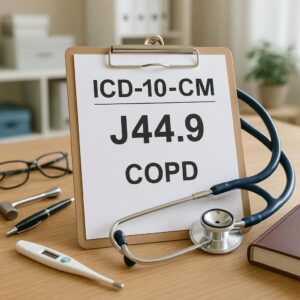
Code: J44.9 (Chronic obstructive pulmonary disease, unspecified)
This is the “default” code for a patient with a diagnosis of COPD who is in a stable state, undergoing routine care, or whose current state (exacerbation/infection) is not documented.
-
Appropriate Use: Routine office visit for medication management of stable COPD. Pre-operative clearance where the patient has COPD but is not currently exacerbated.
-
Inappropriate Use (Common Pitfall): Using J44.9 for a patient presenting to the ER with an acute exacerbation simply because the word “exacerbation” is missing from the chief complaint, even if the body of the note clearly describes an acute worsening. This is where CDI queries are essential.
-
Coding Logic: When in doubt, and no acute acuity is documented, J44.9 is correct. However, it is the coder’s responsibility to ensure documentation reflects the patient’s true status.
7. The Crucial Role of Documentation: A Coder’s Lifeline
The coder is wholly dependent on the clinician’s documentation. Vague notes lead to inaccurate codes. Key terms that must be present:
-
Specificity: “COPD” is better than “chronic lung disease.”
-
Acuity: “Stable,” “exacerbated,” “acute bronchitis superimposed.”
-
Etiology (if known): “Exacerbation due to suspected viral infection,” “flare-up likely from poor air quality.”
A Clinical Documentation Integrity (CDI) program is vital. If a physician documents “COPD flare” in an inpatient setting, a CDI specialist or coder may need to query: “Can you clarify if this COPD flare is an acute exacerbation (J44.1) or is it associated with an acute lower respiratory infection (J44.0)?”
8. Linking Cause and Effect: Tobacco Use (F17.-) and Other Risk Factors
Tobacco use is the leading cause of COPD. ICD-10-CM mandates coding the tobacco dependence or use when it is clinically relevant to the patient’s condition.
-
Guideline I.C.10.a.1): “Code tobacco dependence or exposure when the patient has a condition that is known to be causally related to tobacco use by the classification.”
-
Coding Application: When coding J44.0, J44.1, or J44.9, always check the patient’s history. If they are a current smoker or have tobacco dependence, add the appropriate code from category F17.- (Nicotine dependence).
-
Sequencing: The COPD code (J44.x) is sequenced first as the reason for encounter. F17.- is assigned as an additional code.
-
Other Factors: While not coded as directly as tobacco, documentation of other risk factors (e.g., occupational dust, genetic alpha-1 antitrypsin deficiency coded as E88.01) provides a more complete picture.
9. Associated Manifestations: Coding Complications Like Hypoxia and Cor Pulmonale
COPD often leads to systemic complications. These must be coded separately when present.
-
Hypoxemia & Hypercapnia: Use codes from the R09.02 series for hypoxemia. Blood gas findings should support this.
-
Acute Respiratory Failure (ARF): A life-threatening complication of a severe exacerbation. Code J96.0- (Acute respiratory failure) in addition to J44.1 or J44.0. Sequencing depends on the reason for admission (often ARF is principal).
-
Cor Pulmonale: Right heart failure due to lung disease. Code I27.2 (Other secondary pulmonary hypertension) or more specific heart failure codes (I50.-) in addition to the COPD code.
-
Procedure Codes: Remember to link these manifestations to relevant procedures like continuous pulse oximetry (4A0X7SZ) or non-invasive ventilation (5A09357).
10. The Critical Distinction: COPD vs. Asthma (J45.-)
This is one of the most significant areas of confusion. ICD-10-CM provides clear, if complex, direction.
-
J45.- (Asthma): Characterized by reversible airway obstruction. It is often allergic and episodic.
-
J44.- (COPD): Characterized by irreversible or partially reversible obstruction.
-
The Overlap: The code J44.9 itself includes “chronic obstructive asthma.” If a patient has long-standing, persistent asthma with a fixed obstructive component (a condition sometimes called “Asthma-COPD Overlap” or ACO in clinical practice), and it is documented as such, J44.9 may be appropriate.
-
Coding Rule: When the documentation is unclear, default to the provider’s stated diagnosis. If they call it “asthma,” code J45.-. If they call it “COPD” or “chronic asthmatic bronchitis,” code J44.-. A query may be necessary to clarify.
11. Sequencing and Combination Coding: Mastering the Order of Operations
Correct sequencing is mandated by official guidelines and payer rules.
-
Reason for Visit/Admission: The condition chiefly responsible for the encounter is sequenced first.
-
Inpatient Admission for Severe Exacerbation with ARF: J96.01 (Acute respiratory failure with hypoxia) may be the principal diagnosis, followed by J44.1.
-
Outpatient Visit for Stable COPD Management: J44.9 is the first-listed diagnosis.
-
Combination Coding: Remember, J44.0 is a combination code. Do not add a separate code for the acute bronchitis or pneumonia.
12. Common Pitfalls and Audit Triggers: Mistakes to Avoid
-
Pitfall 1: Automatically coding J44.9 for every COPD patient.
-
Audit Risk: Undercoding acuity, leading to loss of justified reimbursement.
-
Pitfall 2: Coding both J44.1 and a separate code for acute bronchitis (J20.9).
-
Audit Risk: Overcoding/duplication, seen as “unbundling.”
-
Pitfall 3: Missing the mandatory tobacco code (F17.-).
-
Audit Risk: Incomplete coding, potential quality metric impact.
-
Pitfall 4: Confusing emphysema alone (J43.9) with COPD (J44.9).
-
Audit Risk: Inaccurate clinical picture and diagnostic-related group (DRG) assignment.
13. The Impact on Reimbursement: How Accurate Coding Affects the Bottom Line
Precise COPD coding directly influences reimbursement through:
-
MS-DRGs (Inpatient): A case of “COPD with Exacerbation” (J44.1) will typically group to a DRG like DRG 190 (Chronic Obstructive Pulmonary Disease with MCC) or DRG 191 (COPD with CC), with higher weight and payment than DRG 192 (COPD without CC/MCC), which is often used for stable cases. Adding Acute Respiratory Failure (J96.0-) significantly increases the DRG weight.
-
APCs (Outpatient): Correct E/M level selection is supported by the complexity implied by J44.1 vs. J44.9.
-
Risk Adjustment (Medicare Advantage, ACA Plans): Codes like J44.1 contribute more to a patient’s risk score (HCC – Hierarchical Condition Category) than J44.9, appropriately allocating capitated payments for sicker populations.
Impact of ICD-10-CM COPD Codes on Reimbursement & Metrics
| ICD-10-CM Code | Clinical Meaning | Typical MS-DRG Impact (Example) | Risk Adjustment (HCC) Impact | Key Documentation Need |
|---|---|---|---|---|
| J44.0 | COPD with Acute Infection | DRG 190 (with MCC) or 191 (with CC) | Higher weight than J44.9 | Explicit link of infection to COPD |
| J44.1 | COPD with Acute Exacerbation | DRG 190/191 (if with RF/ARF) | High; maps to specific HCC | Word “exacerbation” or equivalent |
| J44.9 | Stable/Unspecified COPD | DRG 192 (without CC/MCC) | Lower weight | Absence of acute worsening terms |
| J44.1 + J96.01 | Exacerbation with ARF | DRG 189 (Pulmonary Edema & Respiratory Failure) | Very High | Documentation of ARF criteria |
14. Case Studies: Applying Knowledge to Real-World Scenarios
Case Study 1: The Unclear Emergency Room Visit
-
Documentation: “55yo male with history of COPD, smoker, presents with 2 days of worse SOB and wheezing. Treated with Duoneb x3 and solumedrol 125mg. Diagnosed with COPD flare. Discharged home.”
-
Analysis: The term “flare” suggests an exacerbation. No mention of infection. Tobacco use is documented.
-
Correct Coding: J44.1, F17.210 (Nicotine dependence, cigarettes, uncomplicated). Query could improve to specify “acute exacerbation.”
Case Study 2: The Inpatient Admission
-
Documentation: “Admitted for acute hypoxic respiratory failure secondary to COPD exacerbation with suspected pneumonia. Patient is a former smoker.”
-
Analysis: Two acute conditions are linked: respiratory failure and COPD exacerbation. Pneumonia is “suspected,” not confirmed.
-
Correct Coding: J96.01 (Acute resp failure with hypoxia) as principal (reason for admission), J44.1 as secondary, Z87.891 (Hx of tobacco use).
Case Study 3: The Routine Office Visit
-
Documentation: “Follow-up for COPD. Patient states breathing is at baseline. Uses Advair daily. No complaints. Continue current plan.”
-
Analysis: No indicators of acuity. Stable management.
-
Correct Coding: J44.9. (Tobacco code added if still using).
15. The Future of COPD Coding: Trends and ICD-11 Preview
The World Health Organization’s ICD-11, which some countries are beginning to adopt, offers a more etiologically detailed structure for COPD. While the U.S. continues to use ICD-10-CM, awareness is key. ICD-11 codes like CA22.0 (COPD due to tobacco smoking) or CA22.1 (COPD due to indoor air pollution) highlight a move towards causal specificity. Furthermore, the integration of SNOMED CT with ICD codes in electronic health records promises more automated and precise coding based on detailed clinical input.
16. Conclusion
Accurate ICD-10-CM coding for COPD transcends mere administrative task completion. It is a precise language that translates complex clinical realities into actionable data, ensuring proper patient classification, valid population health research, and appropriate financial stewardship. Mastery of the J44.x family—from distinguishing J44.0 from J44.1 to avoiding the pitfalls of J44.9—requires a blend of clinical knowledge, meticulous attention to documentation, and strict adherence to evolving guidelines. In an era of value-based care, the humble COPD code stands as a critical nexus between clinical care and the systems that support it.
17. Frequently Asked Questions (FAQs)
Q1: What is the difference between J44.0 and J44.1?
A: J44.0 is used when the acute worsening is specifically attributed to a confirmed or suspected acute lower respiratory infection (e.g., acute bronchitis, pneumonia). J44.1 is used for an acute worsening (exacerbation) from any other cause (e.g., air pollution, non-compliance) or when an infectious cause is not identified or specified.
Q2: Do I always need to add a tobacco use code (F17.-) with a COPD code?
A: Yes, per ICD-10-CM guidelines, if the patient is a current smoker or has nicotine dependence, you must assign an additional code from F17.- when coding for a tobacco-related condition like COPD. For former smokers, use Z87.891.
Q3: Can I code both COPD and asthma for the same patient?
A: It depends entirely on the provider’s documentation. If the patient has two distinct conditions, both can be coded. More commonly, the provider may diagnose “Asthma-COPD Overlap” (ACO). In ICD-10-CM, this is typically captured under the COPD umbrella with J44.9 (which includes chronic obstructive asthma). Never assume an overlap; rely on the documentation.
Q4: What should I do if the provider documents “end-stage COPD” or “severe COPD”?
A: ICD-10-CM does not have unique codes for severity stages. You would still use the appropriate J44.x code based on acuity (exacerbation, infection, stable). The severity is captured clinically and may influence DRG assignment via complications but is not separately coded.
Q5: How do I code a patient with COPD on long-term oxygen therapy (LTOT)?
A: Code the COPD first (e.g., J44.9), and then add the code Z99.81 (Dependence on supplemental oxygen). This provides a complete picture of the patient’s healthcare needs.
18. Additional Resources
-
Official Source: The Centers for Disease Control and Prevention (CDC) ICD-10-CM Browser: https://www.cdc.gov/nchs/icd/icd10cm.htm
-
Guidelines: The ICD-10-CM Official Guidelines for Coding and Reporting (FY 2025): Available on the CDC and CMS websites.
-
Clinical Reference: Global Initiative for Chronic Obstructive Lung Disease (GOLD) Reports: https://goldcopd.org/ (Provides the clinical definitions that inform documentation).
-
Professional Association: American Health Information Management Association (AHIMA): https://www.ahima.org/ (For coding standards and education).
-
Professional Association: American Academy of Professional Coders (AAPC): https://www.aapc.com/ (For certification and coding updates).
Date: December 16, 2025
Author: Clinical Coding Specialist
Disclaimer: This article is for educational purposes and is not a substitute for official coding guidelines, payer-specific policies, or professional medical advice. Always consult the most current ICD-10-CM manual and official resources.