Dizziness is a universal human experience. From the thrilling spin of a carnival ride to the disorienting stumble upon standing up too quickly, it is a sensation known to all. Yet, in the clinical setting, dizziness transforms from a transient oddity into one of the most common, complex, and challenging complaints a healthcare provider can encounter. It is a symptom, not a disease—a cryptic message from the body that something is amiss. The challenge lies in the fact that this single word, “dizzy,” can describe a vast spectrum of sensations originating from a myriad of potential sources: the inner ear, the brain, the heart, the mind, or a complex interplay of all the above. Every year, millions of patients present to primary care physicians, neurologists, cardiologists, and emergency departments with this chief complaint, setting in motion a diagnostic process that can be as straightforward as a simple head maneuver or as intricate as a neurological detective story.
At the heart of documenting this clinical encounter lies a deceptively simple code: ICD-10-CM R42, “Dizziness and Giddiness.” This code serves as the initial digital footprint for a patient’s unsteadiness. It is a placeholder for uncertainty, a flag for a symptom that has yet to be decoded. This article embarks on a deep and comprehensive journey to explore every facet of R42. We will dissect its official definition and coding guidelines, delve into the intricate pathophysiology of dizziness, unravel the sophisticated diagnostic process, and navigate the critical transition from this nonspecific symptom code to a definitive diagnosis. We will also explore the profound implications of this code beyond the clinical note, examining its role in healthcare economics, public health data, and quality patient care. By the end of this exploration, the code R42 will be revealed not as a mere alphanumeric sequence, but as a gateway to understanding one of medicine’s most fascinating and multifaceted symptoms.
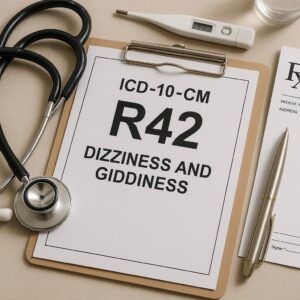
ICD-10-CM Code R42
Chapter 1: Deconstructing ICD-10-CM Code R42 – More Than Just a Code
To the uninitiated, medical coding can seem like a dry, bureaucratic exercise. However, for those who understand its language, each code tells a story. ICD-10-CM Code R42 is a prime example—a code whose simplicity belies a world of clinical complexity.
The Official Description and Taxonomy
The International Classification of Diseases, Tenth Revision, Clinical Modification (ICD-10-CM) is the system used in the United States to classify and code all diagnoses, symptoms, and procedures. Code R42 falls within a specific chapter:
-
Chapter 18: Symptoms, Signs, and Abnormal Clinical and Laboratory Findings, Not Elsewhere Classified (R00-R99)
-
Category R40-R46: Symptoms and signs concerning cognition, perception, emotional state and behavior
-
Code R42: Dizziness and Giddiness
The official full description is simply: Dizziness and giddiness. It is crucial to note what this code includes and, just as importantly, what it excludes.
The “Code Also” and “Excludes” Notes: Navigating the Boundaries
The ICD-10-CM manual includes instructional notes that are critical for accurate coding. For R42, there are no “Code Also” notes, but there are vital “Excludes” notes that define its boundaries with precision.
-
Excludes1: vertigo NOS (R81.0)
-
This is a critical distinction. An Excludes1 note means “NOT CODED HERE.” It indicates that the two codes are mutually exclusive. If the patient has a documented diagnosis of vertigo, you must not use R42. You must use the more specific code R81.0. This forces the coder and clinician to differentiate between the general term “dizziness” and the specific sensation of rotational vertigo.
-
-
Excludes2: light-headedness (R55)
-
An Excludes2 note means “not included here,” but both codes could be used if the patient has both conditions. R55 is for syncope (fainting) and collapse, which often includes the presyncopal sensation of lightheadedness. This note helps distinguish the feeling of impending fainting (R55) from other forms of dizziness (R42).
-
These excludes notes are not mere suggestions; they are rules that ensure data specificity and accuracy. Misapplying R42 when vertigo is present undermines the entire purpose of a detailed classification system.
Why R42 is a “Sign, Symptom, and Ill-Defined Condition”
R42 is classified as a “symptom code.” In the hierarchy of medical diagnoses, a symptom code sits at a lower level of certainty than an etiological (cause-specific) diagnosis. It is used when:
-
A definitive diagnosis cannot be made at the encounter. For example, a patient presents to the Emergency Department with acute dizziness. After initial workup, no specific cause like a stroke or BPPV is identified. The physician documents “dizziness,” and R42 is the appropriate code.
-
The symptom is the primary reason for the encounter, even if an underlying cause is known. For instance, a patient with known hypertension presents for a follow-up specifically complaining of persistent dizziness, which is being investigated as a possible side effect of medication. The focus of the visit is the symptom, so R42 may be used alongside the code for hypertension.
-
A sign or symptom is present at the time of diagnosis and is integral to the patient’s care.
The use of symptom codes is governed by the ICD-10-CM Official Guidelines for Coding and Reporting. Guideline IV.H states that signs and symptoms that are integral to a disease process should not be assigned as additional codes. However, when a symptom is not associated with a definitive diagnosis, or is a reason for encounter, it should be coded. R42 is the epitome of this principle.
Chapter 2: The Clinical Spectrum of Dizziness – A Patient’s Perspective and a Clinician’s Challenge
The single greatest challenge in managing a dizzy patient is the poverty of descriptive language. The word “dizzy” is a blanket term covering four distinct physiological experiences. The clinician’s first and most critical task is to translate the patient’s vague complaint into one of these categories, as each points toward a different underlying cause.
Vertigo: The Illusion of Motion
Vertigo is the false sensation of rotational, spinning, or tilting movement of oneself or the environment. It is an illusion of motion. Patients may describe the room spinning, feeling like they are on a merry-go-round, or the ground tilting beneath them.
-
Pathophysiology: Vertigo almost always arises from an asymmetry in the vestibular system. This system includes the:
-
Peripheral Vestibular System: The labyrinth in the inner ear (semicircular canals, utricle, saccule) and the vestibular nerve (Cranial Nerve VIII).
-
Central Vestibular System: The vestibular nuclei in the brainstem and their connections to the cerebellum, cranial nerves, and thalamus.
-
-
Key Question: “Does it feel like you are spinning, or is the room spinning around you?”
Presyncope: The Feeling of Impending Doom
Presyncope is the sensation of impending fainting or loss of consciousness. Patients often report feeling “lightheaded,” “blacking out,” “woozy,” or like they are about to pass out. It is frequently accompanied by dimming of vision, muffled hearing, and sweating.
-
Pathophysiology: This is typically due to global cerebral hypoperfusion—a temporary, widespread reduction in blood flow to the brain. Common causes include:
-
A sudden drop in blood pressure (orthostatic hypotension).
-
Cardiac arrhythmias that reduce cardiac output.
-
Vasovagal reactions.
-
-
Key Question: “Does it feel like you are going to faint or black out?”
Disequilibrium: The Loss of Balance
Disequilibrium is a sense of imbalance, unsteadiness, or a loss of equilibrium without a false sensation of movement. Patients feel off-balance, particularly when walking or standing. They may feel like they are going to fall to one side.
-
Pathophysiology: This arises from a disruption in the sensory or motor components of the balance system, which integrates input from:
-
Vestibular System (sense of head position and movement).
-
Proprioception (sense of body position from joints and muscles).
-
Vision.
-
Motor System (strength and coordination to make postural corrections).
-
-
Key Question: “Is the problem mainly a feeling of unsteadiness on your feet, especially when walking?”
Lightheadedness: The Vague and Non-Specific Sensation
This is the most nonspecific and psychologically-associated type of dizziness. Patients struggle to describe it, using terms like “spaced out,” “foggy,” “detached from my body” (derealization/depersonalization), or simply “just dizzy.” It is rarely associated with true vertigo or presyncope.
-
Pathophysiology: Often linked to:
-
Psychiatric conditions (anxiety, panic disorder, depression).
-
Hyperventilation.
-
Side effects of medications.
-
Chronic subjective dizziness (a specific neurological disorder).
-
-
Key Question: “Can you describe the feeling without using the word ‘dizzy’?”
The Critical Importance of History-Taking
A meticulous history is 80% of the diagnosis in a dizzy patient. The “Timing and Triggers” framework, popularized by experts like Dr. Kevin A. Kerber, is invaluable:
-
Triggered, Episodic: Symptoms are brought on by specific, reproducible actions (e.g., turning over in bed, looking up). Suggests: BPPV.
-
Spontaneous, Episodic: Symptoms come on out of the blue and last for a period of time (minutes to hours). Suggests: Vestibular migraine, Ménière’s attack, TIA.
-
Continuous, Persistent: Symptoms are constant for days to weeks. Suggests: Vestibular neuritis, central lesions (e.g., stroke), persistent postural-perceptual dizziness (PPPD).*
-
Temporal Pattern: Acute (first time or worst ever) vs. Chronic (recurrent or persistent).
Chapter 3: The Diagnostic Odyssey – From Symptom to Diagnosis
Once the history has narrowed the possibilities, a targeted physical examination and selective testing can confirm the diagnosis.
The Role of the Physical Examination
A comprehensive exam is essential to localize the lesion and assess for red flags.
-
Neurological Examination: A focused exam checking for cranial nerve deficits (especially CN VIII), nystagmus, limb ataxia, dysmetria, and long-tract signs (weakness, sensory loss) that could indicate a central cause like a stroke.
-
Cardiovascular Examination: Orthostatic vital signs (a drop in systolic BP of ≥20 mm Hg or diastolic BP of ≥10 mm Hg upon standing), cardiac auscultation for murmurs, and assessment of rhythm.
-
Vestibular and Otologic Examination: Examination of the external ear and tympanic membrane. Assessment of hearing using a bedside whisper test or tuning fork (512 Hz).
Diagnostic Maneuvers: The Dix-Hallpike and Head-Thrust Tests
These bedside tests are powerful, immediate diagnostic tools.
-
Dix-Hallpike Test: The gold standard for diagnosing posterior canal BPPV. The patient is moved from a sitting to a supine position with the head turned 45 degrees and extended slightly over the edge of the bed. A positive test is indicated by the onset of vertigo and observation of torsional (rotational) nystagmus toward the affected ear.
-
Head-Thrust Test (Head Impulse Test): Assesses the vestibulo-ocular reflex (VOR). The clinician rapidly turns the patient’s head a small distance to one side while the patient focuses on the clinician’s nose. A corrective “saccade” (a quick eye movement back to the target) after the head thrust indicates a peripheral vestibular deficit on that side, as seen in vestibular neuritis.
Ancillary Testing: When to Image, When to Test
Not every dizzy patient needs extensive testing. It is guided by the history and exam.
-
Audiometry and Videonystagmography (VNG): Essential for evaluating inner ear function. Audiometry assesses hearing loss. VNG uses infrared cameras to record eye movements, including nystagmus, and can help differentiate peripheral from central causes.
-
Imaging (MRI, CT, MRA):
-
MRI of the Brain (with contrast) with DWI: The imaging modality of choice when a central cause like stroke, MS, or a brainstem tumor is suspected. Diffusion-weighted imaging (DWI) is highly sensitive for acute ischemic stroke.
-
CT Scan: Less sensitive for posterior fossa strokes but rapidly available in the ER to rule out hemorrhage or a large mass.
-
MRA (Magnetic Resonance Angiography): Can be used to evaluate the vertebrobasilar arteries for stenosis or dissection if posterior circulation ischemia is suspected.
-
-
Laboratory Studies: Not routinely helpful but can be considered based on context (e.g., glucose for hypoglycemia, TSH for thyroid dysfunction, CBC for anemia).
Chapter 4: Beyond R42 – The Differential Diagnosis and Corresponding Codes
The ultimate goal is to move from the symptom code R42 to a definitive diagnosis code. The following table outlines common causes and their corresponding ICD-10-CM codes.
Differential Diagnosis of Dizziness and Corresponding ICD-10-CM Codes
| Diagnostic Category | Specific Condition | ICD-10-CM Code(s) | Key Clinical Features |
|---|---|---|---|
| Peripheral Vestibular | Benign Paroxysmal Positional Vertigo (BPPV) | H81.1- | Brief (<1 min) vertigo triggered by head position changes; positive Dix-Hallpike. |
| Vestibular Neuronitis | H81.2- | Acute, severe, continuous vertigo with nausea/vomiting; positive head-thrust test; no hearing loss. | |
| Labyrinthitis | H83.0- | Similar to neuronitis but with hearing loss. | |
| Ménière’s Disease | H81.0- | Triad of episodic vertigo, fluctuating hearing loss, and tinnitus/aural fullness. | |
| Central Neurological | Posterior Circulation Stroke/TIA | I63.2- (Stroke), G45.0 (TIA) | Acute onset; often with other neurological signs (diplopia, dysarthria, ataxia, weakness). “Red flag” diagnosis. |
| Vestibular Migraine | G43.1- | Episodic vertigo with migrainous features (headache, photophobia, aura); most common cause of spontaneous episodic vertigo. | |
| Multiple Sclerosis | G35 | Can cause vertigo or disequilibrium; often a relapsing-remitting course; lesions on MRI. | |
| Cardiovascular | Orthostatic Hypotension | I95.1 | Lightheadedness/presyncope upon standing; confirmed by orthostatic vital signs. |
| Cardiac Arrhythmia (e.g., AFib, Bradycardia) | I48.-, I49.- | Palpitations, presyncope; can be paroxysmal; diagnosed with ECG, Holter monitor. | |
| Syncope and Presyncope | R55 | Transient loss of consciousness (syncope) or feeling of impending loss (presyncope). | |
| Other Systemic | Hypoglycemia | E16.2 | Lightheadedness, sweating, tremor, confusion; associated with diabetes or fasting. |
| Anxiety / Panic Disorder | F41.0 / F41.1 | Lightheadedness, derealization, palpitations, shortness of breath, fear. | |
| Cervicogenic Dizziness | M53.0, M54.5- | Dizziness/ unsteadiness associated with neck pain and impaired cervical proprioception. | |
| Nonspecific | Dizziness and Giddiness (Symptom Code) | R42 | Used when a more specific diagnosis cannot be determined. |
| Vertigo, Unspecified | R81.0 | Used when the specific sensation is vertigo, but the underlying cause is not yet identified. |
Chapter 5: The Art and Science of Medical Coding with R42
Accurate coding is a blend of clinical knowledge, regulatory guidance, and attention to detail. Misusing R42 can lead to claim denials, inaccurate data, and flawed quality reporting.
Inpatient vs. Outpatient Coding Scenarios
The context of the encounter matters.
-
Outpatient/Clinic Visit: R42 is frequently used as the primary diagnosis if the patient is being evaluated for the symptom and no definitive cause is established during that visit.
-
Inpatient Admission: If a patient is admitted for workup of dizziness and a definitive diagnosis is reached (e.g., acute stroke, vestibular neuritis), the definitive diagnosis becomes the Principal Diagnosis. R42 may be listed as a secondary diagnosis if the symptom was a significant part of the clinical picture. If no definitive diagnosis is made, R42 can remain the principal diagnosis.
The Principle of “Code to the Highest Specificity”
This is the golden rule of medical coding. Never use a general code when a more specific one is available.
-
Incorrect: A patient’s chart states “vertigo.” The coder uses R42.
-
Correct: The coder, seeing “vertigo,” applies the Excludes1 note and assigns R81.0 (Vertigo, unspecified). Even better, if the physician documents “BPPV,” the coder assigns H81.11 (Benign paroxysmal vertigo, right ear) or the appropriate laterality code.
Sequencing R42: Primary vs. Secondary Diagnosis
The order of codes matters for reimbursement and data analysis.
-
Primary Diagnosis: When the reason for the encounter is solely the evaluation and management of the symptom of dizziness, and no cause is found, R42 is the first-listed or principal diagnosis.
-
Secondary Diagnosis: If the patient is seen for a chronic condition (e.g., diabetes, E11.9) but complains of dizziness as a new issue that is addressed, the chronic condition may be primary, and R42 would be secondary. If the dizziness is a known, integral symptom of the chronic condition (e.g., dizziness from orthostatic hypotension in a Parkinson’s patient), it may not be coded separately unless it is a focus of treatment.
Case Studies: Applying R42 in Real-World Scenarios
Case 1: The Emergency Department Visit
-
Scenario: A 45-year-old female presents to the ED with a 2-hour history of acute, severe spinning sensation, nausea, and vomiting. Neurological exam is normal except for a positive head-thrust test to the left. MRI is negative for stroke.
-
Diagnosis: Acute Vestibular Neuronitis.
-
Coding: H81.23 (Vestibular neuronitis, bilateral). R42 is not used because a definitive, more specific diagnosis was established.
Case 2: The Primary Care Follow-up
-
Scenario: A 70-year-old male with a history of hypertension (I10) sees his PCP for a routine follow-up. He mentions he has been feeling “a bit lightheaded and unsteady” for the past few weeks, especially when he first stands up. The physician adjusts his blood pressure medication but does not make a new, specific diagnosis for the dizziness.
-
Diagnosis: Hypertension with reported lightheadedness, possibly medication-related.
-
Coding: I10 (Essential hypertension) as primary, R42 (Dizziness and giddiness) as secondary. The symptom is not integral to hypertension and was addressed during the visit.
Case 3: The Unspecified Complaint
-
Scenario: A 30-year-old female presents to an Urgent Care center stating she has been feeling “dizzy and foggy” for a month. She denies true spinning, presyncope, or imbalance. Examination and basic vitals are normal. The provider documents “dizziness, etiology unclear.”
-
Diagnosis: Dizziness, unspecified.
-
Coding: R42 (Dizziness and giddiness). This is the appropriate symptom code as no more specific diagnosis can be made.
Chapter 6: The Broader Impact of R42 – Billing, Public Health, and Data
The use of R42 extends far beyond the patient’s chart. It has significant implications for healthcare systems and population health.
R42 in the Revenue Cycle: DRGs, HCCs, and Risk Adjustment
-
DRGs (Diagnosis-Related Groups): In the inpatient setting, diagnoses are grouped into DRGs that determine a fixed payment to the hospital. R42, as a symptom code, typically falls into a lower-paying DRG compared to a specific diagnosis like “Acute Ischemic Stroke.” This creates a financial incentive for clinicians to document and coders to assign the most specific diagnosis possible.
-
HCCs (Hierarchical Condition Categories): Used in Medicare Advantage and other risk-adjusted payment models, HCCs predict future healthcare costs. Chronic and serious conditions are assigned risk scores. R42, being a symptom, carries a very low or zero risk score. Failing to code a definitive diagnosis like Ménière’s disease (which has an HCC) means the health plan is not adequately compensated for the patient’s true complexity, potentially impacting resources.
Epidemiological Insights: What R42 Data Tells Us
Tracking the usage of R42 provides valuable public health information.
-
It can help identify trends in symptom presentation.
-
A spike in R42 coding in a specific region could, in theory, prompt an investigation into environmental or infectious causes.
-
It helps quantify the immense burden that dizziness places on the healthcare system in terms of visits, costs, and resource utilization.
Quality Metrics and Patient Safety
Accurate coding is linked to quality. If many patients are discharged from a hospital with a primary diagnosis of R42, it might indicate a problem with diagnostic capabilities or processes. Furthermore, correctly identifying and coding a “red flag” diagnosis like stroke (instead of using R42) is critical for tracking stroke outcomes and adherence to evidence-based care protocols.
Chapter 7: Patient Management and Therapeutic Interventions
Once a diagnosis is reached, targeted treatment can begin. The management of dizziness is as diverse as its causes.
Vestibular Rehabilitation Therapy (VRT)
VRT is a specialized form of physical therapy designed to promote central nervous system compensation for vestibular dysfunction. It is highly effective for unilateral vestibular loss (e.g., neuritis), BPPV, and PPPD. It involves exercises for:
-
Gaze Stabilization: Improving the VOR.
-
Habituation: Reducing dizziness through repeated exposure to provocative movements.
-
Balance Training: Improving static and dynamic postural stability.
Pharmacological Management
Medications are primarily used for symptomatic relief in acute vertigo or for specific conditions.
-
Vestibular Suppressants: For acute symptom control (e.g., meclizine, diazepam). Used short-term as they can hinder long-term compensation.
-
Anti-emetics: For nausea and vomiting (e.g., ondansetron, promethazine).
-
Preventative Medications: For vestibular migraine (e.g., beta-blockers, topiramate) or Ménière’s disease (e.g., diuretics, betahistine).
Canalith Repositioning Procedures (e.g., Epley Maneuver)
A series of specific head and body movements performed by a clinician to relocate displaced otoconia (crystals) in the semicircular canals back to the utricle. It is a curative treatment for BPPV, often providing immediate relief.
Surgical Interventions (A Last Resort)
Rarely used, reserved for intractable, disabling vertigo that fails all other treatments.
-
Vestibular Nerve Section: Cutting the nerve from the affected ear.
-
Labyrinthectomy: Ablating the vestibular organ of the inner ear (causes complete hearing loss in that ear).
Lifestyle and Dietary Modifications
Important for conditions like Ménière’s disease and orthostatic hypotension.
-
Low-Sodium Diet: Can help reduce endolymphatic fluid pressure in Ménière’s.
-
Hydration and Compression Stockings: For orthostatic hypotension.
-
Caffeine and Stress Reduction: Can benefit patients with migraine-associated vertigo and PPPD.
Conclusion: Synthesizing the Journey from Symptom to Solution
The path from a patient’s complaint of dizziness to effective management is a multidisciplinary journey integrating clinical acumen, diagnostic technology, and precise administrative practice. ICD-10-CM code R42 serves as the critical starting point, a humble acknowledgment of a symptom that demands investigation. Through a meticulous process of history-taking, targeted examination, and judicious testing, the vague descriptor of “dizziness” is refined into a specific pathophysiological diagnosis, allowing for the transition from a general symptom code to a definitive one. Ultimately, the accurate application of R42 and its more specific counterparts is not merely a bureaucratic requirement but a fundamental component of delivering high-quality, safe, and efficient patient care, ensuring that every dizzy patient finds their footing on the path to recovery.
Frequently Asked Questions (FAQs)
1. What is the difference between ICD-10 code R42 and R55?
-
R42 (Dizziness and Giddiness) is a broad code for various sensations of unsteadiness, including vague lightheadedness and disequilibrium.
-
R55 (Syncope and Collapse) is specifically for fainting (syncope) or the distinct feeling of impending fainting (presyncope), usually due to a drop in blood flow to the brain. If a patient’s primary sensation is “I felt like I was going to pass out,” R55 may be more appropriate.
2. When should a coder use R42 instead of a code from the H81.- series?
R42 should be used only when the provider’s documentation is limited to the nonspecific term “dizziness” or “giddiness.” The moment the documentation specifies a vestibular condition like “vertigo,” “BPPV,” “vestibular neuritis,” or “Ménière’s disease,” the coder must use the more specific code from the H81.- series or other relevant chapter, following the ICD-10-CM Excludes1 note for vertigo.
3. Can R42 be used as a primary diagnosis for an inpatient admission?
Yes, but it is less common. If a patient is admitted for an extensive workup of dizziness and no definitive diagnosis is ever reached upon discharge, R42 can remain the principal diagnosis. However, if a cause is found during the admission (e.g., a stroke is confirmed on MRI), that definitive diagnosis becomes the principal diagnosis.
4. Why is it important to code beyond R42 to a more specific diagnosis?
Moving to a specific diagnosis is critical for:
-
Patient Care: It guides correct treatment (e.g., Epley maneuver for BPPV, blood thinners for stroke).
-
Reimbursement: Specific diagnoses often map to higher-paying DRGs and HCCs, ensuring fair payment for the complexity of care provided.
-
Data Accuracy: It allows for accurate tracking of disease prevalence, outcomes research, and public health planning.
5. What are the “red flags” in a dizzy patient that require immediate attention?
These suggest a potentially life-threatening central cause like a stroke:
-
Acute, severe onset (the “first and worst” headache or dizziness).
-
New neurological deficits (weakness, slurred speech, double vision, facial droop, severe imbalance).
-
Dizziness associated with a severe headache.
-
Risk factors for stroke (age >60, hypertension, atrial fibrillation).
Additional Resources
-
ICD-10-CM Official Guidelines for Coding and Reporting: Published annually by the CDC and CMS. The definitive source for coding rules.
-
American Academy of Neurology (AAN): Provides practice parameters and guidelines for the evaluation of dizziness.
-
Vestibular Disorders Association (VeDA): A superb patient and professional resource with in-depth information on various vestibular conditions (www.vestibular.org).
-
American Speech-Language-Hearing Association (ASHA): Provides information on the role of audiologists in vestibular assessment.
Disclaimer: This article is for informational purposes only and is intended for healthcare professionals, medical coders, and students. It is not a substitute for professional medical advice, diagnosis, or treatment. The coding information presented is based on the current understanding and is subject to change. Always consult the most current, official ICD-10-CM coding manuals, guidelines, and clinical resources for accurate coding and patient care. The author and publisher are not responsible for any errors or omissions or for any outcomes resulting from the use of this information.
Date: October 25, 2025
Author: Dr. Anya Sharma, MD, Neurologist & Medical Informatics Specialist