If you work in healthcare, medical coding, or billing, you know that accurately documenting a patient’s symptoms is the cornerstone of quality care and proper reimbursement. Two of the most common symptoms presented across all medical specialties are nausea and vomiting. While they seem straightforward, correctly classifying them within the ICD-10-CM system is anything but simple.
Using an incorrect or overly vague code can lead to claim denials, delayed payments, and a fragmented picture of the patient’s health. This guide is designed to be your definitive resource. We will move beyond the basic codes to explore the nuances, clinical contexts, and documentation requirements that ensure you assign the most specific and accurate ICD-10-CM code for nausea and vomiting every time.
“In medical coding, specificity is not just a guideline—it’s the language of precision that connects patient care to administrative accuracy.” – Common Industry Adage
ICD-10-CM Codes for Nausea and Vomiting
Chapter 1: The Fundamentals of ICD-10-CM Coding for Symptoms
Before diving into the specific codes, it’s crucial to understand the philosophy behind the ICD-10-CM system, especially concerning symptoms.
What is ICD-10-CM?
The International Classification of Diseases, Tenth Revision, Clinical Modification (ICD-10-CM) is the standardized system used in the United States to classify and code all diagnoses, symptoms, and procedures. Its primary purposes are to:
-
Facilitate the collection of national health statistics.
-
Enable epidemiological research and tracking of disease patterns.
-
Support medical billing and reimbursement by providing the diagnostic justification for services rendered.
The Importance of Specificity
ICD-10-CM moved healthcare from the broad categories of ICD-9 to a system built on granularity. A single code can now communicate not just the condition, but its etiology, severity, location, and other critical details. For symptoms like nausea and vomiting, this means we must ask:
-
Is it a standalone issue?
-
Is it a symptom of a confirmed disease?
-
What is the presumed cause?
-
Are there associated complications?
Symptom Coding vs. Definitive Diagnosis Coding
A core principle in ICD-10-CM is that you should code to the highest degree of certainty. This creates a hierarchy:
-
Definitive Diagnosis: If a confirmed diagnosis explaining the symptom is established, you code the diagnosis. The symptom code may not be necessary unless it requires separate clinical attention.
-
Unspecified/Signs & Symptoms: If no definitive diagnosis is found during the encounter, you code the symptom(s). This is where codes for nausea and vomiting (R11.0, R11.2, etc.) are primarily used.
This guide will help you navigate both scenarios effectively.
Chapter 2: Core ICD-10-CM Codes for Nausea and Vomiting
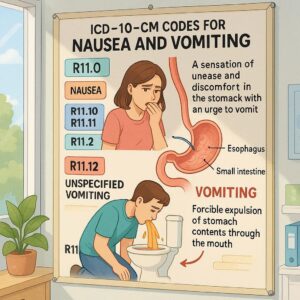
The codes for nausea and vomiting are found in Chapter 18 of ICD-10-CM, which covers “Symptoms, signs, and abnormal clinical and laboratory findings, not elsewhere classified.” Specifically, they are under the category R11: Nausea and vomiting.
Here is a breakdown of the primary codes:
| ICD-10-CM Code | Code Description | Clinical Context & When to Use |
|---|---|---|
| R11.0 | Nausea | Use when the patient presents with the feeling of needing to vomit (queasiness) but has not actually vomited. |
| R11.1 | Vomiting | A general code for the forcible expulsion of stomach contents. Use only when more specific codes (like R11.2 or cause-specific codes) do not apply. |
| R11.2 | Nausea with vomiting | This is the most commonly used code for the combination of both symptoms occurring together. |
| R11.10 | Vomiting, unspecified | Essentially synonymous with R11.1. Represents simple vomiting without further specification. |
| R11.11 | Projectile vomiting | Vomiting that is forcible and ejected some distance. Often associated with gastrointestinal obstructions (e.g., pyloric stenosis) or neurological conditions. Requires explicit documentation. |
| R11.12 | Vomiting of fecal matter | Indicates feculent vomiting, a serious sign typically associated with distal intestinal obstruction or fistula. Requires explicit documentation. |
| R11.13 | Vomiting of blood | This is hematemesis. Code this instead of R11.1. This is a more severe, specified condition that may indicate GI bleeding. |
| R11.14 | Bilious vomiting | Vomiting of bile. Can be associated with bowel obstruction, gastrojejunostomy complications, or prolonged vomiting. |
| R11.15 | Cyclic vomiting | Characterized by recurrent, stereotypical episodes of severe vomiting interspersed with periods of normal health. Often used for disorders like Cannabinoid Hyperemesis Syndrome or idiopathic cyclic vomiting. |
Important Note for Coders: Always review the full clinical documentation. If the provider mentions “nausea and vomiting,” the correct single code is R11.2. Do not code R11.0 and R11.1 separately.
Chapter 3: Beyond the Basics: Associated Symptoms and Combined Codes
Nausea and vomiting rarely occur in a vacuum. ICD-10-CM provides combination codes that capture common symptom clusters, which promote coding efficiency and clinical accuracy.
Key Combination Codes
-
R10.83: Abdominal tenderness, generalized – Often documented with nausea/vomiting in cases of gastroenteritis or peritonitis.
-
R10.84: Generalized abdominal pain – A frequent companion to nausea and vomiting.
-
R19.7: Diarrhea, unspecified – The classic triad for “gastroenteritis” or “stomach flu” is often R11.2 (Nausea with vomiting) and R19.7 (Diarrhea).
-
R50.9: Fever, unspecified – Fever with nausea/vomiting may indicate an infectious process.
-
R53.83: Fatigue – Chronic nausea can be associated with persistent fatigue.
-
R55: Syncope and collapse – Severe vomiting can lead to vasovagal syncope.
Coding for Dehydration – A Critical Complication
Prolonged nausea and vomiting frequently lead to dehydration, a significant complication that often requires treatment (e.g., IV fluids). Coding for dehydration requires careful attention to etiology.
| Clinical Scenario | Primary Code | Secondary Code(s) | Rationale |
|---|---|---|---|
| Dehydration due to acute gastroenteritis with nausea/vomiting | A09 (Infectious gastroenteritis) | E86.0 (Dehydration) | The definitive diagnosis (A09) is primary; dehydration is a resulting condition. |
| Dehydration due to vomiting of unknown origin | R11.2 (Nausea with vomiting) | E86.0 (Dehydration) | The symptom (R11.2) is the cause of the dehydration, so it is sequenced first. |
| Post-operative nausea/vomiting (PONV) leading to dehydration | T88.41XD (PONV, subsequent encounter) | E86.0 (Dehydration) | The complication of medical care (T88.41) is sequenced first. |
Coding Tip: When dehydration is treated, it should almost always be coded, as it significantly impacts the complexity of medical decision-making and resource use.
Chapter 4: Nausea and Vomiting as Symptoms of Underlying Conditions
In many cases, nausea and vomiting are not the primary problem but key indicators of a larger diagnosis. When a definitive diagnosis is established, you typically code that condition instead of the symptom codes (R11.-). Here are major categories:
1. Gastrointestinal Disorders
-
Gastroenteritis and Colitis (A09, K52.9): The most common cause. Code the specific type if known (viral, bacterial, non-infectious).
-
Gastritis and Duodenitis (K29.-): Inflammation of the stomach lining directly causes these symptoms.
-
Functional Dyspepsia (K30): Persistent indigestion and discomfort.
-
Intestinal Obstruction (K56.-): A surgical emergency; vomiting is a hallmark symptom (often projectile or feculent).
-
Cholelithiasis & Cholecystitis (K80.-, K81.-): Gallbladder disease often presents with nausea, especially after fatty meals.
-
Pancreatitis (K85.-, K86.-): Severe epigastric pain radiating to the back, with nausea/vomiting.
2. Neurological Disorders
-
Migraine (G43.-): Nausea and vomiting are defining symptoms of migraine headaches.
-
Increased Intracranial Pressure (G93.2)/Brain Neoplasm (C70-C72, D32-D33): Can cause “projectile” vomiting without nausea, often worse in the morning.
-
Vertiginous Disorders (H81.-, R42): Conditions like labyrinthitis cause severe vertigo, nausea, and vomiting.
3. Metabolic and Endocrine Disorders
-
Diabetic Ketoacidosis (E10.10, E11.10, etc.): A life-threatening complication where nausea/vomiting are early signs.
-
Uremia (N18.6): Kidney failure leads to toxin buildup.
-
Hypercalcemia (E83.52): Can cause severe nausea.
4. Pregnancy-Related
-
O26.81-: Nausea of pregnancy – For nausea alone during pregnancy.
-
O21.-: Excessive vomiting in pregnancy – This category includes hyperemesis gravidarum (O21.0-, O21.1-), a severe condition requiring significant medical intervention. These codes are always primary to any symptom code.
5. Drug-Induced and Post-Procedural
-
Adverse Effect of Drugs (T36-T50 with 5th/6th character 5): A vast number of medications (chemotherapy, opioids, antibiotics) list nausea/vomiting as a side effect. The adverse effect code is sequenced first, followed by the symptom code.
-
Example: T45.1X5A (Adverse effect of antineoplastic/immunosuppressive drugs) + R11.2 (Nausea with vomiting).
-
-
Postprocedural Complications (T81.0-, T88.41-): For nausea/vomiting specifically resulting from anesthesia or surgery.
Clinical Documentation Insight: A provider’s note that states “Patient presents with nausea and vomiting due to acute pancreatitis” should be coded as K85.90 (Acute pancreatitis, unspecified). The R11.2 code would not be used unless the nausea/vomiting itself required separate, distinct evaluation.
Chapter 5: A Practical Coding Guide: Clinical Scenarios and Code Selection
Let’s apply this knowledge to real-world patient encounters. The following table outlines common scenarios and the correct coding approach.
| Patient Presentation & Provider Documentation | Correct ICD-10-CM Code Sequence (Primary First) | Rationale & Key Points |
|---|---|---|
| Scenario 1: A 28-year-old female presents with 24 hours of nausea, vomiting 5-6 times, and 3 episodes of watery diarrhea. No fever. Diagnosis: Acute viral gastroenteritis. | A09 (Infectious gastroenteritis) | The definitive diagnosis is made. The symptoms (nausea, vomiting, diarrhea) are integral to the diagnosis and do not require separate coding. |
| Scenario 2: A 45-year-old male presents with severe, throbbing right-sided headache, photophobia, and nausea with one episode of vomiting. Diagnosis: Acute migraine without aura. | G43.909 (Migraine, unspecified, not intractable, without status migrainosus) | Migraine is the definitive diagnosis. Nausea/vomiting are characteristic symptoms and are not coded separately. |
| Scenario 3: A 60-year-old female presents with persistent nausea and loss of appetite for 2 weeks. No vomiting or diarrhea. Extensive workup reveals no specific cause. Final Impression: Chronic idiopathic nausea. | R11.0 (Nausea) | In the absence of a definitive diagnosis, the symptom is coded. “Idiopathic” means cause unknown. |
| Scenario 4: A 70-year-old male with a history of colon cancer presents with abdominal distension, constipation, and bilious vomiting. CT scan shows a small bowel obstruction. | K56.691 (Other partial intestinal obstruction) | The definitive diagnosis (obstruction) is primary. The specific type of vomiting (bilious) is characteristic of the condition but is not assigned a separate code (R11.14) because it’s part of the obstructive picture. |
| Scenario 5: A patient is seen in the ER 2 days after a laparoscopic cholecystectomy for severe post-operative nausea and vomiting (PONV) leading to moderate dehydration. Treated with IV fluids and antiemetics. | 1. T88.41XA (PONV, initial encounter) 2. E86.0 (Dehydration) |
The complication of the surgical procedure (PONV) is the cause of the dehydration and is sequenced first. Both conditions are treated. |
| Scenario 6: A 32-year-old pregnant female at 9 weeks gestation presents with intractable nausea and vomiting multiple times daily, unable to keep liquids down, with ketonuria. Diagnosis: Hyperemesis gravidarum. | O21.0 (Mild hyperemesis gravidarum) or O21.1 (Hyperemesis gravidarum with metabolic disturbance) | Pregnancy-related vomiting codes (O21.-) are always primary. The specific subcode reflects severity. R11.2 is not used. |
Chapter 6: Documentation Best Practices for Providers
Clear documentation is the fuel for accurate coding. Here’s what providers should include to ensure coders can select the most specific code:
-
Be Specific About the Symptom:
-
Don’t just write “N/V.” Spell out “nausea and vomiting.”
-
Specify if it’s just nausea (R11.0) or nausea with vomiting (R11.2).
-
Describe the vomitus if relevant: “projectile,” “bilious,” “feculent,” “coffee-ground” (hematemesis).
-
-
Link Symptoms to a Diagnosis (When Possible):
-
Clearly state the causal relationship: “Nausea and vomiting are due to acute gastritis.”
-
If the cause is unknown, state that: “Etiology of persistent nausea remains idiopathic after workup.”
-
-
Detail Associated Symptoms and Complications:
-
Always note the presence of abdominal pain, diarrhea, fever, or dizziness.
-
Actively assess and document signs of dehydration (dry mucous membranes, poor skin turgor, orthostatic hypotension, tachycardia). If treated, document the treatment (e.g., “Given 1L NS bolus for dehydration”).
-
-
For Chronic or Recurrent Cases:
-
Use precise terms like “cyclic vomiting” or “chronic functional nausea.”
-
Document the frequency, duration, and triggers.
-
-
Medication and History Context:
-
List current medications, as nausea/vomiting may be an adverse effect.
-
Note relevant surgical history (e.g., “PONV after prior anesthesia”).
-
For females of childbearing age, always document pregnancy status.
-
A Note to Clinicians: Think of your note as telling the patient’s story to both the next caregiver and the coder. The more precise the story, the more accurate the code, which leads to better continuity of care and appropriate reimbursement for your clinical effort.
Chapter 7: Common Pitfalls and How to Avoid Them
Even experienced professionals can stumble. Here are frequent errors and how to steer clear of them.
| Pitfall | Consequence | How to Avoid |
|---|---|---|
| Using R11.1 (Vomiting) when R11.2 (Nausea with vomiting) is documented. | Loss of specificity; may not reflect the full clinical picture. | Always code what is documented. If both symptoms are present, use the combination code R11.2. |
| Coding both a definitive diagnosis AND the symptom code R11.2 when the symptom is integral. | Code overkill; can appear like “upcoding” to payers. | Follow the ICD-10-CM guideline: “Do not code symptoms that are integral to a confirmed diagnosis.” If nausea/vomiting is part of the disease process (e.g., gastroenteritis, migraine), code only the disease. |
| Sequencing dehydration incorrectly. | Claim denial or downcoding. | If the dehydration is due to the nausea/vomiting (or the underlying cause), sequence the etiology (R11.2 or A09, etc.) first, followed by E86.0. |
| Missing pregnancy-related codes. | Significant undercoding; hyperemesis is a high-resource condition. | For any female of reproductive age, confirm and document pregnancy status. Use O21.- or O26.81- codes as primary when applicable. |
| Not using the “Adverse Effect” codes for drug-induced cases. | Missed opportunity to document drug reactions; less specific coding. | When a drug is documented as the cause, use the appropriate T-code from T36-T50 with 5th/6th character ‘5’, followed by the symptom or reaction code. |
Chapter 8: The Future of Coding: A Brief Look Ahead
The ICD-10-CM system is updated annually on October 1st by the CDC and CMS. While the core codes for nausea and vomiting have been stable, the context around them evolves.
-
Increased Specificity: Future updates may further delineate types of functional nausea or cyclic vomiting syndromes.
-
Z-Codes for Social Determinants: Using Z-codes (Z55-Z65) for factors like food insecurity or environmental hazards that might contribute to recurrent illness leading to nausea/vomiting is becoming more relevant for holistic care.
-
Linking to New Technologies: As telehealth and patient-reported symptoms become more integrated into EHRs, coding protocols may adapt to capture data from these sources.
Staying updated requires reviewing the annual ICD-10-CM Official Guidelines for Coding and Reporting and payer-specific policies.
Conclusion
Accurate ICD-10-CM coding for nausea and vomiting is a critical skill that bridges clinical care and healthcare administration. By understanding the core codes (R11.0, R11.2), recognizing when to code an underlying diagnosis instead, properly sequencing complications like dehydration, and relying on precise clinical documentation, you ensure patient records are complete and claims are justified. Remember, the goal is always to tell the most accurate story of the patient’s condition, one code at a time.
Frequently Asked Questions (FAQ)
Q1: What is the difference between ICD-10-CM codes R11.1 and R11.2?
A: R11.1 is for “Vomiting” alone, without mention of nausea. R11.2 is for “Nausea with vomiting” when both symptoms are present. R11.2 is the appropriate single code when the documentation states “nausea and vomiting.”
Q2: When should I not use a code from the R11 series?
A: You should typically avoid R11 codes when a definitive diagnosis that explains the symptom has been established. For example, code migraine (G43.-) for nausea/vomiting from a headache, or gastroenteritis (A09) for vomiting from a stomach bug. Code the cause, not the symptom.
Q3: How do I code nausea and vomiting with dehydration?
A: This is a combination coding scenario. You need two codes:
-
The code for the cause of the dehydration (e.g., R11.2 for nausea with vomiting, or A09 for gastroenteritis).
-
E86.0 for Dehydration.
Sequence the etiology code first, followed by E86.0.
Q4: What is the correct code for “dry heaves” or retching?
A: “Dry heaves” or retching is typically coded as R11.10 (Vomiting, unspecified) or R11.0 (Nausea), depending on the provider’s description. There is no specific code for retching alone; it is classified under the general vomiting or nausea codes.
Q5: Is there a specific code for chemotherapy-induced nausea and vomiting?
A: Yes. This is coded as an adverse effect of the drug. The primary code would be from category T45.1 (Poisoning by, adverse effect of and underdosing of antineoplastic and immunosuppressive drugs) with a 5th or 6th character to specify adverse effect. This would be followed by a code for the symptom, such as R11.2. Always consult the current ICD-10-CM index under “Adverse effect, antineoplastic drug.”
Additional Resources
-
The Authority: The CDC’s ICD-10-CM Official Guidelines – The essential, up-to-date rulebook for all coding.
-
Code Lookup Tool: The CMS ICD-10-CM Code Lookup – A reliable, free tool to search for codes and their descriptors.
Date: December 30, 2025
Author: The WebCoding Team