The human kidney, a bean-shaped organ no larger than a fist, performs a silent, life-sustaining symphony of filtration, balance, and regulation. When this symphony is abruptly disrupted—a condition known as Acute Renal Failure (ARF) or, more contemporarily, Acute Kidney Injury (AKI)—the consequences for the patient are rapid and severe. In the modern healthcare ecosystem, this clinical crisis intersects with another critical domain: the world of medical coding. The assignment of an ICD-10-CM code for acute renal failure is not a mere administrative afterthought. It is a fundamental act of clinical translation, converting a complex patient story into a standardized data point that reverberates through every corridor of healthcare.
This article delves deep into the intricate landscape of ICD-10-CM coding for acute renal failure. We will move beyond a simple code lookup. Our journey will explore the fascinating physiology of the kidney, unravel the varied causes of its acute demise, and master the nuanced guidelines of the ICD-10-CM system. We will examine how precise coding impacts patient care trajectories, hospital reimbursement, quality reporting, and vital public health research. With detailed explanations, practical case studies, and visual aids, this guide aims to be an indispensable resource for coders, clinicians, students, and healthcare administrators alike, ensuring that the story of each kidney in crisis is accurately told in the language of data.
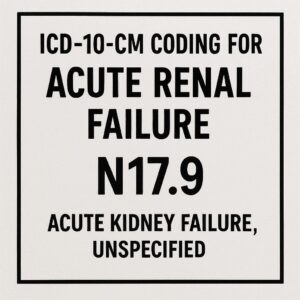
ICD-10-CM Coding for Acute Renal Failure
2. Understanding the Kidney: A Primer on Form and Function
To comprehend failure, one must first understand function. Each kidney contains approximately one million microscopic filtering units called nephrons. A nephron consists of a glomerulus (a tuft of capillaries) and a tubule. The process is elegant:
-
Filtration: Blood pressure forces fluid and small solutes (but not cells or large proteins) from the glomerulus into the tubule, forming “glomerular filtrate.”
-
Reabsorption: As this filtrate travels the convoluted tubule, the kidney reclaims over 99% of water, essential salts (like sodium, potassium), and nutrients (like glucose), returning them to the bloodstream.
-
Secretion: The tubule actively removes additional wastes and drugs from the blood into the filtrate.
-
Excretion: The final, concentrated product is urine, carrying away metabolic wastes like urea and creatinine.
The kidney is also an endocrine organ, producing erythropoietin (stimulates red blood cell production) and renin (regulates blood pressure). It maintains acid-base balance and electrolyte homeostasis. This multifaceted role is why its acute failure creates a systemic catastrophe.
3. Acute Renal Failure Defined: More Than Just a “Code”
Acute Renal Failure (ARF) is now predominantly termed Acute Kidney Injury (AKI) in clinical practice, emphasizing that the injury is a spectrum, not simply an endpoint of “failure.” It is defined as a sudden decrease in kidney function over hours to days, resulting in the accumulation of waste products (like creatinine and urea) and dysregulation of fluid, electrolyte, and acid-base balance.
Diagnosis is based on specific, measurable criteria (KDIGO guidelines):
-
An increase in serum creatinine by ≥0.3 mg/dL within 48 hours; OR
-
An increase in serum creatinine to ≥1.5 times baseline, which is known or presumed to have occurred within the prior 7 days; OR
-
Urine volume <0.5 mL/kg/h for 6 hours.
This abrupt loss of function distinguishes AKI from Chronic Kidney Disease (CKD), which is a slow, progressive loss over months or years.
4. The Pathophysiology of ARF: Prerenal, Intrinsic, and Postrenal
The causes of AKI are classically categorized by where the primary problem originates. This classification is not just academic; it directly guides treatment and is essential for specific ICD-10-CM coding.
A. Prerenal AKI (55-60% of cases): The problem is before the kidney. There is reduced blood flow (hypoperfusion) to otherwise healthy kidneys.
-
Mechanism: Hypovolemia (dehydration, hemorrhage), decreased cardiac output (heart failure, cardiogenic shock), or systemic vasodilation (sepsis, anaphylaxis).
-
Physiology: The kidney compensates by conserving water and sodium, leading to low urine output and high urine concentration. It is typically reversible if perfusion is restored promptly.
B. Intrinsic (or Intrarenal) AKI (35-40% of cases): The problem is within the kidney parenchyma itself.
-
Categories:
-
Acute Tubular Necrosis (ATN): The most common form of intrinsic AKI. Caused by ischemia (prolonged prerenal state) or nephrotoxins (e.g., aminoglycoside antibiotics, IV contrast dye, myoglobin from muscle breakdown).
-
Glomerulonephritis: Inflammation of the glomeruli (e.g., from autoimmune diseases like lupus).
-
Acute Interstitial Nephritis (AIN): Inflammation of the kidney interstitium, often drug-induced (e.g., NSAIDs, antibiotics).
-
Vascular Disorders: Such as vasculitis or thrombotic microangiopathies.
-
C. Postrenal AKI (5-10% of cases): The problem is after the kidney, due to obstruction of urine outflow.
-
Mechanism: Any blockage in the urinary tract—kidney stones, enlarged prostate, tumors, or strictures.
-
Physiology: Backpressure from the obstruction damages nephrons. Often reversible if the obstruction is relieved in time.
5. The ICD-10-CM Framework: Chapter 14 (N17-N19)
The ICD-10-CM manual categorizes diseases of the genitourinary system in Chapter 14. Codes for acute kidney failure and related conditions are found in the range N17-N19.
-
N17: Acute kidney failure – This is the primary category for most AKI diagnoses.
-
N18: Chronic kidney disease (CKD) – Used for long-standing, progressive kidney dysfunction.
-
N19: Unspecified kidney failure – A vague code to be used only when documentation is insufficient to specify acute or chronic.
A crucial guideline, often located at the start of Chapter 14, states: “Use an additional code to identify drug, if drug-induced, or external cause.” This is a cornerstone of accurate AKI coding.
6. Deep Dive into Code N17: Acute Kidney Failure
Code N17 is not a single code but a category requiring a fourth digit for specificity.
ICD-10-CM Codes for Acute Kidney Failure (Category N17)
| Code | Description | Clinical Context & Coding Notes |
|---|---|---|
| N17.0 | Acute kidney failure with tubular necrosis | This is Acute Tubular Necrosis (ATN). Documentation must specify “tubular necrosis” or “ATN.” Code first the underlying cause (e.g., sepsis, shock, toxin). |
| N17.1 | Acute kidney failure with acute cortical necrosis | A rarer, more severe form often from profound ischemia (e.g., obstetric catastrophe, severe sepsis). |
| N17.2 | Acute kidney failure with medullary necrosis | Includes conditions like renal papillary necrosis, often associated with analgesic abuse, sickle cell disease, or diabetes. |
| N17.8 | Other acute kidney failure | A catch-all for specified forms of AKI not elsewhere classified. Examples: “acute glomerulonephritis with acute kidney injury,” “acute nephritic syndrome with acute renal failure.” The specific type of intrinsic injury (if known) should be documented. |
| N17.9 | Acute kidney failure, unspecified | Used when the clinical documentation only states “acute renal failure,” “acute kidney injury,” or “AKI” without any specification of type or cause. This is the most commonly used but least specific code. |
Coding Guidance for N17:
-
Sequencing: The AKI code is sequenced based on the reason for the encounter. If the admission/encounter is primarily for the management of AKI, it should be sequenced first. If AKI develops during an encounter for another condition (e.g., septic shock), the underlying condition is often sequenced first, with AKI as a secondary diagnosis.
-
Etiology is Key: Always look for and code the cause. If a patient has AKI due to dehydration, you would code both N17.9 and E86.0 (Dehydration). If due to sepsis, code the sepsis first (e.g., A41.9) followed by N17.9 or N17.0 if ATN is specified.
7. The Progression to Chronicity: Code N18 and Acute-on-Chronic Renal Failure
A critical distinction is between acute and chronic failure. Code N18 is for Chronic Kidney Disease (CKD), staged from 1-5 based on glomerular filtration rate (GFR). CKD is a risk factor for developing AKI.
A particularly complex scenario is Acute-on-Chronic Renal Failure. This occurs when a patient with known underlying CKD suffers an acute, precipitous decline in function.
-
Coding Rule: Both codes are assigned. Code first the acute kidney injury (N17.-) followed by the appropriate chronic kidney disease code (N18.-). This paints a complete picture of the patient’s status.
-
Example: A patient with Stage 3 CKD (N18.3) is admitted with gastroenteritis and severe dehydration, leading to a sharp rise in creatinine. The coder would assign N17.9 (AKI, unspecified), N18.3 (CKD, stage 3), and K52.9 (Noninfective gastroenteritis).
8. The Imperative of Specificity: Documenting and Coding Etiology
The single most important step in accurate AKI coding is linking it to its cause. The ICD-10-CM system is built on this principle.
Common Etiologies and Their Corresponding Codes:
-
Dehydration/Hypovolemia: E86.0, E86.1
-
Sepsis/Septic Shock: A41.9, R65.21
-
Heart Failure: I50.-
-
Nephrotoxic Agents:
-
Drug-Induced: Code T36-T50 with fifth or sixth character 5 (e.g., T36.0x5A for adverse effect of penicillin). Always add an external cause code (Y-codes) from Chapter 20 to show the circumstance (e.g., Y43.3 for drug administered in therapeutic use).
-
Radiologic Contrast: T50.8X5A (Other contrast media).
-
-
Rhabdomyolysis (muscle breakdown): T79.6, M62.82
-
Urinary Obstruction: N13.8 (Other obstructive and reflux uropathy), N40.1 (Enlarged prostate with lower urinary tract symptoms).
Clinical Documentation Improvement (CDI): Coders often rely on “AKI” documented in progress notes. A strong CDI program encourages providers to specify:
-
“AKI likely secondary to prerenal azotemia from decompensated CHF.”
-
“AKI in the setting of contrast exposure for cardiac catheterization, consistent with contrast-induced nephropathy (CIN).”
-
“Severe AKI with anuric renal failure due to obstructive uropathy from benign prostatic hyperplasia.”
This level of detail allows for precise code assignment from the N17 category and correct etiology coding.
9. AKI Staging (KDIGO) and Its Coding Implications
The Kidney Disease: Improving Global Outcomes (KDIGO) criteria stage AKI based on serum creatinine and urine output. While there is no direct ICD-10-CM code for “AKI Stage 2,” this clinical information is crucial.
-
Clinical Impact: Staging drives treatment intensity, predicts prognosis, and is a key quality measure.
-
Coding Link: The stage itself isn’t coded, but the documented severity (e.g., “anuric renal failure,” “severe AKI requiring dialysis”) supports the medical necessity of the services provided and may be captured in other systems for quality reporting (e.g., U.S. News & World Report, CMS Star Ratings).
10. Complications and Comorbidities: The Essential Additional Codes
AKI rarely exists in isolation. Coders must be vigilant for associated conditions that require their own codes.
-
Hyperkalemia: E87.5 (A life-threatening electrolyte disturbance common in AKI).
-
Metabolic Acidosis: E87.2
-
Fluid Overload/Volume Depletion: E86.- or E87.7-
-
Uremia: R39.2 (Extrarenal uremia)
-
Dialysis Status: Z99.2 (Dependence on renal dialysis). Crucial note: This code is used when the patient is on maintenance dialysis for CKD. For a patient who requires temporary dialysis for AKI, code the AKI (N17.-) and the procedure code for dialysis, but do not assign Z99.2.
11. Case Studies: From Clinical Documentation to Final Code Assignment
Case Study 1: The Post-Operative Patient
-
Scenario: A 70-year-old male undergoes emergency repair of a ruptured abdominal aortic aneurysm. Post-operatively, he develops hypotension requiring vasopressors. His urine output drops, and creatinine rises from 1.0 to 3.2 mg/dL. The nephrologist documents “Acute Tubular Necrosis secondary to ischemic insult from prolonged perioperative shock.”
-
Codes:
-
I71.3 Abdominal aortic aneurysm, ruptured (the reason for surgery).
-
R57.9 Shock, unspecified (or more specific shock code if documented).
-
N17.0 Acute kidney failure with tubular necrosis.
-
-
Rationale: The ATN is coded specifically with N17.0. The underlying cause (shock) is also coded.
Case Study 2: The Medication-Related Injury
-
Scenario: A 58-year-old female with a history of hypertension is treated for cellulitis with IV vancomycin. After 7 days, she develops a rash, fever, and rising creatinine. A renal biopsy shows “acute interstitial nephritis.” The provider states, “AIN, highly likely due to vancomycin.”
-
Codes:
-
N17.8 Other acute kidney failure (used for AIN as it’s not tubular necrosis).
-
T36.0x5A Adverse effect of penicillins, initial encounter. *(Note: Vancomycin is not a penicillin; a more specific code from T36-T50 would be used based on the drug class. This is an example.)*
-
L27.0 Generalized skin eruption due to drugs.
-
Y43.3 Drugs, medicaments and biological substances causing adverse effects in therapeutic use, agents primarily affecting the cardiovascular system. (Example Y-code; must match drug).
-
-
Rationale: This demonstrates the complex but necessary coding of drug-induced injury, requiring codes from Chapters 14 (N17.8), 19 (T-code), and 20 (Y-code).
12. Common Pitfalls, Errors, and How to Avoid Them
-
Defaulting to N17.9 Unnecessarily: Always review the entire record for clues to type (ATN) or cause. Query the provider if unclear.
-
Misapplying Z99.2: Using this for temporary dialysis in AKI patients. This incorrectly labels the patient as having end-stage renal disease (ESRD).
-
Missing Etiology Codes: Failing to code the dehydration, sepsis, or drug that caused the AKI results in incomplete data and may impact reimbursement.
-
Confusing AKI with CKD: Carefully review the history. A patient with a baseline creatinine of 4.0 (CKD) who spikes to 6.0 needs both N17.9 and N18.5.
-
Incorrect Sequencing: Understand the principal diagnosis rules. Was the patient admitted for AKI management, or did it develop during an admission for pneumonia?
13. The Impact of Accurate Coding: Quality Metrics, Reimbursement, and Research
Precise AKI coding is not a clerical task; it is a linchpin of healthcare integrity.
-
Quality Reporting and Pay-for-Performance: AKI rates, hospital-acquired conditions (HACs), and mortality are tracked. Accurate coding ensures correct public reporting and affects value-based purchasing payments.
-
MS-DRG Assignment and Reimbursement: The presence of AKI, especially with complications like dialysis, can significantly change a patient’s Diagnosis-Related Group (DRG), directly impacting hospital revenue. Under-coding leads to financial loss; over-coding is fraudulent.
-
Clinical Research and Epidemiology: Researchers rely on coded data to study AKI incidence, outcomes, and effectiveness of treatments. Vague coding (N17.9) obscures understanding of different AKI subtypes.
-
Public Health Surveillance: Tracking trends in drug-induced or contrast-induced AKI can lead to safer clinical guidelines.
14. The Future: ICD-11 and Beyond
The World Health Organization’s ICD-11, already adopted in some countries, offers greater granularity for AKI. It includes codes for AKI based on etiology (e.g., AKI due to sepsis, due to cardiac failure) and incorporates concepts like “acute kidney disease.” This continued evolution underscores the global importance of capturing kidney injury data with increasing precision to improve patient care worldwide.
15. Conclusion
Accurate ICD-10-CM coding for acute renal failure is a sophisticated process that demands a partnership between clinical insight and coding expertise. It requires moving from a generic “N17.9” to a detailed narrative that captures the type, cause, and context of the kidney injury. By mastering the pathways from prerenal, intrinsic, and postrenal etiology through to the specific codes and guidelines, healthcare professionals ensure that each case of AKI is accurately represented—fueling better patient care, just reimbursement, and meaningful advancements in medical knowledge. The kidney’s story, in crisis and recovery, deserves nothing less than this level of meticulous translation.
16. Frequently Asked Questions (FAQs)
Q1: What is the difference between ICD-10 code N17.9 and N18.9?
A: N17.9 is “Acute kidney failure, unspecified,” used for a sudden, recent loss of kidney function. N18.9 is “Chronic kidney disease, unspecified,” used for long-standing, progressive kidney dysfunction. They are distinct conditions, though one can lead to the other (acute-on-chronic).
Q2: How do I code a patient who has AKI and needs temporary dialysis during their hospital stay?
A: Code the specific AKI code (e.g., N17.9). Also code the dialysis procedure performed. Do NOT assign Z99.2 (Dependence on renal dialysis). Z99.2 is reserved for patients with end-stage renal disease (ESRD) on permanent, maintenance dialysis.
Q3: A provider documents “acute renal insufficiency.” Is this the same as AKI, and can I use N17.9?
A: “Insufficiency” is often considered a milder or earlier form of injury. However, without clear clinical criteria, it can be ambiguous. The best practice is to query the provider for clarification: “Can the renal insufficiency be further specified as acute kidney injury (AKI) per the KDIGO criteria (rise in creatinine, etc.)?” Do not assume equivalence.
Q4: When coding drug-induced AKI, how many codes do I need?
A: Typically, you need three:
-
The AKI code (N17.0 or N17.8).
-
The adverse effect code from the T36-T50 series, with the 5th/6th character ‘5’ (e.g., T45.1X5A for adverse effect of antineoplastic antibiotics).
-
An external cause code from Chapter 20 (Y-codes) to indicate the circumstance of the drug administration (e.g., Y43.3 for drugs affecting the cardiovascular system in therapeutic use).
Q5: How should I handle “contrast-induced nephropathy” (CIN)?
A: CIN is a form of intrinsic AKI, often considered a type of acute tubular necrosis. If documented as “CIN” or “contrast-induced AKI,” code:
-
N17.0 (if ATN is stated) or N17.9.
-
T50.8X5A (Adverse effect of other diagnostic agents).
-
A corresponding Y-code from Chapter 20 for the contrast administration.
17. Additional Resources
-
Centers for Disease Control and Prevention (CDC) – ICD-10-CM: https://www.cdc.gov/nchs/icd/icd-10-cm.htm (Official guidelines and updates).
-
American Hospital Association (AHA) Coding Clinic: The authoritative source for official ICD-10-CM coding advice and quarterly updates.
-
Kidney Disease: Improving Global Outcomes (KDIGO): https://kdigo.org/ (Clinical practice guidelines on AKI and CKD).
-
National Kidney Foundation (NKF): https://www.kidney.org/ (Patient and professional education on kidney diseases).
-
American Health Information Management Association (AHIMA): https://www.ahima.org/ (Resources for coding professionals and best practices in clinical documentation).
Disclaimer: This article is for informational and educational purposes only. It is not a substitute for professional medical advice, clinical judgment, or the official ICD-10-CM coding guidelines. Always consult the most current official code sets, provider documentation, and a certified coding specialist for accurate code assignment. The author and publisher assume no liability for errors or omissions.
Date: December 23, 2025
Author: The Healthcare Coding Insights Team