Allergic rhinitis (AR), commonly known as hay fever, is often trivialized as a seasonal inconvenience. However, for the over 400 million people worldwide who suffer from it, AR is a chronic inflammatory condition of the nasal mucosa that significantly impairs quality of life, sleep, academic performance, and workplace productivity. It represents a major global health issue with substantial economic burdens due to direct medical costs and indirect costs from lost productivity. In the intricate ecosystem of modern healthcare, accurately classifying and coding this condition is not merely an administrative task—it is a critical link in the chain of patient care, epidemiological research, and healthcare economics. This article embarks on a detailed exploration of allergic rhinitis, culminating in a masterful guide to its precise representation within the International Classification of Diseases, 10th Revision, Clinical Modification (ICD-10-CM) coding system. We will unravel the complex immunological mechanisms, delineate evidence-based clinical management, and, most importantly, provide a crystal-clear roadmap for selecting the correct ICD-10-CM code, ensuring specificity, compliance, and a true reflection of the patient’s condition.
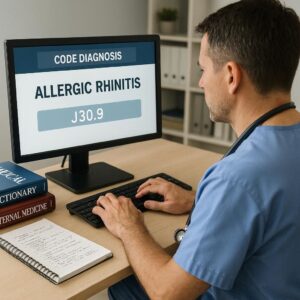
ICD-10-CM coding of allergic rhinitis
2. Understanding the Enemy: The Pathophysiology of Allergic Rhinitis
At its core, allergic rhinitis is a Type I hypersensitivity reaction mediated by Immunoglobulin E (IgE). The process is a misguided defense mechanism against harmless environmental aeroallergens.
The Sensitization Phase: Upon first exposure to an allergen (e.g., pollen, dust mite feces), a genetically predisposed individual’s immune system perceives it as a threat. Antigen-presenting cells process the allergen and present it to T-helper 2 (Th2) lymphocytes. These Th2 cells, in turn, stimulate B-cells to produce allergen-specific IgE antibodies. These IgE molecules then bind with high affinity to FcεRI receptors on the surface of mast cells and basophils, primarily in the nasal mucosa. The individual is now sensitized.
The Effector Phase (Early-Phase Response): Upon subsequent re-exposure, the allergen cross-links two adjacent IgE molecules on the mast cell surface. This triggers immediate degranulation, releasing pre-formed mediators like histamine, tryptase, and chymase. Histamine binding to H1 receptors causes the classic symptoms: sneezing (via neural reflex), pruritus (itching), rhinorrhea (watery discharge), and nasal congestion (via vasodilation). This response peaks within 5-30 minutes.
The Inflammatory Phase (Late-Phase Response): Mast cell degranulation also initiates the synthesis and release of newly formed mediators, including leukotrienes (LTs C4, D4, E4), prostaglandins (PGD2), and cytokines (e.g., IL-4, IL-5, IL-13). These molecules act as chemoattractants, drawing inflammatory cells—particularly eosinophils, basophils, and Th2 lymphocytes—to the nasal mucosa. This cellular infiltration, peaking 6-12 hours after exposure, sustains inflammation, leads to nasal hyperreactivity (an exaggerated response to non-specific triggers like cold air or smoke), and perpetuates symptoms like persistent congestion and anosmia (loss of smell).
Key Allergens:
-
Seasonal (Pollens): Trees (spring), Grasses (late spring/summer), Weeds (e.g., ragweed in fall).
-
Perennial: House dust mites, cockroach particles, animal dander (cat, dog), mold spores.
3. Clinical Presentation: Signs, Symptoms, and Classification
Patients present with a constellation of symptoms that can vary in intensity and timing.
Cardinal Symptoms:
-
Paroxysmal sneezing, often in bouts.
-
Clear, watery rhinorrhea (runny nose).
-
Nasal pruritus (itching), sometimes accompanied by palatal or ocular itching.
-
Nasal congestion/obstruction, which may become the dominant symptom over time.
Associated Features: Post-nasal drip, cough, fatigue, irritability, sleep disturbance, allergic shiners (dark periorbital circles), Dennie-Morgan lines (creases under lower eyelids), and the “allergic salute” (rubbing the nose upward with the palm).
Classification Systems:
-
By Temporal Pattern (ARIA Guidelines):
-
Intermittent: Symptoms present <4 days per week OR <4 consecutive weeks.
-
Persistent: Symptoms present ≥4 days per week AND ≥4 consecutive weeks.
-
-
By Severity (ARIA Guidelines):
-
Mild: Normal sleep; no impairment of daily activities, sport, leisure; normal work/school performance; symptoms not troublesome.
-
Moderate-Severe: Presence of one or more of: abnormal sleep; impairment of daily activities/sport/leisure; impaired work/school performance; troublesome symptoms.
-
This clinical classification directly informs treatment but is distinct from the etiological classification used in ICD-10-CM coding.
4. The Diagnostic Pathway: From History to Testing
Accurate diagnosis is the foundation of correct coding.
-
Detailed History: The cornerstone. Pattern (seasonal/perennial), triggers, symptom characteristics, family history of atopy, response to medications, and impact on quality of life.
-
Physical Examination: Anterior rhinoscopy may reveal pale, bluish, edematous turbinates with watery secretions. Examination of eyes, ears, and chest is crucial to identify comorbidities like asthma, eczema, or otitis media.
-
Diagnostic Testing:
-
Skin Prick Test (SPT): The gold standard. Introduces tiny amounts of allergens into the skin. A wheal-and-flare reaction within 15-20 minutes indicates IgE-mediated sensitization.
-
Serum Allergen-Specific IgE Testing: Useful when SPT is contraindicated (e.g., severe eczema, dermatographism, unable to stop antihistamines).
-
Nasal Smear: Microscopic examination for eosinophils, supporting an allergic etiology.
-
5. Navigating the ICD-10-CM Framework: An Overview
ICD-10-CM is a hierarchical, alphanumeric system used to classify diseases, signs, symptoms, and external causes. Its structure provides unparalleled specificity compared to its predecessor, ICD-9-CM. Codes are composed of 3-7 characters. The first three characters represent the category. The characters following the decimal point provide increasing levels of detail regarding etiology, anatomic site, severity, and laterality.
6. Deep Dive: The J30 Series for Allergic Rhinitis
Allergic rhinitis is primarily categorized under Chapter 10: Diseases of the Respiratory System (J00-J99), specifically within the block J30-J39: Other diseases of the upper respiratory tract.
The foundational category is J30: Vasomotor and allergic rhinitis. It is crucial to note that this category excludes allergic rhinitis with asthma (coded separately under J45.9-), and rhinitis NOS (J31.0).
Here is the complete breakdown of the J30 series:
ICD-10-CM Code Set for Allergic Rhinitis (J30 Series)
| ICD-10-CM Code | Code Description | Clinical Scenario & Notes |
|---|---|---|
| J30.0 | Vasomotor rhinitis | Non-allergic, non-infectious rhinitis triggered by environmental factors (temperature, humidity, strong odors). Often has a dominant congestion symptom. Code for idiopathic or non-allergic causes. |
| J30.1 | Allergic rhinitis due to pollen | Hay fever. This is the code for seasonal allergic rhinitis triggered by tree, grass, or weed pollens. The most common seasonal code. |
| J30.2 | Other seasonal allergic rhinitis | Use for seasonal allergies caused by non-pollen allergens (e.g., specific seasonal molds). Less common than J30.1. |
| J30.5 | Allergic rhinitis due to animal (cat) (dog) hair and dander | Perennial allergic rhinitis specifically triggered by common household pets. Requires documentation of the specific animal. |
| J30.81 | Allergic rhinitis due to animal (cat) (dog) hair and dander | This is a billable code for the condition described in J30.5. The coder would use J30.81. |
| J30.89 | Other allergic rhinitis | A crucial catch-all code. Use for documented allergic rhinitis caused by other specific perennial allergens: Dust mites (most common use), cockroaches, mold spores (non-seasonal), or other identified allergens not represented by a more specific code. |
| J30.9 | Allergic rhinitis, unspecified | Use only when the provider’s documentation is incomplete. It states “allergic rhinitis” but does not specify the cause (pollen, animal, dust, etc.). This is the least specific code and should be avoided when better documentation exists. |
7. Critical Coding Concepts: Specificity, Laterality, and Documentation
-
Specificity is Paramount: Always code to the highest level of specificity documented.
J30.89(dust mite allergy) is superior toJ30.9.J30.5(cat allergy) is superior toJ30.89. -
Laterality: The J30 codes are not laterality-specific. There is no distinction for left, right, or bilateral allergic rhinitis. It is assumed to affect the nasal passages broadly.
-
The Power of Documentation: The medical record must link the diagnosis to the cause. Phrases like “Patient with perennial allergic rhinitis confirmed by skin testing to be due to Dermatophagoides pteronyssinus (dust mite)” directly lead to code
J30.89. -
Combination Coding: If a patient has allergic rhinitis with acute sinusitis, both conditions are coded (
J30.9+J01.90). Allergic rhinitis with asthma requires coding both (J30.9+J45.909).
8. Common Pitfalls and How to Avoid Them
-
Pitfall: Automatically coding “hay fever” as
J30.1. Avoidance: Confirm in the record if the trigger is indeed pollen. “Hay fever” is sometimes used colloquially for any allergic rhinitis. -
Pitfall: Using
J30.9(unspecified) when a more specific code is possible. Avoidance: Query the provider. If allergy testing is noted in the history, the specific allergen is often documented elsewhere in the record. -
Pitfall: Confusing
J30.0(vasomotor/non-allergic) with allergic rhinitis. Avoidance: Look for keywords: “non-allergic,” “idiopathic,” “triggered by weather/scents.” -
Pitfall: Coding chronic sinusitis (
J32.-) instead of, or without, the underlying allergic rhinitis. Avoidance: Allergic rhinitis is a common comorbidity and cause. Code both if documented.
9. Clinical Management and Treatment Strategies
Management follows a stepwise approach, often aligned with the ARIA guidelines:
-
Allergen Avoidance: The first line, though often difficult (e.g., environmental controls for dust mites, pet removal).
-
Pharmacotherapy:
-
Intranasal Corticosteroids (INS): First-line pharmacotherapy for moderate-severe or persistent symptoms (e.g., fluticasone, mometasone).
-
Second-Generation Oral H1-Antihistamines: First-line for mild intermittent or mild persistent symptoms (e.g., cetirizine, loratadine, fexofenadine).
-
Leukotriene Receptor Antagonists: (e.g., montelukast). Often used in patients with concomitant asthma.
-
Nasal Antihistamine Sprays: (e.g., azelastine). Fast-acting, effective for breakthrough symptoms.
-
Decongestants: (Oral or topical). For short-term relief of severe congestion; risk of rebound rhinitis medicamentosa with topical overuse.
-
-
Allergen Immunotherapy (AIT): The only disease-modifying treatment. Administered as subcutaneous (SCIT) or sublingual (SLIT) drops/tablets. Indicated for moderate-severe symptoms not controlled by pharmacotherapy with documented specific IgE.
10. The Intersection of Coding and Patient Care
Accurate ICD-10-CM coding transcends billing. It:
-
Creates Epidemiological Data: Accurate
J30.1codes help track pollen allergy prevalence and healthcare utilization. -
Drives Quality Metrics: Codes identify populations for quality improvement initiatives in chronic disease management.
-
Facilitates Research: Specific codes allow researchers to identify patient cohorts for clinical trials on new antihistamines or immunotherapies.
-
Ensures Appropriate Resource Allocation: Correct coding reflects the true complexity of patient care, supporting appropriate reimbursement for allergy testing and management.
11. Case Studies: Applying ICD-10-CM Codes in Real Scenarios
Case 1: A 28-year-old presents in April with itchy eyes, sneezing fits, and clear rhinorrhea. Symptoms occur every spring. Skin prick test was positive for birch and oak tree pollen. Code: J30.1 (Allergic rhinitis due to pollen).
Case 2: A 10-year-old with year-round nasal congestion and sneezing. The child’s symptoms worsen in the bedroom. An IgE blood test shows high levels of IgE specific to Dermatophagoides farinae (dust mite). Code: J30.89 (Other allergic rhinitis, due to dust mite).
Case 3: A 45-year-old states they have “allergies” and have used over-the-counter loratadine for years. The provider’s assessment today is “Chronic allergic rhinitis.” No further specification on cause is documented. Code: J30.9 (Allergic rhinitis, unspecified). A coding query could be sent to clarify if cause is known.
Case 4: A 32-year-old with known cat allergy (J30.5) presents with acute facial pain and purulent nasal discharge. CT confirms acute maxillary sinusitis. Codes: J30.5 (Allergic rhinitis due to cat hair/dander) AND J01.00 (Acute maxillary sinusitis, unspecified).
12. Conclusion
Allergic rhinitis is a complex, IgE-mediated inflammatory disease with a significant global footprint. Mastering its ICD-10-CM coding—from the general J30.9 to the highly specific J30.1, J30.5, and J30.89—requires a synergy of clinical understanding and meticulous attention to documentation. By pursuing the highest specificity, healthcare professionals ensure accurate data collection, support public health initiatives, and contribute to the financial and clinical integrity of the healthcare system, ultimately leading to better patient outcomes and more targeted research.
13. Frequently Asked Questions (FAQs)
Q1: What is the difference between J30.1 and J30.2?
A: J30.1 is for pollen-induced seasonal allergic rhinitis (classic hay fever). J30.2 is for other seasonal allergic rhinitis, meaning seasonal allergies caused by something other than pollen, such as a specific outdoor mold that appears only at certain times of the year.
Q2: When do I use J30.89 vs. J30.9?
A: Use J30.89 when the cause of the allergic rhinitis is known and specified, but doesn’t have its own unique code (e.g., dust mite, cockroach, non-seasonal mold). Use J30.9 only when the documentation simply states “allergic rhinitis” with no mention of a cause, even after querying the provider.
Q3: How do I code a patient with both seasonal (pollen) and perennial (dust mite) allergies?
A: If a patient is symptomatic year-round with perennial allergens but has exacerbations during pollen season, and both are documented, you would code both J30.1 (for the pollen allergy) and J30.89 (for the dust mite allergy). ICD-10-CM allows and often requires multiple codes to paint a complete picture.
Q4: Is “chronic rhinitis” the same as allergic rhinitis?
A: Not necessarily. “Chronic rhinitis” (coded to J31.0) is a broader term meaning long-term nasal inflammation. It can be allergic (J30.-) or non-allergic (e.g., vasomotor J30.0). You must code based on the physician’s specific diagnosis.
14. Additional Resources
-
Official ICD-10-CM Guidelines: Centers for Disease Control and Prevention (CDC) / CMS – The definitive source for coding rules.
-
ARIA Guidelines (Allergic Rhinitis and its Impact on Asthma): www.whiar.org – The leading global clinical standard.
-
American Academy of Allergy, Asthma & Immunology (AAAAI): www.aaaai.org – Patient and professional education materials.
-
American Health Information Management Association (AHIMA): www.ahima.org – For in-depth coding training and best practices.