In the intricate world of modern healthcare, two languages converge at the patient’s bedside: the nuanced, descriptive language of clinical medicine and the precise, standardized language of medical coding. For conditions like thrombocytopenia—a common yet potentially grave finding—this convergence is not merely administrative; it is a critical determinant of patient care quality, public health understanding, and healthcare system sustainability. A low platelet count is never a final diagnosis; it is a hematologic signpost pointing toward a vast array of possible etiologies, from transient viral insults to life-threatening autoimmune disorders or insidious malignancies. The International Classification of Diseases, Tenth Revision, Clinical Modification (ICD-10-CM) provides the structured vocabulary to translate this clinical complexity into actionable data.
This article embarks on a comprehensive journey through the ICD-10-CM landscape for thrombocytopenia. We will move far beyond a simple code lookup. Our exploration will dissect the logic of the coding system, delve into the pathophysiology that informs code structure, and emphasize the irreplaceable role of meticulous clinical documentation. Whether you are a seasoned hematologist, a diligent medical coder, a clinical researcher, or a healthcare administrator, mastering this nexus is essential. It ensures that the story told by the data—a story of disease prevalence, treatment efficacy, and resource allocation—faithfully reflects the lived experience of the patient and the clinical acumen of their care team. Let us begin by understanding the clinical entity we seek to codify.
ICD-10-CM for Thrombocytopenia
2. Understanding the Foundation: What is Thrombocytopenia?
Pathophysiology and Clinical Significance
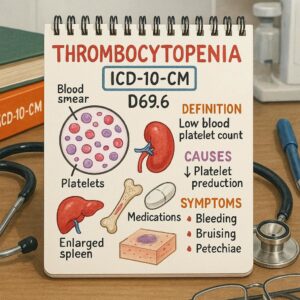
Thrombocytopenia is defined as a reduction in the circulating platelet count below the normal laboratory reference range, typically less than 150,000 platelets per microliter (µL) of blood. Platelets, or thrombocytes, are anucleate cell fragments derived from megakaryocytes in the bone marrow. Their primary function is to initiate hemostasis—the process of forming blood clots at sites of vascular injury to prevent excessive bleeding.
The pathophysiology of thrombocytopenia falls into three principal mechanisms, famously known as the “triad of pathophysiology”:
-
Decreased Platelet Production: Failure of the bone marrow to produce an adequate number of platelets. This can be due to direct marrow infiltration (e.g., leukemia, metastatic cancer), marrow suppression (e.g., chemotherapy, radiation, certain viral infections like parvovirus B19), or nutritional deficiencies (e.g., severe B12 or folate deficiency).
-
Increased Platelet Destruction or Consumption: Platelets are produced normally but are removed from circulation prematurely. This is the most common mechanism and includes immune-mediated destruction (e.g., Immune Thrombocytopenia – ITP), consumption in thrombotic processes (e.g., Disseminated Intravascular Coagulation – DIC, Thrombotic Thrombocytopenic Purpura – TTP), and sequestration in an enlarged spleen (hypersplenism).
-
Abnormal Platelet Distribution (Sequestration): Platelets are pooled abnormally, typically in an enlarged spleen (splenomegaly), reducing the count in the peripheral blood.
The clinical presentation is variable. Mild thrombocytopenia (100,000-150,000/µL) is often asymptomatic. As counts drop lower, patients may exhibit mucocutaneous bleeding such as petechiae (pinpoint red spots), purpura (larger purple bruises), epistaxis (nosebleeds), gingival bleeding, or menorrhagia. Severe thrombocytopenia (<20,000-30,000/µL) carries a risk of spontaneous and potentially fatal internal bleeding, such as intracranial hemorrhage.
3. The ICD-10-CM System: A Primer for Precision
Structure and Logic: From Chapter to Specificity
ICD-10-CM is a hierarchical, alphanumeric system. Codes are composed of 3 to 7 characters, with each character adding a layer of specificity.
-
First Character: Alphabetic (A through Z, excluding U), representing the chapter. Most hematologic conditions, including thrombocytopenia, are found in Chapter 3: Diseases of the blood and blood-forming organs and certain disorders involving the immune mechanism (D50-D89).
-
Characters 2-3: Numeric, defining the category of the disease.
-
Characters 4-6: Provide details about etiology, anatomic site, severity, or other clinical specifics.
-
Character 7: An extension used primarily for injuries/poisonings or to denote encounter type (initial, subsequent, sequela).
The system’s power lies in its ability to move from a general condition (e.g., “thrombocytopenia”) to a highly specific diagnosis (e.g., “post-transfusion purpura”). This specificity is not optional for accurate coding; it is mandated.
4. Navigating the Thrombocytopenia Code Block: D69.5-
The primary home for thrombocytopenia in ICD-10-CM is within category D69 (Purpura and other hemorrhagic conditions). The subcategory D69.5 (Secondary thrombocytopenia) is the critical nexus for most acquired forms. It is essential to understand that “secondary” here implies the thrombocytopenia is a symptom or consequence of another underlying condition, which must be identified.
Table 1: Primary ICD-10-CM Codes for Thrombocytopenia
| Code | Description | Clinical Context & Coding Notes |
|---|---|---|
| D69.5 | Secondary thrombocytopenia, unspecified | Use only when documentation is insufficient to assign a more specific code. A “low platelet count” with no stated cause. |
| D69.41 | Posttransfusion purpura | Severe thrombocytopenia occurring ~5-10 days after blood transfusion, often in multiparous women or previously transfused patients. |
| D69.42 | Thrombocytopenia in viral diseases | Code first the underlying viral disease (e.g., B20 for HIV, B15-B19 for viral hepatitis, B25.9 for CMV). |
| D69.43 | Neonatal thrombocytopenia | Thrombocytopenia in a newborn. Further specified by 5th character: 0 (isoimmune), 1 (other), 9 (unspecified). Code on newborn record. |
| D69.48 | Other secondary thrombocytopenia | The workhorse code. Used for thrombocytopenia due to drugs, systemic conditions (e.g., SLE, cirrhosis), hypersplenism, etc. The underlying cause must be coded first. |
| D69.49 | Other primary thrombocytopenia | For primary disorders where thrombocytopenia is the main feature but doesn’t fit elsewhere. Includes some hereditary forms (if not better specified) and refractory cases. |
D69.48: Other Secondary Thrombocytopenia – A Deep Dive
This code is pivotal. It requires the coder to identify and sequence the underlying etiology first. For example:
-
Drug-induced: If the provider documents “thrombocytopenia due to valproic acid,” you would code T42.6X5A (Adverse effect of valproic acid, initial encounter) followed by D69.48.
-
Due to systemic disease: For “thrombocytopenia associated with systemic lupus erythematosus,” code M32.10 (Systemic lupus erythematosus, organ or system involvement unspecified) first, then D69.48.
-
Due to hypersplenism: For “thrombocytopenia secondary to splenomegaly from cirrhosis,” code K74.60 (Cirrhosis of liver, unspecified) and D73.2 (Hypersplenism) before D69.48.
*[Infographic Suggestion: A flowchart titled “Navigating to D69.48” with the decision tree: 1. Is thrombocytopenia documented? -> 2. Is it primary (e.g., ITP)? -> If no, 3. Is a known cause documented (drug, disease, post-transfusion, viral, neonatal)? -> If yes to drug/disease/hypersplenism, assign D69.48 and sequence underlying cause first.]*
5. Beyond D69.5-: Thrombocytopenia in Systemic and Hereditary Disorders
Thrombotic Microangiopathies (TMA): These are coded elsewhere. Thrombotic thrombocytopenic purpura (TTP) is coded M31.1. Hemolytic Uremic Syndrome (HUS) is coded D59.3. Thrombocytopenia here is an integral part of the syndrome, not a separate code.
Drug-Induced Thrombocytopenia: As noted, this falls under D69.48. However, identification of the drug is crucial and coded from Chapter 19 (Injury, poisoning, and certain other consequences of external causes – T36-T50). The 5th or 6th character defines the intent (adverse effect, poisoning, underdosing).
Thrombocytopenia in Malignancy: This can be direct marrow infiltration (code the malignancy first, e.g., C92.00 Acute myeloid leukemia, not having achieved remission, then D69.48) or treatment-related (chemotherapy-induced, coded as adverse effect of the antineoplastic agent, then D69.48). Myelodysplastic syndromes (MDS) with thrombocytopenia are coded to the specific MDS subtype (D46.-).
Heparin-Induced Thrombocytopenia (HIT): A unique, pro-thrombotic drug reaction. Code T45.515A (Adverse effect of unfractionated heparin, initial encounter) followed by D75.82 (Heparin-induced thrombocytopenia, HIT). Note that HIT has its own unique code in Chapter 4 (D75.82), not under D69.5-.
6. The Art of Clinical Documentation: The Bedrock of Accurate Coding
The physician’s documentation is the source material for all coding. Vague terms lead to unspecified codes, which hinder patient care, research, and reimbursement.
-
Poor Documentation: “Patient has low platelets.” -> D69.5 (Unspecified).
-
Good Documentation: “Patient has thrombocytopenia secondary to chronic hepatitis C infection.” -> B18.2 (Chronic viral hepatitis C) first, then D69.48.
Providers should be encouraged to document:
-
The specific type (e.g., “immune thrombocytopenia,” “drug-induced”).
-
The probable etiology (e.g., “likely related to recent quinine use,” “due to active SLE”).
-
Associations clearly (e.g., “thrombocytopenia associated with sepsis”).
7. Practical Coding Scenarios
Case Study 1: Immune Thrombocytopenia (ITP)
-
Diagnosis: “Chronic primary immune thrombocytopenia (ITP), symptomatic with mucosal bleeding.”
-
ICD-10-CM: D69.3 (Immune thrombocytopenic purpura). No additional code for the bleeding is needed if it’s a routine manifestation. If a specific, significant bleed (e.g., intracranial hemorrhage) occurs, it would be coded additionally.
Case Study 2: Chemotherapy-Induced Thrombocytopenia
-
Diagnosis: “Patient on FOLFOX for metastatic colon cancer presents with severe thrombocytopenia, attributed to oxaliplatin chemotherapy.”
-
ICD-10-CM: T45.1X5A (Adverse effect of antineoplastic and immunosuppressive drugs, initial encounter) + C78.7 (Secondary malignant neoplasm of liver) + D69.48 (Other secondary thrombocytopenia). Sequence depends on reason for encounter.
Case Study 3: Thrombocytopenia in Chronic Liver Disease
-
Diagnosis: “Thrombocytopenia secondary to hypersplenism from decompensated alcoholic cirrhosis.”
-
ICD-10-CM: K70.31 (Alcoholic cirrhosis of liver with ascites) + D73.2 (Hypersplenism) + D69.48 (Other secondary thrombocytopenia).
8. The Impact of Accurate Coding
Accurate coding transcends billing. It fuels epidemiologic studies to track outbreaks of infectious causes (like Dengue). It allows health systems to identify cohorts of patients with complex conditions (like HIT) for quality improvement initiatives. It ensures accurate risk-adjustment in outcome measures. In essence, precise codes transform individual clinical events into a coherent, analyzable body of population health knowledge.
9. Future Directions: ICD-11
ICD-11, already adopted by WHO, offers even greater granularity. In ICD-11, conditions like “Drug-induced immune thrombocytopenia” have distinct codes (3B65.0) within a more logically structured hematology chapter. The transition will further enhance specificity in hematologic coding.
10. Conclusion
Mastering ICD-10-CM coding for thrombocytopenia is a demanding but essential discipline that bridges clinical care and healthcare data infrastructure. It requires a symbiotic partnership between clinicians, who must provide explicit, etiology-driven documentation, and coders, who must apply a deep understanding of both coding guidelines and disease pathology. By moving consistently from the unspecified (D69.5) to the highly specific (e.g., D69.48 with a well-sequenced underlying cause), we ensure that each patient’s diagnostic journey is accurately captured. This fidelity in coding ultimately supports better patient outcomes, drives meaningful research, and fosters a more efficient and accountable healthcare system. The code is not just a number; it is the digital signature of a clinical story.
11. Frequently Asked Questions (FAQs)
Q1: What is the default code for thrombocytopenia if the doctor doesn’t specify a cause?
A: The default code is D69.5 (Secondary thrombocytopenia, unspecified). However, coding professionals should query the provider for clarification to obtain a more specific diagnosis if possible.
Q2: How do I code Immune Thrombocytopenia (ITP)?
A: Primary ITP is coded to D69.3 (Immune thrombocytopenic purpura). There is no further specificity required in ICD-10-CM for acute vs. chronic, though documentation should reflect this clinically.
Q3: A patient has thrombocytopenia due to both cirrhosis and sepsis. How do I code this?
A: This requires careful sequencing based on the reason for the encounter. Both the cirrhosis (K74.60) with hypersplenism (D73.2) and the sepsis (A41.9) can cause thrombocytopenia (D69.48). The underlying condition most responsible for the current treatment should be sequenced first, per the ICD-10-CM Official Guidelines. A query may be necessary.
Q4: Is there a code for “mild” or “asymptomatic” thrombocytopenia?
A: No, ICD-10-CM does not provide codes specifying severity or symptomatology for thrombocytopenia. These clinical details are part of the medical record but do not change the diagnosis code.
Q5: How do I handle “rule-out” or “probable” thrombocytopenia due to a drug?
A: Do not code diagnoses labeled as “probable,” “suspected,” or “rule out.” Code only confirmed conditions or signs/symptoms. In this case, you would code the presenting signs/symptoms and the fact of drug exposure, but not D69.48 until the diagnosis is confirmed.
12. Additional Resources and References
-
Official Sources:
-
Centers for Disease Control and Prevention (CDC) ICD-10-CM Homepage: https://www.cdc.gov/nchs/icd/icd-10-cm.htm (Access to official guidelines and files).
-
American Hospital Association (AHA) Coding Clinic for ICD-10-CM/PCS: The authoritative source for official coding advice and guidance.
-
World Health Organization (WHO) ICD-11 Website: https://icd.who.int/
-
-
Professional Organizations:
-
American Health Information Management Association (AHIMA): https://www.ahima.org/
-
American Academy of Professional Coders (AAPC): https://www.aapc.com/
-
American Society of Hematology (ASH): https://www.hematology.org/ (For clinical practice guidelines).
-
Author: Dr. Eleanor Vance, MD, Hematology & Medical Coding Specialist
Date: December 18, 2025
Disclaimer: This article is for informational purposes only and is intended for healthcare professionals. It does not constitute medical advice. Always consult the most current official ICD-10-CM coding manuals, payer-specific guidelines, and clinical documentation for accurate coding. The author is not responsible for any coding decisions made based on this content.