In the vast and intricate ecosystem of healthcare, a universal language exists—one that transcends spoken tongues and borders. This language is not composed of words in the traditional sense, but of alphanumeric codes that precisely describe diseases, injuries, symptoms, and procedures. For decades, the International Classification of Diseases (ICD) has served as this global lexicon, providing the fundamental data that fuels everything from patient billing and insurance reimbursements to public health tracking and medical research. The transition from the Ninth Revision (ICD-9) to the Tenth Revision (ICD-10) on October 1, 2015, was not merely an update; it was a seismic shift that expanded the vocabulary of medicine exponentially. This change, while necessary, created a formidable challenge: how to bridge the gap between the old, limited language of ICD-9 and the new, highly specific language of ICD-10. Into this breach stepped a seemingly simple solution: the ICD-10 code converter.
But an ICD-10 converter is far more than a simple digital dictionary. It is a complex tool, a potential lifeline, and sometimes, a dangerous crutch. This article delves deep into the world of ICD-10 code conversion, moving beyond a basic definition to explore its mechanics, its varieties, its profound limitations, and its proper role in the modern healthcare workflow. We will dissect why a perfect, one-to-one conversion is often a myth, and how an over-reliance on these tools can lead to clinical inaccuracies, claim denials, and compliance risks. This comprehensive guide is designed for medical coders, health information management (HIM) professionals, physicians, practice managers, and anyone seeking to understand the critical interface between historical patient data and contemporary medical coding standards. Our journey will reveal that the true power of a converter lies not in its ability to provide easy answers, but in its capacity to guide skilled professionals toward the correct questions.
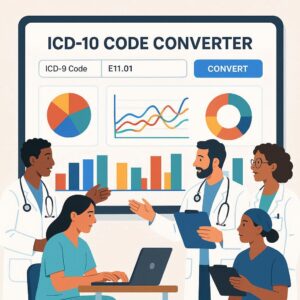
ICD-10 Code Converter
2. Understanding the Foundation: What is ICD-10?
Before we can understand the tool that converts to it, we must first grasp the nature of ICD-10 itself.
A Brief History: From ICD-1 to ICD-10
The history of classifying diseases dates back to the 17th century, but the modern iteration began with the International List of Causes of Death, adopted by the International Statistical Institute in 1893. This evolved into the ICD under the stewardship of the World Health Organization (WHO). The Sixth Revision (ICD-6) in 1948 marked the first inclusion of causes of morbidity (illness), expanding its use beyond mortality statistics. The United States adopted a clinical modification of the Eighth Revision (ICD-8-CM) in 1968 and then ICD-9-CM in 1979. For 36 years, ICD-9-CM was the standard, but its structure eventually became a straitjacket, unable to accommodate advances in medical knowledge and technology. The WHO released ICD-10 in 1990, and after a long delay involving legislative and logistical hurdles, the U.S. finally implemented its clinical modification, ICD-10-CM (for diagnosis) and ICD-10-PCS (for procedures, used only in inpatient hospital settings), in 2015.
The Structure of an ICD-10-CM Code: More Than Just Numbers and Letters
The most immediate difference between ICD-9 and ICD-10 is visual. ICD-9-CM codes are mostly numeric, with 3 to 5 digits (e.g., 486 for pneumonia). ICD-10-CM codes are alphanumeric and can contain up to 7 characters. This expanded structure is the key to its specificity.
An ICD-10-CM code follows this general pattern: XXX.XXXX
-
Characters 1-3: The Category. This part describes the general type of disease or injury. For example, S72 describes a fracture of the femur.
-
Character 4: The Etiology, Anatomic Site, Severity, or Other Detail. This adds a crucial layer of specificity. In our fracture example, S72.0 is a fracture of the neck of the femur.
-
Character 5-7: Extension, Laterality, and Other Specifics. These characters provide even more detail.
-
Laterality: The 6th character almost always indicates laterality. Is it the right arm (S42.301-) or the left arm (S42.302-)? ICD-9 often had ambiguous codes that did not specify side.
-
Episode of Care: The 7th character is an extension that describes the encounter (e.g., initial, subsequent, sequela). For a fracture, ‘A’ is for initial closed treatment, ‘D’ for subsequent encounter with routine healing, and ‘S’ for sequela (a condition resulting from the fracture).
-
Example:
-
ICD-9: 823.0 – Closed fracture of shaft of tibia
-
ICD-10: S82.201A – Unspecified fracture of shaft of right tibia, initial encounter for closed fracture
This structure allows for over 68,000 diagnosis codes in ICD-10-CM, compared to roughly 13,000 in ICD-9-CM.
The Significance of Specificity: Why ICD-10 Was a Necessary Evolution
The granularity of ICD-10 is not bureaucratic red tape; it has tangible benefits for the entire healthcare system:
-
Improved Patient Care: More precise data allows for better tracking of patient outcomes, disease patterns, and treatment effectiveness.
-
Enhanced Public Health Reporting: It enables more accurate monitoring of epidemics, bioterrorism events, and chronic disease burdens.
-
Greater Billing Accuracy: Specific codes reduce ambiguity, leading to more appropriate reimbursements and fewer claim denials due to “invalid” or “not sufficiently specific” codes.
-
Advanced Research: Researchers can analyze data with a level of detail previously impossible, leading to more targeted and effective clinical studies.
3. The Challenge of Transition: The Great Coding Shift of 2015
The transition to ICD-10 was one of the largest IT projects in the history of U.S. healthcare. The core of the challenge was the fundamental architectural difference between the two systems.
The Limitations of ICD-9: A System Pushed to its Limits
By 2015, ICD-9 was obsolete. Its numeric structure had run out of space, leading to illogical groupings of unrelated diseases. It lacked laterality, had no codes for new technologies, and its terminology was outdated. For instance, it had no way to distinguish between a stage 3 pressure ulcer and a stage 4 pressure ulcer on the buttock—a critical distinction for clinical care and reimbursement.
The Immense Gap: Why a Simple “Conversion” is Often Impossible
This is the most critical concept to grasp: There is no direct, one-to-one equivalent for a vast number of ICD-9 codes. The relationship between the two systems is not like converting meters to feet. It is more like translating a simple, archaic word into a modern language that has five different words for different shades of its meaning. The context—the clinical documentation—determines which modern word is correct.
The U.S. government acknowledged this by creating the General Equivalence Mappings (GEMs). The GEMs are the official “dictionaries” between ICD-9-CM and ICD-10-CM/PCS. They are not conversion tools per se, but rather exhaustive files that show all possible connections between codes. They illustrate the three types of mappings:
-
Forward Mapping (ICD-9 to ICD-10): Finds all potential ICD-10 codes that correspond to a given ICD-9 code.
-
Backward Mapping (ICD-10 to ICD-9): Finds all potential ICD-9 codes that correspond to a given ICD-10 code.
-
Approximate Mapping: Indicates when a precise match does not exist and the mapping is only an approximation.
The existence of “approximate” mappings and “one-to-many” relationships is what makes automated conversion so perilous.
4. Defining the ICD-10 Code Converter: Tool, Guide, or Crutch?
An ICD-10 code converter is a software application or online tool that uses a database of mappings (often based on or similar to the GEMs) to suggest one or more potential ICD-10 codes when an ICD-9 code is entered. Its primary purpose is to assist in the translation of historical data or to provide a starting point for coders who are more familiar with the older system.
How Do Converters Actually Work? The Mechanics Behind the Tool
At its core, a converter is a query engine. The user inputs an ICD-9 code. The tool searches its internal database (the mapping file) for that code. The database then returns the associated ICD-10 code(s) based on the rules of the mapping.
-
Simple Converters: These might only return the single “best” match according to their algorithm, which can be dangerously misleading.
-
Advanced Converters: These will return all possible ICD-10 mappings from the GEMs file. They will flag mappings as “approximate” and may provide notes or hints about the clinical documentation required to choose the correct code from the list.
For example, a sophisticated converter querying the ICD-9 code 496 (Chronic airway obstruction, not elsewhere classified) would not give a single ICD-10 code. It would provide a list of possibilities, including J44.9 (Chronic obstructive pulmonary disease, unspecified), J44.1 (Chronic obstructive pulmonary disease with acute exacerbation), and others, along with a note that the coder must review the patient record to make the correct selection.
5. A Taxonomy of Conversion Tools: From Simple Tables to AI-Powered Engines
Not all converters are created equal. They exist on a spectrum of complexity and integration.
Type 1: Basic Crosswalk Tables (GEMs)
These are the most fundamental form of a converter. They are static files, often in Excel or CSV format, that list ICD-9 codes in one column and their potential ICD-10 equivalents in adjacent columns. The CMS provides these for free download. They are powerful reference tools but offer no automation or guidance. Using them requires significant manual effort and expert knowledge to interpret the mappings correctly.
Type 2: Interactive Online Databases and Search Engines
These are the most commonly encountered “converters” by the public and many professionals. Websites from publishers, coding training companies, and health information sites offer search boxes where you can type in an ICD-9 code and get a list of results. They are more user-friendly than raw GEMs files and often include hyperlinks to code details. However, their quality varies widely. Some are excellent, while others may be outdated or oversimplified.
Type 3: Integrated EHR and Encoder Software
This is where conversion becomes a seamless part of the professional coder’s workflow. High-end encoder software (like 3M, Optum, or TruCode) and modern Electronic Health Record (EHR) systems have powerful mapping tools built directly into them. A coder can highlight an old ICD-9 code in a patient’s chart and instantly see a list of potential ICD-10 codes, complete with official coding guidelines, clinical definitions, and CDI tips. This is the gold standard for conversion within an active clinical setting, as it ties the process directly to the patient’s specific documentation.
Type 4: The Future: AI-Powered and NLP-Driven Converters
The next generation of tools is emerging, leveraging Artificial Intelligence (AI) and Natural Language Processing (NLP). Instead of just converting code-to-code, these systems can analyze the clinical documentation itself (the physician’s notes) and suggest the most appropriate ICD-10 code directly. They can learn from a coder’s corrections, improving their accuracy over time. While not purely “converters” in the traditional sense, they represent the ultimate evolution of the concept: moving from a static mapping to a dynamic, intelligent interpretation of clinical intent.
6. The Unavoidable Pitfalls and Critical Limitations of Code Converters
Relying blindly on a converter is one of the most significant risks in modern medical coding. Understanding its limitations is essential for compliance and accuracy.
The 1:Many Problem: One ICD-9 Code Maps to Multiple ICD-10 Codes
This is the most common and dangerous pitfall. Let’s use a concrete example.
ICD-9 Code: 599.0 – Urinary tract infection, site not specified
A basic converter might simply spit out one code. A better converter will show a list. But only a skilled coder with the patient’s chart can choose the correct one.
Potential ICD-10 Mappings (this is a partial list):
-
N39.0 – Urinary tract infection, site not specified (This seems like the direct match, but it’s often incorrect because it lacks specificity).
-
N10 – Acute pyelonephritis (Kidney infection – if the documentation supports it).
-
N30.00 – Acute cystitis without hematuria (Bladder infection – if the documentation supports it).
-
N34.1 – Nonspecific urethritis (Urethra infection).
The 1:Many Mapping Problem – UTI Example
| ICD-9 Code | ICD-9 Description | Potential ICD-10 Code | ICD-10 Description | Clinical Scenario Required |
|---|---|---|---|---|
| 599.0 | Urinary tract infection, site not specified | N39.0 | Urinary tract infection, site not specified | Documentation does not specify site (should be used sparingly). |
| 599.0 | Urinary tract infection, site not specified | N10 | Acute pyelonephritis | Documentation indicates flank pain, fever, CVA tenderness (kidney infection). |
| 599.0 | Urinary tract infection, site not specified | N30.00 | Acute cystitis without hematuria | Documentation indicates dysuria, frequency, suprapubic pain (bladder infection). |
| 599.0 | Urinary tract infection, site not specified | N34.1 | Nonspecific urethritis | Documentation points to urethral symptoms. |
As the table shows, using a converter that automatically selects N39.0 could be a major error, as it may not reflect the true clinical picture and could lead to an underpayment or denial if a more specific code is warranted.
The Concept of “Approximate” Mapping: The Danger of Clinical Inaccuracy
Some ICD-9 codes have no true equivalent in ICD-10. The GEMs flag these as “approximate.” For instance, certain ICD-9 codes for “history of” diseases might map to a Z-code (factors influencing health status) in ICD-10, but the clinical meaning is different. A converter might make this mapping, but it requires human validation to ensure it accurately represents the reason for the current encounter.
The Missing Link: Clinical Documentation is King
A converter has no access to the patient’s medical record. It cannot read the physician’s notes, lab results, or imaging reports. The converter only knows the code you give it. The single most important factor in accurate ICD-10 coding is the quality and detail of the clinical documentation. A converter is useless if the underlying documentation is poor.
The Risk of Automation Complacency
Over-reliance on any automated tool can lead to a degradation of skills. Coders must maintain their expertise in the official ICD-10 guidelines. Using a converter as a shortcut, rather than as a reference, can result in a coder failing to understand the logic and hierarchy of the new system, making them vulnerable to errors that an audit would easily catch.
7. Best Practices for Using an ICD-10 Converter Effectively and Safely
When used correctly, a converter is an invaluable asset. Here’s how to integrate it safely into your workflow.
Principle 1: The Converter as a Starting Point, Not an Endpoint
The best practice is to use the converter to generate a list of potential codes. Treat this list as a guide for what to look for in the medical record. The final code selection must always be based on the physician’s documentation.
Principle 2: Prioritize Clinical Documentation Improvement (CDI)
The most effective way to ensure accurate conversion and coding is to have excellent documentation from the start. A robust CDI program, where specialists work with physicians to ensure notes are specific and detailed, is more valuable than any software tool. Phrases like “type 2 diabetes mellitus with diabetic neuropathy” automatically lead to the correct, specific ICD-10 code, making conversion a non-issue.
Principle 3: Continuous Coder Education and Training
Coders must be perpetual students of ICD-10. Regular training on updates, guidelines, and specialty-specific coding scenarios is essential. This knowledge empowers them to use converters intelligently and to spot erroneous suggestions.
Principle 4: Regular Audits and Quality Checks
Internal and external audits of coded records are crucial. Audits can identify patterns of errors that may stem from a misunderstanding of how to use conversion tools. They provide feedback that leads to improved processes and individual coder development.
8. Case Studies: The Converter in Action
Let’s examine how these principles play out in real-world scenarios.
Case Study 1: Converting a “Simple” Code – 486 (Pneumonia)
-
ICD-9 Code: 486 – Pneumonia, organism unspecified
-
Converter Output: A good converter will suggest J18.9 – Pneumonia, unspecified organism.
-
The Coder’s Action: The coder’s job is not done. They must check the documentation. Does the record specify:
-
Lobar vs. Bronchopneumonia? (J18.1 vs. J18.0)
-
Is it aspiration pneumonia? (J69.0)
-
Is the patient hospitalized? (Could require a code for susceptibility to drug-resistant organisms, Z16.0)
-
-
Verdict: The converter gives a valid, billable code, but a skilled coder using detailed documentation will almost always find a more specific and appropriate code.
Case Study 2: The Orthopedic Challenge – 823.0 (Fracture of Tibia)
-
ICD-9 Code: 823.0 – Closed fracture of shaft of tibia
-
Converter Output: The converter will provide a long list of possibilities from the S82.2- category, requiring laterality and 7th character.
-
The Coder’s Action: The coder must find in the record:
-
Laterality: Is it the right or left tibia?
-
Specifics of the Fracture: Is it a Galeazzi fracture? A comminuted fracture? (This affects the 5th/6th characters).
-
Episode of Care: Is this the initial encounter? A follow-up? A visit for a complication? (This determines the 7th character).
-
-
Verdict: The converter provides the general category, but the coder, guided by precise documentation, selects the full 7-character code (e.g., S82.201A for an initial encounter of an unspecified fracture of the shaft of the right tibia).
Case Study 3: The Specificity of Encounters – V58.0 (Radiotherapy Encounter)
-
ICD-9 Code: V58.0 – Encounter for radiation therapy
-
Converter Output: The converter will likely suggest Z51.0 – Encounter for antineoplastic radiation therapy.
-
The Coder’s Action: The coder must ask: What is the reason for the radiotherapy? Is it for a malignant neoplasm? If so, the malignancy itself becomes the primary code, and Z51.0 is used as a secondary code to explain the encounter. Is the radiotherapy for a benign condition? Then a different code might be needed.
-
Verdict: This demonstrates how ICD-10 often changes the hierarchy of codes. The converter provides a component, but the coder must understand the complex sequencing rules to assemble the final diagnosis list correctly.
9. The Future Beyond Conversion: ICD-11 and the Next Paradigm Shift
The WHO released ICD-11 in 2019, and it is gradually being adopted by countries worldwide. The U.S. is likely still a decade away from implementation, but it’s on the horizon.
Introduction to ICD-11: A Fundamentally Digital Framework
ICD-11 is designed for the digital age. It features a sophisticated ontology-based structure, allowing for much richer data coding. It has over 55,000 codes and uses a completely different alphanumeric system. Instead of a hierarchical decimal system, it uses a stem-code extension model, allowing for unprecedented detail about etiology, severity, anatomy, and function.
Will ICD-11 Render ICD-10 Converters Obsolete?
Yes, and no. The specific tools that convert ICD-9 to ICD-10 will become less critical over time as historical data from the ICD-9 era becomes older. However, the concept of mapping and conversion will be more important than ever. The transition from ICD-10 to ICD-11 will be another monumental shift, requiring new GEMs and new conversion tools. The lessons learned from the ICD-10 transition—about the importance of documentation, the limitations of automation, and the need for coder education—will be directly applicable. The future will likely involve AI-powered tools that can map directly from clinical text to ICD-11 codes, potentially bypassing the need for manual code-to-code conversion altogether.
10. Conclusion: The Converter as a Compass in a Complex Landscape
The ICD-10 code converter is a powerful tool born from necessity, but it is not a magic wand. It serves as a compass, pointing coders in the right direction within the vast and complex terrain of modern medical classification. However, the compass cannot walk the path for you. The journey to accurate and compliant coding still requires the skilled navigation of a trained professional, guided by the fundamental star of detailed clinical documentation. Used wisely as a reference within a robust coding ecosystem, the converter enhances efficiency and supports accuracy. Used recklessly as an automated answer-generator, it becomes a liability that jeopardizes patient care, revenue integrity, and regulatory compliance. The true value of the tool is realized only when it is wielded by experts who understand both its capabilities and its profound limitations.
11. Frequently Asked Questions (FAQs)
Q1: Is there a free, reliable ICD-10 code converter I can use?
A: The CDC and CMS websites offer free access to the General Equivalence Mappings (GEMs), which are the most authoritative source. However, these are complex data files. For a more user-friendly free tool, many reputable medical coding websites and publishers offer searchable converters. Always verify the results against the official ICD-10-CM guidelines.
Q2: My converter gave me one code, but my billing software rejected it. Why?
A: This is a classic sign of an oversimplified converter. The single code it provided was likely either not specific enough (lacked the required 7th character, for example) or was not the most clinically accurate code for the encounter. The rejection is a prompt to consult the medical record and use a professional coder or more advanced software to find the correct code.
Q3: Can I use an ICD-10 converter for coding new patient encounters?
A: Absolutely not. Converters are designed for translating historical ICD-9 codes (e.g., from a patient’s past medical history or for data analysis). For a new encounter, the coder must code directly from the physician’s documentation into ICD-10, using the current year’s code set and official guidelines. Using a converter for new coding would be inefficient and introduce significant error.
Q4: What is the single biggest mistake people make with ICD-10 converters?
A: The biggest mistake is assuming the converter’s output is final and correct. This leads to blindly accepting a code without validating it against the patient’s clinical record. This “automation complacency” is the root cause of many coding errors and claim denials.
Q5: How long will we need ICD-10 converters?
A: They will remain relevant for as long as healthcare organizations need to access and analyze historical patient data that was coded in ICD-9. As the years pass and that data becomes less frequently accessed, their use will diminish. However, the underlying technology and concepts will be vital for the eventual transition to ICD-11.
12. Additional Resources
-
Centers for Disease Control and Prevention (CDC) – ICD-10-CM: https://www.cdc.gov/nchs/icd/icd10cm.htm (Provides official guidelines, code tables, and the GEMs files).
-
Centers for Medicare & Medicaid Services (CMS) – ICD-10: https://www.cms.gov/medicare/coding-billing/icd-10-codes (Offers resources for providers, including news and updates).
-
American Health Information Management Association (AHIMA): https://www.ahima.org/ (The premier professional organization for HIM professionals; offers extensive educational resources, journals, and toolkits on ICD-10).
-
American Academy of Professional Coders (AAPC): https://www.aapc.com/ (A leading organization for medical coders; provides certification, training, and coding resources, including articles and forums on ICD-10).
Disclaimer: *This article is for informational purposes only and is intended for healthcare professionals, medical coders, and health information management specialists. It does not constitute medical coding advice. The ultimate responsibility for accurate code selection and billing lies with the qualified coder or provider, who must consult the official ICD-10-CM/PCS guidelines and current code sets. The author and publisher are not liable for any errors, omissions, or damages resulting from the use of this information. Always refer to the most current, official resources from the Centers for Medicare & Medicaid Services (CMS) and the National Center for Health Statistics (NCHS).*
Date: September 24, 2025
Author: Aria Medical Informatics