In the intricate world of modern healthcare, a simple alphanumeric code can tell a profound story. It can encapsulate a patient’s ailment, guide a treatment pathway, justify a complex medical procedure, and contribute to the vast repository of data that drives medical research and public health policy. Nowhere is this more evident than in the management of complex hematological conditions, where subtle distinctions in diagnosis carry significant implications for prognosis and therapy. This article delves into one such specific code in the International Classification of Diseases, Tenth Revision, Clinical Modification (ICD-10-CM) system: D75.839, Thrombocytosis, Unspecified. While it may appear as a mere entry in a dense manual, this code sits at the crossroads of clinical medicine, laboratory science, and healthcare administration. Understanding its proper application is not just a matter of bureaucratic compliance; it is a fundamental component of providing high-quality, safe, and efficiently managed patient care. We will embark on a detailed exploration of thrombocytosis itself, unravel the structure and logic of the ICD-10-CM system, and master the nuanced application of D75.839, ensuring that this critical piece of the healthcare puzzle is placed correctly for the benefit of patients, providers, and the system as a whole.
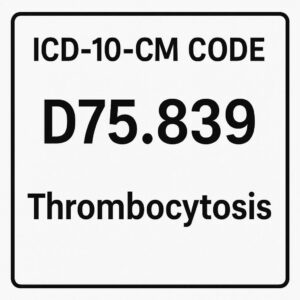
ICD-10 code D75.839 for thrombocytosis
2. Decoding Thrombocytosis: A Primer on Elevated Platelets
The Physiology of Platelets: Tiny but Mighty
Platelets, or thrombocytes, are small, anucleate cell fragments derived from megakaryocytes in the bone marrow. Far from being inert dust, they are dynamic elements circulating in the blood, with a primary function of maintaining hemostasis. When vascular injury occurs, platelets are the first responders, adhering to the site of damage, activating, and aggregating to form a preliminary plug that stops bleeding. This vital function is a delicate balancing act. An insufficient number of platelets (thrombocytopenia) can lead to dangerous bleeding, while an excess (thrombocytosis) can predispose an individual to abnormal and potentially life-threatening clot formation, or thrombosis.
Defining Thrombocytosis: When is a Count Too High?
Thrombocytosis is clinically defined as a platelet count elevated above the upper limit of normal for a specific laboratory’s reference range. This is typically considered to be a count exceeding 450,000 platelets per microliter (µL) of blood. It is crucial to understand that thrombocytosis is not a disease in itself but rather a laboratory finding—a sign of an underlying pathological process. The clinical significance of an elevated platelet count hinges entirely on identifying its root cause.
Clinical Manifestations: From Asymptomatic to Life-Threatening
Many patients with thrombocytosis are entirely asymptomatic, with the condition being discovered incidentally during routine blood tests. When symptoms do occur, they are primarily related to the pro-thrombotic state or, less commonly, to abnormal bleeding.
-
Thrombotic Complications: These can include arterial events like stroke, transient ischemic attack (TIA), myocardial infarction, and peripheral arterial thrombosis, as well as venous events such as deep vein thrombosis (DVT) and pulmonary embolism (PE).
-
Hemorrhagic Complications: Paradoxically, extremely high platelet counts (often over 1,000,000/µL) can lead to bleeding, typically mucocutaneous, due to acquired von Willebrand syndrome—where the high platelet count absorbs the large von Willebrand factor multimers necessary for effective clotting.
-
Other Symptoms: In primary thrombocytosis, patients may experience vasomotor symptoms like erythromelalgia (burning pain and redness in the hands and feet), headaches, dizziness, and visual disturbances.
3. The ICD-10-CM System: A Language for Modern Medicine
Purpose and Structure: Beyond Billing to Public Health
The ICD-10-CM is the official system for assigning codes to diagnoses and procedures in the United States. Its purposes are multifold:
-
Reimbursement: It forms the foundation for billing insurance companies and government payers like Medicare and Medicaid via systems like DRGs (Diagnosis-Related Groups).
-
Epidemiology and Research: It allows for the tracking of disease prevalence, outbreaks, and treatment outcomes on a population level.
-
Clinical Decision Support: Coded data can be used to assess quality of care and identify areas for improvement.
-
Administrative Planning: Health systems and governments use this data for resource allocation and public health planning.
The system is hierarchical and alphanumeric. Chapters are grouped by etiology or body system (e.g., Chapter 2: Neoplasms, Chapter 3: Diseases of the blood…). Codes are composed of 3-7 characters, providing increasing levels of specificity.
The Neoplasm Chapter (C00-D49): A Special Focus
Chapter 2 of ICD-10-CM, which encompasses codes C00-D49, is particularly relevant for hematological conditions. It is critical to distinguish between:
-
Malignant Neoplasms (C00-C96): For invasive, metastatic cancers.
-
In Situ Neoplasms (D00-D09): For non-invasive cancers.
-
Benign Neoplasms (D10-D36): For non-cancerous growths.
-
Neoplasms of Uncertain Behavior, Polycythemia Vera, and Myelodysplastic Syndromes (D37-D48): This section includes the codes for the primary myeloproliferative neoplasms, which are central to the discussion of thrombocytosis.
4. ICD-10-CM Code D75.839: Thrombocytosis, Unspecified – A Deep Dive
Code Definition and Placement
ICD-10-CM code D75.839 is categorized within Chapter 3: Diseases of the blood and blood-forming organs and certain disorders involving the immune mechanism (D50-D89), specifically under the block Other disorders of blood and blood-forming organs (D70-D77). Its parent code, D75, includes other specified and unspecified diseases of the blood and blood-forming organs. The full code D75.839 breaks down as:
-
D75: Other diseases of blood and blood-forming organs
-
.8: Other specified diseases of blood and blood-forming organs
-
.39: Thrombocytosis, unspecified
This placement is significant. It is not listed under the neoplasm chapter, indicating its use for conditions that are reactive or secondary in nature, rather than primary bone marrow disorders.
The Critical Importance of “Unspecified”
The term “unspecified” is the most crucial aspect of this code. In the precise language of ICD-10, “unspecified” is used when the medical record documentation does not provide enough information to assign a more specific code. It does not mean the condition is insignificant; rather, it signifies a lack of diagnostic clarity at the time of coding. This code is a placeholder used when the underlying etiology of the elevated platelet count has not been determined or is not documented by the treating provider.
Clinical Scenarios for Using D75.839
This code is appropriately used in situations such as:
-
An initial workup for an incidentally discovered high platelet count where the cause is still under investigation.
-
A hospital admission for an unrelated condition (e.g., pneumonia) where thrombocytosis is noted as a concurrent finding, but no definitive cause is established during that encounter.
-
When a provider’s note simply states “thrombocytosis” without any further qualification regarding its cause (e.g., “reactive,” “secondary,” or “primary”).
5. Navigating the Excludes1 Notes: The Art of Differential Coding
The ICD-10-CM manual uses “Excludes1” notes to indicate that the two codes listed should not be used together because they are mutually exclusive. The note under category D75 is paramount: “Excludes1: essential thrombocythemia (D47.4)”.
This note is the primary rule that governs the correct use of D75.839.
Essential Thrombocythemia (D47.4): The Primary Myeloproliferative Neoplasm
Essential Thrombocythemia (ET) is a chronic myeloproliferative neoplasm (MPN) characterized by the sustained overproduction of platelets by megakaryocytes in the bone marrow, independent of normal regulatory mechanisms. It is a clonal disorder, meaning it originates from a single abnormal hematopoietic stem cell. The diagnosis of ET is typically made after excluding reactive causes of thrombocytosis and is often confirmed by the presence of a specific genetic mutation, most commonly the JAK2 V617F mutation, but also mutations in CALR or MPL.
Crucial Distinction: If the patient has a confirmed diagnosis of ET, the correct code is D47.4. It is a coding error to use D75.839 for a patient with ET. The “Excludes1” note mandates this.
Other Underlying Causes and Their Codes
Thrombocytosis is far more commonly a reactive (secondary) process. The coder must be vigilant to identify documentation pointing to these causes and assign the corresponding code, not D75.839.
Common Causes of Thrombocytosis and Their Corresponding ICD-10-CM Codes
| Cause of Thrombocytosis | Description | Primary ICD-10-CM Code (NOT D75.839) |
|---|---|---|
| Essential Thrombocythemia | Primary myeloproliferative neoplasm. | D47.4 |
| Other Myeloproliferative Neoplasms | Polycythemia Vera (PV), Primary Myelofibrosis (PMF) can also present with thrombocytosis. | D45 (PV), D47.1 (PMF) |
| Chronic Myeloid Leukemia (CML) | A myeloproliferative neoplasm driven by the BCR-ABL1 fusion gene. | C92.1- |
| Infection / Inflammation | The body’s acute phase response to conditions like sepsis, tuberculosis, or rheumatoid arthritis. | Code the underlying infection (e.g., A41.9 Sepsis) or inflammatory condition (e.g., M06.9 Rheumatoid Arthritis). |
| Iron Deficiency Anemia | A common cause of reactive thrombocytosis. | D50.9 |
| Post-Splenectomy State | The spleen normally sequesters about one-third of platelets; its removal leads to a rise in platelet count. | D73.0 Asplenia (post-splenectomy) |
| Hemorrhage / Trauma | Significant blood loss or tissue damage can stimulate platelet production. | Code the acute bleeding (e.g., K62.5 Hemorrhage of rectum) or trauma. |
| Malignancy | Various cancers can produce cytokines that stimulate platelet production. | Code the primary malignancy (e.g., C18.9 Malignant neoplasm of colon). |
6. The Provider’s Role: Documentation is King
The accuracy of the entire coding process hinges on the quality of clinical documentation.
The Impact of Ambiguous Documentation
Vague terms like “thrombocytosis” alone force the coder to default to D75.839. This can have downstream effects:
-
Clinical Misrepresentation: The patient’s record does not accurately reflect their true health status.
-
Financial Impact: D75.839 may not carry the same reimbursement weight as a code for a specific chronic condition or malignancy.
-
Research Inaccuracy: Population health data becomes skewed if a significant number of ET patients are incorrectly coded as having unspecified thrombocytosis.
**Best Practices for Clinicians and Coders
For Clinicians:
-
Be specific. Use terms like “reactive thrombocytosis due to active rheumatoid arthritis,” “thrombocytosis, likely postsplenectomy,” or “suspected essential thrombocythemia, JAK2 testing pending.”
-
Clearly link the elevated platelet count to its cause in the assessment and plan.
For Coders:
-
Never assume a cause. If the documentation is unclear, you must query the provider for clarification.
-
Scour the entire medical record—lab reports, history and physical, consultation notes—for clues about the etiology.
-
Adhere strictly to the ICD-10-CM Official Guidelines for Coding and Reporting.
7. Case Studies: Applying D75.839 in Real-World Scenarios
Case Study 1: The Post-Splenectomy Patient
-
Scenario: A 55-year-old male is seen for a follow-up visit 3 months after a splenectomy due to traumatic rupture. A CBC reveals a platelet count of 650,000/µL. The provider’s note states: “Patient recovering well. Noted thrombocytosis, consistent with post-splenectomy state.”
-
Incorrect Coding: D75.839
-
Correct Coding: D73.0 (Asplenia, post-splenectomy). The documentation clearly links the thrombocytosis to the absent spleen. The thrombocytosis is a symptom of the asplenia, not a separate, unspecified condition.
Case Study 2: The Patient with Unexplained Thrombocytosis
-
Scenario: A 40-year-old female presents for a routine physical. She is asymptomatic. CBC shows a platelet count of 520,000/µL. The provider’s assessment is: “Asymptomatic thrombocytosis. Etiology unclear. Will order JAK2 mutation testing and iron studies to evaluate.”
-
Correct Coding: D75.839. At this encounter, the cause is truly unspecified. It is the most accurate code until the workup is complete. Once ET is confirmed, the code would change to D47.4.
Case Study 3: The Iron-Deficiency Anemia Connection
-
Scenario: An elderly patient with chronic gastrointestinal bleeding presents with fatigue. Labs show: Hgb 9.0 g/dL, ferritin low, platelet count 580,000/µL. The provider’s diagnosis is “Iron deficiency anemia with reactive thrombocytosis secondary to chronic GI blood loss.”
-
Incorrect Coding: D75.839
-
Correct Coding: D50.9 (Iron deficiency anemia, unspecified). The thrombocytosis is a documented reactive phenomenon to the anemia. The anemia is the codeable condition.
8. Thrombocytosis in Specific Patient Populations
Pediatric Considerations
Thrombocytosis in children is almost always reactive, most commonly to infection. Primary myeloproliferative disorders like ET are exceedingly rare in childhood. Coders should have a very high index of suspicion for a reactive cause (infection, iron deficiency) before considering D75.839 in a pediatric patient.
Geriatric Considerations
In older adults, the differential diagnosis broadens. While reactive causes remain common, the incidence of myeloproliferative neoplasms like ET and other occult malignancies increases. This makes a thorough diagnostic workup and precise documentation even more critical in this population.
9. Beyond D75.839: The Complete Coding Picture
The Role of Additional Codes
A patient’s encounter is rarely defined by a single code. For a patient with thrombocytosis, other codes may be necessary to paint a complete picture.
-
Code for the Underlying Cause: As shown in Table 1, this is the primary code when known.
-
Code for Complications: If the thrombocytosis has led to a clinical event, that event must also be coded (e.g., I63.9 for an acute ischemic stroke, I26.99 for a pulmonary embolism).
-
Code for Symptoms: If the patient presents with symptoms like headache (R51) or erythromelalgia (L94.5), these should be included.
Sequencing: Primary Diagnosis vs. Contributing Condition
The sequencing of codes (which is listed first) follows the ICD-10 guidelines. The reason for the encounter determines the principal (first-listed) diagnosis.
-
If the encounter is for managing the thrombocytosis itself, its code would be primary.
-
If the encounter is for a complication like a DVT, the DVT code (I82.409) would be primary, and the code for the cause of thrombocytosis (e.g., D47.4) would be listed as a secondary diagnosis.
-
If the thrombocytosis is an incidental finding during an encounter for another condition (e.g., diabetes), the code for the other condition is primary, and the thrombocytosis code is secondary.
10. The Ripple Effect: How Accurate Coding Impacts Healthcare
Reimbursement and Revenue Cycle
Accurate coding ensures appropriate reimbursement. Using an unspecified code like D75.839 when a more specific, higher-weighted code like D47.4 is justified can lead to significant financial underpayment for the healthcare facility. Conversely, incorrectly coding a reactive process as a neoplasm can be considered fraud.
Research, Epidemiology, and Public Health
Precise data is the lifeblood of medical research. If a large number of ET cases are miscoded as D75.839, it becomes impossible to accurately study the epidemiology, natural history, and treatment outcomes of ET. This impedes progress in understanding and managing the disease.
Quality Metrics and Performance Improvement
Health systems track quality metrics, such as rates of thrombosis in high-risk populations. Accurate coding allows for the correct identification of patient cohorts (e.g., all patients with ET) to monitor these outcomes and implement quality improvement initiatives, such as ensuring appropriate anticoagulation prophylaxis.
11. Conclusion: Synthesizing Clinical Insight with Coding Precision
The ICD-10-CM code D75.839 serves as a critical, though temporary, label for a clinically significant laboratory finding. Its accurate application requires a deep understanding of the pathophysiology of thrombocytosis and a rigorous approach to clinical documentation. By distinguishing reactive processes from primary myeloproliferative neoplasms and adhering to the strict hierarchy of the coding system, healthcare professionals ensure that this simple code accurately reflects a complex clinical story, thereby supporting optimal patient care, fair reimbursement, and the advancement of medical science.
12. Frequently Asked Questions (FAQs)
Q1: Can I use both D75.839 and D47.4 on the same claim?
A: No. The “Excludes1” note under D75 explicitly prohibits this. They are mutually exclusive. A patient has either essential thrombocythemia (D47.4) or an unspecified/reactive thrombocytosis (D75.839), not both.
Q2: What if the provider’s note says “thrombocythemia” without specifying “essential”?
A: The term “thrombocythemia” is often used interchangeably with “essential thrombocythemia” in clinical practice. However, for coding purposes, specificity is required. If the documentation is not clear, a query to the provider is necessary to confirm if they mean ET or are just using it as a synonym for a high platelet count.
Q3: A patient has a history of ET, but this encounter is for an unrelated sprained ankle. The platelet count is still high. What do I code?
A: The reason for the encounter is the sprained ankle (S93.41-). The history of ET (Z85.6) can be reported as a secondary code if it has a bearing on the current care. The active, current diagnosis of ET (D47.4) would typically be used if the encounter was for managing the ET itself. The Z85.6 code indicates a personal history of the disease, which is appropriate for a stable, chronic condition being managed elsewhere.
Q4: How long should I use D75.839 while a patient is undergoing a workup?
A: You should use D75.839 for each encounter where the etiology remains unspecified. Once a definitive diagnosis is made and documented in the record, you must switch to the corresponding specific code (e.g., D47.4, D50.9) for all subsequent encounters.
13. Additional Resources
-
CDC ICD-10-CM Official Guidelines: https://www.cdc.gov/nchs/icd/icd-10-cm.htm – The definitive source for coding rules and updates.
-
American Health Information Management Association (AHIMA): https://www.ahima.org/ – Provides resources, education, and best practices for clinical documentation integrity and coding.
-
National Cancer Institute: Myeloproliferative Neoplasms Treatment: https://www.cancer.gov/types/myeloproliferative – Authoritative clinical information on diseases like Essential Thrombocythemia.
-
The Leukemia & Lymphoma Society: https://www.lls.org/ – Provides patient education and support resources for blood cancers and disorders.