Receiving news about a medical test result can sometimes feel like reading a map in a foreign language. If you have recently taken a Cologuard test and received a positive result, you might be diving into the world of medical billing and coding to understand what happens next.
Specifically, you might be searching for the “ICD 10 code for positive Cologuard test.” This is a common search, but it comes with a significant nuance that is important to understand right from the start: there is no specific ICD-10 code that means “positive Cologuard.”
Instead, healthcare providers use a combination of codes to describe the situation accurately. This guide will walk you through everything you need to know about these codes, what a positive result means, and the essential steps you should take next.
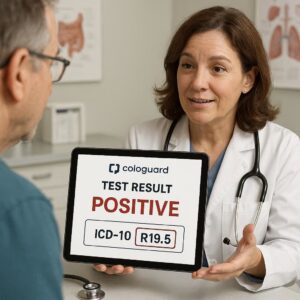
ICD-10 Code for a Positive Cologuard Test
What is an ICD-10 Code?
Before we dive into the specifics, let’s briefly cover what an ICD-10 code actually is.
ICD-10 stands for the International Classification of Diseases, 10th Revision. It is a system of alphanumeric codes used by healthcare providers and insurers worldwide to classify and code all diagnoses, symptoms, and procedures.
Think of it as a universal language for health conditions. When you visit a doctor, they assign these codes to your visit for several key reasons:
-
Billing and Insurance: Insurance companies use these codes to determine what services are covered and how much to reimburse the healthcare provider.
-
Medical Records: They provide a standardized way to document your health history.
-
Data and Research: Public health officials use this data to track diseases and health trends.
So, when you are looking for a code related to a test result, you are essentially looking for the official “language” used to describe your current health status to your insurance company and in your permanent medical record.
The Truth About the “ICD 10 Code for Positive Cologuard Test”
Here is the most important fact to understand: Cologuard, like other stool-based tests, is a screening test, not a diagnostic test.
A positive result means that the test detected DNA markers or blood in your stool that could be associated with colon cancer or precancerous polyps. However, it is not a definitive diagnosis of cancer. Because it is not a diagnosis, you cannot be assigned a code that says, “You have colon cancer.”
Instead, the positive result is classified as an abnormal finding from a screening program. Therefore, the primary ICD-10 code used in this situation is:
The Primary Code: R19.5 – Other Fecal Abnormalities
The most accurate and commonly used ICD-10 code for a positive Cologuard test is R19.5: Other fecal abnormalities.
This code falls under the category of “Symptoms, signs, and abnormal clinical and laboratory findings, not elsewhere classified.” It is the catch-all code for abnormal findings in stool content, including:
-
Occult blood in feces (hidden blood, which Cologuard tests for)
-
Abnormal stool color or consistency related to a finding
This code accurately reflects the situation: a screening test has produced an abnormal result that requires further investigation.
The “Z” Code: Z12.11 – Encounter for Screening for Colon Cancer
Often, you will see R19.5 used in conjunction with another important code: Z12.11.
-
Z12.11 specifically means “Encounter for screening for malignant neoplasm of colon.”
This code explains why the Cologuard test was performed in the first place. It was a routine screening for colon cancer, typically for an average-risk individual without any symptoms.
How they work together:
When you visit your doctor to discuss your positive Cologuard result, they might document the encounter using both codes:
-
Z12.11 to indicate the original purpose of the test (screening).
-
R19.5 to indicate the current, specific finding (an abnormal fecal test result).
This combination provides a complete and accurate picture for your medical records and insurance.
The Codes You Won’t See (Yet)
It is equally important to know which codes are not used for a positive Cologuard result.
-
C18-C20 (Malignant neoplasms of colon, rectosigmoid junction, and rectum): These codes are for a confirmed diagnosis of cancer, usually after a biopsy. Using them after a positive Cologuard would be incorrect and alarmist.
-
D01.0 (Carcinoma in situ of colon): This is for a very early-stage cancer that has not spread, again confirmed by a tissue sample (biopsy).
-
K63.5 (Polyp of colon): While polyps are a common cause of a positive Cologuard, this code is for a confirmed diagnosis of a polyp, typically after a colonoscopy. It is not used based on the stool test alone.
Using a diagnostic code prematurely can lead to serious issues with insurance coverage and can create errors in your permanent health record.
Why the Distinction Between Screening and Diagnostic Matters
Understanding the difference between a screening code (Z12.11) and a diagnostic code (like those for cancer) is crucial, primarily for your wallet.
Under the Affordable Care Act (ACA), most private health insurance plans are required to cover preventive care services, including colorectal cancer screening tests like Cologuard, at no out-of-pocket cost to you (no copay, no deductible). This is why the test was free or low-cost for many people.
However, if a screening test is positive, the rules change. The follow-up procedure, almost always a colonoscopy, is no longer considered a “screening.” It becomes a diagnostic procedure. The purpose is no longer to look for a problem in a healthy person; it is to investigate a known abnormal finding.
-
A screening colonoscopy (for an average-risk, asymptomatic person) is typically covered at 100%.
-
A diagnostic colonoscopy (to follow up on a positive stool test) is usually subject to your plan’s standard deductible and coinsurance. This means you may be responsible for a portion of the cost.
This is a critical point to discuss with your doctor’s office and your insurance company before scheduling your follow-up colonoscopy. Ask them to verify your benefits for a “diagnostic colonoscopy following a positive non-colonoscopy screening test.”
The Importance of Follow-Up
The primary purpose of a screening test like Cologuard is not to diagnose, but to triage. It separates people who are likely fine from those who need a closer look. A positive result is not a cancer diagnosis, but it is a clear signal that a follow-up colonoscopy is medically necessary.
| Cologuard Result | What It Means | Recommended Next Step | ICD-10 Code Used |
|---|---|---|---|
| Negative | No DNA markers or blood were detected. High confidence that no significant findings are present. | Continue routine screening as recommended by your doctor (usually in 1-3 years for Cologuard, or 10 years for colonoscopy). | Z12.11 (Encounter for screening) |
| Positive | DNA markers and/or blood were detected. It does not mean you have cancer. It means something was found that requires further investigation. | Colonoscopy is required. This is the only way to confirm the cause of the positive result and, if necessary, remove any polyps. | R19.5 (Other fecal abnormalities) & Z12.11 (Encounter for screening) |
Delaying or skipping the follow-up colonoscopy after a positive Cologuard test defeats the entire purpose of screening. It leaves a potential health issue uninvestigated. Studies have shown that completing the follow-up colonoscopy after a positive stool-based test is crucial for realizing the life-saving benefits of colorectal cancer screening.
What Happens During the Follow-Up Colonoscopy?
If you have a positive Cologuard test, your doctor will recommend a colonoscopy. Knowing what to expect can ease some of the anxiety you might be feeling.
-
Preparation (The “Prep”): This is often the part people worry about most. You will need to clean out your colon completely so the doctor can see the lining clearly. This involves following a clear liquid diet for a day and taking a strong laxative solution. Your doctor will provide specific instructions.
-
The Procedure: You will be given sedation to make you comfortable and sleepy. The doctor will insert a long, flexible tube with a tiny camera into your rectum and guide it through your entire colon. They are looking for polyps or other abnormal tissue.
-
If Polyps Are Found: If the doctor sees a polyp, they will typically remove it during the procedure. This is quick and painless because of the sedation. The polyp is then sent to a lab for a biopsy to determine if it is benign, precancerous, or cancerous.
-
Recovery: You will wake up in a recovery area and will need someone to drive you home because of the sedation. Most people feel fine by the next day.
-
Results: Your doctor will discuss the findings of the colonoscopy with you, usually right after the procedure for the visual findings, and later for the biopsy results.
Quotation from a Specialist
To provide a clear medical perspective, we spoke with Dr. Emily Carter, a gastroenterologist.
“Patients often feel a wave of panic when they see a ‘positive’ result on their Cologuard report. My first message to them is always to take a deep breath. This result is not a diagnosis of cancer. It is a highly effective alarm system telling us we need to look more closely.
The next step is a colonoscopy, which is the gold standard for a reason. It allows us to not only find the source of the abnormal finding but also to treat it immediately by removing polyps. Using the correct ICD-10 code, like R19.5 for the abnormal finding, ensures that the medical record is accurate and that we can proceed with the appropriate, life-saving follow-up care.”
Frequently Asked Questions (FAQ)
Here are some common questions people have about ICD-10 codes and positive Cologuard results.
Q: Can I use the ICD-10 code for a positive Cologuard test on my own insurance claim?
A: No. Patients should never assign their own medical codes. Medical coding is a complex professional field. If you need to submit a claim to your insurance, your healthcare provider’s billing department will assign the correct codes based on their professional evaluation and your medical records.
Q: My doctor’s office said they used code R19.5. Will my insurance think I have a chronic bowel problem?
A: No, R19.5 is a very specific code for an “abnormal finding on lab test.” It is commonly used for situations exactly like this—a one-time abnormal result that requires follow-up. It is not a chronic condition code. Insurance companies understand that this code is routinely used for positive stool-based screening tests.
Q: What if I had symptoms (like blood in my stool or unexplained weight loss) before taking Cologuard?
A: This is an important distinction. Cologuard is approved for average-risk, asymptomatic individuals. If you were having symptoms, you should not have taken Cologuard. In this case, a colonoscopy is the appropriate first step. Your doctor would use a code related to your symptoms (e.g., K92.1 for melena or R64 for cachexia) rather than the screening code Z12.11.
Q: I received my Explanation of Benefits (EOB) from my insurance and it shows the colonoscopy was not fully covered. Is this a mistake?
A: Possibly, but it might not be. As explained earlier, once a screening test is positive, the follow-up colonoscopy becomes a diagnostic procedure. Check your EOB carefully. It will likely show the procedure as diagnostic, which falls under your regular deductible and coinsurance. If you believe it was coded incorrectly as a screening colonoscopy for an asymptomatic person, you can contact your provider’s billing office to review the codes used.
Q: Is R19.5 the only code used for a positive Cologuard?
A: While R19.5 is the most common and specific code for the abnormal lab finding itself, you might see R19.5 as the primary diagnosis, with Z12.11 listed as a secondary diagnosis to provide context for the visit. In some cases, if the doctor is documenting a visit specifically to discuss the result, they may use a code for a “general adult medical examination” with the abnormal finding code. Always trust your healthcare provider to select the most appropriate combination.
Additional Resource
For official and up-to-date information on colorectal cancer screening, guidelines, and statistics, the Centers for Disease Control and Prevention (CDC) is an excellent resource.
[Visit the CDC’s Colorectal Cancer Awareness Page] (https://www.cdc.gov/cancer/colorectal/)
Conclusion
Finding the right code for a positive Cologuard test can be confusing. Remember, the primary ICD-10 code used is R19.5 (Other fecal abnormalities) , often alongside the screening code Z12.11. This combination accurately reflects an abnormal screening result that requires a follow-up colonoscopy. Understanding this distinction helps you navigate the next steps, from insurance discussions to the medical procedure itself, with clarity and confidence.
Disclaimer: This article is for informational purposes only and does not constitute medical advice. Always consult with a qualified healthcare professional for any health concerns or before making any decisions related to your health or treatment. The information regarding coding and insurance coverage is general and subject to change; you should verify details with your insurance provider and healthcare provider’s billing department.