So, you’ve just received your fecal immunochemical test (FIT) results, and the news is back: it’s positive. It’s a word that naturally makes anyone pause. Your next step is likely a call with your healthcare provider, and soon after, you might find yourself looking at a stack of paperwork, an explanation of benefits from your insurance, or a summary in your patient portal. In the middle of all that medical jargon, you might see a strange alphanumeric code: something like R19.5.
That, in a nutshell, is the ICD-10 code for a positive FIT test, but as with most things in healthcare, the full story is a bit more nuanced.
Navigating the world of medical codes can feel like trying to read a foreign language. But understanding these codes—specifically the ICD-10 codes related to a positive FIT—can empower you. It helps you understand your medical records, ensures your insurance claims are processed correctly, and clarifies the next steps in your healthcare journey.
This guide is designed to be your friendly, reliable roadmap. We’ll walk through exactly what an ICD-10 code is, which one applies to your positive FIT result, and, most importantly, what happens next. We’ll cut through the complex terminology and give you the clear, honest information you need.
Let’s get started.
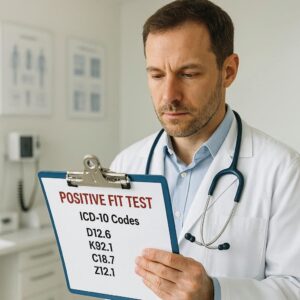
ICD-10 Code for a Positive FIT Test
What is an ICD-10 Code, Anyway?
Before we dive into the specific code for a positive FIT, it helps to understand what these codes are and why they exist. Think of them as the common language of the healthcare world.
The Language of Healthcare: A Quick Overview
ICD-10 stands for the International Classification of Diseases, 10th Revision. It’s a system of alphanumeric codes assigned by the World Health Organization (WHO) to every possible symptom, complaint, condition, disease, or injury a person could have.
When you visit a doctor, they don’t just write “stomachache” in your chart. They translate that complaint into a standardized code that can be understood by every other doctor, every hospital, and every insurance company in the country (and much of the world).
Why Your Diagnosis Code Matters (Beyond the Paperwork)
These codes are far more than just bureaucratic checkboxes. They serve several critical functions:
-
For Your Medical Record: They provide a precise history of your health. Ten years from now, a doctor can look at your chart and instantly know the specific reason for a past visit, ensuring continuity of care.
-
For Insurance and Billing: This is the big one. Insurance companies use ICD-10 codes to determine if a service (like a test or a procedure) was medically necessary. They won’t pay for a colonoscopy if the reason given (the ICD-10 code) is “annual checkup,” but they will if the code is for a “positive screening test.” The code is the key that unlocks coverage.
-
For Public Health: Aggregated, anonymous data from millions of these codes helps researchers track disease outbreaks, understand public health trends, and allocate funding for research.
So, when we talk about the ICD-10 code for a positive FIT test, we are talking about the specific “reason” that is attached to that result and the subsequent care you will need.
The Main Event: The ICD-10 Code for a Positive FIT Test
If you search for the answer to “What is the ICD-10 code for a positive FIT test?” you will almost always land on the same result: R19.5.
Let’s unpack what that code actually means.
R19.5: Other Fecal Abnormalities
The full description for code R19.5 is “Other fecal abnormalities.” Within this category, the specific finding is often further described as “occult blood in feces,” which is the medical term for hidden blood in the stool that isn’t visible to the naked eye.
This is the most accurate and commonly used code to report the finding of a positive FIT test. It’s a symptom code, not a disease code. This is a crucial distinction. R19.5 is saying, “This patient has a symptom—blood in their stool detected by a lab test.” It is not saying, “This patient has colon cancer.” It is simply documenting the objective result of the laboratory analysis.
Why the Result Itself is a “Symptom,” Not a Diagnosis
This is arguably the most important concept to understand in this entire article.
Think of it like this: if you go to the doctor with a persistent cough, the doctor doesn’t immediately diagnose you with pneumonia. They note the symptom (cough) and then order further tests—like a chest X-ray—to find the cause of the cough.
A positive FIT test is the same. It’s a symptom. It tells us there is bleeding somewhere in the digestive tract. The FIT itself cannot tell us why there is bleeding or where it is coming from.
Possible causes of a positive FIT (occult blood) include:
-
Benign (Non-cancerous) causes:
-
Hemorrhoids
-
Anal fissures (small tears)
-
Diverticulosis (small pouches in the colon wall)
-
Peptic ulcers
-
Gastritis
-
Certain foods or medications (though modern FIT tests are less sensitive to dietary factors than older tests, it’s still a consideration)
-
-
Pre-cancerous or Cancerous causes:
-
Colorectal polyps (some types can become cancerous over time)
-
Colorectal cancer
-
Because the cause could be something minor or something serious, the medical coding reflects the objective finding (R19.5), which then necessitates further investigation to determine the root cause.
Not So Fast: Other Important Codes in the Process
While R19.5 is the code for the positive result itself, it rarely exists in a vacuum. To get a complete picture of your medical situation, it’s helpful to understand the codes that come before and after the positive result.
Screening vs. Diagnostic: The Critical Difference (Z12.11 vs. K63.5)
Understanding the difference between a screening test and a diagnostic procedure is vital for understanding your medical records and insurance coverage.
| Type of Encounter | Purpose | Typical ICD-10 Code | Example |
|---|---|---|---|
| Screening | To detect a potential problem in someone without any symptoms. It’s proactive medicine. | Z12.11 (Encounter for screening for malignant neoplasm of colon) | A routine, at-home FIT kit mailed to you as part of a public health initiative. You feel fine and have no reason to suspect a problem. |
| Diagnostic | To investigate a specific problem or symptom to find the cause. | K63.5 (Polyp of colon) or C18.9 (Colon cancer) or other codes related to the final finding. | The colonoscopy you have after the positive FIT. The doctor is looking for the reason behind the bleeding. |
A doctor will almost always use Z12.11 when ordering your initial screening FIT. But once the result comes back positive (R19.5), the subsequent colonoscopy is considered a diagnostic procedure. Its code will depend on what the doctor finds and removes during the procedure (e.g., a polyp or something else).
Codes for the Follow-Up: What Happens Next?
The story doesn’t end with R19.5. The definitive diagnosis comes from the follow-up colonoscopy. Here are some of the ICD-10 codes you might see on the report from that procedure:
-
D12.6: Benign neoplasm of colon, unspecified. This might be used if a non-cancerous polyp is found and removed.
-
K63.5: Polyp of colon. A very common code for any type of colonic polyp.
-
C18.0 – C18.9: Malignant neoplasm of colon. These codes are used if cancer is found. The number after the decimal specifies the exact location within the colon (e.g., C18.4 for cancer of the transverse colon).
-
Z86.010: Personal history of colonic polyps. Once a polyp has been removed, this code might be used in future visits to indicate you have a history of polyps and may need more frequent screenings.
As you can see, R19.5 is just one piece of a larger diagnostic puzzle.
Real-World Scenarios: How the Code is Used
Sometimes, seeing how things work in practice makes it all click. Let’s walk through a couple of common scenarios.
Scenario A: The Routine Screening That Finds Something
-
The Appointment: You have a routine check-up with your primary care doctor. You are 55 and have no digestive complaints.
-
The Order: Your doctor gives you a FIT kit to take home. On the order form, she lists the reason for the test: Z12.11 (Encounter for screening for malignant neoplasm of colon) .
-
The Result: You complete the test and mail it in. A week later, your doctor’s office calls. The lab reported the result as positive for occult blood.
-
The Coding of the Result: The lab result itself is filed in your chart with the code R19.5 (Other fecal abnormalities) .
-
The Follow-Up: Your doctor schedules you for a colonoscopy. Because you now have a documented symptom (positive FIT, coded as R19.5), this colonoscopy is diagnostic.
-
The Outcome: During the colonoscopy, the gastroenterologist finds and removes two benign polyps.
-
The Final Code: The report from the colonoscopy will list the final diagnosis as D12.6 (Benign neoplasm of colon) or K63.5 (Polyp of colon) .
Scenario B: A Positive FIT in a Symptomatic Patient
-
The Appointment: You go to your doctor because you’ve been having some rectal bleeding and abdominal pain for a few weeks.
-
The Exam: Because you have symptoms, the doctor might perform an in-office FIT or order a colonoscopy directly.
-
The Coding: In this case, the initial visit code would be for your symptoms, like K62.5 (Hemorrhage of anus and rectum) or R10.9 (Unspecified abdominal pain) . A screening code like Z12.11 would not be appropriate because you are not asymptomatic.
In this scenario, the FIT is part of a diagnostic workup from the very beginning, not a screening triggered by a positive result.
Common Pitfalls and Honest Mistakes to Avoid
Medical coding is complex, and even professionals can make errors. Being aware of common pitfalls can help you ask informed questions if something on your paperwork doesn’t look right.
1. Using R19.5 as the Final Diagnosis
This is the biggest and most common mistake. R19.5 is a signpost, not a destination. It points toward a potential issue but doesn’t define it. Using it as a final diagnosis is like saying the cause of a “check engine” light is the light itself. The light is just a symptom; the real diagnosis is whatever is wrong with the engine. A positive FIT requires a colonoscopy to get to the actual diagnosis.
2. Confusing Screening and Diagnostic Codes
Using a screening code (Z12.11) for a diagnostic colonoscopy is a frequent error. This can lead to insurance claims being denied. Insurance companies have different coverage policies for screening versus diagnostic procedures. If a code suggests a routine screening when the record clearly shows a follow-up for a positive result, the claim may be rejected or you may be billed for costs you thought were covered. This is why the trail from Z12.11 (screening order) to R19.5 (positive result) is so important—it establishes medical necessity for the diagnostic colonoscopy.
3. Lack of Specificity in the Medical Record
Sometimes, the doctor’s notes are a little too vague. For example, a final diagnosis of “colon abnormality” isn’t very helpful. A good medical record will be specific: “Tubular adenoma (polyp) found in ascending colon, removed in entirety.” This level of detail allows for a much more precise code, which leads to better tracking of your health history and more accurate data for research.
Beyond the Code: Your Health Journey After a Positive FIT
We’ve spent a lot of time talking about codes, but let’s bring it back to what really matters: you and your health. Seeing a positive result on a medical test can be anxiety-inducing. We want to offer you some clear, reassuring guidance.
What Your Doctor Will Do Next (And Why It’s Crucial)
The standard of care after a positive FIT test is a follow-up colonoscopy. This is not an overreaction; it’s a necessary and potentially life-saving step.
The colonoscopy serves two main purposes:
-
To Diagnose: It allows the doctor to visually examine the entire length of your colon and identify the exact source of the bleeding.
-
To Treat: If a polyp is found, it can often be removed right then and there during the procedure, before it has a chance to turn into cancer. If something else is found, a biopsy can be taken.
Think of the FIT as an excellent, non-invasive screening tool. The colonoscopy is the definitive diagnostic and therapeutic procedure.
A Note on False Positives
It is also important to know that false positives can happen. A false positive means the test indicates there is blood when there isn’t a significant problem. This can be caused by:
-
Certain medications like aspirin, ibuprofen, or blood thinners.
-
Bleeding gums from brushing your teeth (if you swallow the blood).
-
In rare cases, menstrual blood.
-
Non-cancerous conditions like hemorrhoids.
However, because a colonoscopy is the only way to know for sure, it is never safe to assume a positive result is “just a false positive.” You must follow up with your doctor to be certain.
Frequently Asked Questions (FAQ)
Here are answers to some of the most common questions we hear about positive FIT tests and the associated codes.
Q: Is R19.5 the only code for a positive FIT?
A: For the laboratory finding itself, yes, R19.5 (Other fecal abnormalities) is the standard and most accurate code. However, it will be used in conjunction with other codes that explain why the test was done (like Z12.11) and what was found on follow-up (like K63.5 or D12.6).
Q: Will my insurance cover the colonoscopy after a positive FIT?
A: In almost all cases, yes. Because the positive FIT (coded as R19.5) establishes a medical necessity, the follow-up colonoscopy is considered a diagnostic procedure. The Affordable Care Act requires most private insurance plans to cover colorectal cancer screening, and this includes the diagnostic colonoscopy that follows a positive non-colonoscopy screening test. However, it’s always a good idea to check with your specific insurance provider to understand your plan’s benefits and any potential out-of-pocket costs.
Q: Does the ICD-10 code change if the FIT is done in the doctor’s office vs. at home?
A: The ICD-10 code for the result (R19.5) does not change based on where the test is performed. It describes the finding, not the location of the test. The code for the encounter (e.g., the doctor visit) might differ, but that’s a different type of code (CPT code), which is outside the scope of this guide.
Q: Can I use R19.5 for a visible blood in my stool?
A: Technically, R19.5 includes “occult” (hidden) blood. For visible blood, a more specific code like K62.5 (Hemorrhage of anus and rectum) is often more accurate. Your doctor will choose the code that best matches your specific symptoms and findings.
Q: My FIT was positive, but my colonoscopy was clear. What code will be on that report?
A: If the colonoscopy finds absolutely no abnormalities, the code might be Z01.89 (Encounter for other specified special examinations) or the doctor may still use the symptom code R19.5, noting that no source of bleeding was found. It essentially confirms the positive FIT was likely a false positive or from a source outside the colon.
Additional Resources
For more reliable information on colorectal cancer screening, we highly recommend visiting these trusted sources:
-
American Cancer Society: [Link to American Cancer Society colorectal cancer section]
-
Centers for Disease Control and Prevention (CDC): [Link to CDC colorectal cancer screening page]
-
American College of Gastroenterology: [Link to ACG patient resources]
Conclusion
Understanding the ICD-10 code for a positive FIT test—R19.5—is more than just a trivia fact. It empowers you to be an active participant in your healthcare. It helps you understand that a positive result is a symptom, a crucial piece of information that guides the next, essential step: a follow-up colonoscopy. Remember, this code is the bridge between a routine screening and a definitive diagnosis, ensuring you get the care you need and that your journey is accurately documented every step of the way.
Disclaimer:
The information provided in this article is for informational purposes only and is not a substitute for professional medical advice, diagnosis, or treatment. Always seek the advice of your physician or other qualified health provider with any questions you may have regarding a medical condition or coding practices. While we strive for accuracy, coding guidelines and insurance policies can change.