If you have been dealing with a stiff, painful shoulder that seems to be getting tighter by the day, you might have heard your doctor mention the term “adhesive capsulitis.” More commonly, we know it as “frozen shoulder.” Whether you are a patient trying to decipher your medical summary, a student, or a healthcare professional brushing up on coding, finding the exact medical code can feel like a puzzle.
Today, we are taking a deep dive into one specific, very common query: the ICD 10 code for adhesive capsulitis right shoulder.
We will break down what this code means, why it is used, how it differs from other shoulder issues, and what it means for treatment and insurance. Let’s demystify the jargon and get you the clear answers you need.
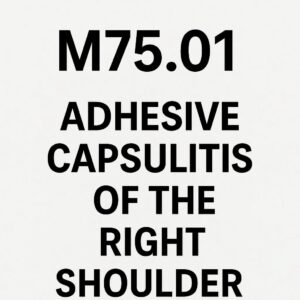
ICD 10 Code for Adhesive Capsulitis of the Right Shoulder
What is Adhesive Capsulitis? Understanding the Condition
Before we jump into the numbers and letters of the code, it is important to understand the “what” and “why” behind the diagnosis. Adhesive capsulitis sounds intense, but it describes a fairly straightforward (though painful) process.
Inside your shoulder joint, you have a capsule of connective tissue that surrounds the ball-and-socket mechanism. In adhesive capsulitis, this capsule thickens and tightens around the shoulder joint, restricting its movement. Think of it like the skin shrinking and tightening around a healing wound, but inside your joint.
The Three Stages of Frozen Shoulder
Understanding the stage is often key to treatment, and it adds context to the diagnosis code. Adhesive capsulitis typically progresses through three phases:
-
The Freezing Stage: Every movement causes pain, and the shoulder’s range of motion starts to become limited. This can last from 6 weeks to 9 months.
-
The Frozen Stage: Pain may actually diminish during this stage, but the shoulder becomes stiffer. Using the shoulder becomes more difficult. This can last 4 to 6 months.
-
The Thawing Stage: Range of motion slowly begins to improve. Complete recovery from onset to thawing can take anywhere from 6 months to 2 years.
The Specifics: ICD 10 Code for Adhesive Capsulitis Right Shoulder
In the world of medical billing and health records, precision is everything. You cannot just code for “shoulder pain.” You need to specify the condition and the side of the body.
The official ICD-10-CM (International Classification of Diseases, 10th Revision, Clinical Modification) code for this condition is:
M75.01
Let’s break that down:
-
M75: This category covers shoulder lesions.
-
M75.0: This specifically refers to adhesive capsulitis of the shoulder.
-
M75.01: The final digit specifies the right shoulder.
Important Note: If you are coding for the left shoulder, the code would be M75.02. If the condition is present in both shoulders (bilateral), you would bill M75.00 (Adhesive capsulitis of unspecified shoulder), but best practice is to code both sides separately as M75.01 and M75.02 if possible.
A Quick Reference Table for Codes
To make it easy to see the differences at a glance, here is a simple breakdown of the codes related to adhesive capsulitis:
| Condition Description | Specificity | ICD-10 Code |
|---|---|---|
| Adhesive Capsulitis, Right Shoulder | Specific Side | M75.01 |
| Adhesive Capsulitis, Left Shoulder | Specific Side | M75.02 |
| Adhesive Capsulitis, Unspecified Shoulder | Side not specified | M75.00 |
| Adhesive Capsulitis, Bilateral | Both Shoulders | M75.00 (or code both sides) |
Using the correct laterality code is not just bureaucratic paperwork; it is essential for tracking treatment progress and ensuring insurance claims are processed without delay.
Why Laterality Matters: Right vs. Left vs. Unspecified
You might wonder why it matters so much which shoulder is affected. In the world of digital health records, laterality (the side of the body) is a core data point.
-
For the Patient: It ensures your medical record accurately reflects your history. If you had surgery on your right shoulder five years ago, but a new doctor sees a code for the left shoulder in your file, it could cause confusion.
-
For Treatment: Physical therapists design specific exercise regimens based on the affected side. Knowing it is the right shoulder helps them understand the impact on your daily life (like shaking hands or writing).
-
For Insurance: Payers often look for consistency. If a surgeon bills for a procedure on the right shoulder, but the diagnosis code is for the left, the claim will likely be rejected.
A Word on “Unspecified”
You will notice the code M75.00 is for an “unspecified” shoulder. While it exists, coders and clinicians are encouraged to avoid it. Using M75.00 is only acceptable if the medical documentation truly does not indicate which shoulder is affected. In almost all modern practices, specifying the side is the standard of care.
Differentiating from Other Shoulder Conditions
One of the most common reasons for coding errors is confusing adhesive capsulitis with other shoulder problems. They might feel similar to a patient, but they are distinct conditions requiring different codes.
Here is how M75.01 differs from other common shoulder issues:
-
vs. Rotator Cuff Syndrome (M75.1-): Rotator cuff issues involve tears or inflammation of the tendons and muscles. While frozen shoulder involves the entire capsule tightening. Pain and weakness are usually more localized with rotator cuff injuries.
-
vs. Bicipital Tendinitis (M75.2-): This is inflammation of the biceps tendon in the shoulder groove. Pain is often felt in the front of the shoulder and can radiate down the arm.
-
vs. Shoulder Impingement Syndrome (M75.4-): This occurs when the tendons of the rotator cuff get pinched during movement. It is a mechanical issue, whereas adhesive capsulitis is a tightening of the capsule itself.
A Helpful Checklist for Providers
When documenting to support the use of M75.01, a clinician will typically look for and note:
-
Restricted passive and active range of motion (especially external rotation).
-
Normal X-ray findings (to rule out arthritis or fractures).
-
History of progressive stiffness.
-
Pain located deep in the shoulder, often worse at night.
-
Associated conditions like diabetes or thyroid disorders.
The Link Between Diabetes and Adhesive Capsulitis
This is a crucial point that often comes up in clinical discussions. There is a well-documented connection between diabetes mellitus and adhesive capsulitis.
Patients with diabetes are significantly more likely to develop frozen shoulder, and their symptoms may be more stubborn and last longer. In fact, it is not uncommon for a patient with undiagnosed diabetes to first seek medical help for a frozen shoulder.
If a patient has diabetes and adhesive capsulitis of the right shoulder, you would code:
-
M75.01 (for the shoulder)
-
Appropriate diabetes code (e.g., E11.9 for Type 2 diabetes without complications).
This is called “comorbidity coding,” and it paints a full picture of the patient’s health.
Treatment Options and How Coding Supports Them
Once the diagnosis of M75.01 is locked in, the treatment journey begins. The ICD-10 code is the “why” behind the treatment. It justifies the medical necessity for the procedures that follow.
Common Treatments and Associated CPT Codes
While the ICD-10 code is the diagnosis, CPT (Current Procedural Terminology) codes are used for the procedures. Here is how they often pair up:
-
Physical Therapy: The cornerstone of frozen shoulder treatment. A doctor will prescribe PT to restore range of motion.
-
*ICD-10:* M75.01 (justifies the need for therapy).
-
CPT: 97110 (Therapeutic exercises), 97140 (Manual therapy).
-
-
Corticosteroid Injections: Often used in the “freezing” stage to reduce inflammation and pain, allowing for more effective physical therapy.
-
*ICD-10:* M75.01
-
CPT: 20610 (Arthrocentesis, aspiration and/or injection; major joint).
-
-
Manipulation Under Anesthesia (MUA): If therapy fails, a doctor may manipulate the shoulder while the patient is asleep to break up the adhesions.
-
*ICD-10:* M75.01
-
CPT: 23700 (Manipulation under anesthesia).
-
-
Arthroscopic Capsular Release: For severe, resistant cases, surgery is done to cut the tight capsule.
-
*ICD-10:* M75.01
-
CPT: 29806 (Arthroscopy, shoulder, surgical; capsulorraphy) or 29807 (for other repairs).
-
Reader Note: It is vital that the documentation in your medical record supports the severity of the condition to justify more invasive procedures like surgery. Insurance companies will look for proof that physical therapy was attempted first.
Common Billing and Coding Pitfalls with M75.01
Even with the correct code, mistakes happen. Here are the top three errors to avoid when billing for adhesive capsulitis of the right shoulder:
-
Failing to Document Laterality: Submitting M75.0 instead of M75.01 is a major red flag for auditors. Always specify the side.
-
Coding from a Report, Not the Record: Coders should only code what the physician has documented. If the doctor wrote “frozen shoulder” in the note but the X-ray report says “tendinitis,” you code for the diagnosis, not the X-ray impression.
-
Upcoding Severity Without Support: You cannot bill for a complex procedure if the doctor’s notes only mention mild stiffness. The treatment must match the severity described in the history and physical exam.
Living with M75.01: A Patient’s Perspective
If you are reading this because you were just handed a diagnosis of adhesive capsulitis in your right shoulder, take a deep breath. The code M75.01 might look cold and clinical, but it represents a real, frustrating, and sometimes painful experience.
The Daily Impact:
-
Simple Tasks: Reaching for a coffee cup, putting on a seatbelt, or brushing your hair becomes a strategic challenge.
-
Sleep: Lying on your right side is impossible. Even lying on your left side might cause a dull ache.
-
Work: Desk work can be painful, and physical labor might be completely out of the question.
A Message of Hope:
The good news is that M75.01 is not a life sentence. While it can take months to resolve, the vast majority of people regain full or near-full range of motion with consistent treatment. The key is patience and sticking to your home exercise program.
“My doctor told me it would feel like forever, and she was right. For six months, I couldn’t put my right hand behind my back. But I did my pulley exercises every single day, and slowly, it came back. Now, I barely think about it.” — Sarah, former frozen shoulder patient.
Conclusion
In summary, the specific ICD 10 code for adhesive capsulitis right shoulder is M75.01. This code captures both the diagnosis of a tightening shoulder capsule and the crucial detail that it is the right side. Using this precise code ensures accurate medical records, proper insurance reimbursement, and a clear path for treatment planning. Whether you are a patient understanding your chart or a professional coding a claim, remembering the specificity of M75.01 is the key to clarity.
Frequently Asked Questions (FAQ)
Q1: Can I use code M75.01 if my doctor just said I have “frozen shoulder”?
Yes. “Frozen shoulder” is the common name for adhesive capsulitis. If the physician documents “frozen shoulder of the right shoulder” in your medical record, the coder can assign M75.01.
Q2: Is there a different code for acute vs. chronic adhesive capsulitis?
ICD-10 codes for adhesive capsulitis do not typically differentiate between acute and chronic in the code itself. However, the provider should specify the stage (e.g., “freezing stage”) in the clinical notes to support the treatment plan.
Q3: What if the patient has adhesive capsulitis in the right shoulder but also has arthritis?
You code both. You would list M75.01 for the capsulitis and a separate code for the type of arthritis (e.g., M19.011 for primary osteoarthritis of the right shoulder). This shows the full clinical picture.
Q4: My insurance denied the claim for my physical therapy. Could it be a coding error?
It is possible. If the physical therapy was for your right shoulder but the claim was submitted with M75.02 (left shoulder) or M75.00 (unspecified), the insurance company might reject it. Contact your provider’s billing department to verify the codes used.
Additional Resources
For the most up-to-date coding guidelines and to verify any changes to the ICD-10-CM manual, you should always refer to the official source. You can access the CDC’s National Center for Health Statistics website, which provides the official ICD-10-CM files and updates.
[Link to Official CDC ICD-10 Website]
Disclaimer
The information provided in this article, including the ICD-10 codes and medical descriptions, is for general informational and educational purposes only. It is not a substitute for professional medical advice, diagnosis, or treatment. Medical coding standards and guidelines can change. Always consult with a qualified healthcare provider for any health concerns and with a certified professional coder or the latest official coding manuals for billing and coding decisions.