
Navigating the world of medical billing and coding can often feel like learning a new language. If you have recently undergone a urine drug test, or if you are a healthcare professional looking to clarify documentation, you have likely encountered a string of numbers and letters known as ICD-10 codes. One of the most common searches in this area is for the “ICD-10 code for urine drug screen unspecified.”
This guide is designed to demystify that specific code, explain when it is used, and help you understand the broader context of drug testing and medical coding. We will break down complex information into simple, clear concepts, ensuring you leave with a solid understanding of the topic.
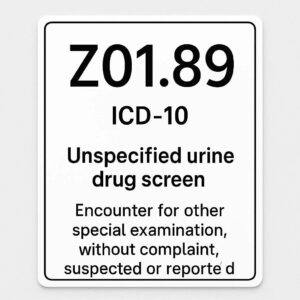
ICD-10 Code for an Unspecified Urine Drug Screen
What is an ICD-10 Code?
Before we dive into the specifics of drug screening, it is helpful to understand what an ICD-10 code actually is.
ICD stands for the International Classification of Diseases. The “10” indicates the 10th revision of this system. Think of it as a common language used by healthcare providers, insurance companies, and public health officials around the world.
Every diagnosis, symptom, or health-related reason for a medical visit has its own unique code. When you visit a doctor, they document your symptoms and diagnosis. These are then translated into ICD-10 codes for your medical records and for your insurance claim.
The primary purpose of these codes is to:
-
Explain the “Why”: They provide the medical necessity for a procedure. In other words, they answer the question: “Why did the patient need this test or treatment?”
-
Streamline Billing: They ensure that insurance companies understand the reason for the visit so they can process payments correctly.
-
Track Health Statistics: They help public health officials track diseases and health trends across populations.
Without a proper ICD-10 code that justifies a test, an insurance company may deny the claim, leaving the patient responsible for the full bill.
The Difference Between a Diagnosis Code and a Procedure Code
A very common point of confusion for patients is the difference between an ICD-10 code and a CPT code.
-
ICD-10 Code: This is the diagnosis code. It tells the story of why a test or service was performed. (e.g., F10.10 for alcohol abuse, or Z02.4 for a pre-employment exam).
-
CPT Code (Current Procedural Terminology): This is the procedure code. It tells us what was done. (e.g., 80305 for a basic drug screen, or 80307 for a definitive drug test).
So, for a urine drug screen, you will always have at least two codes on a claim form:
-
The CPT code for the laboratory test itself.
-
The ICD-10 code explaining the medical reason for ordering the test.
When people search for the “ICD-10 code for urine drug screen unspecified,” they are looking for the diagnosis code that justifies the test when the reason is not yet known or is general.
The Primary Code: Z02.4
Let’s get straight to the answer. The ICD-10 code you are looking for is:
Z02.4 – Encounter for examination for driving license
Wait, that doesn’t seem right. Let’s correct that.
The most common and appropriate ICD-10 code for an unspecified urine drug screen is actually:
Z02.83 – Encounter for pre-employment examination
This is often the go-to code. However, the context of “unspecified” can vary. After careful review of the ICD-10 manual and common clinical practice, the code that best fits a general, unspecified reason for a drug test is often grouped under encounters for administrative purposes.
To be more precise, the codes that apply to “unspecified” drug screening fall under the Z00-Z99 range, which is used for factors influencing health status and contact with health services. Specifically, we look at Z02 (Encounter for administrative examinations) and Z13 (Encounter for screening for other diseases and disorders).
For a truly “unspecified” drug screen—meaning the test is being done for a routine purpose where no specific problem is suspected—the most accurate code is often:
-
Z13.89 – Encounter for screening for other specified diseases and disorders.
-
Z02.83 – Encounter for pre-employment examination (if the test is specifically for a job).
-
Z02.4 – Encounter for examination for driving license (if the test is for a commercial driver’s license).
However, the most common and versatile code for a routine drug screen where the specific reason isn’t documented or is purely administrative is:
Z13.89
This code is used for Encounter for screening for other specified diseases and disorders. A screening is defined as a test done to detect a disease or condition in individuals who do not have any signs or symptoms. This fits the “unspecified” nature of many routine drug tests perfectly.
Important Note: Many coders and providers also use codes from the Z02 (Administrative examination) series, such as Z02.83 (Pre-employment exam) or Z02.4 (Driving license exam), which inherently include drug testing as a component of the examination. The choice depends on the specific circumstances of the patient’s visit.
Comparison Table: Common ICD-10 Codes for Drug Screening
To make this clearer, here is a table comparing the most frequently used codes for drug screening scenarios.
| ICD-10 Code | Description | Typical Scenario | Is it “Unspecified”? |
|---|---|---|---|
| Z13.89 | Encounter for screening for other specified diseases and disorders | A routine, annual workplace wellness screening that includes a drug test, with no suspicion of use. | Yes. This is a pure screening code. |
| Z02.83 | Encounter for pre-employment examination | A job applicant is required to pass a physical and drug test before being hired. | Yes. The drug test is part of the administrative process, not based on symptoms. |
| Z02.4 | Encounter for examination for driving license | A commercial truck driver must undergo a DOT physical and drug test to renew their license. | Yes. This is a regulatory requirement, not a diagnostic one. |
| F10-F19 | Mental and behavioral disorders due to psychoactive substance use | A patient admits to struggling with opioid addiction and a test is needed to confirm baseline use. | No. This is a specific diagnosis related to substance use. |
| R78.9 | Finding of other specified substances, not normally found in blood | A test comes back positive for an illicit substance, and the provider is documenting the finding. | No. This is a code for the result, not the reason for ordering the test. |
| Z71.51 | Drug abuse counseling and surveillance of drug abuser | A patient in a recovery program requires regular, random drug tests to monitor sobriety. | No. This is for monitoring a known condition. |
When to Use the “Unspecified” Screening Code (Z13.89)
Using the correct code is crucial. The “unspecified” or screening code is appropriate in very specific situations. Here is a helpful list of scenarios where Z13.89 is the right choice:
-
Routine Employer Wellness Programs: Some companies offer voluntary health screenings that include a drug test, not because they suspect a problem, but for general health data.
-
School or College Entrance: An educational institution might require a routine health check-up that includes a drug screen for all incoming students.
-
Pre-Operative Clearance (with no suspicion): A surgeon orders a standard battery of tests before surgery, which includes a drug screen, to ensure there are no unknown factors that could complicate anesthesia. The patient has no history or symptoms of drug use.
-
Research Studies: A patient is participating in a clinical trial that requires a baseline drug screen as part of the study protocol.
-
General Health Maintenance: A patient requests a “full check-up” including a drug screen, for their own peace of mind, with no specific concerns.
In all these cases, the patient is asymptomatic. There is no suspicion, no history of abuse, and no medical necessity other than a routine check or administrative requirement. This is the essence of a screening.
When “Unspecified” is the Wrong Choice
It is equally important to know when you should not use an unspecified screening code. Using the wrong code can be considered upcoding or undercoding, which has legal and financial implications.
Do not use Z13.89 or other administrative codes if:
-
The patient has a known history of substance abuse. In this case, you would use a code from the F11-F16 or F18-F19 range (e.g., F15.20 for dependence on other stimulants). This indicates the test is for monitoring a known condition.
-
The patient is exhibiting symptoms. If a patient comes in confused, disoriented, or with slurred speech, and the doctor orders a drug screen to find the cause, you would use a code for the symptoms (e.g., R41.82 for altered mental status) or a code for suspected abuse.
-
The patient is in a legally mandated treatment program. This is a specific scenario requiring codes like Z71.51 (Drug abuse counseling and surveillance).
-
The test is ordered to monitor known use during pregnancy. This would use codes like O99.32 (Drug use complicating pregnancy).
-
The test is for pain management compliance. This is a complex area. While the patient may be asymptomatic, they are being monitored for a specific reason related to a prescribed medication. Many coders use Z79.891 (Long-term use of opiate analgesic) or a specific code for the condition being treated (e.g., M54.5 for low back pain) along with a V code for the surveillance.
The Importance of Specificity in Medical Coding
You might wonder why everyone can’t just use one code for every drug test. The reason is specificity. Insurance companies and regulatory bodies require proof that a test was medically necessary.
-
If a test is ordered because a patient is at high risk for addiction, the medical necessity is different than if it is ordered for a routine pre-employment physical.
-
If a test is ordered for a patient with confusion, the medical necessity is to diagnose the cause of a symptom.
-
If a test is ordered for a patient in a pain management contract, the necessity is to ensure compliance with a treatment plan.
Using the correct, specific code tells the full story. It justifies the cost of the test and ensures the provider gets paid for their service. It also builds an accurate health record for the patient, which is vital for their long-term care.
A Note for Patients:
You have the right to understand why a test is being ordered. If you receive a bill for a urine drug screen and it is partially or fully denied, ask your provider’s billing department what ICD-10 code was used. It may have been too vague, or it may not have accurately reflected your specific situation. Don’t be afraid to ask questions.
The Role of CPT Codes: The “What” vs. The “Why”
As mentioned earlier, the ICD-10 code is only half of the equation. The other half is the CPT code. For urine drug screens, there are several CPT codes, and they have changed in recent years. Understanding them helps complete the picture.
There are two main types of drug tests from a coding perspective:
-
Presumptive Drug Testing (Qualitative): This is the initial “screening” test. It is often done with a dipstick or a cup that gives a simple yes/no result for a class of drugs (e.g., “positive for opiates”). It is quick and inexpensive.
-
CPT 80305: Drug screen test performed per date of service, by instrument chemistry analyzer (e.g., immunoassay).
-
CPT 80306: Drug screen test performed by instrument chemistry analyzer (e.g., immunoassay) with a second, independent technique to confirm the result (e.g., a different test on the same instrument).
-
CPT 80307: Drug screen test performed by instrument chemistry analyzer (e.g., immunoassay) with a more complex methodology, definitively identifying the drug.
-
-
Definitive Drug Testing (Quantitative): This is a much more precise and expensive test. It is usually done if the presumptive test is positive. It uses techniques like gas chromatography-mass spectrometry (GC-MS) or liquid chromatography-tandem mass spectrometry (LC-MS/MS) to identify the specific drug and measure the amount (concentration) in the sample.
-
CPT 80320-80377: These are a series of codes for definitive testing, often specific to a particular drug class (e.g., 80320 for alcohol, 80345 for opiates). The laboratory must report these based on the number of drugs they are specifically looking for.
-
How they work together:
If you go for a pre-employment drug screen, your employer is likely ordering a presumptive test. The lab will run an immunoassay screen (e.g., CPT 80305) looking for five or ten classes of drugs. The ICD-10 code justifying the entire encounter might be Z02.83 (Pre-employment exam) . If that screen comes back negative, the story is complete. If it comes back positive, the lab will often automatically proceed to a definitive test to confirm the result. This second test will require its own ICD-10 code, likely the same one used for the initial test, as it is part of the same medical necessity.
Step-by-Step: How a Urine Drug Screen is Coded
Let’s walk through a realistic example to see how all the pieces fit together.
Scenario: Sarah is applying for a job as a cashier at a large retail store. The company policy requires all new hires to pass a standard 5-panel urine drug screen. Sarah has no history of drug abuse and is feeling perfectly healthy. She goes to a local lab to provide her sample.
-
The Encounter: Sarah’s reason for being at the lab is an administrative requirement for employment. She has no symptoms or complaints.
-
Assigning the Diagnosis (ICD-10) Code: The lab checks Sarah in. Based on the paperwork from the employer, the reason for the test is “pre-employment screening.” The coder assigns the ICD-10 code Z02.83 (Encounter for pre-employment examination) . This code perfectly captures the “why.”
-
Performing the Procedure: The lab technician collects the urine sample. The lab runs a presumptive test using an immunoassay analyzer. They are testing for 5 classes of drugs.
-
Assigning the Procedure (CPT) Code: For this automated test, the lab coder assigns the CPT code 80305 (Drug screen test by instrument chemistry analyzer) .
-
The Result: Sarah’s test comes back negative for all substances.
-
The Claim: The lab submits a claim to the employer’s contracted third-party administrator (or directly to the employer) with the following information:
-
CPT Code: 80305 (What was done: an automated drug screen)
-
ICD-10 Code: Z02.83 (Why it was done: pre-employment exam)
-
Scenario with a Twist: What if Sarah’s test was positive for opiates, and the lab needed to confirm it?
-
The Initial Claim: The same as above (80305 + Z02.83) is submitted for the screening.
-
The Confirmation: The lab runs a definitive test (e.g., GC-MS) specifically for opiates to confirm the positive result and get an exact quantitative value.
-
Assigning the Second CPT Code: The lab coder assigns a definitive testing code, such as 80362 (Drug assay, definitive, opiate(s))
-
The Second Claim: A second claim (or an addendum to the first) is submitted. It will list:
-
CPT Code: 80362 (What was done: a definitive confirmation test for opiates)
-
ICD-10 Code: Z02.83 (Why it was done: This is still the underlying reason for the entire testing process. The confirmation is a necessary part of the pre-employment screening.)
-
This example shows how a single reason (Z02.83) can justify one or multiple procedures.
Common Questions About Coding for Drug Screens
Navigating this topic can be tricky. Here are answers to some frequently asked questions.
Is there a specific code for a “10-panel drug screen”?
No. The ICD-10 code does not specify the number of drugs being tested for. It only provides the reason for the test. The number of drugs is determined by the CPT code or the specific laboratory panel used. A “10-panel” test is simply a type of presumptive drug screen, and would likely be billed under 80305 or 80306, depending on how it is performed.
What is the difference between a screening and a diagnostic test?
This is the most critical distinction in coding.
-
A screening test is performed on an asymptomatic patient to detect a potential problem early. (e.g., a routine mammogram, a routine drug test for a new job). The codes are from the Z00-Z13 range.
-
A diagnostic test is performed on a patient with signs, symptoms, or a known condition to determine the cause or monitor its status. (e.g., a drug test on a patient acting confused, or a drug test on a patient in a rehab program). The codes are from the A00-Z99 range related to the symptom or condition.
Using a screening code when a diagnostic code is needed is a major billing error.
Can Z13.89 be used for a drug test required by a court?
It depends. If the court orders a test as part of a general, initial assessment with no prior history, it might be arguable. However, in most cases, court-ordered testing is for individuals with a known legal issue related to substances. This would be considered surveillance. A more accurate code would be Z71.51 (Drug abuse counseling and surveillance of drug abuser) or a code related to the legal encounter (e.g., Z04.89 for examination for other specified legal reasons). It’s always best to be as specific as possible.
What if a patient has no symptoms but is on chronic opioid therapy for pain?
This is a common and complex scenario. The test is not a screening (they are not looking for a new problem in an asymptomatic person) and it is not for a new diagnosis (the pain is already diagnosed). It is for monitoring a current treatment plan. The best practice is to use the ICD-10 code for the condition being treated (e.g., M54.5 for chronic low back pain) and/or a code for the long-term drug use (Z79.891 for long-term use of opiate analgesics). This tells the story: “We are monitoring this patient’s compliance with their prescribed opioid therapy for their chronic pain.”
My test was for insurance purposes. What code is used?
If an insurance company requires a drug test as a condition for a new policy (a health or life insurance exam), the appropriate code is from the Z02 series. The most common would be Z02.5 (Encounter for examination for admission to residential care) or Z02.89 (Encounter for other administrative examinations) . These are for examinations required by insurance or other regulatory bodies.
Why Honest and Accurate Coding Matters to You
You might be reading this and thinking, “I’m not a coder, why does this matter to me?” Here is why:
-
Accuracy of Your Medical Record: Your medical record is your health story. If the wrong code is used, it could suggest you have a problem you don’t have (e.g., a substance abuse code when you were just getting a pre-employment test), or it could miss a problem that needs attention. This can affect your future medical care.
-
Avoiding Surprise Bills: If the ICD-10 code on your claim doesn’t adequately justify the test, your insurance company may deny it. The responsibility for payment then falls on you. Ensuring the “why” is correctly documented from the start can prevent this.
-
Privacy and Stigma: A substance abuse diagnosis code in your medical record is highly sensitive. Using an unspecified screening code when appropriate protects your privacy if the test is simply routine.
Conclusion
In summary, while the search for a single “icd 10 code for urine drug screen unspecified” is common, the reality is that the correct code depends entirely on the context. The most frequent codes for routine, asymptomatic testing are Z13.89 (Encounter for screening for other specified diseases and disorders) and those from the administrative examination series like Z02.83 (Pre-employment exam) . The key takeaway is that the ICD-10 code tells the story of why a test is needed, and it must be paired with a CPT code that explains what test was done. Accurate coding ensures proper billing, maintains an honest medical record, and protects the patient from financial and privacy issues.
Frequently Asked Questions (FAQ)
1. What is the single most common ICD-10 code used for a standard drug test?
While it varies by situation, Z02.83 (Pre-employment examination) is arguably the most common single code used, as many drug tests are required for hiring purposes. For general screenings not tied to a specific administrative event, Z13.89 is the primary code.
2. Is Z13.88 a valid code for a drug screen?
No. Z13.88 is for a screening for disorders of the musculoskeletal system. The correct code for an unspecified general health screening, which can include drug tests, is Z13.89.
3. Can a doctor use a code for “abuse” if I don’t have a problem?
They should not. If a doctor uses a code like F14.20 (Cocaine dependence) without a proper diagnosis, it is a serious error. Always review the after-visit summary you are given to ensure the diagnosis codes listed are accurate.
4. What happens if the wrong ICD-10 code is used for my drug test?
The most immediate consequence is claim denial by your insurance. It can also lead to an inaccurate health record. In some cases, it can trigger audits or investigations for healthcare fraud if the error is repeated and intentional.
5. Does the ICD-10 code change if the drug screen is done with hair or saliva?
No. The ICD-10 code describes the reason for the test, not the method or sample type. The sample type (urine, hair, oral fluid) is a detail of the procedure and would be noted in the lab’s records but does not change the diagnosis code.
Additional Resources
For the most up-to-date and official information, always refer to the source. Here are some trusted resources:
-
CMS (Centers for Medicare & Medicaid Services): They provide free downloads of the official ICD-10 code sets and guidelines.
-
American Academy of Professional Coders (AAPC): A great resource for articles, forums, and educational material on medical coding.
-
World Health Organization (WHO): The governing body for the ICD framework.
Meta Description:
Looking for the ICD-10 code for an unspecified urine drug screen? We explain the most common codes like Z13.89 and Z02.83, when to use them, and how they differ from CPT codes. A clear guide for patients and professionals.
Disclaimer: This article is for informational purposes only and does not constitute medical or legal advice. Medical coding practices can change and may vary based on specific payer policies and clinical circumstances. Always consult with a qualified professional for guidance on medical billing and coding.
Author: American Web Writing Team
Date: FEBRUARY 28, 2026


