If you have been searching for the correct medical code for carpal tunnel syndrome affecting both hands, you have likely encountered a confusing list of numbers and letters. Medical coding can sometimes feel like learning a foreign language. But when you are dealing with a condition as common and frustrating as carpal tunnel syndrome (CTS), getting the code right matters.
Whether you are a medical coder double-checking your work, a billing specialist processing claims, or a patient curious about what is on your medical chart, this guide is for you. We will break down everything you need to know about the ICD-10 code for bilateral carpal tunnel, moving beyond just the code itself to explore the clinical context, billing implications, and what this diagnosis means for treatment.
Let’s demystify the process together.
What is Carpal Tunnel Syndrome? A Quick Overview
Before we dive into the coding deep end, it helps to understand the condition itself. Carpal tunnel syndrome is not just a “tingly hand.” It is a specific medical condition caused by compression of the median nerve.
This nerve runs from your forearm into the palm of your hand, passing through a narrow passageway in your wrist called the carpal tunnel. This tunnel is rigid—it has bones on the bottom and a tough ligament on top. When tendons in the tunnel become irritated or swollen, they narrow the space and pinch the nerve.
Common Symptoms to Recognize
People with CTS often report a gradual onset of symptoms. It is rare for it to hit suddenly. Here is what it usually feels like:
-
Numbness or Tingling: A “pins and needles” sensation, most often in the thumb, index, and middle fingers.
-
Shock Sensations: Some describe a feeling like an electric shock running through their wrist and into their fingers.
-
Weakness: A tendency to drop objects. This happens because the nerves controlling the thumb muscles aren’t working correctly.
-
Nighttime Troubles: Many people notice symptoms wake them up at night. Shaking the hands out often provides temporary relief.
Why Does It Happen?
While repetitive hand use (like typing or assembly line work) is a well-known cause, it is not the only one. Other factors can contribute significantly:
-
Anatomy: A simple fact of wrist anatomy—some people just have smaller carpal tunnels.
-
Health Conditions: Diabetes, rheumatoid arthritis, and thyroid imbalances increase the risk.
-
Pregnancy: Hormonal changes can cause fluid retention, leading to swelling in the tunnel.
-
Injury: A wrist fracture or dislocation can create extra pressure on the nerve.
Understanding these symptoms and causes is the first step. The next is figuring out how to accurately document it for medical records, which is where the ICD-10 code comes in.
Decoding ICD-10: The Language of Medicine
ICD-10 stands for the International Classification of Diseases, 10th Revision. Think of it as a dictionary for diseases. Every health condition, from a common cold to a complex surgical complication, has its own unique code.
These codes are essential for:
-
Medical Records: Ensuring your health history is accurate.
-
Insurance Billing: Telling your insurance company why you saw a doctor and what treatment was needed.
-
Health Statistics: Tracking disease patterns across populations.
For carpal tunnel syndrome, all codes fall under the “G” category, which covers diseases of the nervous system. Specifically, we look at G56 – Mononeuropathies of the upper limb.
The Specific Code: G56.03
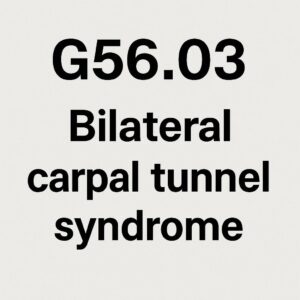
So, what is the answer to the main question? The ICD-10 code for bilateral carpal tunnel syndrome is G56.03.
This code is highly specific. It is broken down into three parts:
-
G56: Indicates a mononeuropathy (a single nerve issue) in the upper limb.
-
.0: Specifies that the affected nerve is the median nerve (which is the nerve involved in CTS).
-
3: Denotes the laterality. In ICD-10, “3” almost always means “bilateral.”
Important Note for Readers: Never use a unilateral (one-sided) code for a bilateral condition. If a patient has issues in both wrists, G56.03 is the only correct choice.
Why Laterality Matters: Bilateral vs. Unilateral
One of the biggest improvements from the old ICD-9 system to ICD-10 was the addition of laterality. In the past, you could only code for “carpal tunnel syndrome.” Now, the system demands precision.
Here is how the codes break down for the median nerve:
| Condition | Laterality | ICD-10 Code |
|---|---|---|
| Carpal Tunnel Syndrome | Bilateral (Both sides) | G56.03 |
| Carpal Tunnel Syndrome | Right | G56.01 |
| Carpal Tunnel Syndrome | Left | G56.02 |
| Carpal Tunnel Syndrome | Unspecified | G56.00 |
Why is this distinction so important?
Imagine a patient, Sarah. She has tingling in both hands, but the right hand is much worse. Her doctor recommends surgery. If the medical records only show “G56.00 (unspecified),” the insurance company might question which hand is being operated on. This could lead to a denial of the claim, delaying Sarah’s surgery.
Using the correct bilateral code (G56.03) immediately tells the entire story: the condition affects both of Sarah’s hands. This precision streamlines billing, reduces paperwork, and ensures the patient’s chart accurately reflects their reality.
The Clinical Picture: Diagnosing Bilateral CTS
Getting to the diagnosis of bilateral carpal tunnel syndrome isn’t usually a single event. It’s a process. A doctor won’t just look at your hands and assign a code. They need evidence.
The Patient History
This is where the story begins. The doctor will ask questions like:
-
“Do your symptoms wake you up at night?”
-
“Which fingers are affected?”
-
“Does shaking your hands help?”
-
“What kind of work do you do?”
Because the condition is bilateral, the patient might describe difficulty doing tasks that require both hands, such as driving, typing, or even washing dishes.
The Physical Exam
Next, the doctor performs specific physical maneuvers designed to provoke the symptoms. Two common tests are:
-
Tinel’s Sign: The doctor taps lightly over the median nerve at the wrist. If it causes a tingling sensation in the fingers, the test is positive.
-
Phalen’s Maneuver: The patient presses the backs of their hands together with wrists fully flexed for about 60 seconds. If this reproduces the numbness or tingling, it suggests CTS.
The Gold Standard: Nerve Conduction Studies (NCS)
While the history and physical exam are crucial, the most definitive test is often a nerve conduction study. This test measures how fast electrical signals travel through your nerves.
In a patient with bilateral CTS, the test will show a slowing of the signal as it passes through the carpal tunnel on both sides. The degree of slowing can even tell the doctor how severe the condition is—mild, moderate, or severe. This objective data is what solidifies the use of the G56.03 code.
Billing and Documentation: Getting it Right
For medical professionals, knowing the code is only half the battle. The documentation must support the code. Here are practical tips for accurate billing.
Linking Diagnosis to Procedure
If a patient with bilateral CTS receives a corticosteroid injection, the doctor must link the G56.03 code to the procedure code for the injection.
Since it is bilateral, the billing might look like this:
-
Diagnosis Code: G56.03 (Bilateral Carpal Tunnel Syndrome)
-
Procedure Code (CPT): 20526 (Injection, therapeutic, carpal tunnel) with a modifier.
Because the procedure was done on both wrists, a modifier is needed to tell the insurance company it was performed twice.
-
RT (Right) and LT (Left) modifiers are often used, meaning you would bill the procedure code twice: once with RT and once with LT.
-
Alternatively, a 50 modifier (Bilateral Procedure) can be used, depending on the insurance company’s preference.
Common Billing Mistakes to Avoid
Even experienced coders can slip up. Here is a checklist to keep your claims clean:
-
Mismatched Laterality: Do not use G56.03 if you only treated the right wrist. Use G56.01.
-
Using Unspecified Codes: Avoid G56.00 if you know the laterality. Insurance companies prefer specific codes and may deny claims that are “unspecified” when they shouldn’t be.
-
Not Linking Symptoms: If the patient’s chief complaint was “pain in both hands,” ensure the doctor’s note connects that pain to the nerve compression (CTS) to justify the G56.03 code.
Treatment Options for Bilateral Carpal Tunnel Syndrome
Receiving a diagnosis of bilateral CTS can feel overwhelming. However, having it in both hands doesn’t necessarily mean you need surgery on both. Treatment is highly individualized.
Conservative (Non-Surgical) Approaches
For mild to moderate cases, doctors often start with less invasive options.
-
Wrist Splinting: Wearing braces on both wrists at night keeps them in a neutral position, preventing the wrist flexion that aggravates the nerve during sleep.
-
Activity Modification: This means looking at your daily habits. Can you adjust your keyboard? Take more frequent breaks? Change how you hold your phone?
-
Medications: Anti-inflammatories (like ibuprofen) can reduce swelling, while corticosteroid injections can provide temporary relief by calming the inflammation inside the tunnel.
Surgical Interventions
If conservative treatments fail or the nerve compression is severe, surgery might be recommended. This is where the bilateral nature of the condition presents a unique decision point.
Do surgeons operate on both hands at once?
Usually, no. Most surgeons recommend operating on one hand at a time. This allows the patient to use their “non-operative” hand for daily tasks like eating, writing, and hygiene during recovery. The second surgery is typically scheduled a few weeks or months after the first, once the patient has regained function.
The surgery itself, called a carpal tunnel release, involves cutting the ligament that is pressing on the nerve to create more space. This can be done with a traditional open incision or with an endoscopic camera through a smaller cut.
Living with Bilateral CTS: Patient Stories and Advice
To truly understand what G56.03 means, we have to look beyond the chart and at the person.
A Conversation with “James,” a Long-Haul Truck Driver
“I thought it was just part of the job, you know? The vibration from the wheel, the long hours. First, my right hand would go numb. Then my left started doing it. Pretty soon, I couldn’t feel the steering wheel properly. That’s when I got scared. My doctor diagnosed me with bilateral carpal tunnel. It was a relief to have a name for it, but terrifying to think it could end my career. I sleep in bulky braces on both hands now. It’s not glamorous, but it works.”
James’s story highlights a key point: bilateral CTS can threaten a person’s livelihood. For him, the ICD-10 code for bilateral carpal tunnel isn’t just a billing item; it’s the key to accessing treatment that allows him to keep working.
Tips for Managing Daily Life
If you are dealing with this, small changes can make a big difference:
-
Ergonomic Tools: Look for kitchen utensils, pens, and gardening tools with thick, padded grips. They require less force to hold.
-
Heat Therapy: Before activities, applying warm packs can increase blood flow and flexibility to the hands.
-
Cold Therapy: After activity or when pain flares up, cold packs can reduce inflammation.
-
Be Vocal: Tell your family, friends, and coworkers. When they understand that your hands need rest, they will be more likely to help with tasks like opening jars or carrying heavy bags.
Frequently Asked Questions (FAQ)
Q: Is G56.03 the only code for bilateral carpal tunnel?
A: Yes, for carpal tunnel syndrome specifically caused by median nerve compression in both wrists, G56.03 is the correct and only code. There are no alternative codes for this specific diagnosis.
Q: Can I use G56.03 if I have symptoms in both hands but only one was tested?
A: No. The diagnosis must be confirmed by a physician. If only one hand was tested, or if the doctor’s documentation only mentions one hand, you cannot bill for the bilateral condition. The clinical evidence must support the code.
Q: What is the difference between G56.03 and G56.00?
A: G56.03 is a specific code for bilateral (both sides) carpal tunnel. G56.00 is an unspecified code, meaning the medical record does not specify if it’s the left, right, or both hands. Specific codes are always preferred for quality care and accurate reimbursement.
Q: Does the ICD-10 code affect how much I pay for treatment?
A: Indirectly, yes. The code tells your insurance company what condition is being treated. If the code is incorrect (e.g., using a unilateral code for a bilateral procedure), the insurance company may deny the claim, leaving you responsible for the full bill. Accurate coding ensures your benefits are applied correctly.
Q: My doctor says I have CTS, but my chart says G56.03. What does that mean for my long-term health?
A: It simply means your doctor has officially diagnosed you with carpal tunnel syndrome in both hands. This code will stay in your medical history to ensure any future treatment for your hands is consistent with this diagnosis. It does not indicate anything negative about your overall health prognosis.
Additional Resources
For the most up-to-date information on coding standards and guidelines, the best resource is the official source.
-
Resource Link: Centers for Medicare & Medicaid Services (CMS) – ICD-10
This government website provides access to the official ICD-10 code sets, coding guidelines, and educational resources. It is an invaluable tool for professionals and a transparent resource for patients who want to dive deeper into the world of medical coding.
Conclusion
Navigating the world of medical codes can be complex, but the system is designed to bring clarity to healthcare. The ICD-10 code for bilateral carpal tunnel syndrome, G56.03, is a perfect example of this precision. It tells a complete story: a mononeuropathy of the median nerve affecting both the left and right upper limbs.
For patients, understanding this code can empower you to have better conversations with your doctors. For professionals, mastering its use ensures accurate documentation, proper reimbursement, and the highest standard of patient care. Whether you are dealing with tingling fingers or processing insurance claims, remember that G56.03 is more than just a number—it is a key piece of information on the path to treatment and recovery.
Disclaimer: This article is for informational purposes only and does not constitute medical advice. Medical coding guidelines and insurance policies can change. Always consult with a qualified healthcare provider for diagnosis and treatment, and with a certified coding specialist for billing advice.