Navigating the world of medical coding can sometimes feel like learning a new language. If you are here, you are likely trying to find the specific ICD-10 code for biventricular heart failure, and you want to make sure you get it exactly right.
Whether you are a medical coder, a biller, a healthcare administrator, or a patient trying to understand a medical record, accuracy is everything. In the complex landscape of cardiology, using the correct code isn’t just about paperwork; it affects treatment plans, insurance reimbursements, and the overall understanding of a patient’s health status.
Biventricular heart failure is a serious condition where both sides of the heart are failing. Because it involves both the left and right ventricles, coding it correctly requires a specific approach that differs from general heart failure codes.
In this guide, we will walk you through everything you need to know. We will cover the exact code, the clinical context, the official guidelines, and practical tips to ensure your coding is precise and compliant.
Let’s dive in and take the confusion out of the process.
ICD-10 Code for Biventricular Heart Failure
Table of Contents
ToggleWhat is Biventricular Heart Failure? (A Quick Clinical Overview)
Before we jump into the codes, it is helpful to understand what is happening inside the body. This context ensures that the code you pick truly matches the patient’s condition.
The heart is a two-sided pump. The left side receives oxygen-rich blood from the lungs and pumps it out to the rest of the body. The right side receives oxygen-poor blood from the body and pumps it into the lungs to get more oxygen.
-
Left-sided heart failure often leads to fluid buildup in the lungs (pulmonary edema), causing shortness of breath and fatigue.
-
Right-sided heart failure typically causes fluid to back up in the body, leading to swelling (edema) in the legs, ankles, and abdomen, as well as fluid retention.
Biventricular heart failure occurs when both pumps are struggling. Most commonly, it starts as left-sided failure. When the left side fails, it creates a backup of pressure. Over time, this pressure extends back through the lungs and damages the right side of the heart. When both sides are compromised, the patient experiences a combination of symptoms: difficulty breathing and significant swelling.
Important Note: Because the right side usually fails as a consequence of the left, biventricular failure is often considered an advanced stage of heart failure. It requires complex management to balance fluid levels and support the heart’s output.
The Exact ICD-10 Code for Biventricular Heart Failure
Now, let’s get to the core of your search.
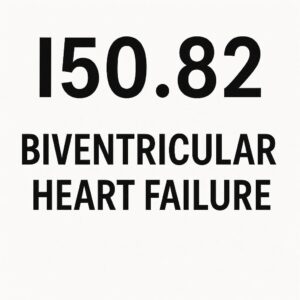
The specific ICD-10-CM code for this condition is:
I50.82 – Biventricular Heart Failure
This is the code you will use when the medical documentation clearly states that the patient has failure of both the left and right ventricles.
However, in the world of ICD-10, a single code is rarely used in a vacuum. There is a hierarchy and specific classifications for heart failure that you need to be aware of to ensure you are using I50.82 correctly.
The Heart Failure “Family” of Codes (I50.-)
Code I50.82 falls under the broader category I50 (Heart failure) . To use it accurately, you must distinguish it from other similar codes:
| ICD-10 Code | Description | When to Use It |
|---|---|---|
| I50.1 | Left ventricular failure | Use this when only the left side of the heart is failing. This is often accompanied by pulmonary congestion. |
| I50.2 | Systolic (congestive) heart failure | This is a general code for heart failure where the heart muscle doesn’t contract effectively. It does not specify which side, though it is often left-sided. |
| I50.3 | Diastolic (congestive) heart failure | This is used when the heart muscle is stiff and doesn’t relax properly to fill with blood. It is a functional classification, not a side-specific one. |
| I50.4 | Combined systolic and diastolic heart failure | Use this when the documentation specifies that the patient has both pumping and filling problems. |
| I50.9 | Heart failure, unspecified | This is a last-resort code. Use it only if the physician does not specify the type or side of heart failure. |
| I50.82 | Biventricular heart failure | This is our focus. Use this when the documentation explicitly states “biventricular” or confirms failure of both the left and right ventricles. |
As you can see, I50.82 is very specific. It tells the story that the disease has progressed to involve the entire heart.
When to Use I50.82: Coding Scenarios
Knowing the code is one thing. Knowing how to apply it in real-world medical records is another. Let’s look at a few practical scenarios.
Scenario 1: The Clear Diagnosis
A cardiologist writes in their note: “The patient presents with worsening dyspnea and significant lower extremity edema. Echocardiogram confirms reduced ejection fraction of 35% and evidence of right ventricular dysfunction. Diagnosis: Biventricular heart failure.”
-
Your code: I50.82
Scenario 2: Left-Sided Failure with Secondary Right-Sided Symptoms
A patient with a history of chronic left-sided heart failure comes in with new-onset swelling in the legs and jugular venous distention. The physician notes, “Acute on chronic left-sided heart failure with signs of right heart failure.”
-
Your code: This is a judgment call based on specificity. If the physician only mentions “signs of” but does not explicitly state the right side is failing, you may need to query the physician. However, if the note connects the symptoms to right-sided failure, I50.82 is appropriate. You would also code the underlying chronic condition.
Scenario 3: The Unspecified Note
A hospital discharge summary states: “Diagnosis: Congestive Heart Failure. Patient treated with diuretics for fluid overload.”
-
Your code: I50.9 (Heart failure, unspecified). You cannot assume it is biventricular, left, or right based on “fluid overload” alone, as this can happen in many types of heart failure.
The Importance of Accurate Coding for Biventricular Heart Failure
Why does it matter if you use I50.82 versus I50.9 or I50.2? It matters more than you might think.
-
Reflects Disease Severity: Biventricular failure indicates a more advanced disease process than isolated left-sided failure. Using the specific code paints a more accurate picture of the patient’s health journey.
-
Impacts Reimbursement: Payers, including Medicare and private insurance companies, use codes to determine reimbursement rates. A more specific and complex diagnosis like biventricular heart failure often justifies a higher level of care and, consequently, appropriate reimbursement for the hospital or provider.
-
Guides Treatment and Research: Accurate data is vital for public health research and improving treatment protocols. If every case of advanced heart failure is simply coded as “congestive heart failure,” it becomes difficult to track outcomes and allocate resources for patients with biventricular involvement.
-
Ensures Compliance: Using unspecified codes when a more specific code exists can raise red flags during an audit. Payers want to see that you are coding to the highest level of specificity available in the medical record.
Mastering the Specifics: Laterality, Acuity, and Manifestations
One of the great things about the ICD-10 system is its depth. While I50.82 is the base code for biventricular failure, you will often need to add additional codes to capture the full clinical picture.
1. Acuity: Is it Acute or Chronic?
Heart failure can be acute (sudden onset), chronic (long-standing), or acute-on-chronic (a sudden worsening of a chronic condition). You will use additional codes to specify this.
-
I50.82 covers the fact that it is biventricular, but you must also code the type:
-
I50.22 for Chronic systolic (congestive) heart failure
-
I50.32 for Chronic diastolic (congestive) heart failure
-
I50.42 for Chronic combined systolic and diastolic heart failure
-
For acute failure, you would look at codes like I50.21 (Acute systolic) or I50.31 (Acute diastolic) in conjunction with I50.82.
-
Coding Rule: When a patient has both an acute exacerbation and an underlying chronic condition, you typically code the acute condition first, followed by the chronic.
2. Underlying Cause (Etiology)
Heart failure is almost always a symptom of another problem. The ICD-10 system encourages you to code the underlying cause as well.
-
Hypertensive Heart Disease: If the patient has hypertension and heart failure, you should first code a code from I11.0 (Hypertensive heart disease with heart failure) . The “with” in the code means they are linked. You would then use I50.82 as a secondary code to specify the type of failure.
-
Coronary Atherosclerosis: If the heart failure is due to clogged arteries, you would code the atherosclerosis (e.g., I25.10 for atherosclerotic heart disease of native coronary artery) first, followed by I50.82.
3. Manifestations or Complications
What is happening because of the heart failure?
-
Fluid overload (E87.79): If the patient is in fluid overload.
-
Pleural Effusion (J91.8): If fluid has accumulated around the lungs.
-
Cardiogenic Shock (R57.0): If the heart failure is so severe that it is causing shock to the body. (This would be a primary diagnosis).
Common Documentation Pitfalls to Avoid
Even experienced coders can run into trouble. Here are the most common pitfalls when coding biventricular heart failure and how to avoid them.
-
Pitfall #1: Coding from the Pharmacy Sheet: You see “Lasix” or “Furosemide” on the medication list and assume it is heart failure. The Fix: Always code from the physician’s note, not the medication list. Diuretics can be used for hypertension or kidney issues.
-
Pitfall #2: Assuming “CHF” means Biventricular: “Congestive Heart Failure” is a broad term. It does not automatically mean both sides are failing. The Fix: Look for specific language: “right ventricular dysfunction,” “elevated right atrial pressure,” “biventricular failure,” or an echo report showing issues on both sides.
-
Pitfall #3: Ignoring the “With” Guidelines: The ICD-10 manual has a special rule. If the heading says “with,” it means the conditions are linked. For example, “Hypertensive heart disease with heart failure” means you do not have to write a separate link; the code assumes it. The Fix: Always check the Tabular List for instructional notes.
-
Pitfall #4: Forgetting to Query the Provider: If the documentation says “right-sided heart failure secondary to left-sided disease” but doesn’t use the word “biventricular,” it is technically correct to use I50.82. However, if you are unsure, or if the documentation is vague (“probable right-sided involvement”), you must send a query to the physician for clarification. It is better to ask than to guess.
A Step-by-Step Guide to Coding a Biventricular Heart Failure Chart
To bring everything together, here is a simple workflow you can follow every time you encounter a chart with potential biventricular heart failure.
-
Find the Diagnosis: Locate the physician’s statement of the diagnosis. Highlight the specific terms used (e.g., “biventricular,” “left and right,” “global heart failure”).
-
Identify the Type: Is it systolic, diastolic, or combined? Is it acute, chronic, or acute-on-chronic?
-
Find the Cause: Look for the underlying etiology. Does the patient have hypertension, coronary artery disease, or a valvular issue?
-
Sequence Correctly:
-
If caused by hypertension, sequence I11.0 first.
-
If caused by CAD, sequence the CAD code (e.g., I25.10) first.
-
If the reason for the encounter is the acute exacerbation, sequence the acute failure code first.
-
-
Assign I50.82: Apply the biventricular code as a secondary diagnosis (unless it is the only diagnosis and not linked to hypertension/CAD in the Tabular List instructions).
-
Add Specifics: Add codes for manifestations like fluid overload or edema.
-
Review: Double-check that your codes match the documentation and that you have coded to the highest level of specificity.
Frequently Asked Questions (FAQ)
Here are some of the most common questions we hear from readers about coding this condition.
Q1: Can I use I50.82 if the doctor only writes “CHF with volume overload”?
A: No. “CHF” is not specific enough. You must have documentation that explicitly mentions the right side is involved. If it isn’t documented, you cannot assume it. You would use I50.9 or a more specific left-sided code if applicable.
Q2: What is the difference between I50.82 and I50.9?
A: I50.82 (Biventricular failure) is highly specific. It tells us that both pumping chambers are failing. I50.9 (Heart failure, unspecified) is a general code used when the physician provides no details about the type or side of the failure. Specific is always better.
Q3: If a patient has left-sided failure and leg swelling, does that mean it’s biventricular?
A: Not necessarily. While leg swelling (peripheral edema) is a classic sign of right-sided failure, it can sometimes be caused by other factors or severe left-sided failure. However, it is a strong indicator. The physician must make the clinical connection in their note for you to use I50.82.
Q4: What does “acute on chronic” mean for I50.82?
A: It means the patient has a long-standing history of biventricular heart failure, but they are now experiencing a sudden worsening of their symptoms. You will need to sequence the acute specific code first (like I50.21 for acute systolic) followed by the chronic code (like I50.22 for chronic systolic) and then I50.82.
Q5: Is biventricular heart failure the same as congestive heart failure?
A: Biventricular heart failure is a type of congestive heart failure. Congestive heart failure is the umbrella term for when the heart isn’t pumping well and fluid builds up. Biventricular specifies that the congestion is happening because both sides are failing.
Conclusion
Finding the right ICD-10 code for biventricular heart failure doesn’t have to be a struggle. By remembering the specific code I50.82 and understanding the clinical context behind it, you can ensure your coding is both accurate and compliant.
Always let the physician’s documentation guide your choices, and don’t be afraid to dig deeper to find the underlying causes like hypertension or coronary artery disease. Accurate coding tells a complete story—one that ensures the patient is properly represented, the provider is fairly reimbursed, and the data contributes to better heart care for everyone.
Additional Resource
For the most up-to-date official guidelines, you should always refer to the CMS (Centers for Medicare & Medicaid Services) ICD-10-CM Official Guidelines for Coding and Reporting. You can find the latest version on the CMS.gov website. These guidelines are updated annually and provide the final word on complex coding scenarios.
Disclaimer: The information provided in this article is for informational and educational purposes only and does not constitute professional medical coding or legal advice. Medical coding guidelines and regulations are subject to change. Always consult the current official ICD-10-CM code set and guidelines, and seek advice from a certified professional for specific coding situations.