Navigating the world of medical billing can sometimes feel like learning a new language. If you’ve recently had a Cologuard test ordered, or if you are a healthcare professional double-checking your codes, you’ve probably found yourself searching for the correct “ICD 10 code for Cologuard.”
The good news is that you are not alone, and the answer isn’t always a simple one-liner. Because Cologuard is a specific type of screening tool (a multi-target stool DNA test), the code you use depends entirely on the patient’s history and the reason for the test.
This guide is designed to be your friendly, reliable roadmap. We’ll break down exactly which diagnosis codes pair with Cologuard, how to avoid common billing pitfalls, and what you need to know to ensure your claim is processed smoothly.
Let’s dive in and clear up the confusion once and for all.
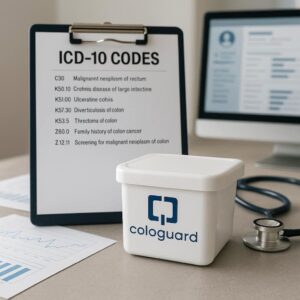
ICD 10 Code for Cologuard
What is Cologuard and Why Does the Correct Code Matter?
Before we get into the nitty-gritty of codes, it’s helpful to understand what Cologuard is. Manufactured by Exact Sciences, Cologuard is a non-invasive stool DNA screening test designed to detect colon cancer or precancerous polyps. It looks for altered DNA and blood in the stool.
Because it is a screening test, it falls into a very specific category for insurance purposes. Using the wrong ICD-10 code can lead to a claim denial, leaving you with an unexpected bill.
Important Note: This article is for informational purposes only and does not constitute medical or billing advice. Coding guidelines can change, and insurance policies vary. Always verify with your payer and the latest coding manuals.
The Primary ICD-10 Codes Used for Cologuard
In the world of ICD-10, there isn’t a single code that says “patient used Cologuard.” Instead, you use a code that explains why the test is being performed. For colorectal cancer screening, the codes fall into two main categories: screening and diagnostic.
H2: The Screening Codes (The Most Common Scenario)
For the vast majority of average-risk patients taking Cologuard, you will be using a screening code. These codes indicate that the patient has no signs, symptoms, or personal history of the condition; the test is purely for early detection.
Here are the primary screening codes:
-
Z12.11 – Encounter for screening for malignant neoplasm of colon
-
When to use it: This is the most common code used for Cologuard. It is for an asymptomatic patient with no personal history of colon cancer or polyps. They are simply due for their routine colorectal cancer screening.
-
-
Z12.12 – Encounter for screening for malignant neoplasm of rectum
-
When to use it: While Cologuard screens the entire colon and rectum, this code is sometimes used interchangeably with Z12.11, though Z12.11 is generally the preferred and more specific code for colon cancer screening.
-
Quick Comparison: Screening vs. Diagnostic
| Feature | Screening (e.g., Z12.11) | Diagnostic (e.g., K63.5, R19.5) |
|---|---|---|
| Patient Status | Asymptomatic. No complaints. | Symptomatic. Has a complaint or issue. |
| Purpose | Early detection in an average-risk patient. | Investigation of a specific problem. |
| Insurance Coverage | Often covered at 100% under preventive care (for eligible plans). | Subject to deductible and coinsurance. |
| Example | Patient turns 45 and is due for their first screening. | Patient has blood in their stool. |
H2: When Not to Use a Screening Code
It is critical to know when not to use a screening code. If a patient has symptoms or a relevant personal history, using a screening code like Z12.11 would be incorrect and could be considered fraud.
H3: Codes for Patients with Signs or Symptoms
If a patient is experiencing symptoms, the test is no longer considered a “screening.” It becomes a diagnostic test. In these cases, you must code the reason for the test—the symptom itself.
Common symptom codes that might warrant a colorectal cancer test include:
-
R19.5 – Other fecal abnormalities
-
Use this for: Blood in stool (occult blood). This is a common code if a patient mentions seeing blood or if a simple fecal occult blood test (FOBT) was positive, prompting a more specific test like Cologuard.
-
-
K62.5 – Hemorrhage of anus and rectum
-
Use this for: Rectal bleeding.
-
-
R10.9 – Unspecified abdominal pain
-
Use this for: Generalized abdominal pain.
-
-
R64 – Cachexia
-
Use this for: Unexplained weight loss.
-
-
D64.9 – Anemia, unspecified
-
Use this for: Iron deficiency anemia, which can be a sign of colon cancer.
-
H3: Codes for Patients with a Personal History
If a patient has a personal history of colon cancer or polyps, Cologuard is generally not the recommended test. Current guidelines typically recommend colonoscopy for surveillance in these high-risk patients. However, there may be rare instances where a doctor orders it. In such cases, a screening code is inappropriate. You would use a “personal history” code.
-
Z86.010 – Personal history of colonic polyps
-
Z85.038 – Personal history of other malignant neoplasm of large intestine
Crucial Note: Most insurance policies explicitly exclude Cologuard for patients with a personal history of polyps or cancer. Billing with these codes will almost certainly result in a denial.
H2: The Role of the “High-Risk” Screening Code: Z15.09
This is an area that often causes confusion. There is a specific code for patients who are at high risk for colon cancer due to a family history.
-
Z80.0 – Family history of malignant neoplasm of digestive organs
-
When to use it: This code is used for screening a patient who is asymptomatic but has a first-degree relative (parent, sibling, child) who had colon cancer. This code designates the patient as “high-risk” for screening purposes.
-
Can you use it with Cologuard? Sometimes. While colonoscopy is the gold standard for high-risk patients, some insurers may still cover Cologuard for average-risk patients only. You must check the specific coverage policy of the patient’s insurance plan. If the plan covers Cologuard for high-risk patients, you would pair the Cologuard procedure code with Z80.0.
-
H2: Which Code is Right for Your Situation?
To make this as simple as possible, let’s look at a few patient scenarios.
Scenario 1: The Average-Risk Screening
-
Patient: A 50-year-old who is healthy, has no digestive complaints, and no family history of colon cancer. They just want to get their routine screening done.
-
Correct ICD-10 Code: Z12.11
-
Rationale: This is the textbook definition of a screening encounter.
Scenario 2: The Worried Patient with Symptoms
-
Patient: A 55-year-old who has noticed occasional blood in their stool and mentions this to their doctor. The doctor orders a Cologuard to investigate.
-
Correct ICD-10 Code: R19.5 (Other fecal abnormalities) or K62.5 (Hemorrhage of rectum).
-
Rationale: The presence of a symptom (bleeding) changes the encounter from screening to diagnostic.
Scenario 3: The Patient with a Strong Family History
-
Patient: A 48-year-old whose father had colon cancer at age 60. They are asymptomatic and want a non-invasive option.
-
Correct ICD-10 Code: This is payer-dependent. You would ideally use Z80.0 (Family history). However, you must verify that the patient’s insurance plan covers Cologuard for high-risk individuals. If they do not, the test may be denied, and a colonoscopy may be recommended instead.
H2: The Procedure Code (CPT Code) for Cologuard
While this article focuses on ICD-10 diagnosis codes, it’s helpful to know the other half of the billing equation. The CPT (Current Procedural Terminology) code for Cologuard is:
-
81528 – Oncology (colorectal) screening, quantitative real-time target and signal amplification of 10 DNA markers (KRAS mutations, promoter methylation of NDRG4 and BMP3) and fecal hemoglobin, utilizing stool, algorithm reported as a positive or negative result.
This code describes the test itself. In a claim, you will submit the CPT code 81528 along with the appropriate ICD-10 code (like Z12.11) to tell the insurance company what you did and why you did it.
H2: Common Billing Errors and How to Avoid Them
Avoiding denials is all about accuracy. Here are the most common mistakes people make when billing for Cologuard:
-
Using a Symptom Code for an Asymptomatic Patient: This can inadvertently turn a free preventive screening into a diagnostic test subject to a deductible. If the patient is truly asymptomatic, always use Z12.11.
-
Using a Screening Code for a Symptomatic Patient: This is the opposite problem. If a patient has symptoms, using Z12.11 is medically inaccurate and can lead to audits.
-
Using Codes for Personal History: As mentioned, using Z86.010 (personal history of polyps) will almost always result in a denial, as Cologuard is not indicated for post-polypectomy surveillance.
-
Not Checking Payer Policies: Insurance plans, including Medicare, have specific coverage guidelines. Some require that Cologuard be used strictly for average-risk patients. Others may have age restrictions. Always check.
H2: Frequently Asked Questions (FAQ)
Q: Is there an official “ICD 10 code for Cologuard” itself?
A: No, not exactly. ICD-10 codes are for diagnoses and reasons for the encounter, not for specific brand-name products. You use a code that describes why the test is being done, such as Z12.11 for a routine screening.
Q: Does Medicare use the same ICD-10 code for Cologuard?
A: Yes, Medicare follows the ICD-10 coding system. For an average-risk, asymptomatic patient, Medicare expects to see Z12.11 paired with the CPT code 81528. However, Medicare has specific frequency rules (e.g., once every 3 years) that you must also follow.
Q: My doctor ordered Cologuard because I have a family history of colon cancer. What code is used?
A: Your doctor should use the code for family history, Z80.0. However, it is vital to confirm with your insurance that they cover Cologuard for high-risk screening before you take the test, as many plans still require a colonoscopy in this situation.
Q: What happens if my doctor uses the wrong code?
A: If the wrong code is used, your insurance claim will likely be denied. For example, if a symptom code is used by mistake, you might be charged for the test even though it should have been a free screening. You would then need to work with your doctor’s office to correct the claim.
Q: Can I use Z12.11 if I had polyps removed 5 years ago?
A: Generally, no. A personal history of polyps usually moves you into a surveillance category, where colonoscopy is the standard of care. Using Z12.11 in this case would likely be incorrect. The appropriate code would be Z86.010, but again, Cologuard is typically not covered for this purpose.
H2: Additional Resources
For the most up-to-date information on coding and coverage, it is always best to consult official sources.
-
Exact Sciences (Cologuard Provider): [Link to Exact Sciences Healthcare Provider Page]
-
Centers for Medicare & Medicaid Services (CMS): [Link to CMS.gov National Coverage Determination for Colorectal Cancer Screening]
-
American Medical Association (AMA): [Link to AMA CPT Code 81528 information]
Conclusion
Finding the correct ICD-10 code for Cologuard doesn’t have to be a headache. The key takeaway is to focus on the patient’s story: are they asymptomatic, do they have symptoms, or do they have a family history? For the vast majority of routine screenings, Z12.11 is your go-to code. By pairing the right diagnosis code with the procedure code 81528, you ensure accurate billing, reduce the risk of denials, and help keep preventive care accessible.
Disclaimer
The information provided in this article is for general informational purposes only and does not constitute legal, medical, or professional billing advice. All coding and billing decisions should be based on the current official ICD-10 and CPT coding guidelines, as well as the specific policies of the relevant insurance payer. While we strive to keep the information accurate and up-to-date, coding rules and regulations are subject to change. You should consult with a qualified medical billing specialist or attorney for advice regarding your specific situation.