Navigating the world of medical billing and coding can sometimes feel like learning a new language. If you are a healthcare provider, a medical coder, or even a patient trying to understand an explanation of benefits, you know exactly what I mean. One area that frequently raises questions is preventative care and screening, specifically when it comes to liver health.
Hepatitis—an inflammation of the liver—is a serious public health concern. Screening for it is crucial because many forms, particularly Hepatitis B and C, can be silent for years, causing significant damage before symptoms appear.
But when it comes time to bill for that essential blood work, what code do you use? What is the correct ICD-10 code for hepatitis panel screening?
The short answer is that it’s rarely a single code. In the world of ICD-10, “screening” is a specific concept, and the codes we use tell a story. They tell the insurance company why we performed the test. This guide will walk you through everything you need to know to code hepatitis screening accurately, compliantly, and confidently in 2026.
We will cover the specific codes, the difference between screening and diagnosis, how to handle patients with risk factors, and even answer some of the most frequently asked questions we hear from our readers. Let’s demystify this process together.
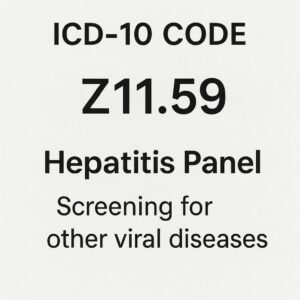
ICD-10 Code for Hepatitis Panel Screening
Understanding the Basics: Screening vs. Diagnosis
Before we dive into the specific alpha-numeric combinations, we need to establish a fundamental principle of ICD-10 coding: the reason for the encounter.
Think of it like this: You go to the doctor for two very different reasons.
-
You feel perfectly fine, but you know you are in a high-risk group, so you want to get checked.
-
You feel tired, your skin has a yellowish tint, and you feel pain in your abdomen.
In the first scenario, the doctor is screening for a disease. In the second, the doctor is diagnosing the cause of your symptoms. The ICD-10 codes for these two scenarios are different, and using the wrong one can lead to a denied claim.
What is a Screening Code?
According to ICD-10 guidelines, screening is the testing of an asymptomatic individual for a disease. The patient has no signs, symptoms, or related complaints. The goal is early detection.
What is a Diagnosis Code?
This is used when a patient presents with signs, symptoms, or a confirmed condition. The test is being used to confirm or rule out a suspected illness.
Mixing these up is one of the most common billing errors. If you use a diagnostic code for a screening, the insurance company may view the test as not medically necessary for a “sick” patient and deny the claim. Conversely, using a screening code for a symptomatic patient is inaccurate and could be viewed as miscoding.
For the purpose of this article, we are focusing on the screening aspect.
The Primary ICD-10 Code for Hepatitis Screening
So, if your patient is asymptomatic and you are performing a hepatitis panel to screen for the disease, what is the correct code to use?
The primary code you will use is:
Z11.59 – Encounter for screening for other viral diseases
This is the code for an encounter with a patient for the purpose of screening for viral diseases, and it is the most accurate code for a general hepatitis panel when no specific virus is suspected and the patient has no symptoms.
Think of Z11.59 as your “home base” code. It tells the payer, “We performed this test to look for a viral disease in a person who feels fine.”
Why isn’t there a specific code for “Hepatitis Panel Screening”?
You might wonder why there isn’t a single code that says “Screening for Hepatitis.” The ICD-10 system is structured in categories. There is a specific code for screening for Viral Hepatitis, but it’s important to know exactly which one that is.
-
Z11.5 is the broader category for “Encounter for screening for other viral diseases.”
-
Historically, and in many coding systems, Z11.59 is the specific code you will use for hepatitis screening. It is the “other” code that captures viral hepatitis when a more specific code isn’t listed elsewhere.
It is always best practice to confirm with your specific coding software or the latest ICD-10-CM manual, but Z11.59 is the industry-standard code for a general hepatitis screening panel.
Deeper Dive: Codes for Specific Hepatitis Screening
Sometimes, a screening isn’t general. Perhaps a patient is pregnant, and you are screening specifically for Hepatitis B. Or maybe a patient had a high-risk exposure in the past and you are screening for Hepatitis C. In these cases, you can (and should) get more specific.
While the panel itself might test for multiple things, the reason for the encounter (the screening) can be focused on one specific virus. In these cases, you might use a different code from the Z11 category.
-
Z11.52 – Encounter for screening for COVID-19: While not hepatitis-related, it’s good to know this exists as a distinct code.
-
Z11.59 – Encounter for screening for other viral diseases: This remains the workhorse code for hepatitis screening, as it includes viral hepatitis.
Important Note: There are also codes for screening for non-viral forms of hepatitis, such as alcohol-induced hepatitis, but these are different categories entirely (often found under Z13, screening for mental health and behavioral disorders, or Z71.41 for alcohol abuse counseling, not for the liver condition itself).
For the vast majority of viral hepatitis screening, Z11.59 is your go-to.
The Role of Z Codes: Why Risk Factors Matter
One of the best ways to support the medical necessity of a screening is to document the patient’s risk factors. This is where Z codes (factors influencing health status and contact with health services) become incredibly valuable. They are like the supporting evidence for your main screening code.
If you only submit Z11.59, the payer sees “screening.” But if you submit Z11.59 along with a code that explains why the patient is being screened, it paints a much clearer picture.
Here are some common risk factors for Hepatitis that you can document with additional Z codes:
-
Z72.89 – Other problems related to lifestyle: This can be used for lifestyle risk factors, though it is very broad.
-
Z20.5 – Contact with and (suspected) exposure to viral hepatitis: This is a powerful code. If the patient tells you they live with someone who has Hepatitis C, or they had a needlestick injury, use this code.
-
Z77.21 – Contact with and (suspected) exposure to potentially hazardous body fluids: Another excellent code for supporting the need for a test after a specific exposure event.
-
Z72.5 – High risk sexual behavior: A critical risk factor for Hepatitis B and C.
-
Z72.89 can also be used for a history of injection drug use, another major risk factor, but more specific counseling codes (Z71.7) might be more appropriate in some contexts.
Example in practice:
A 45-year-old patient comes in for a physical. They have no symptoms. In their history, they mention they received a blood transfusion before 1992. This is a known risk factor for Hepatitis C. Your coding could look like this:
-
Z11.59 (Encounter for screening for other viral diseases)
-
Z77.21 (Contact with and exposure to potentially hazardous body fluids) – This implies the historical exposure via transfusion.
By adding the second code, you have provided a clear, justifiable reason for the screening, dramatically reducing the chance of a claim denial.
The Hepatitis Panel: What Does It Include?
To code accurately, it helps to understand what the “panel” actually is. When a provider orders a “Hepatitis Panel,” they are typically ordering a specific set of blood tests designed to give a comprehensive picture of a patient’s current or past infection with the most common hepatitis viruses.
While lab panels can vary slightly by facility, a standard Hepatitis Panel usually includes tests for:
| Virus | Common Test(s) | What It Screens For |
|---|---|---|
| Hepatitis A | Anti-HAV, IgM Anti-HAV | Past or current infection. |
| Hepatitis B | HBsAg, Anti-HBs, Anti-HBc | Current infection, immunity, or past infection. |
| Hepatitis C | Anti-HCV | Antibodies indicating exposure to the virus. |
Sometimes, a more comprehensive panel might include Hepatitis D and E, but A, B, and C are the most common in the United States.
The ICD-10 code for hepatitis panel screening (Z11.59) covers the reason for ordering this entire set of tests. The specific CPT codes (the procedure codes for the blood work itself) will be billed separately by the lab.
Scenarios and Examples: Putting It All Together
Let’s walk through a few realistic scenarios to see how these codes work in practice. This will help you visualize the application of the ICD-10 code for hepatitis panel screening.
Scenario 1: The Routine Physical
The Patient: Maria, a 35-year-old woman, is here for her annual wellness visit. She feels great and has no complaints. Her doctor, following USPSTF guidelines, recommends a one-time hepatitis C screening for all adults.
-
Symptoms? None.
-
Reason for Test: Routine screening per guidelines.
-
Primary ICD-10 Code: Z11.59 (Encounter for screening for other viral diseases)
-
Supporting Code: None needed, but Z00.00 (Encounter for general adult medical examination without abnormal findings) would be the primary reason for the visit.
Scenario 2: The High-Risk Patient
The Patient: David, a 50-year-old man, is seeing his doctor for a check-up. He has no liver-related symptoms. During the history, he mentions that he used intravenous drugs in his 20s. The doctor orders a hepatitis panel.
-
Symptoms? None.
-
Reason for Test: Screening based on high-risk history.
-
Primary ICD-10 Code: Z11.59 (Encounter for screening for other viral diseases)
-
Supporting Code: Z72.89 (Other problems related to lifestyle) or a more specific code for personal history of drug use if applicable.
Scenario 3: Post-Exposure Screening
The Patient: Sarah, a 28-year-old nurse, comes to occupational health after a needlestick injury from a patient whose hepatitis status is unknown. She has no symptoms. The doctor orders a baseline hepatitis panel.
-
Symptoms? None.
-
Reason for Test: Screening following a specific exposure.
-
Primary ICD-10 Code: Z11.59 (Encounter for screening for other viral diseases)
-
Supporting Code: Z20.5 (Contact with and exposure to viral hepatitis) This is the perfect code for this situation.
Scenario 4: The Symptomatic Patient (Important Distinction!)
The Patient: Robert, a 60-year-old man, comes in complaining of fatigue, dark urine, and jaundice for the past week. The doctor orders a hepatitis panel to help diagnose the cause of his symptoms.
-
Symptoms? Yes (fatigue, jaundice).
-
Reason for Test: Diagnostic workup.
-
Primary ICD-10 Code: R53.83 (Other fatigue) and R17 (Unspecified jaundice). These are the symptom codes.
-
You would NOT use Z11.59 here. The test is not a screening; it is part of a diagnostic investigation. You are coding the symptoms, and the results of the test will lead to a specific disease code (e.g., B17.9 for Acute viral hepatitis) later.
Common Pitfalls and How to Avoid Them
Even experienced coders can stumble. Here are the most common pitfalls related to coding hepatitis screening and how to steer clear of them.
Pitfall 1: Using a Diagnostic Code for a Screening
As we discussed, using a code like B19.20 (Unspecified viral hepatitis C without hepatic coma) for a screening is incorrect. That code is for a confirmed diagnosis. Using it implies the patient has hepatitis, which is not true at the time of screening. This can lead to major denials and even flag your account for review.
Solution: Master the difference between Z codes (for encounters) and B codes (for confirmed diseases). Stick with Z11.59 for asymptomatic screening.
Pitfall 2: Forgetting the “Screening” Definition
If a patient has a history of hepatitis, and you are testing to see if it’s cleared, that’s not a screening. That is follow-up care. You would use a code for the history of the condition (e.g., Z86.19 for personal history of other infectious and parasitic diseases) along with the appropriate test codes.
Solution: Always ask: “Is this patient here because they are worried they might get a disease (screening), or because they have a history of the disease and we are monitoring it (follow-up)?”
Pitfall 3: Not Linking the Diagnosis to the Procedure
On the claim form (like the CMS-1500), you must link the ICD-10 code to the specific procedure (CPT code). Make sure the ICD-10 code for hepatitis panel screening (Z11.59) is the one linked to the line item for the hepatitis panel lab work.
Solution: Double-check your claim form or software to ensure the correct diagnosis pointer is next to the hepatitis panel CPT code.
Pitfall 4: Inadequate Documentation
If you only put Z11.59 on the claim without any supporting notes or additional codes for risk factors, it can sometimes be flagged, especially for patients who don’t fall into standard age-based screening guidelines.
Solution: Document, document, document! A quick note in the patient’s chart stating “Patient meets CDC criteria for Hep C screening” or “Patient requests screening due to high-risk behavior” is invaluable.
A Look Ahead: Coding in 2026 and Beyond
Medical coding is not static. Codes are updated, added, and deleted every year on October 1st. As of February 13, 2026, we are currently in the middle of the FY2026 coding set.
At the time of this writing, no major disruptive changes have been announced for the ICD-10 code for hepatitis panel screening. Z11.59 remains the active and appropriate code.
However, here are a few trends to watch:
-
Emphasis on Social Determinants of Health (SDOH): There is a growing push to use Z codes that capture social factors affecting health, which are often linked to hepatitis risk (e.g., Z55-Z65 for persons with potential health hazards related to socioeconomic and psychosocial circumstances).
-
Harmonization with Screening Guidelines: As the CDC and USPSTF update their screening recommendations (like the universal screening for Hepatitis C), insurance companies are less likely to deny claims with Z11.59, as it aligns with these broad guidelines.
-
More Specificity: It’s always possible that in future updates, CMS could create a more specific code for “Encounter for screening for viral hepatitis,” splitting it out from the general Z11.59. We will keep an eye on this for you.
For now, you can be confident that Z11.59 is the correct and most up-to-date code to use.
Frequently Asked Questions (FAQ)
Here are some of the most common questions we receive from our readers about coding for hepatitis screening.
Q: Can I use Z11.59 for a hepatitis C screening only?
A: Yes, absolutely. Z11.59 is the appropriate code for screening for any viral hepatitis, including a test that is solely for Hepatitis C antibodies. It is the general code for screening for viral diseases.
Q: My patient is pregnant. Is there a different code for prenatal hepatitis B screening?
A: The screening code is often still Z11.59. However, in pregnancy, the reason for the visit is the prenatal care. The primary code for the encounter would be a Z34 code (e.g., Z34.90 for supervision of normal pregnancy). The screening code Z11.59 would be a secondary diagnosis to support the blood work. Some payers also recognize Z11.59 in conjunction with pregnancy codes as standard of care.
Q: What is the difference between Z11.59 and B19.20?
A: This is the most important distinction. Z11.59 is a screening code for an asymptomatic person. B19.20 is a diagnosis code for a patient who has unspecified viral hepatitis C. Never use a B code for screening.
Q: Will Medicare accept Z11.59 for hepatitis screening?
A: Yes, Medicare covers hepatitis screening (particularly Hepatitis C and B for high-risk individuals) and accepts Z11.59 as a valid ICD-10 code to support the claim, provided the patient meets their specific coverage criteria.
Q: I used Z11.59 and the claim was denied. What could be wrong?
A: Denials can happen for several reasons:
-
Medical Necessity: The payer may feel the patient doesn’t meet their specific risk criteria for the screening. Check their medical policy. Adding a secondary risk factor code (like Z20.5 or Z72.89) can help.
-
Incorrect Patient Demographics: A very common reason for denial is that the patient’s age or sex doesn’t match the payer’s internal logic for the test. For example, if a payer’s system is outdated and only expects Hepatitis B screening for pregnant women, a claim for a young man might get auto-denied. An appeal with proper documentation usually fixes this.
-
Coding Error: The CPT code and the ICD-10 code may not be linked correctly on the claim form.
Additional Resource
For the most current and detailed information on viral hepatitis screening recommendations, we highly recommend visiting the official website of the Centers for Disease Control and Prevention (CDC) . Their Division of Viral Hepatitis page offers comprehensive guides for both patients and healthcare professionals.
[Visit the CDC Viral Hepatitis Website] (https://www.cdc.gov/hepatitis/index.htm)
Important Note for Readers
*This article is intended for informational purposes only and provides a general overview of ICD-10 coding practices related to hepatitis screening as of February 13, 2026. While every effort has been made to ensure accuracy, medical coding is complex and subject to change. Coding rules, payer policies, and coverage determinations vary. Always consult the most current ICD-10-CM official guidelines, your specific payer contracts, and use your professional judgment when assigning codes. This information does not constitute legal or billing advice. For specific guidance on claims, please consult with a qualified coding specialist or healthcare attorney.*
Conclusion
Finding the correct ICD-10 code for hepatitis panel screening is a straightforward process once you understand the logic behind it. The key takeaway is that Z11.59 is your primary code for any asymptomatic patient undergoing screening for viral hepatitis. Remember to support this code with detailed documentation of risk factors using additional Z codes, and always distinguish screening from diagnostic testing for symptomatic patients. By following these guidelines, you can ensure accurate, compliant coding that facilitates proper reimbursement and supports vital public health efforts in detecting and managing hepatitis.