If you work in healthcare—whether as a medical coder, a nurse, or a physician—you know that accuracy is everything. One small misstep in coding can lead to claim denials, audits, or a confusing medical record. One area that often causes a bit of head-scratching is coding for a patient’s surgical history, particularly when it comes to weight loss procedures.
You might be looking at a patient’s chart and know they had gastric bypass five years ago. They are here today for a routine check-up or an unrelated issue like a sprained ankle. So, how do you document that history? What is the correct code?
The answer is a specific “Z” code designed for this exact scenario. Let’s dive into the world of ICD-10 and clarify once and for all how to code for a history of bariatric surgery.
ICD-10 Code for History of Bariatric Surgery
What is the Correct ICD-10 Code for History of Bariatric Surgery?
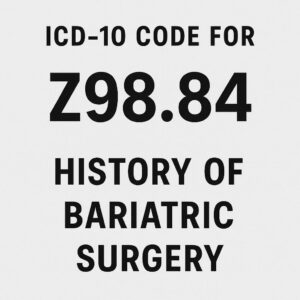
The specific ICD-10-CM code you are looking for is Z98.84.
This code falls under the category of “Other postprocedural states.” Its full descriptor is: “History of bariatric surgery.”
This code is a status code. It is not used to report the surgery itself (that would be a procedure code from the ICD-10-PCS system, used only in inpatient hospital settings) or to report a current complication from the surgery. It is simply a flag in the patient’s chart that says, “This patient has undergone bariatric surgery in the past.”
When should you use Z98.84?
You should use Z98.84 when a patient with a history of bariatric surgery presents for:
-
A routine general medical exam.
-
An unrelated medical condition, such as an upper respiratory infection, a fracture, or hypertension.
-
Follow-up care after the immediate postoperative period has ended. (The “global period” for surgery is usually 90 days. After that, you would use Z98.84 to indicate the history).
-
Management of long-term sequelae (like vitamin deficiencies) as long as the condition is not an active complication requiring treatment for the surgical site itself.
Important Note for Readers:
Always code for the patient’s reason for the encounter first. The history code is a secondary, additional code. For example, if a patient comes in for diabetes management and has a history of gastric bypass, you would code the diabetes first (e.g., E11.9), and then Z98.84 to provide the full clinical picture.
Why Using This Code Matters More Than You Think
You might be tempted to skip adding a history code. After all, the patient is here for a cold, right? However, including Z98.84 is a best practice for several important reasons:
-
It Provides Crucial Context: A history of bariatric surgery changes everything. It affects medication absorption, nutritional needs, and can be a risk factor for conditions like hernias or bowel obstructions. A future provider seeing only “hypertension” in the chart misses this critical piece of the puzzle.
-
It Justifies Medical Decision-Making: If a doctor spends extra time checking the patient’s iron levels or adjusting medication dosages because of their surgical history, the code Z98.84 helps justify the complexity of the visit.
-
It Supports Population Health Management: Healthcare systems use these codes to track patient populations. This helps them proactively reach out to bariatric patients to ensure they are getting their annual vitamin level checks or cancer screenings.
-
It Prevents Incorrect Assumptions: Without the code, a new provider might not know why a patient has specific dietary restrictions or why they react differently to certain medications.
Z98.84 vs. Other Related Codes: A Clear Comparison
One of the biggest sources of confusion is knowing when to use the history code versus other codes related to the digestive system or complications. Let’s break it down in an easy-to-read table.
| ICD-10 Code | Description | When to Use It | Real-World Example |
|---|---|---|---|
| Z98.84 | History of bariatric surgery | The patient had surgery in the past and is now here for an unrelated reason. This is a status code. | A 45-year-old patient who had gastric sleeve surgery in 2021 comes in for a routine physical. |
| K95.81 | Complication of gastric band procedure | The patient has an active problem directly related to their bariatric surgery, such as an infection, erosion, or obstruction. | A patient presents with severe abdominal pain. An endoscopy reveals that their gastric band has eroded into the stomach wall. |
| K95.89 | Other complications of bariatric surgery | The patient has an active complication not specified by another code, like a leak at the anastomosis site or a stricture. | A patient who had gastric bypass 6 months ago reports persistent nausea and vomiting. A scope shows a narrowing (stricture) at the surgical connection site. |
| E43-E46 | Various Malnutrition codes | The patient has a current diagnosis of malnutrition related to their surgery, but it’s being managed as a condition, not an acute surgical complication. | A patient is found to have severe protein malnutrition due to poor dietary adherence post-surgery. You would code the malnutrition (e.g., E43) and then Z98.84. |
| Z90.3 | Acquired absence of part of stomach | This is a tricky one. It indicates a part of the stomach is missing. While true for bariatric surgery, Z98.84 is the more specific and preferred code for the history of the procedure. | A general surgeon removes a large tumor from a patient’s stomach. The correct code is Z90.3. For a planned bariatric procedure, stick with Z98.84. |
Common Scenarios: How to Apply the Code in Practice
Theory is great, but real-world application is where it counts. Here are a few patient scenarios to help you visualize how to use Z98.84 correctly.
Scenario 1: The Annual Physical
-
The Patient: Sarah, 38 years old. She had Roux-en-Y gastric bypass surgery four years ago. She has maintained her weight loss and feels great. Today, she is here for her annual wellness exam.
-
The Provider’s Note: “Patient here for annual physical. No acute complaints. History of gastric bypass in 2020. Vitals stable. Will order routine blood work including B12 and iron panel.”
-
The Coding:
-
Primary Code: Z00.00 (Encounter for general adult medical examination without abnormal findings)
-
Secondary Code: Z98.84 (History of bariatric surgery)
-
Scenario 2: An Unrelated Injury
-
The Patient: Mark, 52 years old. He had laparoscopic adjustable gastric banding (Lap-Band) seven years ago. He slipped on ice and hurt his wrist.
-
The Provider’s Note: “Patient presents with left wrist pain after a fall. Exam reveals swelling and tenderness over the distal radius. X-ray confirms a non-displaced fracture. Will apply a short arm cast. Patient has a history of bariatric surgery, which is stable.”
-
The Coding:
-
Primary Code: S52.531A (Greenstick fracture of the distal end of left radius, initial encounter for closed fracture)
-
Secondary Code: Z98.84 (History of bariatric surgery)
-
Scenario 3: Managing a Late Effect
-
The Patient: David, 60 years old. He had gastric sleeve surgery five years ago. He has been feeling fatigued. Blood work shows he is vitamin B12 deficient, a known long-term effect of his surgery.
-
The Provider’s Note: “Patient here for fatigue. Labs show B12 deficiency, likely related to his post-bariatric surgery state. Will administer a B12 injection today and prescribe supplements.”
-
The Coding:
-
Primary Code: E53.8 (Deficiency of other specified B group vitamins)
-
Secondary Code: Z98.84 (History of bariatric surgery)
-
Scenario 4: The Acute Complication (DO NOT USE Z98.84)
-
The Patient: Maria, 47 years old. She had gastric bypass surgery two months ago. She presents to the ER with severe abdominal pain, fever, and vomiting.
-
The Provider’s Note: “Patient is post-op day 60 from gastric bypass. CT scan shows evidence of an anastomotic leak. Will admit for surgical intervention.”
-
The Coding:
-
Primary Code: K95.89 (Other complications of bariatric surgery)
-
Secondary Code: (Any additional codes for the leak, sepsis, etc., but NOT Z98.84, because the reason for the visit is an active complication of the surgery itself).
-
A Helpful Checklist for Coders and Clinicians
To make sure you’re on the right track, here is a simple checklist you can use when you encounter a patient with a history of bariatric surgery.
-
[ ] Is the patient here for a reason directly related to a problem with the surgery? (e.g., pain at the site, leak, infection, band slippage).
-
If YES: Look for a code in the K95.- (Complications of bariatric procedures) range. Do not use Z98.84 as the primary diagnosis.
-
-
[ ] Is the patient here for a routine follow-up or a completely unrelated issue? (e.g., physical, cold, broken bone).
-
If YES: Code the reason for the visit first. Then, add Z98.84 as a secondary code to provide important context.
-
-
[ ] Is the patient here for a known long-term consequence, like malnutrition or vitamin deficiency?
-
If YES: Code the specific deficiency or condition first. Then, add Z98.84 as a secondary code to show the “why” behind the condition.
-
-
[ ] Is this an inpatient admission for the bariatric surgery itself?
-
If YES: You will use procedure codes (from the 0D series in ICD-10-PCS) for the surgery. Z98.84 is not used for the surgical admission.
-
The Bigger Picture: Why Documentation is Key
At the end of the day, a code is only as good as the documentation that supports it. Physicians and advanced practice providers play a crucial role here. A note that simply says “hx bariatric sx” is good, but a note that says “Patient has a history of Roux-en-Y gastric bypass in 2019, which is stable and without current complications” is even better.
This level of detail confirms that this is a historical state (Z98.84) and not an active problem. It also paints a clearer picture for anyone reading the chart in the future.
Accurate coding is a team sport. When clinicians document clearly and coders translate that documentation into the correct codes, everyone wins. The patient’s record is accurate, the provider is fairly reimbursed for the complexity of the visit, and the data contributes to a better understanding of patient populations.
Frequently Asked Questions (FAQ)
1. Can I use Z98.84 for a patient who had bariatric surgery many years ago?
Yes, absolutely. This code is specifically for a history of the procedure, regardless of how long ago it was performed. As long as the patient is not here for an active complication of that surgery, Z98.84 is the appropriate code to indicate their surgical history.
2. What is the difference between Z98.84 and a code for a personal history of other diseases?
Z98.84 is a “postprocedural state” code. It signifies that a procedure was done and the patient is now living with the result of that procedure (e.g., a smaller stomach, altered anatomy). It is different from a “personal history” code (like Z86.- for history of cancer), which indicates a disease that has been resolved and is no longer present.
3. My doctor documented “Post-op bariatric surgery.” Should I use Z98.84?
It depends on the context. If the patient is still within the 90-day global post-operative period, you may be coding for a surgical follow-up visit. If the patient is well past that period, “Post-op bariatric surgery” in the assessment for a routine visit would indeed be correctly coded with Z98.84.
4. If a patient has a gastric band that was removed, can I still use Z98.84?
This is a nuanced situation. If the patient had a band, had it removed, and has not had any other bariatric procedure, their anatomy may be largely restored. In this case, Z98.84 may no longer be accurate. You might need to code for the “acquired absence of organ” or simply document their current gastrointestinal status. It’s best to follow the provider’s specific documentation of the patient’s current anatomy.
5. Is Z98.84 a billable code?
Yes, Z98.84 is a valid and billable ICD-10-CM diagnosis code. However, as a history or status code, it is almost always a secondary diagnosis. It should be submitted alongside a primary code that describes the reason for the specific encounter.
Additional Resource
For the most up-to-date official information, you can always refer to the CDC’s National Center for Health Statistics, which maintains the ICD-10-CM code set. Their website provides the official code tables, guidelines, and addenda.
Access the Official ICD-10-CM Browser Tool Here
Disclaimer: This article is for informational purposes only and does not constitute legal or professional medical coding advice. Coding guidelines and payer policies can vary and are subject to change. Always rely on your current ICD-10-CM codebook, official coding guidelines, and your organization’s coding policies to ensure accuracy and compliance.
Conclusion
In short, the ICD-10 code for a history of bariatric surgery is Z98.84. Use it as a secondary code to provide essential background on a patient’s altered anatomy, but never as the primary diagnosis for an active complication. Mastering this distinction ensures accurate records and better patient care.