If you work in healthcare administration, medical coding, or even if you are a patient trying to make sense of an Explanation of Benefits (EOB), you have likely asked a very specific question: “What is the ICD 10 code for med refill?”
It sounds like a simple question. You need a refill, you go to the doctor, and you expect a code to exist for that transaction. However, the world of medical coding is built on diagnosis, not procedures.
Here is the honest truth: There is no specific ICD-10 code for a “medication refill.”
This might be frustrating, but it is actually logical. ICD-10 codes are used to describe why a patient is sick or why they need medical attention. A routine refill, in a vacuum, isn’t a sickness. So, how do doctors bill insurance when you come in just to get a new prescription? They bill for the visit and use diagnosis codes that justify why you are on that medication in the first place.
This comprehensive guide will walk you through exactly how to handle coding for medication refills, the correct codes to use, and how to avoid common pitfalls in 2026.
ICD 10 Code for Med Refill
Why “Refill” Isn’t a Diagnosis (And What to Use Instead)
Before we dive into the specific codes, we need to understand the philosophy behind ICD-10. The system is designed to classify diseases and health conditions.
Imagine you go to a mechanic because your car needs an oil change. If the mechanic asks, “What is wrong with the car?” you wouldn’t say, “I need an oil change.” You would say, “Nothing is wrong, it just needs maintenance.”
Medical coding works the same way. “Medication refill” is the service (like the oil change), but the ICD-10 code must explain the underlying reason for the service—the chronic condition that requires the medication.
When a patient comes in solely for a refill, the provider is usually performing one of two services:
-
Medication Management: Checking to ensure the drug is still effective and not causing harm.
-
Established Patient Office Visit: A brief check-in to authorize a continuation of care.
To bill for this, you need to link the visit to the diagnosis codes that justify the medication.
The Correct Codes to Use for Medication Refills
Since there is no single “refill” code, medical billers typically look at two categories: the reason for the visit and the status of the patient’s health.
Here are the most common codes used in a medication refill scenario.
Z79.- (Long-term Drug Therapy) – The “Refill” Code
While not specifically a refill code, the Z79 series is the closest you will get. These codes indicate that a patient is on long-term, continuous medication. When paired with the underlying diagnosis, they tell the insurance company, “This patient is on maintenance drugs.”
These are often used in conjunction with the chronic condition codes.
-
Z79.4: Long-term (current) use of insulin.
-
Z79.84: Long-term (current) use of oral hypoglycemic drugs (for diabetes).
-
Z79.82: Long-term (current) use of aspirin.
-
Z79.891: Long-term (current) use of opiate analgesic.
-
Z79.899: Other long-term (current) drug therapy (This is a catch-all for blood pressure meds, cholesterol meds, etc.).
Important Note: These Z-codes are never supposed to be the primary diagnosis. They are secondary codes. They support the story that the medication is necessary.
Chronic Condition Codes (The Primary Diagnosis)
To justify the prescription, you must code the condition being treated. If you don’t code the hypertension, the insurance company won’t pay for the blood pressure medication refill visit.
Here are examples of how to pair the condition with the long-term drug use:
| Scenario | Primary Diagnosis (Condition) | Secondary Diagnosis (Drug Use) |
|---|---|---|
| High Blood Pressure Refill | I10 (Essential Hypertension) | Z79.899 (Other long-term drug therapy) |
| Type 2 Diabetes Refill | E11.9 (Type 2 diabetes without complications) | Z79.84 (Long-term use of oral hypoglycemic drugs) |
| High Cholesterol Refill | E78.5 (Hyperlipidemia, unspecified) | Z79.899 (Other long-term drug therapy) |
| Anxiety Medication Refill | F41.9 (Anxiety disorder, unspecified) | Z79.899 (Other long-term drug therapy) |
| Thyroid Medication Refill | E03.9 (Hypothyroidism, unspecified) | Z79.89 (Other long-term drug therapy) |
Z00.00 – The “Annual Physical” Misconception
A common mistake is using Z00.00 (Encounter for general adult medical examination without abnormal findings) for a medication refill. Do not do this.
Z00.00 is for routine wellness checks and preventive care. If a patient schedules an annual physical and also mentions they need a refill, you often need to split the bill or use a different code for the “problem-oriented” part of the visit. Using a physical code for a sick visit (even a minor one) can lead to claim denials.
When the Refill Requires a “Work-Up” (New Symptoms)
Sometimes, a patient comes in for a refill, but during the conversation, they mention something has changed.
-
“I need my blood pressure meds refilled, but I’ve also been getting really dizzy lately.”
-
“I need my inhaler refilled, but it doesn’t seem to be working as well.”
In this case, you are no longer coding for a routine refill. You are coding for a change in condition.
You must shift to the new symptom as the primary focus.
-
R42 (Dizziness and giddiness)
-
J45.901 (Unspecified asthma with (acute) exacerbation)
The focus of the visit has shifted from “maintenance” to “evaluation of a new problem,” and your coding must reflect that to be compliant.
The Evaluation and Management (E/M) Component
It is vital to understand that the ICD-10 code describes why the patient is there, but the CPT code describes what was done.
For a medication refill, you are likely billing an E/M code (Evaluation and Management) for the office visit.
-
99212 or 99213: These are common for established patients coming in for medication management. They represent a brief or low-complexity visit, which is typical for an uncomplicated refill where the patient is stable.
The combination looks like this on a claim form:
-
CPT: 99213 (Established patient office visit)
-
ICD-10: I10 (Hypertension)
-
ICD-10: Z79.899 (Long-term drug therapy)
Common Pitfalls and Denials to Avoid
Coding for refills seems straightforward, but it is a minefield of denials if done incorrectly. Here is what gets medical billers in trouble.
1. Refilling a Medication Without Seeing the Patient
Many providers offer refills via patient portals or phone calls without an official visit. This is high risk.
-
The Risk: If you chart a note and prescribe medication, you have created a patient encounter. If you do not bill for it, it could be considered providing free care. If you do bill for it without a valid diagnosis linked to the service, it looks like fraud.
-
The Solution: If you prescribe, you must have a documented medical decision. Even for a “nurse visit” for a blood pressure check, you need an ICD-10 code like Z01.30 (Encounter for examination of blood pressure without abnormal findings) to justify the encounter.
2. Using Expired or Unspecified Codes
ICD-10 updates every year on October 1st. While 2026 is still ahead, ensure your system is updated.
-
Avoid using unspecified codes (like E78.5 for cholesterol) if you have a more specific diagnosis (like E78.00 for pure hypercholesterolemia). Insurance companies are increasingly denying unspecified codes for medication authorizations.
3. Compliance and Adherence Checks
If a patient misses a dose or stops taking medication and needs a “rescue” refill, the coding changes slightly. You might consider:
-
Z91.14: Patient’s noncompliance with medication regimen.
This tells the story of why the refill is needed outside of the normal schedule.
A Practical Guide for Patients: What Your EOB Means
If you are a patient reading this because you saw “ICD-10” on your bill, here is a simple translation.
You went to the doctor for a refill. The doctor’s office did not submit a code that says “refill” because that code doesn’t exist.
-
They submitted the code for your condition (e.g., High Blood Pressure).
-
They submitted a code for the visit (e.g., a short check-up).
-
They may have submitted a Z-code to show you are on long-term meds.
If your insurance denied the claim, it might not be because the refill wasn’t “covered,” but because the doctor didn’t sufficiently prove that the visit was medically necessary by linking it to your specific, active diagnosis.
Conclusion
Navigating the ICD-10 system for medication refills requires a shift in perspective. You must stop looking for a “refill” button and start thinking about the underlying condition. The combination of a chronic condition code (like I10 or E11.9) paired with a long-term drug use code (Z79.-) is the golden standard for compliant, successful billing. By focusing on the diagnosis that necessitates the medication, you ensure accurate reimbursement and clear communication with payers.
Frequently Asked Questions (FAQ)
1. What is the exact ICD-10 code for a medication refill?
There is no exact code for “refill.” The correct approach is to use the code for the chronic condition (e.g., I10 for high blood pressure) and a secondary code for long-term drug use (Z79.899).
2. Can I use Z76.0 for a prescription refill?
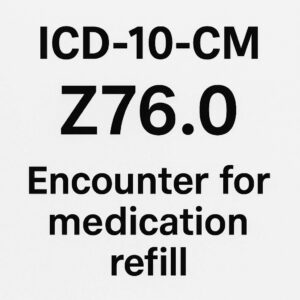
Z76.0 is for “Encounter for issue of repeat prescription.” While this sounds correct, it is intended for situations where the patient is not seen by a provider (e.g., picking up a prescription at the pharmacy or a nurse issuing a repeat without exam). For a physician visit, it is not appropriate. Use the chronic condition codes instead.
3. What if the patient is not currently having symptoms?
That is fine. Chronic disease management often occurs when the patient is asymptomatic. The ICD-10 code for the chronic disease is still valid (e.g., a patient with diabetes often has no symptoms when their sugars are controlled). You are treating the disease, not just the symptoms.
4. Is a “medication management” code different from a “refill” code?
“Medication management” is a type of service (CPT code), not a diagnosis (ICD-10). The ICD-10 codes used for medication management are the same ones listed above: the chronic condition plus the Z79 code.
5. Do I need a new ICD-10 code for every single refill?
The code remains the same as long as the condition remains the same. If you are treating chronic hypertension, you will use I10 for every refill visit until the diagnosis changes or resolves.
Additional Resource
For the most up-to-date official ICD-10 lookup and coding guidelines, you should always refer to the Centers for Medicare & Medicaid Services (CMS) website. You can access their free ICD-10 lookup tool here:
CMS ICD-10 Medical Coding Reference
Disclaimer: This article is for informational purposes only and does not constitute legal or medical advice. Coding guidelines and payer policies vary. Always consult with a certified professional coder or your specific insurance carrier for definitive guidance on claim submissions.